
Views: 288 Author: Dingnuo Electric Publish Time: 2026-07-22 Origin: Site


Content Menu
● What Reactive Power Compensation Means
● What Is a Static VAR Generator
● Key Difference Between SVG and Capacitor Bank
● Where Capacitor Banks Work Best
● How to Select the Right Solution
● Industry Application Perspective
● Practical Design Considerations
● FAQ
>> 1. What is the main difference between a Static VAR Generator and a capacitor bank?
>> 2. Which one is better for fast reactive power compensation?
>> 3. Can a capacitor bank be used in a plant with harmonics?
>> 4. Is SVG always the best choice?
>> 5. Which industries benefit most from SVG?
>> 6. Does SVG require less maintenance than a capacitor bank?
In modern industrial facilities, reactive power compensation is a practical necessity, not a theoretical topic. It directly affects voltage stability, equipment performance, energy efficiency, and the reliability of production lines. When electrical loads change quickly, the compensation system must respond just as fast or the plant may suffer from unstable voltage, poor power factor, and unnecessary energy losses.
Two of the most common solutions are the Static VAR Generator (SVG) and the capacitor bank. Both are widely used in factories, substations, and utility-connected systems, but they are not equal in performance or behavior. The right choice depends on whether the plant needs speed, precision, simplicity, or lower initial investment.
For manufacturers, utilities, and engineering teams, this is an important decision. A compensation system that matches the actual load profile can improve power quality, protect equipment, and reduce operating costs over the long term.
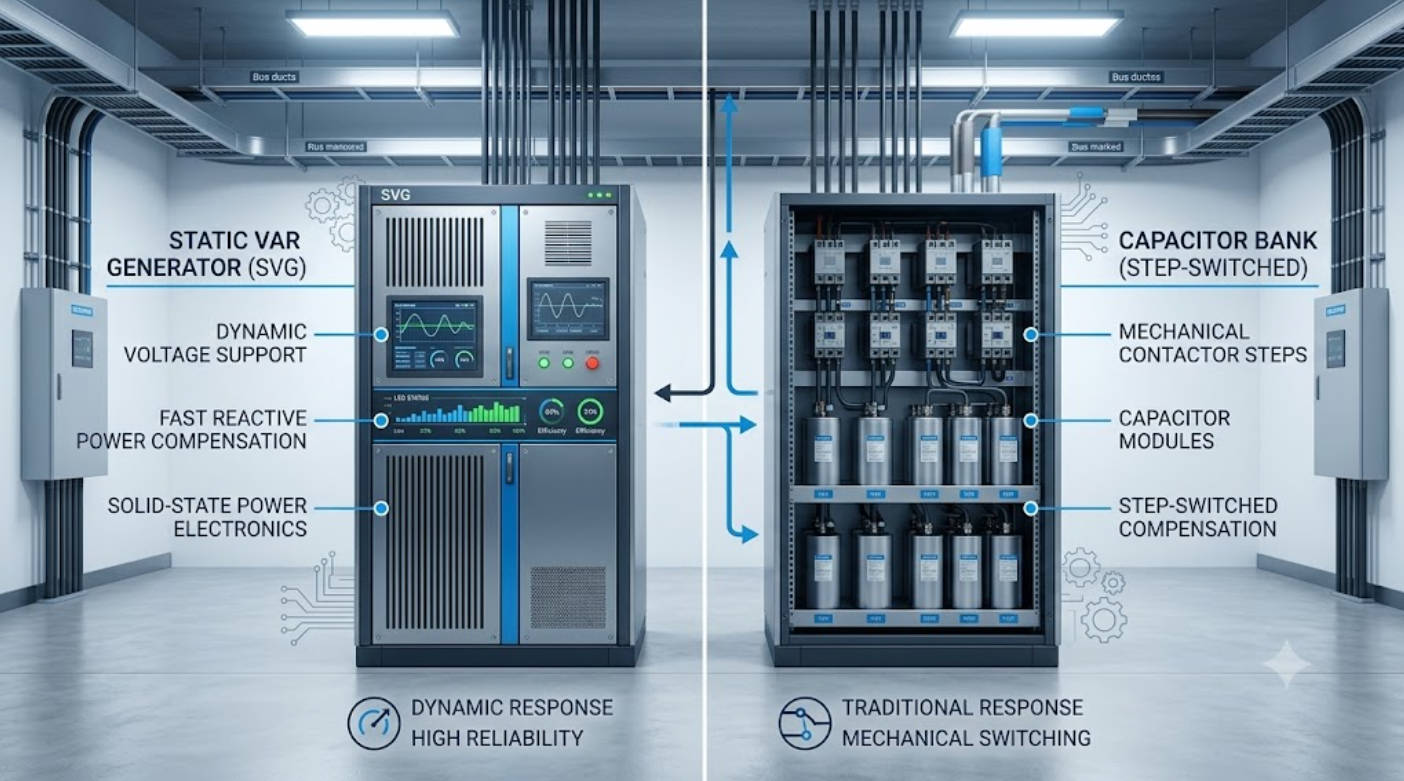
Reactive power is the portion of electrical power that supports magnetic fields in inductive equipment such as motors, transformers, welders, and industrial drives. It does not perform useful mechanical work directly, but it still flows through cables, transformers, and switchgear. When too much reactive power is present, current rises, losses increase, and voltage can become unstable under heavy load.
Reactive power compensation solves this problem by supplying the needed reactive current closer to the load. That reduces the burden on the upstream grid and improves the overall power factor. In practical terms, this means lower line losses, better voltage behavior, and more efficient use of electrical infrastructure.
In stable plants, compensation is often a matter of reducing penalties and improving efficiency. In dynamic plants, however, it becomes a power quality issue as well. Fast-changing load conditions require a compensation device that can react quickly and continuously.
A Static VAR Generator is an active compensation device based on power electronics. It measures the system in real time and injects or absorbs reactive current as needed. Because it uses fast electronic switching, it can respond in milliseconds and adjust output continuously rather than in fixed steps.
This makes SVG especially suitable for plants with fluctuating loads. It can maintain a stable power factor even when demand changes rapidly from moment to moment. It is also effective in applications where voltage flicker, poor dynamic response, or sensitive equipment are major concerns.
Another important advantage is control precision. An SVG is not limited to pre-set capacitor steps. It can provide smooth, accurate compensation that follows the actual system condition. In demanding industrial environments, this precision can make a major difference in power quality.
A capacitor bank is a passive compensation solution that supplies capacitive reactive power to offset inductive loads. It is one of the most established power factor correction methods in industrial power systems. Capacitor banks may be fixed or automatically switched in steps depending on load conditions.
The main attraction of a capacitor bank is its simplicity. It is familiar to engineers, widely available, and often lower in initial cost than active solutions. For many facilities with steady electrical demand, it offers an effective and economical way to improve power factor.
However, capacitor banks work best when the load is relatively stable. If the demand changes quickly, the stepped compensation may lag behind the actual need. In such cases, the system can become overcompensated or undercompensated, which reduces performance and may create additional electrical stress.
The most important difference is the way each system responds to changing conditions. SVG uses active control and provides fast, stepless compensation. A capacitor bank uses passive capacitors, often arranged in switched stages, so it reacts more slowly and in discrete increments.
This difference affects nearly every operating characteristic. SVG performs better in dynamic environments, while capacitor banks are more suitable for steady-state applications. SVG also handles harmonic-rich systems more effectively, while capacitor banks may require careful design to avoid resonance or harmonic amplification.
The selection should therefore not be based on device type alone. It should be based on the plant's load profile, power quality goals, harmonic conditions, and long-term operational priorities.
| Item | Static VAR Generator (SVG) | Capacitor Bank |
|---|---|---|
| Compensation method | Active, electronic, stepless | Passive, stepped or fixed |
| Response speed | Very fast, typically milliseconds | Slower, depends on switching stages |
| Load suitability | Dynamic and rapidly changing loads | Stable and predictable loads |
| Harmonic behavior | Better for harmonic environments | May need detuned reactors or extra protection |
| Voltage support | Strong dynamic voltage support | Limited dynamic support |
| Control precision | High precision | Step-based control |
| Maintenance profile | Lower mechanical wear | More switching and aging concerns |
| Initial cost | Higher | Lower |
| Best use case | Fast reactive power compensation | Basic power factor correction |
The table shows a clear pattern. SVG is the stronger choice for speed, precision, and power quality. Capacitor banks remain attractive where load conditions are simple and cost sensitivity is high.
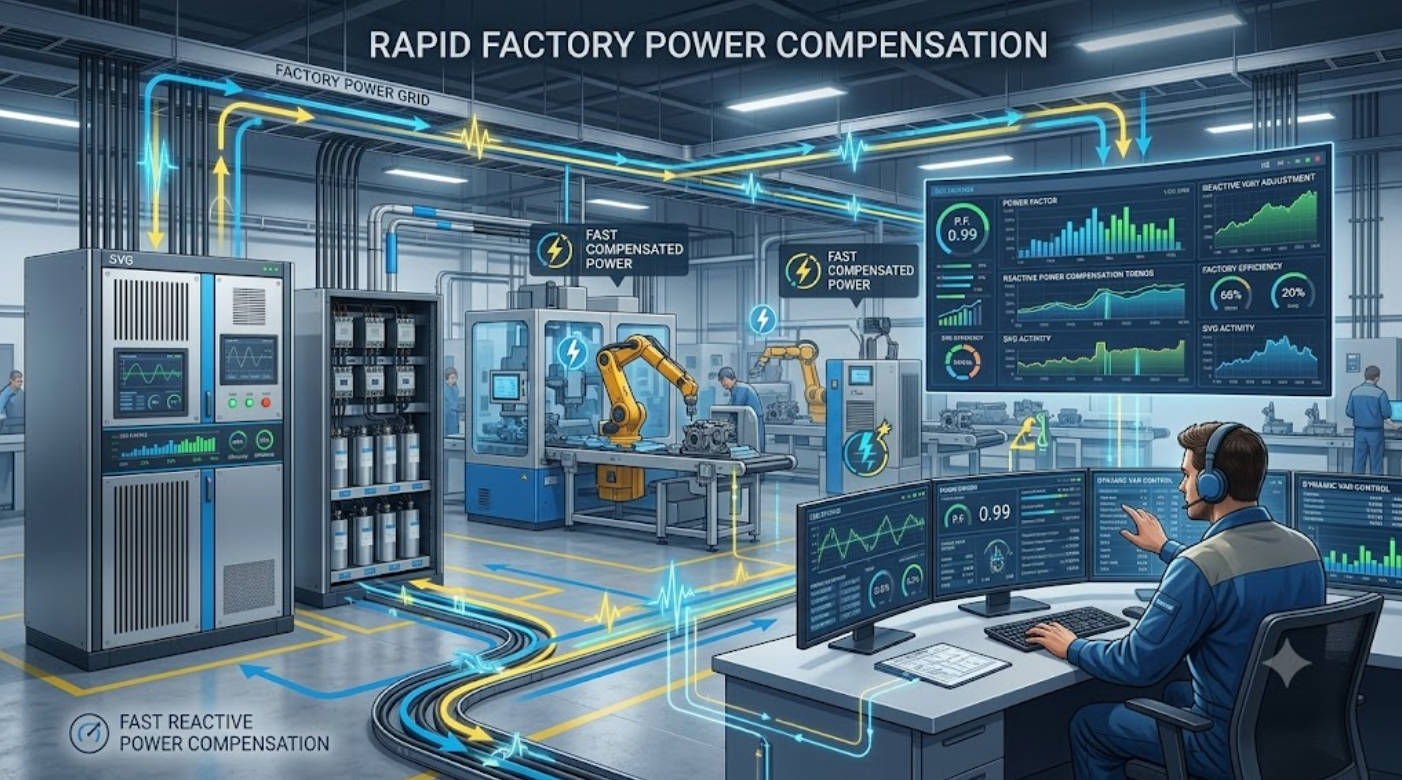
Fast response is critical in many industrial environments. Loads such as cranes, presses, arc furnaces, welding lines, rolling mills, and variable-speed drive systems can change very quickly. When this happens, the compensation system must adapt immediately or the plant may experience flicker, voltage sag, or unstable power factor.
SVG is designed for these conditions. It monitors the system continuously and reacts without the delay associated with mechanical switching. This makes it highly effective for plants that need stable voltage and consistent electrical performance during rapid load changes.
Capacitor banks, by contrast, respond in steps. Even when they are automatically switched, there is still a delay between detection and adjustment. That delay may be acceptable in some facilities, but it is not ideal where the electrical demand changes frequently.
Harmonics are a major concern in many modern factories. Equipment such as frequency converters, rectifiers, UPS systems, and welding machines can introduce distortion into the power system. In these situations, reactive power compensation must be designed carefully.
A capacitor bank can sometimes interact with system impedance and create resonance conditions. This may amplify harmonics and worsen power quality instead of improving it. For this reason, capacitor banks in harmonic-rich systems often need detuned reactors or additional protective measures.
SVG is better suited to these environments because it uses active control rather than simple capacitive injection. While it is not a full substitute for harmonic filtering in every case, it is generally more flexible and more stable in electrically complex systems. For plants with both reactive power issues and harmonic distortion, SVG often provides a more reliable path.
The decision between SVG and capacitor bank is not only technical. It is also financial. A capacitor bank usually has a lower initial purchase cost, which makes it attractive for projects with limited budgets. For stable loads, it can deliver excellent value and a relatively fast payback.
SVG typically requires a higher upfront investment. However, this should be evaluated against the total cost of ownership. In dynamic plants, SVG may reduce penalties, improve voltage stability, lower maintenance needs, and prevent losses caused by compensation errors. Over time, these benefits can outweigh the higher initial price.
When comparing options, it is better to look at the full lifecycle rather than the equipment price alone. A lower-cost solution that cannot keep up with the load may become more expensive in operation. A higher-cost solution that stabilizes the system may deliver better long-term value.
Capacitor banks are a practical solution in plants with stable and predictable demand. Typical examples include continuous motor loads, pumps, fans, and conventional manufacturing lines where power factor remains relatively constant during operation. In these systems, fixed or automatically switched capacitors can perform very well.
They are also suitable for facilities where the primary goal is to reduce utility penalties at the lowest possible capital cost. If the electrical system does not suffer from rapid load fluctuation or severe harmonics, a capacitor bank can be the simplest and most cost-effective choice.
For many industrial users, this remains the right balance of performance and investment. The key is to ensure that the capacitor system is properly sized, protected, and coordinated with the rest of the electrical network.
SVG is the better choice when the load changes quickly or unpredictably. This includes steel plants, automotive production lines, petrochemical facilities, paper mills, textile plants, and other industries with variable process loads. In these environments, stable compensation is essential for smooth operation.
SVG is also valuable in weak grids, systems with voltage flicker, and installations that require very precise power factor control. Its ability to respond quickly and continuously makes it well suited to demanding applications where power quality is closely tied to production reliability.
In many cases, SVG is not just a replacement for capacitor banks. It is a higher-performance solution for a different class of problem. Where dynamic behavior dominates, active compensation is usually the better technical choice.
The selection process should always begin with a load analysis. Without real operating data, even a well-designed system may fail to deliver the expected result. A good engineering decision depends on the actual electrical behavior of the plant, not just on nameplate capacity.
A practical selection process includes the following steps:
1. Measure the load profile across a full production cycle.
2. Record power factor, voltage fluctuation, and harmonic distortion.
3. Identify whether the load is stable, semi-variable, or highly dynamic.
4. Define the target compensation level and operating objectives.
5. Compare initial investment, maintenance needs, and long-term operating cost.
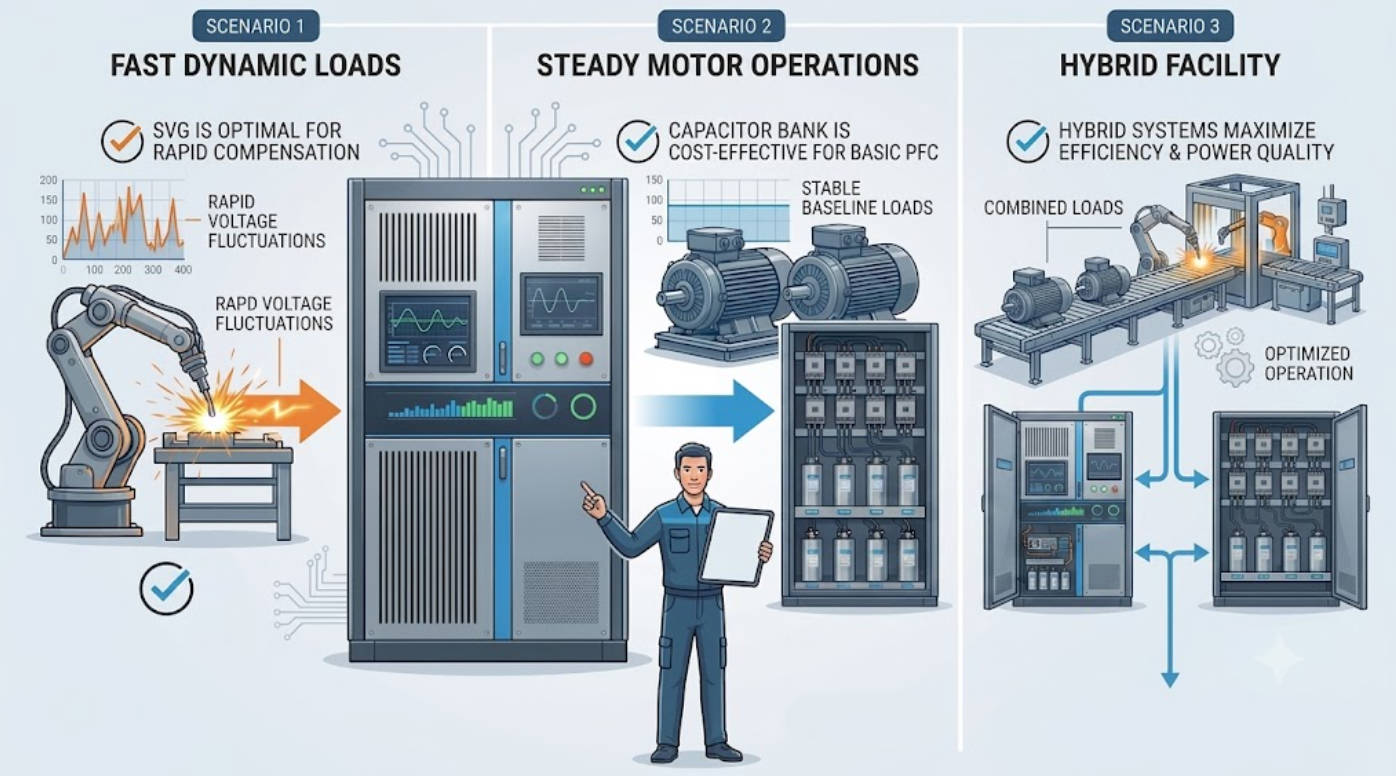
If the plant has stable loads and low harmonic content, a capacitor bank may be sufficient. If the plant has frequent load swings, sensitive equipment, or power quality problems, SVG is usually the stronger option.
In heavy industry, the electrical environment is often more demanding than in standard commercial facilities. Metallurgical plants may experience large current swings. Petrochemical sites may run complex motor systems. Automotive plants often combine automation, drives, and intermittent high-load processes. These conditions make reactive power compensation more challenging.
For such applications, compensation equipment must do more than improve numbers on a meter. It must support stable operation, reduce voltage disturbance, and adapt to process changes. SVG is often favored in these settings because it can follow the load in real time. Capacitor banks still have value, especially where the electrical profile is steady, but they are less suitable when the plant behavior changes quickly.
For engineering teams, the best strategy is usually to match the device to the real process profile rather than to the industry label alone. Two factories in the same sector may need completely different solutions depending on how they operate.
Several engineering details should be reviewed before final selection. System voltage level, transformer capacity, harmonic content, load fluctuation frequency, and future expansion plans all matter. The compensation device must also be coordinated with protection devices, switchgear, and plant automation.
For capacitor banks, protection against inrush current, overheating, and resonance is essential. Proper step sizing and switching coordination are important for stable operation. For SVG, cooling, control integration, and installation space should be considered carefully.
A well-planned system will always perform better than a standard product chosen without analysis. In power quality projects, design quality is often as important as equipment type.
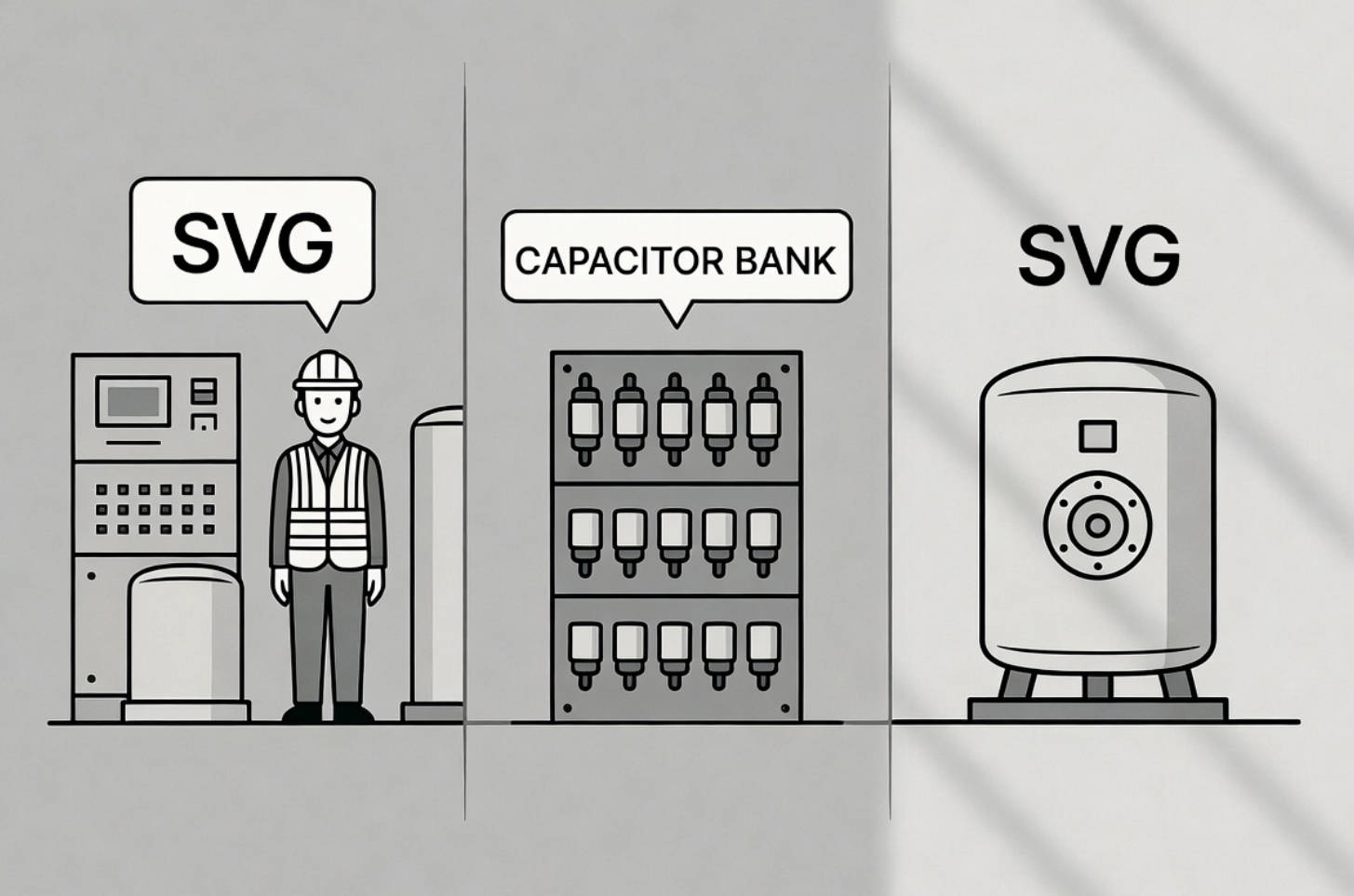
Static VAR Generators and capacitor banks both play important roles in reactive power compensation, but they are built for different operating conditions. SVG is the better option for fast reactive power compensation, dynamic loads, harmonic environments, and plants that demand precise control. Capacitor banks remain an effective and economical solution for stable systems with lower technical complexity.
The best choice depends on the behavior of the electrical load, the quality of the grid, and the plant's long-term operating goals. When the system is properly matched to the application, compensation equipment becomes a powerful tool for improving power quality, reducing losses, and supporting reliable industrial production.
A Static VAR Generator is an active compensation device that responds quickly and continuously, while a capacitor bank is a passive solution that works in fixed or switched steps.
A Static VAR Generator is better because it can respond in milliseconds and adapt to rapidly changing load conditions.
Yes, but it must be designed carefully. In harmonic-rich systems, a capacitor bank may need detuned reactors or other protection to avoid resonance problems.
No. If the load is stable and the goal is basic power factor correction at lower cost, a capacitor bank may be the more practical option.
Industries with dynamic loads, such as metallurgy, automotive manufacturing, petrochemicals, paper, textiles, and heavy machinery, often benefit most from SVG.
In many cases, yes. SVG has fewer mechanical switching parts, so it often experiences less wear related to repeated switching operations.
1. [PowerQualitySTATCOM: What is the difference between a static var generator and a capacitor bank?]
2. [Giant Electric: Capacitor Bank: The Complete Guide To Power Factor Correction]
4. [Adroit Power: Static Var Generator]
5. [PQ TEAM: Medium Voltage Static Synchronous Compensator (SVG)]


