
Views: 243 Author: Dingnuo Electric Publish Time: 2026-09-18 Origin: Site


Content Menu
● What Is an Active Harmonic Filter?
>> How an Active Harmonic Filter Works
● Why Harmonics Are a Serious Industrial Power Quality Problem
>> Operational Consequences of High Harmonic Distortion
● Active Harmonic Filter vs Passive Harmonic Filter
>> When an Active Harmonic Filter Is Usually the Better Choice
● Active Harmonic Filter Benefits for Industrial Facilities
>> 1. Lower Harmonic Current Distortion
>> 2. Improved Transformer Utilization
>> 3. Dynamic Reactive Power Compensation
>> 4. Better Reliability for Capacitors and Switchgear
>> 5. Greater Adaptability Than Fixed-Tuned Solutions
● How to Size an Active Harmonic Filter Correctly
>> Step 1: Perform a Power Quality Assessment
>> Step 2: Identify the Actual Harmonic Source
>> Step 3: Define the Performance Objective
>> Step 4: Select Capacity With Engineering Margin
>> Step 5: Confirm Installation and Commissioning Details
● A Practical Industrial Case: Solving Harmonics and Low Power Factor Together
● Active Harmonic Filters in Key Industries
>> Metallurgy and Metal Processing
>> Petrochemical and Process Facilities
>> Paper and Textile Manufacturing
>> Municipal and Infrastructure Projects
● Choosing an Active Harmonic Filter Manufacturer
● Conclusion: Start With Measurement, Then Build the Right Solution
● FAQ
>> 1. What is the difference between an active harmonic filter and an active power filter?
>> 2. Can an active harmonic filter improve power factor?
>> 3. Where should an active harmonic filter be installed?
>> 4. Do active harmonic filters replace capacitor banks?
>> 5. What causes high THDi in an industrial facility?
>> 6. Can an active harmonic filter reduce transformer overheating?
>> 7. How do I know what size active harmonic filter I need?
>> 8. Can active harmonic filters work with VFDs?
An active harmonic filter (AHF), also called an active power filter (APF), is a power-quality device that continuously measures distortion in an electrical system and injects precisely controlled compensating current to cancel unwanted harmonics. For industrial facilities with variable-frequency drives, rectifiers, welders, UPS systems, arc furnaces, and other nonlinear loads, an active harmonic filter can reduce harmonic distortion, support reactive power compensation, and improve the reliability of transformers, cables, capacitors, switchgear, and production equipment.
At DINGNUO ELECTRIC CO., Ltd., we work with customers facing practical power-quality issues—not merely theoretical harmonic values. Across metallurgy, petrochemical processing, automotive manufacturing, paper production, textiles, building-material plants, and municipal infrastructure projects, the common concerns are familiar: overheated busbars, overloaded transformers, capacitor failures, nuisance tripping, blown fuses, unstable voltage, and excessive reactive-power demand. An active harmonic filter is often an important part of the answer, but it must be selected from measured system data rather than simply added as a standard cabinet.
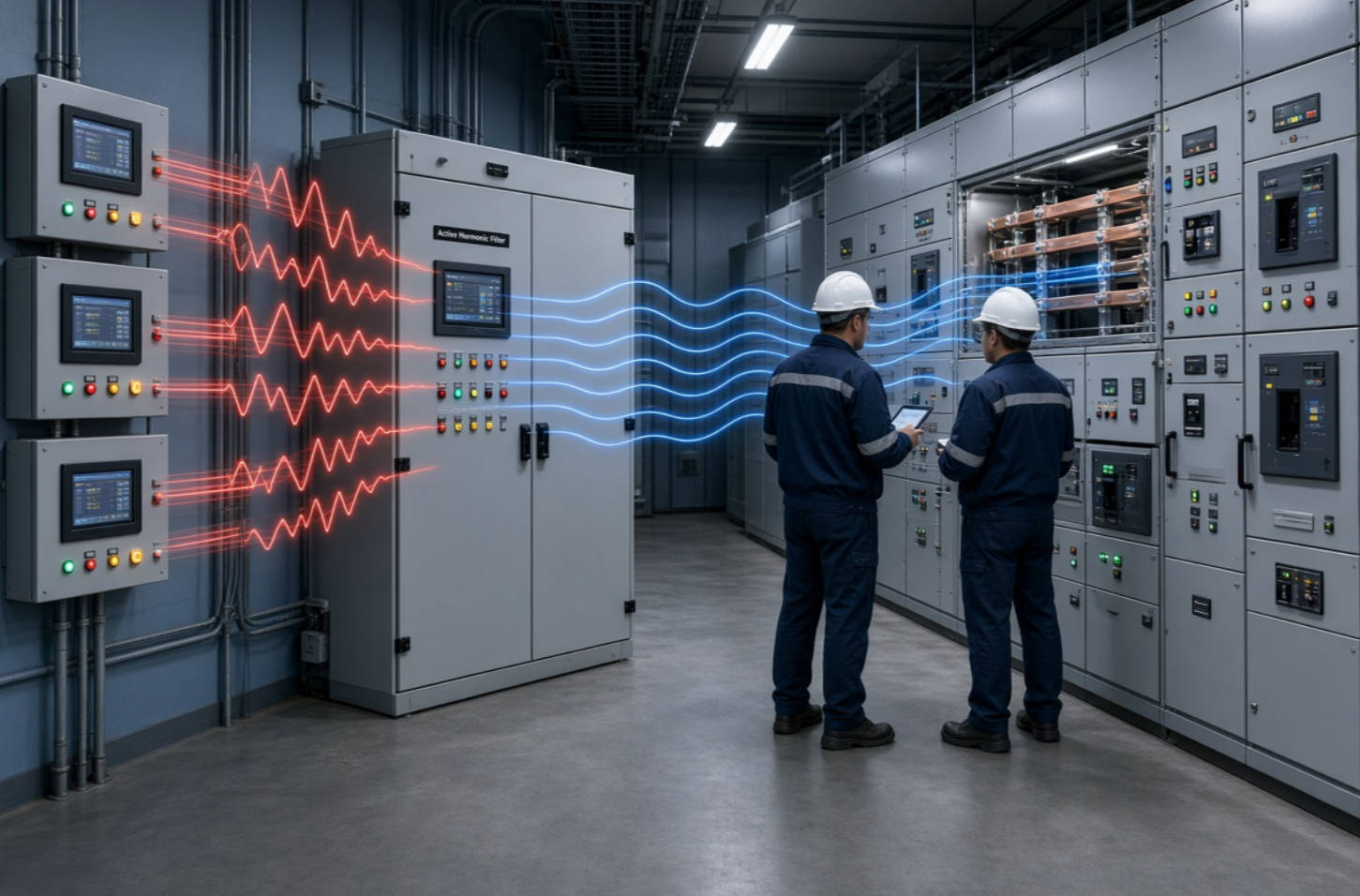
An active harmonic filter is a parallel-connected electronic power-quality solution designed to identify harmonic current and generate an equal-but-opposite compensating current.
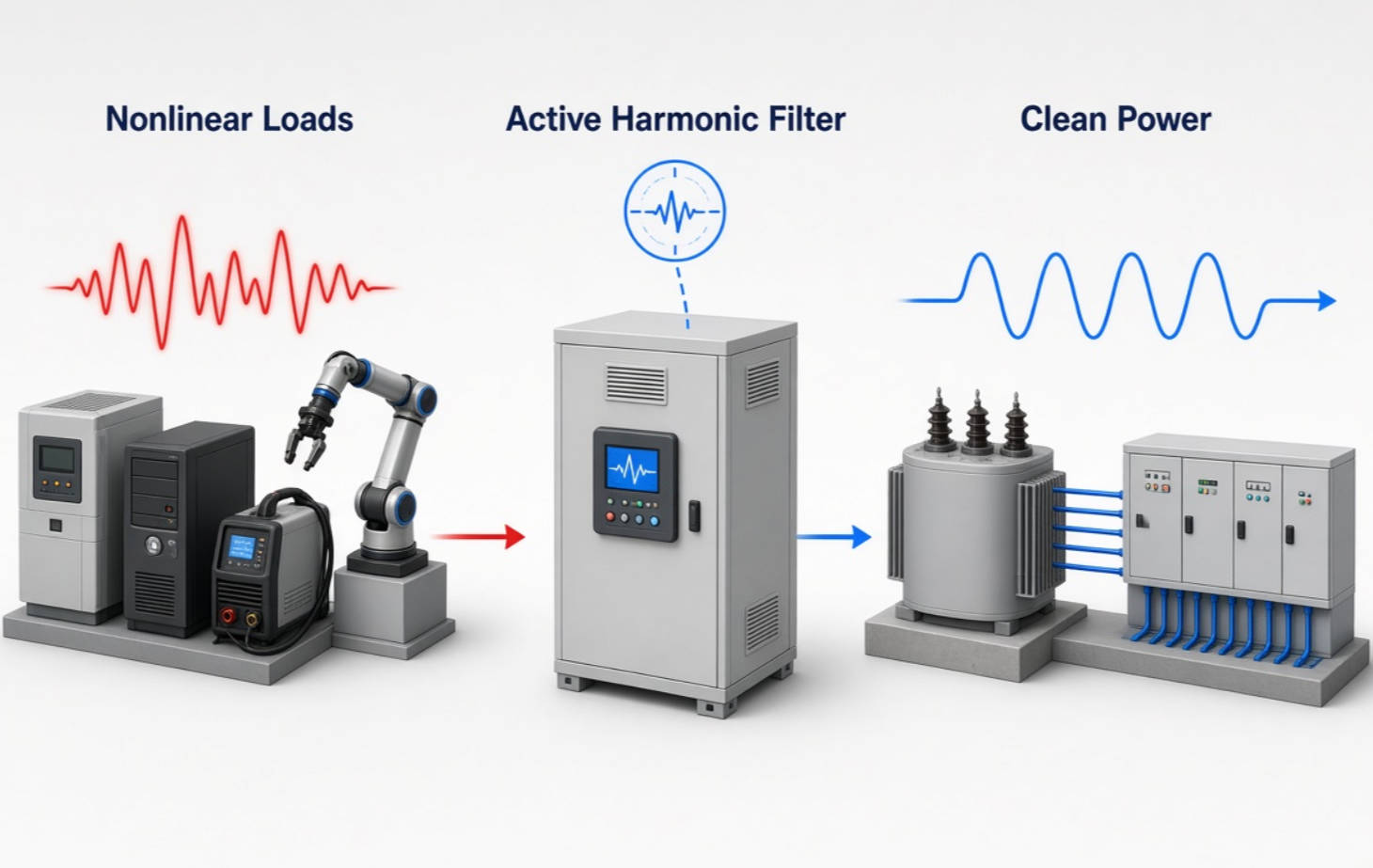
In simple terms, nonlinear loads draw current in irregular pulses rather than a smooth sine wave. Those distorted current waveforms create harmonics, which may travel through cables and transformers and distort the voltage supplied to other equipment. The active harmonic filter monitors the waveform in real time, calculates the unwanted harmonic content, and injects compensation current to reduce the distortion seen by the electrical system.
Unlike a conventional capacitor bank, an active harmonic filter is not only used to improve power factor. Its primary purpose is to control harmonic current dynamically. Many modern APF systems can also compensate reactive power and help balance phase loading, depending on the configuration and available capacity.
An active harmonic filter does not eliminate the nonlinear load itself. Instead, it reduces the harmful electrical effects that the load creates in the distribution system.
Most active harmonic filters use current transformers to detect load current. Their controller separates the useful fundamental-frequency current from unwanted components, including harmonic current and reactive current. Power-electronic switching technology then produces a compensating current and injects it into the system.
The process typically follows these steps:
1. Measure load current through current transformers installed at the appropriate monitoring point.
2. Analyze the waveform to identify harmonic orders, reactive current, and phase imbalance.
3. Calculate compensation demand based on the selected operating mode and filter capacity.
4. Generate compensating current using a high-speed inverter and PWM control technology.
5. Inject compensation current in parallel with the load so that harmonic current is reduced at the selected point in the electrical network.
Because the process is dynamic, an active harmonic filter can respond when production equipment starts, stops, changes speed, or shifts between operating loads.
Harmonics are voltage or current components at frequencies that are integer multiples of the fundamental supply frequency. In a 50 Hz system, the fifth harmonic is 250 Hz, the seventh harmonic is 350 Hz, and so on. In a 60 Hz system, the fifth harmonic is 300 Hz.
Harmonics are common in modern facilities because many efficient and controllable electrical loads use power electronics. These loads are essential to automation and process control, but they can create significant distortion when not properly assessed and managed.
Common harmonic-producing loads include:
- Variable-frequency drives and servo drives
- Soft starters and thyristor-controlled equipment
- Arc furnaces and induction furnaces
- Welding equipment
- Rectifiers and DC power supplies
- UPS systems and data-center power equipment
- Battery chargers
- LED lighting systems
- CNC machines
- Industrial automation equipment
- HVAC systems with variable-speed drives
- Electric-vehicle charging infrastructure
Harmonic distortion can create costs that are difficult to identify until equipment begins to fail or production reliability declines. The effects are not limited to one device. Harmonics may affect the entire low-voltage distribution system.
Typical symptoms include:
- Transformer overheating and reduced usable capacity
- Overloaded neutral conductors, especially where triplen harmonics are present
- Cable overheating caused by higher RMS current
- Premature capacitor-bank failure
- Fuse and contactor failures
- Circuit-breaker nuisance tripping
- Busbar heating
- Motor vibration, noise, and additional losses
- Poor power factor performance
- Voltage distortion affecting sensitive controls
- Production interruptions and maintenance costs
A facility can appear to have sufficient transformer capacity based on kW demand while still experiencing overheating because harmonic current increases total RMS current. This is why power-quality investigations should evaluate more than active power consumption.
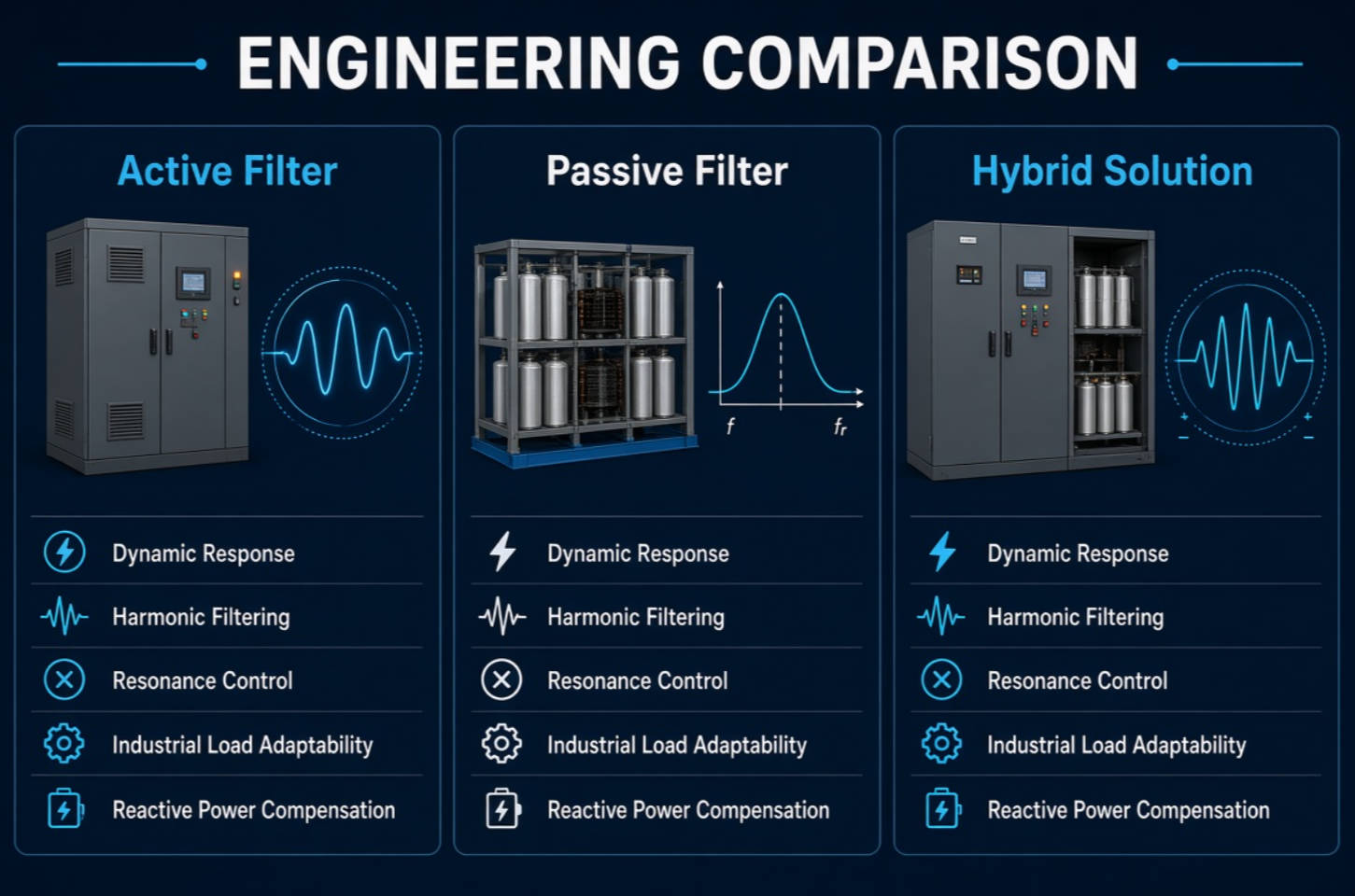
Both active and passive filters can be effective. However, they solve harmonic problems in different ways and are appropriate for different electrical conditions.
A passive harmonic filter usually combines capacitors and reactors to create a tuned circuit. It is designed to absorb or divert specific harmonic frequencies. An active harmonic filter uses power electronics and software control to dynamically inject compensating current.
| Comparison Item | Active Harmonic Filter | Passive Harmonic Filter |
|---|---|---|
| Main operating principle | Injects real-time compensating current | Uses tuned capacitor-reactor circuits |
| Harmonic response | Dynamic and adaptive | Fixed around selected tuning frequencies |
| Harmonic orders addressed | Can compensate multiple harmonic orders | Usually targets selected dominant orders |
| Reactive power compensation | Often available as a configurable function | Commonly provided by capacitor-based design |
| Response to changing loads | Strong | Limited when load profile changes significantly |
| Resonance risk | Lower when correctly applied | Must be carefully engineered to avoid resonance |
| Space requirement | Often compact for modular capacity | May require larger capacitor and reactor assemblies |
| Initial investment | Often higher | Often lower for stable, predictable loads |
| Best-fit applications | Variable loads, multiple VFDs, dynamic processes | Stable loads with known dominant harmonics |
The best solution is not always "active versus passive." In many industrial projects, a hybrid design provides the strongest result. A detuned capacitor bank or tuned passive filter can provide economical base reactive-power support, while an active harmonic filter manages rapidly changing harmonic current, residual distortion, and load imbalance.
An APF is especially valuable when a facility has:
- Rapidly changing load conditions
- Multiple VFDs operating at different speeds
- Expansion plans that may change harmonic characteristics
- High harmonic current across several orders
- Sensitive automation, communication, or control equipment
- Repeated capacitor-bank failures
- Limited space for large passive filter banks
- A need for harmonic filtering and reactive-power compensation in one system
- Unbalanced single-phase loads
- A requirement to improve power quality without stopping major process equipment
A properly engineered active harmonic filter can bring measurable and operational benefits. The exact result depends on system impedance, load profile, filter capacity, installation point, and the selected compensation target.
The central benefit is a reduction in harmonic current. By reducing harmonic current flowing through transformers, feeders, and switchgear, an APF can help lower electrical stress throughout the facility.
The aim should not be to pursue the lowest possible THDi value without considering cost and system needs. The right target should be based on the point of common coupling, utility requirements, applicable standards, equipment sensitivity, and the economics of the project.
Harmonic current consumes transformer capacity. When distortion is high, a transformer may run hotter than expected even though its apparent active load appears acceptable.
Reducing harmonic current can help a facility:
- Release usable transformer capacity
- Reduce temperature rise
- Delay transformer upgrades
- Support future production expansion
- Improve the stability of downstream voltage
For a plant with limited transformer headroom, this can be more valuable than a simple reduction in an electrical measurement. It can become a production-capacity decision.
Many active harmonic filters can compensate reactive current while filtering harmonics. This feature can help improve displacement power factor under changing load conditions.
However, reactive power compensation and harmonic mitigation must be coordinated. Installing conventional capacitor banks in a harmonic-rich system without appropriate detuning reactors can create resonance risk and accelerate capacitor damage. A power-quality assessment should always come before equipment selection.
Capacitor failures, burned contactors, blown fuses, and overheated busbars are frequently warning signs of an electrical environment that needs investigation. An active harmonic filter can reduce harmonic-related stress, but it should be paired with a review of existing capacitor banks, reactors, switching devices, protection settings, and thermal conditions.
A passive filter is typically engineered around known harmonic orders and stable operating conditions. By contrast, an active filter can adapt to changing production schedules and load patterns.
This flexibility is particularly useful in automotive plants, textile factories, paper mills, and municipal facilities where equipment does not always operate at one constant load.
Active harmonic filter sizing should never rely only on facility transformer rating, total installed motor power, or a rough assumption about VFD capacity. An oversized system increases project cost. An undersized system may not achieve the required result.
The correct approach begins with measurement.
Use a power-quality analyzer to collect data at the relevant electrical points. Depending on the project, monitoring may be required at the main incomer, individual transformers, motor-control centers, capacitor-bank feeders, or specific production lines.
Measure and record:
- Total harmonic current distortion
- Total harmonic voltage distortion
- Individual harmonic orders
- RMS current and demand current
- kW, kVAR, and kVA
- True power factor and displacement power factor
- Transformer loading
- Voltage unbalance and current unbalance
- Neutral current, where applicable
- Load variation over production cycles
- Existing capacitor-bank switching behavior
- Temperature indications at busbars, cables, and transformers
A short measurement taken during low production may lead to the wrong solution. Ideally, data should capture normal, peak, and transitional operating conditions.
The next question is not simply "How high is THDi?" It is "Which loads are creating it, and where should compensation be installed?"
For example, a facility may have a high THDi reading at the main distribution board, but the dominant source may be one VFD-intensive production line. Installing a filter close to that line can reduce harmonic current before it spreads through the plant network.
A project may have one or more objectives:
- Reduce harmonic current at the transformer secondary
- Improve voltage quality at sensitive equipment
- Meet a utility or project specification
- Reduce transformer heating
- Prevent capacitor-bank resonance and failure
- Improve power factor
- Increase available system capacity
- Reduce nuisance trips and unplanned downtime
The intended result determines the installation location, control mode, and APF capacity.
APF capacity is usually specified in amperes. The selected rating should account for measured harmonic current, reactive compensation demand if required, future expansion, operating diversity, and the actual harmonic spectrum.
For modular systems, multiple APF modules can often be installed in parallel. This approach supports staged investment, redundancy, and future capacity expansion.
Do not assume that harmonic current will remain unchanged after equipment upgrades. Adding drives, chargers, furnaces, UPS units, or automated lines can materially change the electrical profile.
A successful APF project includes more than equipment delivery. Engineering teams should verify:
- Current-transformer ratio, orientation, and installation point
- Cable sizing and protective devices
- Cabinet ventilation and ambient temperature
- Network voltage and frequency
- Grounding arrangement
- Parallel-operation settings for multiple modules
- Harmonic compensation priority
- Reactive-power compensation priority
- Communication and monitoring requirements
- Post-commissioning harmonic performance
A common industrial scenario involves a plant with extensive VFD usage, insufficient reactive-power compensation, and aging active filtering equipment. Operators may report low power factor, high distortion, overheated busbars, frequent blown fuses, and damaged contactors.
In one DINGNUO project scenario, the customer faced low power factor, inadequate compensation capacity, and significant harmonic distortion. The corrective approach involved replacing deteriorated capacitors, adding a Static VAR Generator cabinet to improve power factor, and installing an active power filter cabinet for harmonic mitigation.
This type of solution is important because it addresses the electrical system as a whole:
- The SVG supplies dynamic reactive-power compensation.
- The APF targets harmonic current.
- Updated capacitor equipment removes unreliable components.
- Proper cabinet engineering improves safety, maintainability, and monitoring.
In another retrofit scenario, a site with many variable-frequency drives experienced serious copper-busbar overheating. Because space was restricted and existing active filters had aged, the practical solution was to retrofit the existing capacitor cabinet into an active filter cabinet and replace obsolete filtering equipment.
The lesson is clear: the best active harmonic filter solution is site-specific. Electrical drawings, load data, waveform measurements, space constraints, thermal conditions, and future expansion plans should all influence the final design.
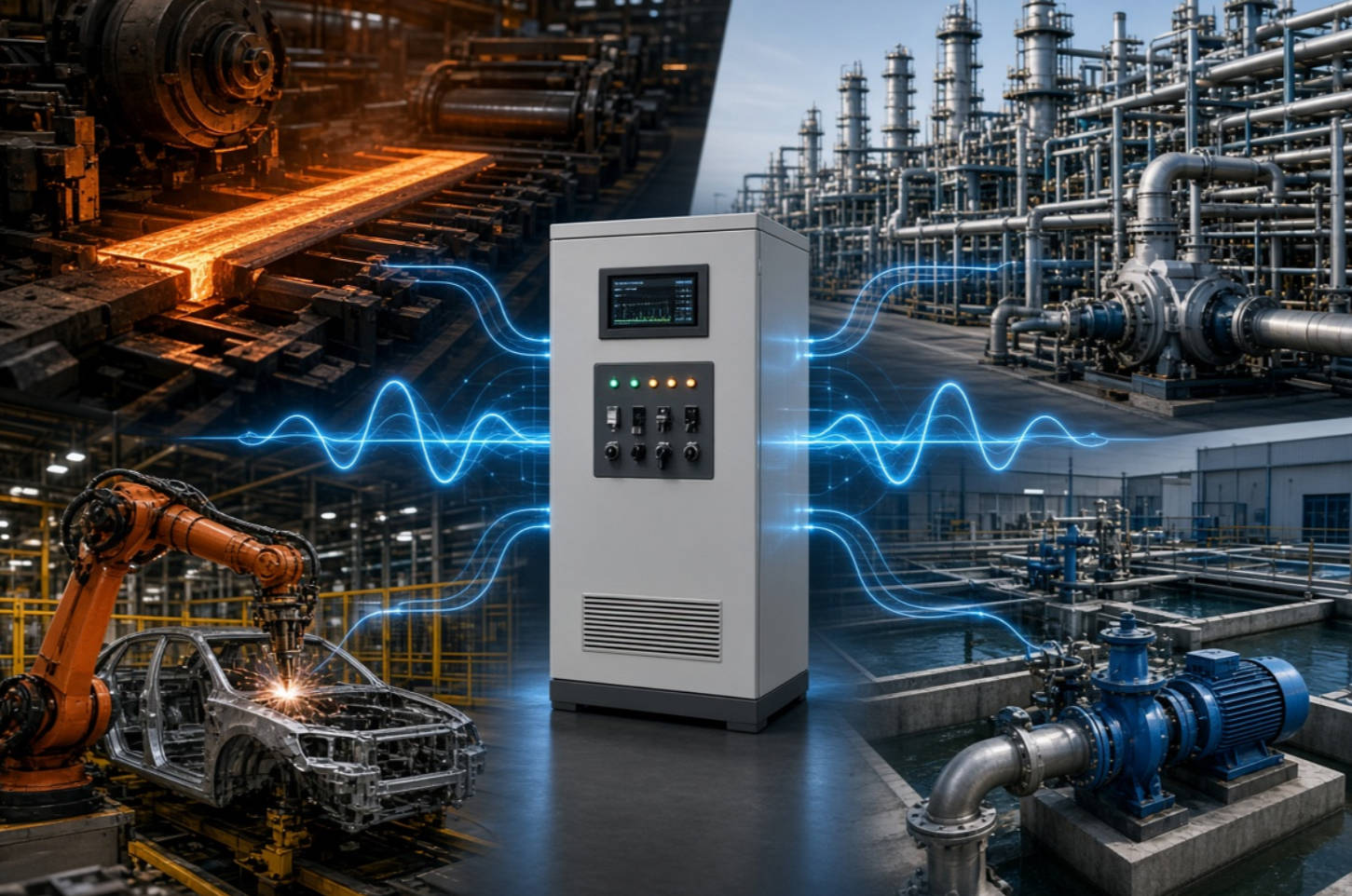
Arc furnaces, rolling mills, induction heating systems, and high-power drive systems can create severe and rapidly changing harmonic conditions. APFs can support a broader power-quality strategy by reducing distortion and improving the operating environment for transformers and switchgear.
Petrochemical plants often depend on continuous operation. VFD-driven pumps, compressors, blowers, and process-control systems may introduce harmonics while requiring high reliability. Harmonic filtering can help protect sensitive automation and reduce electrical stress during variable process demand.
Robotic welding, automation systems, conveyors, test equipment, and variable-speed drives create a complex electrical environment. A modular active harmonic filter can be useful where load profiles shift between production lines and operating shifts.
Paper machines, winding equipment, extrusion lines, spinning equipment, and drive systems often use speed control extensively. These processes may benefit from harmonic reduction, reactive-power support, and targeted filtering at motor-control centers or transformer secondary distribution boards.
Water-treatment plants, pumping stations, transportation facilities, public buildings, and utility-related projects increasingly use VFDs, UPS systems, LED lighting, and automation platforms. Active harmonic filtering can help maintain stable power quality while supporting long operating cycles and remote monitoring needs.
Selecting an active harmonic filter is not only a product purchase. It is an engineering decision that affects electrical reliability, project cost, maintenance requirements, and future plant capacity.
Before selecting a supplier, ask these questions:
1. Can the supplier review your single-line diagram and power-quality measurement data?
2. Does the proposed solution include harmonic filtering, reactive-power compensation, phase balancing, or only one of these functions?
3. Is the filter capacity based on actual measured harmonic current?
4. Can the system be expanded through parallel modules?
5. What harmonic orders can the system compensate?
6. How will current transformers be installed and configured?
7. Is the cabinet designed for your voltage, frequency, space, temperature, and protection requirements?
8. Can the supplier provide commissioning guidance, monitoring support, and technical service?
9. How will the supplier verify performance after installation?
10. Does the supplier understand the interaction between capacitor banks, detuned reactors, APFs, SVGs, and the facility's existing electrical network?
DINGNUO ELECTRIC provides customized power-quality solutions that can integrate capacitors, low- and high-voltage reactors, active power filters, Static VAR Generators, harmonic filter cabinets, tuned filter cabinets, intelligent controllers, and metering solutions. From electrical schematics and component selection to cabinet assembly, commissioning support, and technical service, the goal is to provide a practical solution tailored to the customer's electrical conditions.
An active harmonic filter is a powerful solution for controlling harmonic current in modern industrial electrical systems. It can help reduce distortion, improve equipment reliability, support reactive-power compensation, release transformer capacity, and protect critical production assets.
But an APF is most effective when it is engineered around real operating conditions. The right solution starts with power-quality measurement, identifies the harmonic source, defines clear performance objectives, and combines the appropriate technologies—such as active power filters, capacitors, detuned reactors, tuned filters, or SVGs.
If your facility is experiencing high THDi, overheating transformers or busbars, damaged capacitor banks, low power factor, nuisance tripping, or unstable electrical performance, contact DINGNUO ELECTRIC for a power-quality assessment and customized active harmonic filter solution. Share your single-line diagram, transformer rating, load information, and power-quality data so our engineering team can recommend the most suitable configuration for your project.
In industrial power-quality applications, the terms are often used interchangeably. Both generally refer to electronic systems that detect harmonic current and inject compensating current into the electrical network. Depending on the design, the equipment may also compensate reactive power and phase imbalance.
Yes. Many active harmonic filters can provide reactive-current compensation and improve displacement power factor. However, the available capacity must be allocated between harmonic filtering and reactive-power compensation, so the system should be sized according to the required operating priorities.
An APF can be installed at the main low-voltage incomer, transformer secondary, motor-control center, distribution board, or near a major harmonic-producing load. The best location depends on where harmonics originate, which equipment needs protection, cable lengths, and the desired performance target.
Not always. An APF can compensate reactive power, but capacitor banks may remain a cost-effective way to provide base reactive-power compensation. In harmonic-rich systems, capacitor banks should be designed with appropriate detuned reactors or integrated into a coordinated hybrid power-quality solution.
High THDi is commonly caused by nonlinear loads, including VFDs, rectifiers, welders, UPS systems, arc furnaces, battery chargers, DC power supplies, and electronic lighting systems. The resulting current waveform differs from a pure sine wave and contains multiple harmonic frequencies.
It can help when harmonic current is a major contributor to transformer heating. Harmonics increase RMS current and additional losses. A power-quality study should confirm the actual cause of overheating, because transformer temperature can also be affected by overloading, ventilation, ambient temperature, loose connections, and poor conductor conditions.
The correct size should be based on measured harmonic current, reactive-power requirements, load variation, transformer loading, target performance, future expansion, and the point where the filter will be installed. A qualified engineering assessment is recommended before selecting APF capacity.
Yes. Active harmonic filters are frequently applied in facilities with variable-frequency drives. They are particularly valuable when multiple drives operate at changing speeds and loads, creating a variable harmonic profile that is difficult for a fixed passive filter to address.
1. IEEE Standards Association. “IEEE 519-2022: IEEE Recommended Practice and Requirements for Harmonic Control in Electric Power Systems.”
[https://standards.ieee.org/ieee/519/10677/]
2. Eaton. “IEEE 519 Standard: What Do I Need to Know?”
3. Mirus International. “IEEE Std 519-2014 Harmonic Limits.”
4. New York State Energy Research and Development Authority. “At Load Power Factor Correction.”
5. Schneider Electric. “EasyLogic Active Harmonic Filter User Manual.”
[https://www.se.com/my/en/download/document/EZAPF3160898EN_00/]
6. DINGNUO ELECTRIC CO., Ltd. “Reactive Power Compensation, Active Power Filter, and Static VAR Generator Solutions.”
[https://www.dingnuopower.com/]
7. DINGNUO ELECTRIC CO., Ltd. “Projects: Harmonic and Reactive Power Control Solutions.”
[https://www.dingnuopower.com/Projects.html]
8. YT Electric. “What Is an Active Harmonic Filter?”
[https://www.ytelect.com/blog/what-is-an-active-harmonic-filter_b340]


