
Views: 246 Author: Dingnuo Electric Publish Time: 2026-10-05 Origin: Site


Content Menu
● Why Source Reactive Power Compensation Equipment From China?
● How We Evaluated Manufacturers
>> Technical Background: What Buyers Should Understand
● Top 10 Reactive Power Compensation Device Manufacturers in China
>> 1. DINGNUO ELECTRIC CO., Ltd.
>> 2. SINEXCEL
>> 3. CHINT
>> 4. TBEA
>> 7. INVT
● Manufacturer Comparison Table
● Technical Buying Guide for Reactive Power Compensation
>> Capacitor Banks vs SVG vs APF
● The Hidden Sourcing Risk: "Same kVAr" Does Not Mean Same Quality
>> Internal Avoidance Tip: Check the Reactor-Capacitor Pairing, Not Only Each Component
● Common Procurement Mistakes and How to Avoid Them
>> Mistake 1: Choosing only by lowest price
>> Mistake 2: Installing capacitor banks without harmonic measurement
>> Mistake 3: Selecting SVG only by nominal kVAr
>> Mistake 4: Ignoring ambient temperature and ventilation
>> Mistake 5: Treating CE marking as a complete quality guarantee
>> Mistake 6: Failing to define commissioning responsibility
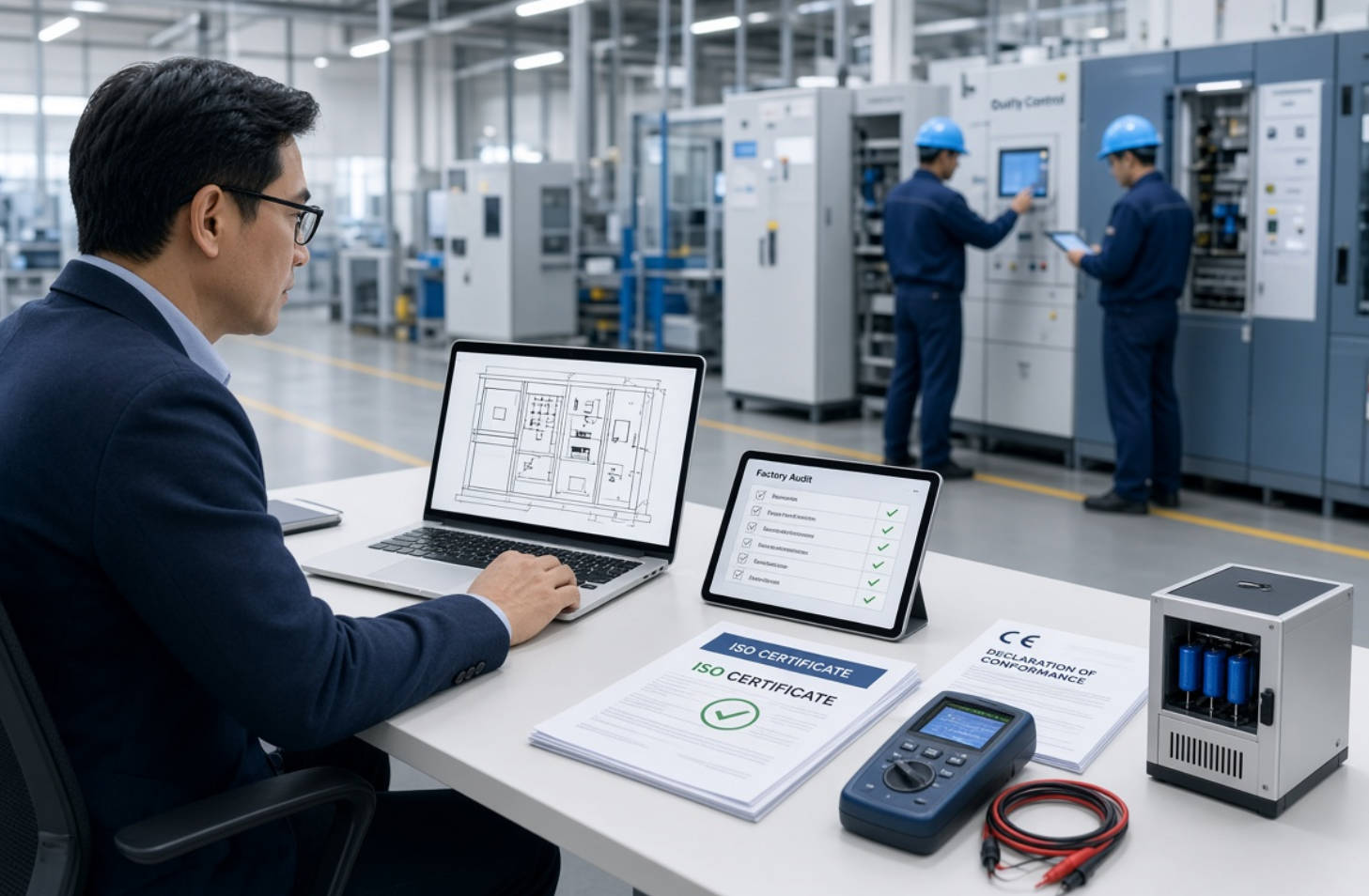
● How to Verify a Chinese Factory Before Ordering
>> 2. Verify ISO certificates correctly
>> 3. Ask for product-level evidence
>> 4. Conduct a video factory audit
>> 5. Use a pre-shipment inspection plan
● FAQ
>> 1. How can I verify whether a supplier's ISO 9001 certificate has expired?
>> 2. What information is required to size a reactive power compensation system correctly?
>> 3. Why do capacitor banks fail quickly in plants with VFDs or rectifiers?
>> 4. Should I choose a capacitor bank, SVG, APF, or hybrid solution?
>> 5. What should be included in a warranty clause for SVG/APF or capacitor-bank equipment?
China has become one of the world's most important supply bases for reactive power compensation equipment, supported by large-scale power-grid investment, industrial electrification, renewable-energy integration, and a mature electrical-equipment supply chain. For global buyers, the opportunity is not simply lower procurement cost: the strongest Chinese manufacturers can now provide engineered solutions spanning power capacitors, detuned reactors, intelligent capacitor modules, Static Var Generators (SVG), Active Power Filters (APF/AHF), hybrid compensation cabinets, and medium- or high-voltage dynamic reactive-power systems.
However, "reactive power compensation manufacturer" is a broad label. A supplier that is appropriate for a 10 kV photovoltaic plant may not be the right choice for a low-voltage textile factory with high fifth-harmonic distortion. Likewise, a company with strong utility-scale STATCOM capability may not be efficient at serving an OEM customer that needs a flexible MOQ, customized enclosure, multilingual label, and fast engineering response.
This guide is written for procurement managers, electrical contractors, panel builders, EPC companies, and industrial end users evaluating long-term Chinese suppliers. The manufacturers below are not ranked solely by company size. They are assessed according to product coverage, engineering relevance, verification transparency, export suitability, certification capability, and practical fit for different buyer types.
China's power-quality equipment market is expected to continue expanding as industrial automation, distributed renewable energy, EV charging, data centers, and nonlinear loads place more pressure on distribution networks. One market estimate values China's power-quality-equipment market at approximately USD 5.28 billion in 2025, with projected growth toward USD 8.9 billion by 2033.

China's advantage is not based on one production city alone. Instead, it is built on several connected industrial clusters:
- Zhejiang, especially Ningbo and Wenzhou, has strong ecosystems for low-voltage electrical components, capacitor banks, reactors, switchgear accessories, control devices, and panel integration.
- Jiangsu, including Jiangyin and surrounding industrial areas, has a mature base for energy meters, monitoring devices, distribution automation, and low-voltage power-quality equipment.
- Shenzhen and Guangdong are important centers for power electronics, IGBT-based SVG/APF equipment, digital controllers, communication interfaces, and energy-management systems.
- Shanghai, Jiangsu, and Anhui support higher-end grid equipment, FACTS technologies, transmission-and-distribution engineering, and utility-scale reactive-power projects.
China's electrical-equipment export ecosystem is also substantial. According to China's General Administration of Customs, electro-mechanical products represented 60.5% of China's total exports in the first three quarters of 2025, reaching RMB 12.07 trillion and growing 9.6% year on year. This does not mean every manufacturer is export-ready, but it shows that Chinese electrical suppliers operate within a large, globally connected manufacturing and logistics environment.
For buyers, the practical benefits can include:
- Competitive pricing for standard capacitor banks, reactors, intelligent capacitors, and low-voltage SVG/APF modules.
- Broad access to component supply chains, including metallized polypropylene film capacitors, copper or aluminum windings, IGBTs, CTs, controllers, contactors, thyristor switches, and cabinet hardware.
- Flexible integration of compensation, harmonic filtering, three-phase balancing, monitoring, and remote communication.
- Availability of OEM/ODM support for panel builders, regional electrical brands, and energy-efficiency contractors.
- Faster product iteration for digital power-quality equipment.
The key is to select a supplier based on the actual electrical conditions of the project—not on catalog appearance or the lowest quotation.
A reliable reactive power compensation supplier should be evaluated through technical, operational, and commercial evidence. This is especially important because compensation equipment is often connected directly to critical industrial distribution systems, where poor component selection can cause capacitor failure, resonance, overheating, nuisance tripping, or production downtime.
The companies in this list were reviewed using the following criteria.
| Evaluation area | What professional buyers should verify | Why it matters |
|---|---|---|
| Product range | Capacitors, reactors, APF, SVG, SVC, STATCOM, controllers, complete cabinets | A broader range can simplify engineering and after-sales coordination |
| Engineering depth | Harmonic study, capacitor/reactor matching, CT selection, protection coordination, communications | Compensation capacity alone does not guarantee system performance |
| Manufacturing capability | In-house assembly, testing equipment, traceability, quality-control records | Helps reduce batch inconsistency and post-installation failures |
| Certifications | ISO management systems, CE, RoHS, CCC, CQC, IEC/EN compliance documentation | Required for many tenders, markets, and buyer quality systems |
| R&D capability | Patents, firmware development, power-electronics design, testing resources | Particularly important for SVG, APF, hybrid, and customized systems |
| Export readiness | English documents, packaging, labeling, technical support, Incoterms experience | Reduces friction during international purchasing and installation |
| OEM/ODM flexibility | Branding, enclosures, voltage options, dimensions, interface localization, lower MOQ | Important for panel builders and distributors creating their own product line |
| Delivery stability | Component availability, production planning, inspection procedure, spare-parts support | Critical for EPC schedules and long-term framework orders |
Reactive power compensation is used to manage reactive power demand, improve power factor, reduce distribution losses, stabilize voltage, and avoid utility penalties where applicable. Different technologies serve different load profiles:
- Fixed capacitor banks are suitable for relatively stable inductive loads.
- Automatic capacitor banks use contactor or thyristor switching to follow step changes in load demand.
- Detuned capacitor-reactor systems are used where harmonics are present and resonance risk must be controlled.
- SVG or STATCOM systems use power-electronic converters—typically IGBT-based—to provide fast, continuously variable capacitive or inductive reactive-power compensation.
- APF/AHF systems actively inject compensating current to reduce harmonic currents.
- Hybrid systems combine capacitors/reactors with SVG or APF functions to balance performance and investment cost.
For example, SINEXCEL states that its SVG platform uses DSP/IGBT-based control and can improve power factor to 0.99 within 15 ms under specified operating conditions, with listed low-voltage capacities across 200 V, 400 V, 480 V, 600 V, and 690 V configurations. This illustrates why dynamic compensation products should be compared through technical parameters—not only through nominal kVAr ratings.
Location: Ningbo, Zhejiang, China
Established: 2008
Main focus: Intelligent capacitors, reactors, SVG, APF, reactive power compensation, harmonic-control systems, and customized power-quality solutions
Suitable for: Industrial end users, panel builders, small and mid-sized electrical brands, distributors, OEM/ODM buyers, and project contractors seeking responsive technical support
DINGNUO ELECTRIC CO., Ltd. is a Ningbo-based manufacturer focused on reactive power compensation and harmonic-control solutions for power-distribution systems. Established in 2008, the company integrates product R&D, production, sales, and technical support. Its core product scope includes intelligent capacitors, reactors, SVG systems, APF systems, and related power-quality products.
For international buyers, DINGNUO's practical strength is its balance between technical product coverage and flexible project support. Rather than positioning itself only as a high-volume standardized supplier, the company is suitable for customers who need customization in electrical parameters, product dimensions, cabinet layout, functions, labeling, and product configuration.
DINGNUO reports complete production and test equipment for its core products and states that its production process is supported by quality, environmental, and safety management systems. Its products have completed CCC, CQC, CE, and other certifications, while the company also reports more than 40 invention patents, utility-model patents, and software copyrights.
The company's product and solution experience covers industries with demanding electrical conditions, including metallurgy, petrochemicals, automotive manufacturing, paper, textiles, building materials, and municipal engineering projects. These industries often include nonlinear loads, variable-speed drives, welding systems, furnace loads, pumps, compressors, and other conditions where simple capacitor-bank selection may not be sufficient.
Core strengths
- Broad low-voltage power-quality product coverage, including intelligent capacitors, reactors, SVG, and APF.
- Flexible OEM/ODM capability for overseas brands, panel builders, and project integrators.
- Engineering-oriented communication for applications involving reactive power, harmonics, and three-phase imbalance.
- CE, CCC, and CQC-related product compliance support, subject to model-specific confirmation.
- Responsive service positioning, including 24/7 phone and online support and an on-site response commitment for qualifying cases.
- Strong fit for buyers who need customized designs but may not meet the very high MOQ requirements of larger standardized manufacturers.
OEM/ODM scope to discuss with DINGNUO
- Customized voltage, frequency, kVAr, current rating, and compensation topology.
- Branded front panels, labels, manuals, packaging, and export documentation.
- Cabinet dimensions and installation arrangements.
- RS485/Modbus or other project-required communication configurations.
- Capacitor and reactor combinations for harmonic-heavy industrial loads.
- Customized SVG/APF cabinet solutions for factory retrofits, new panel projects, and distributor programs.
Buyer perspective
DINGNUO is particularly relevant for overseas customers that value communication speed, configuration flexibility, and engineering support in addition to price. It may be a practical partner for regional brands and industrial contractors that need an adaptable supplier rather than a rigid catalog-only factory.
Location: Shenzhen, Guangdong, China
Established: 2007
Main focus: SVG, APF, power-quality systems, energy storage, EV charging, and power-electronics solutions
Suitable for: Industrial projects, data centers, renewable-energy facilities, high-speed dynamic compensation requirements, and buyers seeking established power-electronics capability
SINEXCEL is a Shenzhen-based power-electronics company founded in 2007. It provides products across energy storage, EV charging, and power-quality applications, with SVG and APF equipment forming an important part of its power-quality business.
Its SVG technology is designed for fast dynamic reactive-power compensation, three-phase balancing, and voltage support. The company's product information describes 100% inverter-based technology, digital and semiconductor control, and modular low-voltage SVG options across multiple voltage classes.
For buyers managing highly variable loads—such as welding workshops, lift systems, semiconductor facilities, automated factories, large HVAC installations, charging infrastructure, and renewable-energy projects—dynamic SVG compensation can be more suitable than conventional stepped capacitor banks.
Core strengths
- Established power-electronics background.
- Broad SVG voltage and capacity options.
- Strong suitability for dynamic and fluctuating reactive-power conditions.
- Relevant for projects requiring harmonics management, three-phase balance, and digital monitoring.
- Experience across industrial and renewable-energy-related applications.
OEM/ODM scope
SINEXCEL is generally better suited to technical project procurement and branded system solutions than to very small private-label orders. Buyers should confirm customization thresholds, communication protocols, enclosure requirements, and local after-sales arrangements early in the sourcing process.
Location: Wenzhou, Zhejiang, China
Established: 1984
Main focus: Low-voltage and high-voltage electrical equipment, capacitors, reactors, SVG, APF, switchgear, transmission and distribution solutions
Suitable for: Global distributors, utility-linked projects, industrial facilities, and buyers requiring broad product-system integration
CHINT is one of China's most internationally recognized electrical-equipment groups. Its portfolio includes low-voltage capacitors, reactors, high-voltage compensation installations, SVG systems, and broader transmission-and-distribution products.
The company's dry low-voltage shunt capacitors are designed for systems up to 1,000 V and use self-healing metallized polypropylene film, flame-retardant materials, built-in over-voltage protection, and discharge safety designs. Its NWC6 low-voltage capacitor range is described as complying with IEC/EN 60831-1/2 and is available in 5–40 kVAr capacities.
CHINT also provides solutions that combine capacitors and reactors for harmonic-heavy sites. Its technical guidance recommends series reactors with 7% or 14% reactance where THDu exceeds 5%, helping suppress harmonics and extend capacitor life.
Core strengths
- Very broad product ecosystem, from low-voltage components to high-voltage T&D equipment.
- Strong global distribution footprint.
- Suitable for buyers seeking one supplier for multiple electrical product categories.
- Capability in capacitor banks, reactors, SVG/APF, switchgear, and grid-related equipment.
- IEC-oriented product documentation across many product lines.
OEM/ODM scope
CHINT is usually best approached for standard or project-based product lines, distribution agreements, and larger-volume procurement. Smaller customers should verify MOQ, territory restrictions, product availability, and branding policy before investing in qualification work.
Location: Xinjiang and multiple manufacturing bases in China
Established: 1988
Main focus: High-voltage equipment, transformers, transmission and distribution systems, capacitors, reactors, and high-voltage dynamic reactive-power compensation
Suitable for: Utility, renewable-energy, transmission, substation, and large industrial projects
TBEA is a major Chinese power-equipment manufacturer with a broad industrial system covering transformers, high- and low-voltage switchgear, capacitors, reactors, cables, secondary power systems, and related T&D products.
Its reactive-power compensation portfolio is particularly relevant for medium- and high-voltage applications. TBEA states that its high-voltage TSVG range covers 6 kV to 35 kV and 1–120 Mvar, with an online operation rate above 99% according to the company's product information.
This makes TBEA more appropriate for buyers sourcing utility-grade equipment, renewable-energy grid-connection systems, large industrial substations, and technically complex compensation projects rather than small low-voltage panel-builder orders.
Core strengths
- Strong high-voltage and utility-scale engineering capacity.
- Relevant product scope for renewable-energy grid integration.
- Broad coverage of capacitors, reactors, switchgear, and T&D equipment.
- Suitable for large tenders and engineered projects.
- Strong fit for high-voltage TSVG and system-level reactive-power requirements.
OEM/ODM scope
For TBEA, buyers should expect a project-based engagement model. Detailed technical specifications, grid-code requirements, site studies, delivery schedules, and commissioning responsibilities should be clarified at the beginning.
Location: Shanghai, China
Established: 1993
Main focus: Power transmission and distribution equipment, STATCOM, power-quality systems, grid modernization, rail transit, and infrastructure
Suitable for: Grid-scale projects, large renewable-energy facilities, rail-transit projects, substations, and critical infrastructure
Sieyuan Electric is a global power-equipment manufacturer with more than 30 years of experience. It serves utility-scale renewable energy, grid modernization, data centers, rail transit, and infrastructure projects across more than 100 countries.
The company's STATCOM solution is described as a cascaded H-bridge reactive-power compensator for power grids, new-energy sites, and industrial facilities. Such systems are designed for larger and more demanding voltage-stability applications where fast response and grid support are required.
Core strengths
- Strong grid and transmission-distribution background.
- More than 30 years of industrial experience.
- International market reach across 100+ countries.
- Relevant for STATCOM, substation equipment, renewable-energy integration, and critical-infrastructure projects.
- Suitable for buyers that need high-voltage engineering support and established project credentials.
OEM/ODM scope
Sieyuan is generally more suitable for formal project procurement than small-batch private-label OEM. Buyers should prepare a clear technical specification, single-line diagram, grid requirements, harmonic study data, and commercial qualification documents.
Location: Jiangyin, Jiangsu, China
Main focus: Power monitoring, energy management, APF, SVG, reactive-power compensation, harmonic management, and electrical safety systems
Suitable for: Smart distribution projects, industrial energy-management upgrades, commercial buildings, data collection, and low-voltage power-quality retrofits
Acrel is known for energy-management, electrical-monitoring, and power-quality products. Its power-quality range includes active filters, reactive-power compensation equipment, harmonic control, and protection solutions.
The company describes its APF as a parallel-connected solution for low-voltage networks with harmonic loads, designed to track and compensate harmonic current in real time. Its SVG products are positioned for fast and continuous compensation of reactive power, negative sequence, and three-phase imbalance.
Acrel is especially relevant when buyers need more than compensation hardware. For example, a commercial building, manufacturing site, or data-center project may require metering, power-quality analysis, alarms, energy dashboards, and remote monitoring together with APF or SVG equipment.
Core strengths
- Strong overlap between power-quality equipment and energy-monitoring systems.
- Suitable for digital power-management projects.
- Good fit for low-voltage harmonic control and compensation retrofits.
- Supports solutions for three-phase imbalance, power factor, and real-time harmonic management.
- Relevant for projects requiring data visibility and energy-efficiency reporting.
OEM/ODM scope
Acrel may be best suited to customers that value system integration and monitoring functions. Confirm cloud-platform accessibility, communication protocols, data ownership, localization options, and software-language support before procurement.
Location: Shenzhen, Guangdong, China
Established: 2002
Main focus: Industrial automation, drives, renewable-energy systems, high-voltage SVG, and industrial power-electronics products
Suitable for: Solar, industrial automation, variable-frequency-drive-heavy plants, and projects requiring high-voltage dynamic reactive-power compensation
INVT is widely known in industrial automation and variable-frequency-drive applications, making it relevant to facilities where nonlinear loads, changing motor loads, and renewable-energy integration affect power quality.
Its iSVG product series is described as high-voltage static var generator equipment that can compensate reactive power and harmonics. In a published solar-project application, INVT described a 30 MWp PV plant that used an iSVG solution with ±7.5 MVar reactive compensation capacity and Modbus communication for remote monitoring and control.-V3.1.pdf)
Core strengths
- Strong relationship to industrial automation and motor-drive applications.
- Relevant for high-voltage SVG and renewable-energy projects.
- Suitable for PV stations and industrial sites requiring remote communication.
- Experience with Modbus-based monitoring and grid-side control objectives.
- Useful for projects where reactive-power control must coordinate with automation systems.
OEM/ODM scope
INVT is generally strongest in project-oriented and system-oriented procurement. Buyers should verify whether the solution includes commissioning support, grid-code compliance, protective relays, and local technical-service capacity.
Location: Wenzhou, Zhejiang, China
Main focus: Intelligent capacitors, SVG, APF/AHF, reactors, capacitor contactors, composite switches, controllers, and low-voltage power-quality products
Suitable for: Distributors, industrial panel builders, low-voltage compensation projects, and buyers seeking a broad component-and-system product portfolio
Baoyu Holdings produces a wide range of low-voltage reactive-power compensation and harmonic-control products. Its public product information includes active power filters, SVG systems, intelligent capacitors, power capacitors, reactive-power compensators, composite switches, capacitor contactors, thyristor switches, reactors, and controllers.
Its products are positioned for applications including factories, petrochemical plants, coal mines, metallurgy, ships, airports, and solar and wind-power projects.
Baoyu can be relevant for buyers seeking product variety under one supplier, particularly for conventional low-voltage automatic compensation systems and distributor-oriented product lines.
Core strengths
- Broad low-voltage product catalog.
- Suitable for standard capacitor-bank and harmonic-control component sourcing.
- Product range spans active and passive compensation equipment.
- International-market orientation, with stated exports to regions including Europe, America, Southeast Asia, and the Middle East.
- Potential fit for distributors and panel assemblers.
OEM/ODM scope
Buyers should check the specific quality-control process for capacitor production, reactor winding, cabinet assembly, and final-system testing. Do not assume that catalog breadth guarantees equal depth across every product category.
Location: Shanghai, China
Main focus: Hybrid active power factor correction, SVG, capacitor-reactor compensation systems, and power-quality solutions
Suitable for: Industrial retrofits requiring a balance between conventional capacitor systems and active dynamic compensation
YT Electric offers hybrid active power-factor-correction solutions combining advanced SVG technology with switched capacitor/reactor compensation units. Its hybrid system is designed to configure compensation according to actual site conditions and balance technical performance with cost.
Its listed hybrid compensation cabinets cover 100–500 kVAr per cabinet and can support SVG control together with thyristor-switched or contactor-switched capacitor configurations.
This type of product may be attractive for industrial facilities where a pure SVG system would be unnecessarily expensive, while a conventional capacitor-bank system would be too slow or too vulnerable to dynamic load changes.
Core strengths
- Clear focus on hybrid compensation architecture.
- Suitable for buyers optimizing lifecycle cost rather than purchasing only the lowest-cost capacitor bank.
- Flexible mix of SVG and capacitor-reactor compensation.
- Relevant for variable industrial loads.
- Available in modular and cabinet-based forms.
OEM/ODM scope
YT Electric may be a useful supplier for customers that need application-specific engineering. Buyers should request a load profile analysis, harmonic spectrum, CT location recommendation, and expected power-factor improvement calculation before selecting the system.
Location: Beijing, China
Established: 1994
Main focus: Power-system protection, automation, digital substations, renewable energy, enterprise power systems, and reactive-power compensation
Suitable for: Renewable-energy plants, industrial microgrids, rail transit, utility automation, and grid-connected energy projects
Beijing Sifang Automation provides products and solutions across transmission, transformation, protection, automation, power generation, enterprise power, and distribution systems. Its portfolio includes renewable-energy solutions, reactive-power compensation, power-quality improvement, digital substations, industrial microgrids, railway and subway protection, and automation systems.
Sifang is less focused on commodity low-voltage capacitor-bank sourcing and more relevant to buyers evaluating integrated automation and power-system-control projects. It may be appropriate where reactive-power compensation must be coordinated with substation automation, dispatch systems, protection devices, renewable generation, or microgrid controls.
Core strengths
- Strong power-system automation and protection background.
- Relevant for complex industrial and grid-connected projects.
- Suitable for digital substation and renewable-energy integration.
- Useful when reactive-power compensation is part of a wider automation architecture.
- Applicable to rail, metro, industrial microgrid, and utility environments.
OEM/ODM scope
Engagement is likely to be project-based. Buyers should clarify scope boundaries between the equipment supplier, EPC contractor, protection-relay supplier, SCADA provider, and commissioning team.
The following comparison is intended as a buyer-orientation tool rather than a substitute for formal RFQ qualification. Actual capacity, MOQ, certification scope, and delivery time vary by product, rating, design, and order volume.
| Manufacturer | Main Product Focus | Typical Buyer Fit | Capacity / Project Orientation | MOQ Flexibility | Certifications / Compliance to Verify |
|---|---|---|---|---|---|
| DINGNUO ELECTRIC | Intelligent capacitors, reactors, SVG, APF, harmonic control | OEM buyers, panel builders, industrial projects, SMEs | Low-voltage systems and customized power-quality projects | Generally flexible; request model-specific MOQ | CE, CCC, CQC, management-system documentation, patent evidence |
| SINEXCEL | SVG, APF, dynamic power quality | Industrial, data center, renewable energy | Modular low-voltage SVG and active compensation | Usually project/product dependent | Product-specific CE, EMC, safety, factory QA documentation |
| CHINT | Capacitors, reactors, SVG/APF, T&D systems | Distributors, industrial and utility buyers | Low-voltage to high-voltage equipment | Often higher for standard global product programs | IEC/EN product standards, product-specific certificates |
| TBEA | High-voltage TSVG, capacitors, reactors, T&D | Utility, substation, renewable energy | Medium- and high-voltage, large Mvar projects | Project-based | Project-specific IEC, grid, testing, and tender documents |
| Sieyuan Electric | STATCOM, grid equipment, T&D | Grid, rail, infrastructure, renewable projects | High-value utility and critical infrastructure | Project-based | Project-specific international and utility requirements |
| Acrel | APF, SVG, monitoring, energy management | Smart distribution, industrial retrofits | Low-voltage power quality plus data monitoring | Product/program dependent | Metering, communication, electrical safety, CE as applicable |
| INVT | High-voltage SVG, automation, PV solutions | PV, industrial automation, VFD-heavy plants | High-voltage dynamic compensation | Project-based | Grid-code, communication, project-specific compliance |
| Baoyu Holdings | Capacitors, reactors, SVG, APF, controllers | Distributors, low-voltage panel builders | Broad standard product catalog | Often suitable for distribution orders | Product-specific IEC/CE/quality documents must be verified |
| YT Electric | Hybrid SVG + capacitor/reactor systems | Cost-sensitive industrial retrofits | 100–500 kVAr hybrid cabinets | Product/project dependent | System testing, harmonic design calculations, CE where required |
| Sifang Automation | Automation, protection, reactive compensation | Utility, microgrid, railway, renewable projects | System-level projects | Project-based | Utility/project approvals, automation protocol compatibility |
Selecting the right manufacturer starts with selecting the right compensation technology. Procurement teams frequently make the mistake of requesting only a kVAr rating. That is insufficient.
A proper RFQ should include:
- System voltage and frequency, such as 400 V / 50 Hz, 480 V / 60 Hz, 690 V / 50 Hz, 6 kV, 10 kV, or 35 kV.
- Transformer capacity and impedance.
- Existing power factor and target power factor.
- Load profile by hour, shift, or production cycle.
- Harmonic measurements, including THDi and THDu.
- Dominant harmonic orders, such as 5th, 7th, 11th, 13th, or higher-frequency components.
- Presence of VFDs, rectifiers, welding machines, UPS systems, induction furnaces, EV chargers, cranes, elevators, or arc loads.
- Existing capacitor-bank configuration and failure history.
- Required communication protocol, such as Modbus RTU, Modbus TCP, Profibus, Profinet, Ethernet/IP, or IEC 61850.
- Installation environment, including temperature, humidity, dust, altitude, corrosion risk, and available cabinet space.
- Target standards for the destination market.
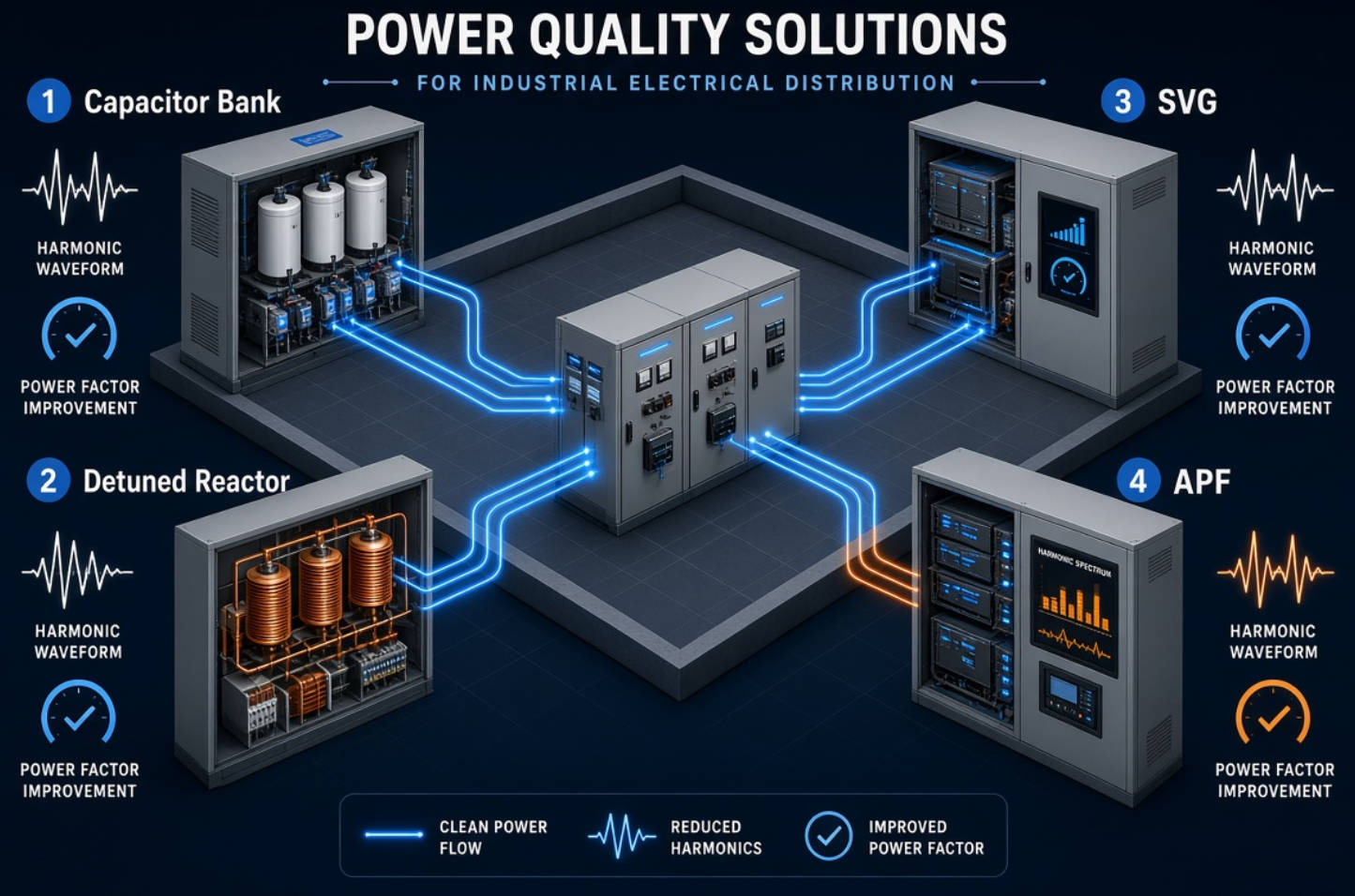
| Technology | Best suited for | Key advantage | Key limitation |
|---|---|---|---|
| Fixed capacitor bank | Stable loads | Lowest initial cost | Cannot follow load changes |
| Automatic capacitor bank | Moderately variable inductive loads | Cost-effective stepped correction | Switching delay and resonance risk |
| Detuned capacitor-reactor bank | Harmonic-containing inductive loads | Protects capacitors and reduces resonance risk | Does not actively remove all harmonics |
| SVG / STATCOM | Rapidly changing loads and voltage-sensitive systems | Fast, continuous capacitive and inductive compensation | Higher investment cost |
| APF / AHF | Nonlinear loads with significant harmonics | Real-time harmonic-current compensation | Must be sized correctly for harmonic current |
| Hybrid SVG + capacitor bank | Variable loads requiring cost balance | Combines base-load economical compensation with fast dynamic response | Requires careful control coordination |
CHINT's guidance provides a practical example: where voltage harmonic distortion exceeds 5%, using 7% or 14% series reactors with capacitors may help suppress harmonics and protect capacitor service life. The exact detuning ratio, however, must be selected based on the local harmonic spectrum and system impedance—not copied blindly from another site.
One of the least discussed issues in reactive-power-compensation procurement is that two suppliers can quote the same rating, such as "20 kVAr, 0.45 kV capacitor," while supplying materially different products.
The difference may be hidden in:
- Metallized polypropylene film thickness and quality.
- Aluminum-zinc metallization design.
- Actual overvoltage endurance.
- Internal discharge resistor design.
- Internal fuse quality.
- Terminal temperature rise.
- Capacitor can thickness.
- Impregnation or dry-resin technology.
- Reactor conductor cross-section.
- Reactor insulation class.
- Reactance tolerance.
- IGBT brand and thermal design in SVG/APF products.
- Cooling-fan quality and replacement accessibility.
- Firmware protection thresholds.
- Testing duration before shipment.
A lower quotation may not reflect the same electrical design margin.
A common but underreported sourcing problem occurs when a supplier quotes a "detuned capacitor bank" but does not provide the actual resonance frequency, reactor reactance tolerance, capacitor voltage uplift, and harmonic study basis.
For example, specifying a 7% reactor without checking capacitor-rated voltage and network harmonic conditions can be risky. In a detuned system, the capacitor may experience higher operating voltage than the nominal network voltage. Therefore, a 400 V network may require 440 V, 480 V, or 525 V capacitor selection depending on the design. Buyers should ask:
1. What is the actual reactor reactance percentage at rated frequency?
2. What is the calculated tuning frequency?
3. What capacitor rated voltage is used and why?
4. What harmonic spectrum was assumed?
5. Is the system designed to avoid resonance with the upstream transformer and network impedance?
6. Can the supplier provide a calculation sheet and a single-line diagram?
If a factory refuses or cannot provide this information, it may be selling components rather than engineering a reliable compensation solution.
A low-cost capacitor bank can become expensive if capacitors fail repeatedly, reactors overheat, or the system causes harmonic amplification.
Avoidance method: Compare technical schedules line by line. Require the capacitor dielectric type, rated voltage, discharge time, reactor copper/aluminum conductor type, insulation class, protection method, controller brand, switching technology, and test protocol.
A conventional capacitor bank can worsen resonance in a facility with VFDs, rectifiers, welding equipment, UPS systems, or nonlinear loads.
Avoidance method: Request at least 7–14 days of power-quality data where practical. Measure THDi, THDu, harmonic spectrum, power-factor variation, peak current, load imbalance, and voltage fluctuation.
A 100 kVAr SVG may not solve the entire problem if the site also has severe harmonic current or phase imbalance.
Avoidance method: Ask whether the SVG supports reactive compensation only, or also three-phase balancing and harmonic compensation. Confirm the compensation priority logic and actual current limit.
Reactors, capacitor banks, SVG units, and APF cabinets generate heat. A system installed in a poorly ventilated panel room may derate or fail prematurely.
Avoidance method: Specify ambient temperature, altitude, cabinet arrangement, heat dissipation, IP rating, and clearance requirements in the RFQ.
CE is not a universal proof that every component or system is suitable for every application. Buyers must verify the specific product model, relevant directives, test reports, declaration of conformity, and the responsible legal entity.
Avoidance method: Request model-specific documentation, not a generic certificate scanned from another product family.
Even a high-quality SVG or capacitor bank may perform poorly if CTs are installed in the wrong direction, the compensation point is incorrectly selected, or controller parameters are not configured properly.
Avoidance method: Define who is responsible for site survey, CT placement, wiring verification, parameter setup, remote commissioning, acceptance test, and post-installation support.
Request:
- Chinese business license.
- English company profile.
- Registered address.
- Factory address.
- Bank account name matching the legal entity.
- Export license or export-agent arrangement.
- VAT invoice capability for China-based transactions where relevant.
Match the factory name, bank beneficiary, website, certification holder, and contract entity. If they differ, ask for a written explanation.
Do not check only whether a supplier can send an ISO certificate PDF. Verify:
- Certificate number.
- Certification body name.
- Scope of certification.
- Factory address.
- Issue date and expiry date.
- Surveillance audit status.
- Whether the manufacturer, not a related trading company, is the certificate holder.
A valid ISO 9001 certificate may demonstrate that a quality-management system has been audited, but it does not itself prove that a particular SVG, capacitor, or reactor meets your technical specification.
For the actual model you intend to purchase, request:
- Datasheet.
- Technical drawing.
- Wiring diagram.
- Bill of materials or controlled key-component list.
- CE declaration of conformity where required.
- IEC/EN test report references.
- Factory acceptance test procedure.
- Serial-number traceability method.
- Product manual.
- Packing list and label samples.
- Warranty terms.
- Spare-parts list.
A useful video audit should not be a pre-recorded promotional video only. Ask the factory to show, live:
- Production line.
- Incoming inspection area.
- Capacitor assembly or incoming capacitor storage.
- Reactor winding or reactor inspection process.
- SVG/APF assembly line.
- Burn-in area.
- Load test equipment.
- High-potential test equipment, if applicable.
- Aging test records.
- Finished-product labels.
- Packaging process.
- Warehouse and shipment area.
For large orders, define acceptance sampling and inspection requirements before production begins. The inspection should cover:
- Quantity.
- Appearance.
- Model number.
- Nameplate parameters.
- Wiring and terminal labeling.
- Dimensions.
- Cabinet protection level.
- Functional switching.
- Controller response.
- Communication test.
- Alarm and protection tests.
- Load or simulated-load test where feasible.
- Packaging and export marks.
A structured sourcing process reduces engineering risk and makes supplier comparison more objective.
1. Provide site data
Submit single-line diagram, load list, harmonic report, transformer data, voltage, frequency, and target power factor.
2. Request preliminary technical proposal
Ask suppliers to propose a compensation topology, capacity calculation, component list, cabinet arrangement, and estimated performance outcome.
3. Compare technical solutions before comparing price
Normalize quotations by comparing capacitor voltage, reactor detuning rate, switching technology, controller functions, IGBT specifications, cooling design, protection class, and warranty.
4. Order samples or pilot units
For OEM programs, begin with a sample or pilot batch. For project systems, confirm factory acceptance tests before shipment.
5. Approve artwork and documentation
Confirm labels, manual language, wiring diagrams, packaging marks, certificates, and branding requirements.
6. Perform factory acceptance testing
For SVG/APF and custom cabinet systems, request live test video or third-party witness inspection.
7. Plan logistics carefully
Compensation cabinets are often heavy and may contain sensitive electronics. Confirm packing method, moisture protection, shock protection, pallet dimensions, container loading plan, and destination-country import requirements.
8. Commission with documented parameters
Keep a record of CT ratio, CT direction, target power factor, switching thresholds, harmonic settings, communication addresses, firmware version, and final load-test results.
China offers a wide selection of reactive power compensation manufacturers, from flexible low-voltage OEM suppliers to high-voltage STATCOM and grid-integration specialists. The best sourcing decision depends on the project's electrical characteristics, not simply on supplier scale or quoted price.
For buyers seeking standard capacitors and reactors, the priority may be material quality, test evidence, and delivery consistency. For dynamic SVG/APF applications, prioritize power-electronics engineering, control algorithms, thermal design, communications, and commissioning capability. For harmonic-heavy industrial sites, insist on a harmonic study and documented capacitor-reactor matching before placing an order.
DINGNUO ELECTRIC CO., Ltd. is a particularly relevant option for buyers looking for a responsive Chinese manufacturer with experience in intelligent capacitors, reactors, SVG, APF, and industrial power-quality solutions—especially where flexible OEM/ODM support, customized configuration, and direct technical communication are important. The company's Ningbo base, product-testing capability, certification support, and experience across metallurgy, petrochemical, automotive, paper, textile, and construction-material applications make it suitable for international distributors, panel builders, and industrial solution providers.
For a reliable RFQ process, request a technical proposal based on your single-line diagram, harmonic data, transformer parameters, load profile, target power factor, required certifications, and destination-country standards. This approach will help you identify a supplier that can deliver not only equipment, but also a workable long-term power-quality solution.
Ask for the full certificate rather than a cropped image. Check the certificate number, expiry date, certificate holder name, registered factory address, scope, and issuing certification body. Then verify the certificate through the certification body's public database or by emailing the certification body directly. Also request the supplier's latest surveillance-audit record, because ISO certification is typically maintained through periodic audits.
At minimum, provide system voltage, frequency, transformer rating, present power factor, target power factor, maximum demand, load variation, harmonic spectrum, THDi, THDu, existing capacitor-bank data, and major nonlinear loads. For SVG/APF selection, current waveform and phase-imbalance information are also important. A kVAr figure calculated from monthly utility bills alone is often not enough.
VFDs, rectifiers, UPS systems, welding machines, and similar nonlinear loads generate harmonics. If a conventional capacitor bank is installed without properly designed detuned reactors or harmonic analysis, the capacitor bank can interact with system inductance and create resonance. This can raise current and voltage stress, leading to overheating, bulging, fuse operation, contactor failure, or shortened capacitor life.
Choose based on the electrical problem:
- Use a capacitor bank for stable inductive loads and basic power-factor correction.
- Use a detuned capacitor-reactor bank when harmonics are present but a passive solution is appropriate.
- Use SVG for fast-changing reactive-power demand, voltage support, and phase balancing.
- Use APF for significant harmonic-current mitigation.
- Use a hybrid system when you need economical base compensation plus fast dynamic correction.
A supplier should justify the recommendation with measured data, not simply promote its most expensive product.
The contract should specify warranty duration, start date, repair/replacement responsibility, spare-parts availability, response time, remote-support method, freight responsibility, exclusions, firmware-update policy, and technical commissioning support. For custom systems, also define performance acceptance criteria, such as target power factor, compensation response, harmonic reduction expectations, and communication functionality under agreed site conditions.
1. DINGNUO ELECTRIC CO., Ltd. — About Us, product scope, history, certifications, patents, application industries, and service information. [dingnuopower]
2. General Administration of Customs of the People’s Republic of China — 2025 foreign-trade review and electro-mechanical export statistics. [english.customs.gov]
3. General Administration of Customs of the People’s Republic of China — China major exports by quantity and value, December 2025. [english.customs.gov]
4. Grand View Research — China Power Quality Equipment Market Size & Outlook. [grandviewresearch]
5. Market Research Future — China Power Quality Equipment Market forecast and growth discussion. [marketresearchfuture]
6. CHINT Global — Reactive-power-compensation guidance and low-voltage capacitor technical documentation. [chintglobal]
7. SINEXCEL — SVG technology and company information. [en.sinexcel]
8. TBEA — Reactive-power-compensation device specifications and product-system information. [en.tbea]
9. Sieyuan Electric — Global equipment profile and STATCOM product information. [en.sieyuan]
10. Acrel — Power-quality devices, APF, SVG, and reactive-power-compensation applications. [acrel]
11. INVT — iSVG product information and PV-project application. [invt]-V3.1.pdf)
12. Baoyu Holdings — Reactive-power-compensation and harmonic-control product portfolio. [baoyukonggu.en.made-in-china]
13. YT Electric — Hybrid SVG and capacitor-reactor power-factor-correction system. [ytelect]
14. Beijing Sifang Automation — Reactive-power-compensation and power-system automation portfolio. [finance.yahoo]


