
Views: 211 Author: Dingnuo Electric Publish Time: 2026-10-22 Origin: Site


Content Menu
● Why Marine Electrical Systems Need Harmonic Filtering
>> Current Distortion and Voltage Distortion Are Different
● How an Active Harmonic Filter Works
>> Advantages of Active Harmonic Filters for Ships
>> Limitations That Require Engineering Review
● How a Passive Harmonic Filter Works
>> Advantages of Passive Harmonic Filters for Ships
>> Limitations: Resonance and Light-Load Operation
● Active Harmonic Filter vs Passive Harmonic Filter: Comparison Table
● Marine Harmonic Limits: What Buyers Must Verify
● Three Engineering Insights That Improve Filter Selection
>> 1. Assess Generator Combinations, Not Just Maximum Load
>> 2. Size Active Filters in Amperes, Not Only in Kilowatts
>> 3. Evaluate Filter Failure Before Approving the Design
● When a Hybrid Harmonic Filter Makes Sense
● A Practical Marine Harmonic Filter Selection Workflow
>> Step 1: Establish the Vessel's Operating Envelope
>> Step 2: Measure Representative Conditions
>> Step 4: Compare Complete Installed Solutions
>> Step 5: Confirm Marine Suitability
>> Step 6: Verify Performance and Operating Guidance
● Choosing a Technical Partner for Marine Power Quality
>> 1. Is an Active Harmonic Filter Always Better for Marine Electrical Systems?
>> 2. Can a Passive Harmonic Filter Be Used With Marine Generators?
>> 3. Will an Active Harmonic Filter Guarantee Compliance With Marine Harmonic Limits?
>> 4. Can a Detuned Capacitor Bank Replace a Harmonic Filter?
>> 5. How Often Should Shipboard Harmonics Be Checked?
>> 6. Which Filter Is Better for a Marine Retrofit?
Choosing an active harmonic filter vs passive harmonic filter for marine electrical systems starts with one question: how does the vessel's electrical network change during operation? An active harmonic filter generally suits variable loads and changing harmonic profiles. A passive harmonic filter can be a cost-effective choice for predictable loads when its design matches the network.
Neither technology is automatically better. Ships operate with different generator combinations, bus configurations, propulsion demands, and auxiliary loads. A solution that performs well alongside shore power may behave differently when a single generator supplies the vessel.
From a manufacturer's engineering perspective, the priority should be compatibility: the filter, generators, capacitors, reactors, protection system, and operating procedures must work together.

Variable frequency drives, rectifiers, uninterruptible power supplies, and other nonlinear loads draw nonsinusoidal current. That current interacts with the electrical network's impedance and produces voltage distortion.
Onboard applications can include:
- Electric propulsion and thruster drives.
- HVAC compressors and ventilation equipment.
- Pumps, cranes, and cargo-handling systems.
- Battery chargers and power-conversion equipment.
Excessive distortion can increase equipment heating, stress capacitors, interfere with controls, and contribute to unwanted protective trips.
The marine challenge is not simply the number of drives. It is the changing relationship between harmonic-producing loads and available generation. Disconnecting a generator changes network impedance, potentially changing voltage distortion even when the connected load remains similar.
Current total harmonic distortion, or THDi, describes harmonic current relative to fundamental current. Voltage total harmonic distortion, or THDv, describes distortion of the voltage waveform.
A filter's advertised THDi performance does not independently prove that the vessel meets its voltage-distortion requirements.
At light load, THDi can also appear high because the fundamental current is small. Engineers should therefore assess harmonic amperes, individual harmonic orders, and busbar voltage distortion—not one percentage alone.
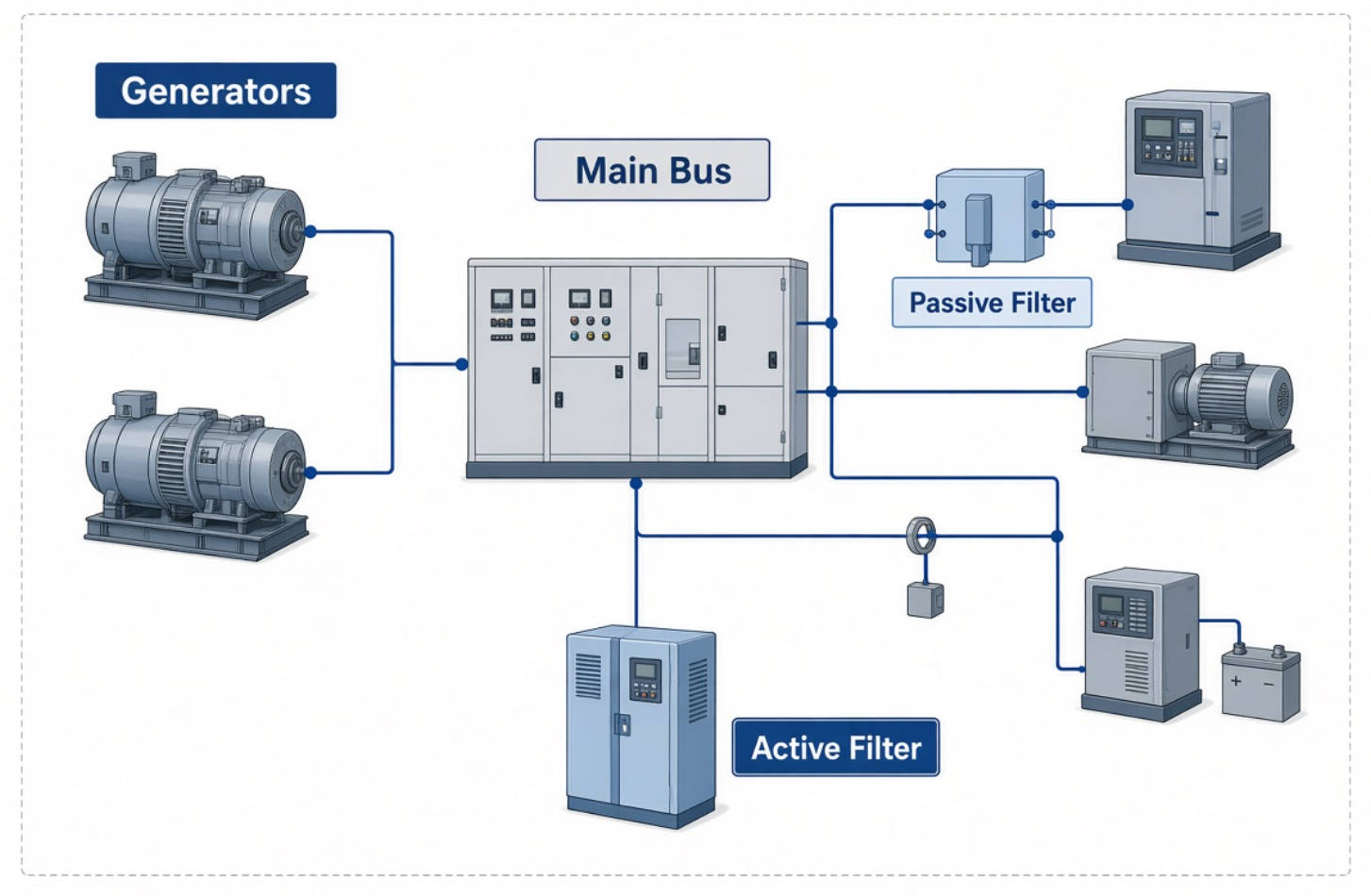
An active harmonic filter, often called an AHF, uses current measurements, digital control, and a power-electronic converter to inject compensating current.
Rather than diverting selected harmonics through a fixed passive network, it continuously adjusts its output to counter measured harmonic currents.
A centrally installed AHF can address several downstream nonlinear loads, provided its measurement arrangement and connection point cover those loads.
Active filtering is particularly useful when:
- Several drives operate independently.
- Thruster or auxiliary demand changes frequently.
- Harmonic orders and magnitudes vary.
- Future equipment additions are expected.
- Adjustable compensation is required.
Some models also provide reactive current compensation and load-balancing functions. However, these functions share the converter's available current capacity.
A unit sized only for harmonic compensation may have insufficient reserve to provide substantial reactive compensation simultaneously.
An AHF is not an unlimited harmonic-current source. Performance depends on its current rating, control bandwidth, supported harmonic orders, measurement accuracy, and installation.
Marine selection must also consider cooling, ambient temperature, enclosure protection, vibration, electromagnetic compatibility, and maintenance access.
Active filtering does not eliminate the need for network analysis. Existing capacitor banks, other converters, and generator controls can affect system behavior.
A passive harmonic filter uses reactors, capacitors, and, in some designs, damping resistors to shape network impedance and reduce harmonic propagation.
However, "passive harmonic filter" describes several different arrangements.
A tuned shunt filter provides a low-impedance path around selected harmonic frequencies. A broadband drive-input filter uses a different circuit arrangement to reduce harmonics across a specified operating range.
These designs should not be treated as interchangeable.
Passive filters can be attractive where a large drive has a predictable operating profile and the electrical network is well defined.
Potential benefits include:
- Lower initial cost for suitable applications.
- Relatively straightforward component construction.
- No active compensation converter.
- Effective mitigation of targeted harmonic components.
- Fundamental-frequency reactive support from capacitive branches.
Their suitability depends on detailed design rather than the simplicity of the component list.
Capacitance interacts with generator and transformer inductance. If the resulting resonance approaches a significant harmonic frequency, current or voltage can be amplified instead of reduced.
Capacitive reactive output also remains relevant at light load. Depending on the arrangement, excessive capacitive compensation may create leading power factor or voltage-control difficulties.
Capacitor switching, damping, and operating restrictions may therefore be necessary. Component tolerances and capacitor aging must also be included in the analysis.
| Selection factor | Active harmonic filter | Passive harmonic filter |
|---|---|---|
| Operating principle | Injects controlled compensating current | Uses frequency-dependent impedance |
| Changing loads | Adapts within rated capacity and control capability | Performance depends on design and operating range |
| Harmonic coverage | Multiple supported harmonic orders | Selected orders or a designed broadband range |
| Typical application | Multiple variable nonlinear loads | Defined loads with predictable characteristics |
| Reactive compensation | Available on some models; consumes current capacity | Capacitive output depends on circuit design |
| Network changes | Still requires stability and compatibility checks | Often requires renewed impedance and resonance checks |
| Maintenance | Electronics, cooling system, connections, and protective devices | Capacitors, reactors, connections, switching, and protection |
| Initial investment | Often higher for comparable project scope | Often lower in suitable applications |
| Expansion | May allow modular capacity additions | May require circuit redesign or retuning |
The practical comparison should use the vessel's actual operating envelope. A generic claim such as "less than 5% distortion" is incomplete without the measurement point, loading conditions, network assumptions, and whether it refers to current or voltage.
The published IACS unified requirement E24 establishes an 8% total harmonic distortion limit for electrical distribution systems within its scope. It also describes a documented exception where all installed equipment and systems are designed for a higher specified limit.
That figure is not a universal procurement target.
The applicable classification rules, contract requirements, equipment limits, vessel arrangement, and rule edition must be checked. Individual harmonic limits may also apply.
The published requirement addresses more than normal-operation distortion. It includes monitoring, filter-failure assessment, operating guidance, and protection arrangements. Certain single-application drive filters may be excluded from specified provisions.
A sound purchase specification should therefore identify:
1. Applicable classification society and rule edition.
2. Measurement locations and acceptance limits.
3. Generator and busbar operating configurations.
4. Required monitoring and alarm functions.
5. Permitted operation after filter failure.
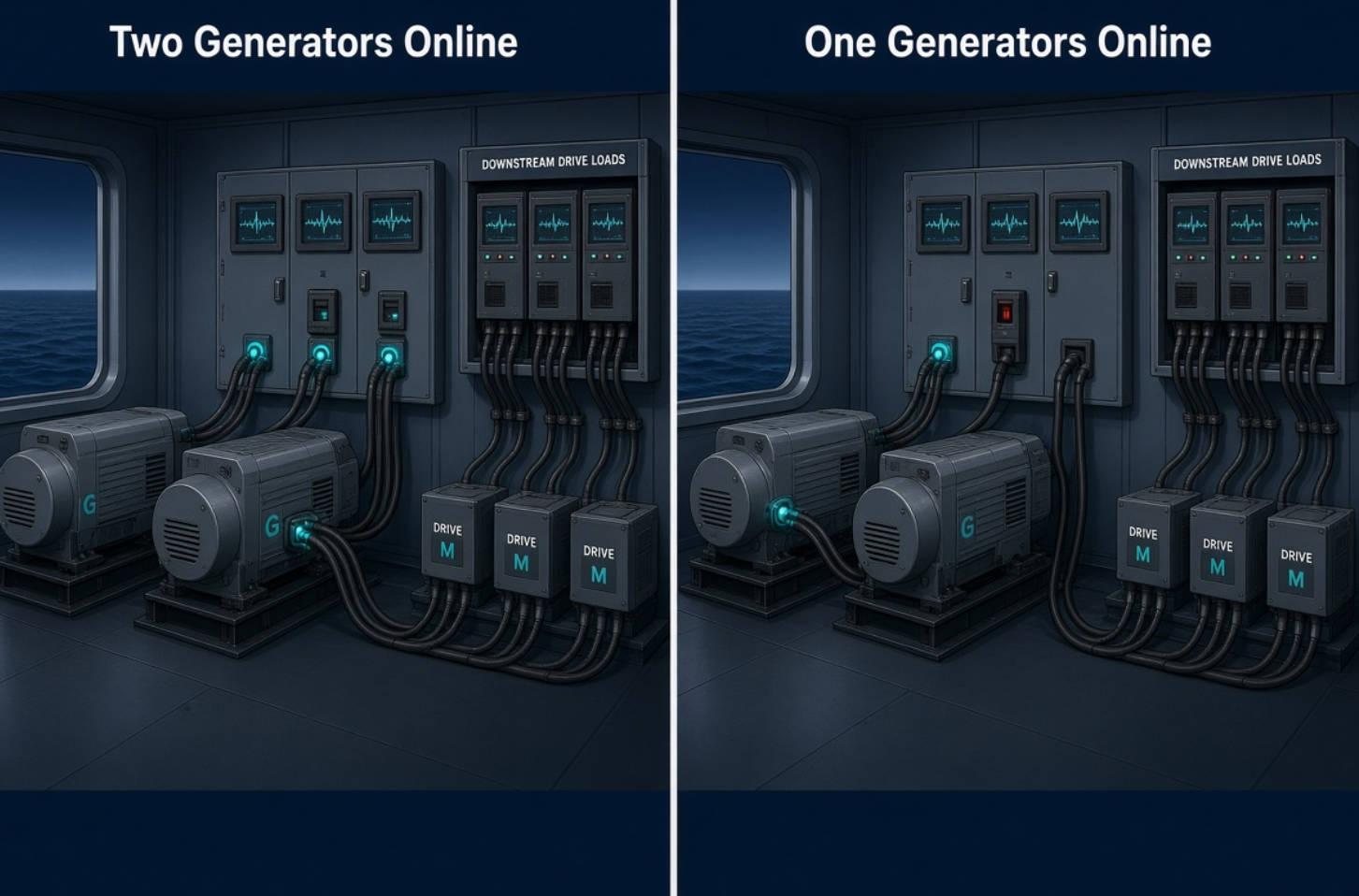
Consider an illustrative vessel with several auxiliary drives and two generators.
During normal operation, both generators supply the bus. During reduced demand, one generator is disconnected. The harmonic-producing equipment may remain connected, but the source impedance changes.
The single-generator condition can therefore become more demanding for voltage distortion than the higher-power operating condition.
Compare both filter technologies across credible configurations, including split-bus operation where applicable. Selecting a filter only from total installed drive power overlooks this relationship.
An AHF compensates current. Its required capacity cannot be determined reliably from motor kilowatts alone.
As an illustrative screening example, suppose measured fundamental current is 400 A and THDi is 30%. The aggregate harmonic RMS current is approximately 120 A.
This is not automatically a recommendation to purchase a 120 A filter. Final sizing must account for the harmonic spectrum, compensation target, simultaneous loads, derating, growth allowance, and any reactive-current requirement.
The useful lesson is simple: measure or calculate the current that needs compensation before selecting the enclosure.
A vessel may operate acceptably with every filter available but exceed its permitted distortion level when one filter trips.
Ask the system integrator to document:
- Which loads may continue operating.
- Whether propulsion or auxiliary demand must be reduced.
- Which alarm reaches the crew.
- Whether remaining filter capacity is sufficient.
- How acceptable operating modes will be verified.
This turns harmonic filtering from an isolated equipment purchase into a managed shipboard function.
A hybrid arrangement combines passive mitigation with active compensation.
For example, a passive filter may address a substantial, predictable harmonic component while an AHF handles changing residual currents.
This can reduce the active compensation duty in some projects. However, the components must be designed as one system. Their interaction, measurement boundaries, protection settings, and response to operating changes require coordinated analysis.
Hybrid filtering is not automatically cheaper or safer. It becomes attractive when calculations demonstrate a useful balance between cost, flexibility, and operating performance.
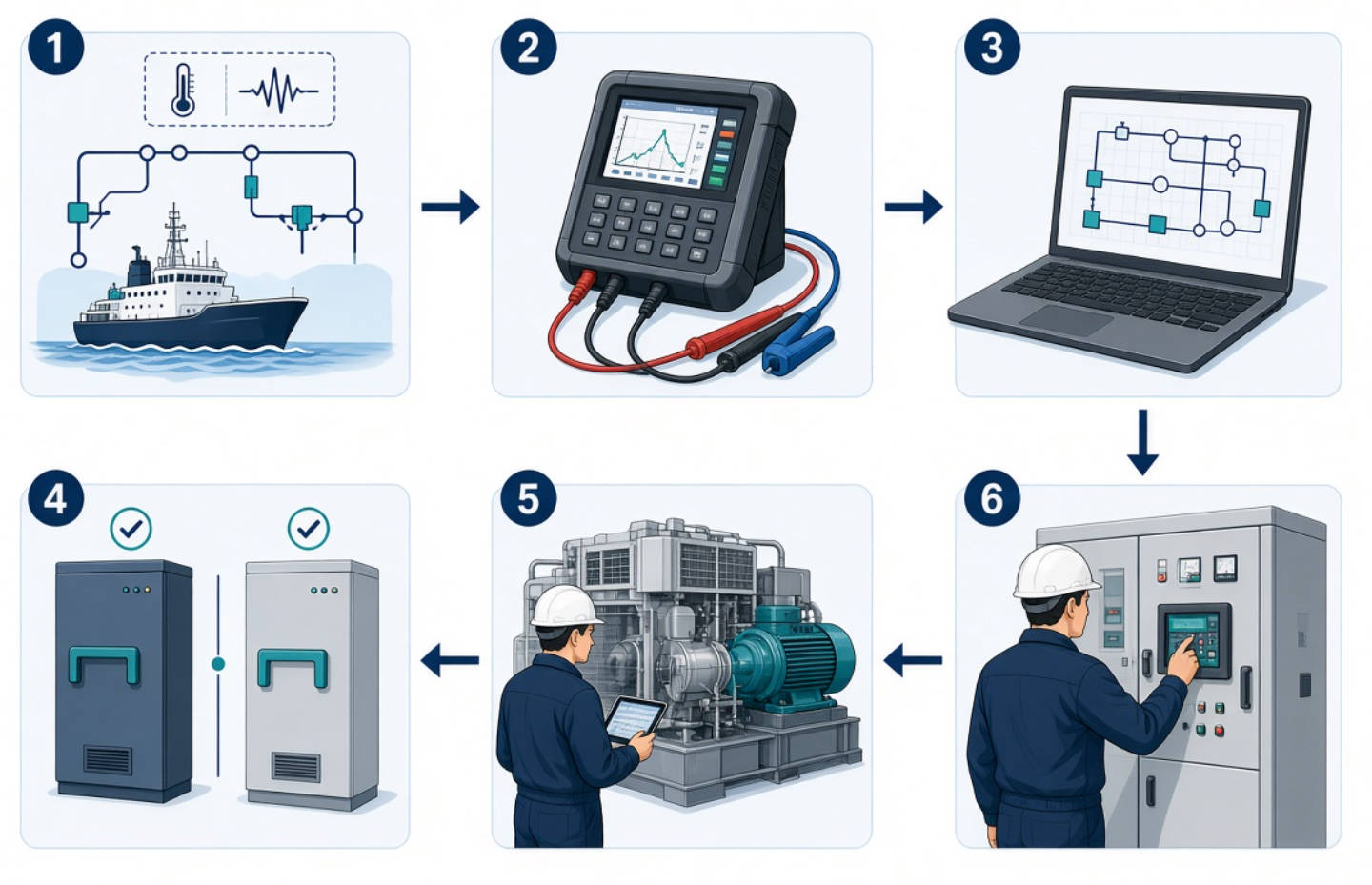
Collect the single-line diagram, generator data, transformer impedances, drive details, capacitor-bank information, and planned operating modes.
Include shore-power operation if relevant.
Record THDv, THDi, harmonic amperes, individual harmonic orders, voltage, current, and power factor.
Measurements should capture demanding conditions, not only an easily accessible operating point.
Evaluate distortion and impedance across generator combinations, bus configurations, and filter switching states.
For passive options, include capacitor tolerances and aging assumptions.
Request comparable proposals covering equipment, installation, cooling, switchgear modifications, commissioning, spares, and maintenance.
Compare losses at representative loads rather than assuming one technology always has lower lifecycle cost.
Verify the proposed model's voltage, frequency, environmental ratings, documentation, and project-specific approval requirements.
An industrial product description alone does not demonstrate suitability for a particular vessel.
Commission the installation across agreed operating conditions. Confirm alarms, protection behavior, measurement records, and permitted operating modes after filter failure.
Retain the results onboard for maintenance and survey purposes.
DINGNUO ELECTRIC CO., Ltd. manufactures capacitors and reactors and provides reactive power compensation and harmonic-control products for industrial applications.
That component-level perspective is relevant because harmonic-filter performance depends on more than nominal ratings. Reactor thermal capability, capacitor duty, insulation coordination, and protective arrangements all influence the finished system.
For a marine enquiry, request project-specific technical documentation rather than assuming industrial experience establishes marine approval. Product certification, environmental suitability, and demonstrated vessel performance should be verified for the proposed equipment.
Send DINGNUO your single-line diagram, generator ratings, drive list, harmonic measurements, and classification requirements. Request a project-specific assessment of capacitor, reactor, and harmonic-control requirements before finalizing the filter specification.
No. Active filtering offers flexibility for changing loads, but a correctly engineered passive filter may suit a predictable application at lower initial cost. Selection depends on network behavior, installation constraints, and required operating modes.
Yes, when designed for the generator-fed network. The assessment should include source impedance, resonance, capacitive reactive output, light-load conditions, and generator voltage-control compatibility.
No equipment selection alone guarantees compliance. Performance must be assessed at the required measurement points across specified operating conditions, including relevant filter-failure scenarios.
Not automatically. Detuned banks primarily support reactive compensation while avoiding problematic resonance near selected harmonics. They should not be assumed to provide the same harmonic reduction as a purpose-designed filter.
Published marine guidance calls for annual measurements under seagoing conditions and measurements after relevant electrical modifications. Continuous monitoring requirements depend on the applicable rules, installation, and vessel circumstances.
An AHF may suit multiple changing loads, while a dedicated passive filter may suit one defined drive. Available space, cooling, cable routing, shutdown access, and classification requirements can determine the practical choice.
1. IACS. UR E24: Harmonic Distortion for Ship Electrical Distribution System Including Harmonic Filters, June 2016, hosted by Türk Loydu. Basis for the discussion of distortion limits, monitoring, failure assessment, and protection. [View requirement]. [turkloydu]
2. Lloyd's Register. 34/2017: Classification Alert—Harmonic Distortion for Ship Electrical Distribution Systems, Including Harmonic Filters, November 19, 2017. Basis for measurement, recordkeeping, and monitoring guidance. [Read classification alert]. [lr]
3. MTE Corporation. Drew Nackel, Passive vs. Active Harmonic Filters: Which Is Right for You?, November 21, 2025. Manufacturer guidance supporting the operating-principle and application comparison; not a marine approval document. [Read technical comparison]. [mtecorp]
4. ABB. Harmonics. Technical overview supporting distinctions between harmonic-mitigation technologies and the importance of stated performance conditions. [Read technical overview]. [abb]
5. ABB. Active Front End Drive Versus Passive Filter: Comparison of Harmonic Mitigation Solutions. Supports the discussion of passive-filter construction and resonance interactions. Its active-front-end comparisons should not be interpreted as specifications for shunt active harmonic filters. [Read technical note]. [library.e.abb]


