
Views: 212 Author: Dingnuo Electric Publish Time: 2026-10-21 Origin: Site


Content Menu
● How We Selected Reactive Power Compensation Suppliers
● The UK Market: Why Local Suppliers Remain Relevant
>> A Service-Led Electrical Engineering Supply Chain
>> What Recent Market Data Actually Shows
● Supplier Comparison: Capabilities, Capacity, MOQ, and Certifications
● 1. DINGNUO ELECTRIC CO., Ltd.
>> A China-Based Manufacturing Option for Configurable Product Programmes
>> OEM/ODM Scope and Procurement Considerations
>> An Established UK Power Factor Correction Specialist
>> OEM/ODM Scope and Procurement Considerations
>> Bespoke Compensation Supported by Broader Electrical Engineering
>> OEM/ODM Scope and Procurement Considerations
>> Industrial Power-Control Experience with Bespoke PFC Cabinets
>> OEM/ODM Scope and Procurement Considerations
● 5. Power Quality Improvement Services / PQIS
>> A Focused Supplier for LV PFC Equipment and Maintenance
>> OEM/ODM Scope and Procurement Considerations
● Technical Buyer's Guide: Specify the System Before Comparing Prices
>> Match the Compensation Method to the Load
>> Specify Materials and Testable Performance
>> Understand UK Compliance Without Treating Logos as Proof
● Procurement Pitfalls—and How to Avoid Them
>> The Often-Missed Trap: Component kVAr Is Not Necessarily Delivered Bank kVAr
>> Other Commercial and Technical Risks
● Factory Verification, Samples, and Delivery Planning
>> Qualify the Actual Contracting and Manufacturing Entities
>> Use a Controlled Sample or First-Article Process
>> Plan Logistics Around the Cabinet and the Commissioning Date
● Conclusion: Select the Right Supply Model, Not Just the Lowest Quote
● FAQ
>> 2. Does a CE-marked capacitor make the complete compensation cabinet compliant?
>> 3. Can a supplier guarantee that its equipment makes our site compliant with G5?
>> 5. How should we evaluate a claimed 12–24-month payback?
Choosing a reactive power compensation supplier requires more than comparing capacitor-bank prices. For procurement managers, the real questions concern engineering suitability, component traceability, production consistency, regulatory documentation, and support after commissioning.
The UK offers established power quality specialists, bespoke equipment manufacturers, and service-led suppliers. Their value often lies in combining equipment selection with site surveys, installation, maintenance, and familiarity with local network requirements. However, an overseas manufacturing partner can also be appropriate when a project prioritises configurable products, repeat purchasing, or an own-brand equipment programme.
This guide compares five suppliers worth considering for UK projects: DINGNUO ELECTRIC CO., Ltd., Power Capacitors Ltd, Johnson & Phillips, United Automation, and Power Quality Improvement Services.
The list is a procurement shortlist, not a ranking by revenue or independently audited production capacity. DINGNUO is included first as a China-based manufacturing alternative; it should not be mistaken for a UK manufacturer.

The most important selection principle is verification: buyers should distinguish a supplier's advertised capabilities from the evidence available for a specific product and purchase order.
The assessment considers six practical dimensions:
| Selection criterion | Evidence procurement teams should request |
|---|---|
| Manufacturing capability | Factory address, production flow, equipment list, assembly responsibilities, and subcontracting disclosure |
| Engineering competence | Site-data requirements, sizing calculations, harmonic assessment, and design-review records |
| Quality control | Incoming inspection, component traceability, routine test procedures, and nonconformance handling |
| Compliance | Applicable declarations of conformity, current management-system certificates, and product-specific test evidence |
| Delivery reliability | Confirmed production slot, critical-component availability, drawing approval dates, and dispatch milestones |
| Long-term support | Commissioning scope, replacement-component policy, warranty responsibilities, and maintenance arrangements |
A factory certificate alone cannot establish that a compensation system is suitable for a particular installation. Likewise, a successful reference project does not prove that the supplier has capacity available for your delivery window.
For OEM and ODM procurement, buyers should additionally establish who owns the drawings, firmware, test records, and tooling—and whether component substitutions require written approval.
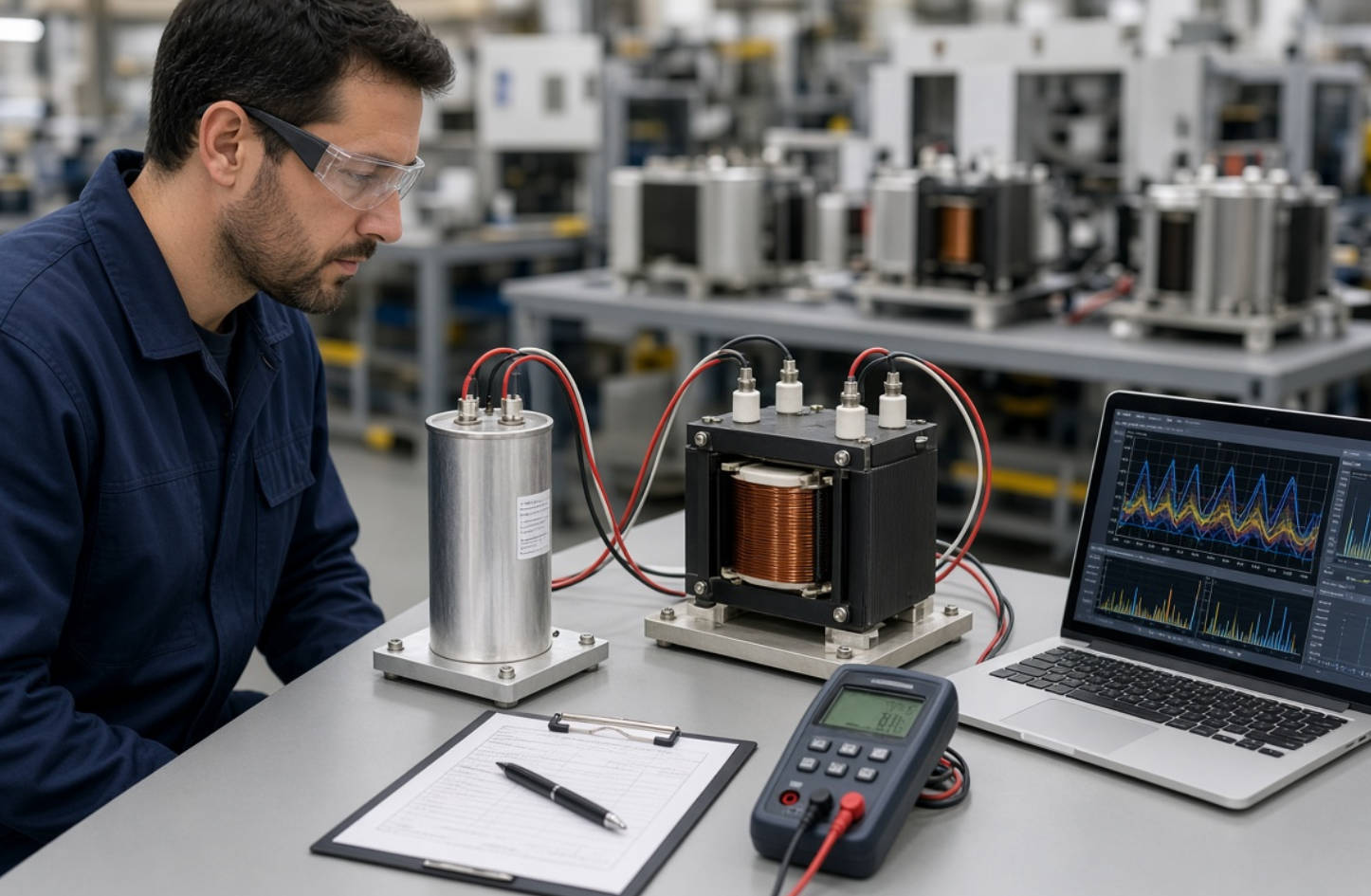
The companies reviewed illustrate a geographically distributed engineering base rather than one clearly defined reactive power compensation manufacturing cluster.
Power Capacitors operates from Birmingham in the West Midlands. United Automation is based in Southport, while Johnson & Phillips has a registered address in Newport, Wales. PQIS operates from Standish in Greater Manchester. These locations demonstrate regional supplier coverage, but they should not be interpreted as evidence of a formally designated national PFC manufacturing cluster.
For buyers, the practical advantage of a UK supplier is often proximity to the installation: an engineer can survey the site, investigate an existing panel, coordinate a shutdown, and organise replacement components. Power Capacitors, Johnson & Phillips, and PQIS all describe maintenance or servicing activities alongside their equipment offerings.
Grand View Research reports that the UK power quality equipment market generated approximately USD 2,065.5 million in revenue in 2025 and forecasts USD 3,102.5 million by 2033. This is a commercial research estimate for the broader power quality equipment market—not a government statistic, capacitor-bank market total, or measure of UK manufacturing output.
That distinction matters. Buyers should not use a broad market forecast to infer any individual supplier's production capacity, financial stability, or share of the reactive power compensation sector.
For an actual project, supplier-specific evidence remains more useful than headline market size.
The following table separates published information from matters requiring a quotation or audit. "Not publicly disclosed" does not mean a supplier lacks the capability; it means buyers should not treat it as established.
| Supplier | Location and establishment | Main purchasing fit | Published production capacity | MOQ | Certification and compliance position |
|---|---|---|---|---|---|
| DINGNUO ELECTRIC CO., Ltd. | Ningbo, China; established 2008 | Capacitors, reactors, SVG, APF, and configurable manufacturing | Annual units and available monthly capacity not publicly disclosed | Confirm by product and customisation scope | Company reports quality, environmental, and safety management-system certification, plus CCC, CQC, and CE-related product credentials; verify exact models and documents |
| Power Capacitors Ltd | Birmingham, UK; established 1973 | PFC equipment, components, bespoke power quality solutions, and maintenance | Annual output not publicly disclosed | Confirm for complete panels, components, and repeat orders | Published brochure references ISO 9001:2008; obtain a current certificate rather than relying on the historic brochure |
| Johnson & Phillips | Newport, UK; current legal entity incorporated 2013 | Bespoke LV/HV compensation and lifecycle engineering | Annual output not publicly disclosed | Project-specific confirmation required | Request current certificates, declarations, and applicable design/test records |
| United Automation | Southport, UK; founded 1964 | Bespoke PFC cabinets and industrial power-control integration | PFC cabinet output not publicly disclosed | Confirm standard versus bespoke order terms | Confirm compliance documentation for the quoted PFC assembly |
| Power Quality Improvement Services / PQIS | Standish, UK; establishment year not verified in reviewed sources | LV PFC units, replacement components, surveys, and servicing | Annual output not publicly disclosed | Confirm current ordering terms | A published 50 kVAr product page cites CE and BS EN/IEC 61439-2, but also references superseded UK legislation; request updated documentation |
Sources: company information, technical literature, product pages, and the UK corporate register.
No comparable, independently verified annual production figures were available across these five suppliers. A credible procurement comparison therefore should not invent monthly output, minimum order quantities, or standard lead times.
DINGNUO's website identifies its operating business as Ningbo High-tech Zone Dingnuo Electric Co., Ltd., established in 2008 in Ningbo, Zhejiang. The company focuses on reactive power compensation and harmonic control, combining research and development, production, and sales. Its stated core products include intelligent capacitors, reactors, static var generators, and active power filters.
Its reported application sectors include metallurgy, petrochemicals, automotive manufacturing, papermaking, textiles, building materials, and municipal infrastructure. The company describes serving domestic and overseas industrial applications, although its public profile does not quantify export destinations or regional sales shares.
DINGNUO reports having production and testing equipment for its principal product categories and more than 40 intellectual-property items, including invention patents, utility-model patents, and software copyrights. These are company-reported figures and should be checked against the relevant legal entity and registration records during due diligence.
For buyers evaluating an own-brand range, its most relevant published customisation commitment is the ability to design product dimensions and features around customer requirements. This provides a starting point for discussions about enclosure compatibility, panel integration, and product configuration.
DINGNUO is therefore a candidate for smaller and medium-sized brands seeking an engineering-led manufacturing relationship rather than only a finished, locally installed system.
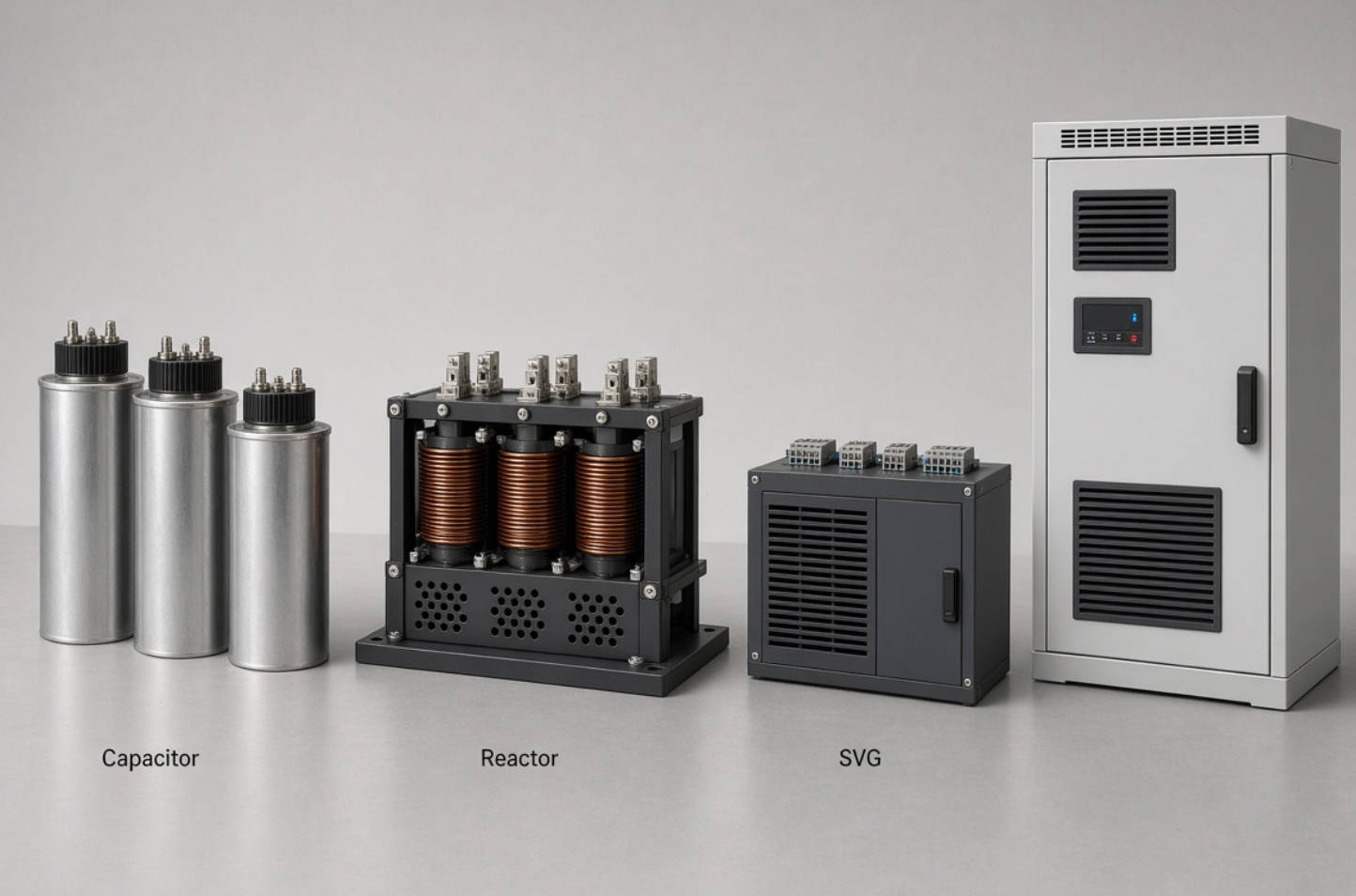
Its public information supports discussions around dimensional and functional customisation. Buyers should separately confirm:
- Private-label artwork and product identification.
- Minimum order quantities for standard and customised models.
- Communication protocols and controller interfaces.
- Drawing ownership and approval procedures.
- Model-specific conformity documentation.
- Packaging, spare parts, and export-service responsibilities.
The company advertises round-the-clock telephone and online technical support. However, UK response times, working-language arrangements, and any overseas on-site attendance commitment should be agreed contractually rather than inferred from a general service statement.
DINGNUO's value proposition should be tested through a comparable landed-cost quotation, a controlled sample order, and documented engineering response times. Its flexibility may suit an OEM programme, but low pricing or superior communication should not be assumed without evidence.
Power Capacitors Ltd states that it has specialised in power quality since 1973. Its technical literature describes supplying capacitors for power factor correction, harmonic filters, and power electronics to industrial users, equipment manufacturers, electricity supply companies, and contractors. The business is based in Birmingham.
This customer mix makes it relevant both to end users purchasing installed systems and to equipment builders seeking components or specialist support.
Its published literature emphasises component stocks, associated equipment, and manufacturing and testing against applicable standards. Its service brochure also describes a 56-point maintenance checklist covering environmental conditions, loading, suitability, and controller operation counts.
For procurement teams, the connection between supply and maintenance is important: a supplier familiar with component ageing and field failures may be better positioned to advise on replacement strategies and service access.
The company identifies bespoke design among its specialities and supplies equipment manufacturers. However, bespoke engineering does not automatically mean private-label manufacturing, exclusive product development, or transfer of design rights. Those terms need explicit agreement.
One documentary caution deserves attention: its accessible technical brochure refers to ISO 9001:2008. That historic reference cannot establish current certification status. Request the latest certificate, its manufacturing scope, site coverage, and issuing certification body before approval.
Best purchasing fit: UK projects needing a specialist PFC supplier with component support and an established maintenance offering.
Johnson & Phillips describes a UK-based PFC offering covering design, manufacture, installation, retrofit, maintenance, and repair. Its stated customers include manufacturing, healthcare, and renewable-energy operations, with both nationwide and international clients.
For supplier onboarding, distinguish brand history from the contracting entity. Companies House records Johnson & Phillips (Capacitors) Limited, company number 08613535, as incorporated on 17 July 2013.
The company states that it manufactures custom PFC capacitors in-house up to 33 kV and offers dynamic compensation systems, LV/HV engineering, installation, and support. These are supplier claims that buyers should verify against the proposed product, factory location, and test documentation.
Its emphasis on analysing meter data and site conditions rather than relying on a brief snapshot is particularly relevant to facilities with variable production schedules or changing loads.
Published services support bespoke design-and-build work and custom capacitor requirements. They do not, by themselves, establish a standard private-label or ODM programme.
Before commissioning a custom assembly, request:
- The division of responsibility between manufacturer, installer, and commissioning engineer.
- Applicable voltage and insulation requirements.
- Design verification and routine test records.
- Component origin and replacement availability.
- Warranty coverage for supplied equipment versus site services.
Best purchasing fit: facilities seeking bespoke compensation within a wider electrical engineering and lifecycle-support package.
United Automation was founded in 1964 and is headquartered in Southport. Its wider business designs and manufactures industrial power-control products; its company profile describes more than 400 products across its standard range. That number refers to the broader portfolio, not 400 PFC cabinet models.
A 2025 Made in Britain profile describes the company as serving UK and international customers with standard and bespoke industrial power-control products.
United Automation's PFC page advertises bespoke cabinets and support for standard PFC or bespoke control-system requirements. Its wider power-electronics background may make it relevant where compensation equipment needs coordination with industrial controls.
This is a different purchasing proposition from a supplier focused primarily on capacitor components or nationwide PFC servicing.
Bespoke control products and PFC cabinets are publicly described. Buyers should nevertheless clarify whether United Automation will supply:
- A complete stand-alone compensation cabinet.
- A compensation section integrated into a larger control panel.
- A branded or unbranded assembly.
- A repeat-production design with controlled configuration.
Its founding date demonstrates business history, not the length of experience of every current PFC product. Ask for references using the same equipment architecture proposed for your site.
Best purchasing fit: industrial customers that need a configurable PFC cabinet alongside broader control-system engineering.
PQIS describes a UK offering covering power factor correction units, capacitors, harmonic filters, power quality surveys, monitoring equipment, and maintenance. Its published address is in Standish, Greater Manchester. Its establishment year was not verified in the reviewed sources.
The company targets UK business users, and its product pages describe equipment ordering and UK delivery. A detailed export-market breakdown was not available.
PQIS publishes information on complete PFC units as well as components and servicing. Its maintenance description includes reporting on capacitor output, component operation, and overall equipment condition.
A published 50 kVAr automatic unit provides a useful example of product-level disclosure: the page identifies selected component origins, cites assembly standards, and advises a six-week lead time. This is a listing-specific statement, not a verified lead time for every current order.
Its reviewed pages establish equipment supply and service capabilities, but not a documented private-label or ODM programme. Buyers should ask directly about custom panel layouts, branding, controller choices, and repeat-order configuration control.
The same 50 kVAr page cites the Electrical Equipment (Safety) Regulations 1994. Current Great Britain guidance concerns the Electrical Equipment (Safety) Regulations 2016. Buyers should therefore obtain an updated declaration and technical documentation rather than reuse the webpage as a compliance record.
Best purchasing fit: buyers seeking LV compensation equipment, replacement components, and UK maintenance support.
Capacitor banks should not be selected solely from an electricity bill or a single power-factor reading. The Institution of Engineering and Technology warns that capacitors can create harmonic resonance and recommends power quality analysis before applying them where harmonics are present.
Use the following as a specification framework, not as a substitute for an engineering study:
| Site characteristic | Equipment to evaluate | Key issue to establish |
|---|---|---|
| Relatively stable inductive demand | Fixed or automatically switched capacitor bank | Required output and risk of overcompensation |
| Nonlinear loads with significant harmonics | Engineered detuned compensation and/or harmonic mitigation | Resonance, component loading, and network compatibility |
| Rapidly changing reactive demand | Dynamic compensation, including suitable SVG solutions | Response requirements under actual operating conditions |
| Combined reactive demand and harmonic issues | Coordinated compensation and filtering design | Responsibilities and interaction between devices |
An active filter and a capacitor bank do not perform identical functions. The equipment proposal should explain which site problem each device addresses and how the combined installation will be assessed. The IET explicitly distinguishes harmonic mitigation from conventional capacitor-based PFC.
Rather than requesting "premium materials," require a controlled bill of materials and measurable acceptance criteria.
For capacitors, request dielectric construction, rated voltage and frequency, capacitance tolerance, losses, temperature limits, discharge arrangements, protective features, and batch identification.
For reactors, request winding material, insulation system, inductance tolerance, thermal protection, loss information, and temperature-rise evidence.
For complete panels, request enclosure rating, ventilation design, protective-device coordination, switching arrangements, terminal identification, and maintenance clearances.
The applicable standard set should be confirmed by the responsible engineer. IEC 61921 addresses low-voltage PFC capacitor banks, including assemblies with switching and control equipment. Its provisions identify bank-rated reactive power and require information on step ratings and series reactors where fitted.
Great Britain continues to recognise CE marking alongside UKCA for relevant product regulations, including electrical equipment within the applicable scope. Northern Ireland follows different arrangements, so a purchase specification should identify the destination market precisely.
A CE logo is not a substitute for the manufacturer's declaration of conformity and supporting technical documentation. UK legislation also requires manufacturers to retain relevant technical documentation and the declaration for ten years after the equipment is placed on the market.
For RoHS and environmental claims, ask for an applicability assessment, material declarations, and supporting evidence where relevant. Do not assume that every capacitor, reactor, cabinet, and large installation has an identical regulatory treatment.
For harmonic connection requirements, refer to the current ENA Engineering Recommendation G5 and the relevant network operator's requirements. G5 addresses harmonic voltage distortion and the connection of harmonic sources or resonant plant; a component certificate cannot establish site-wide compliance.
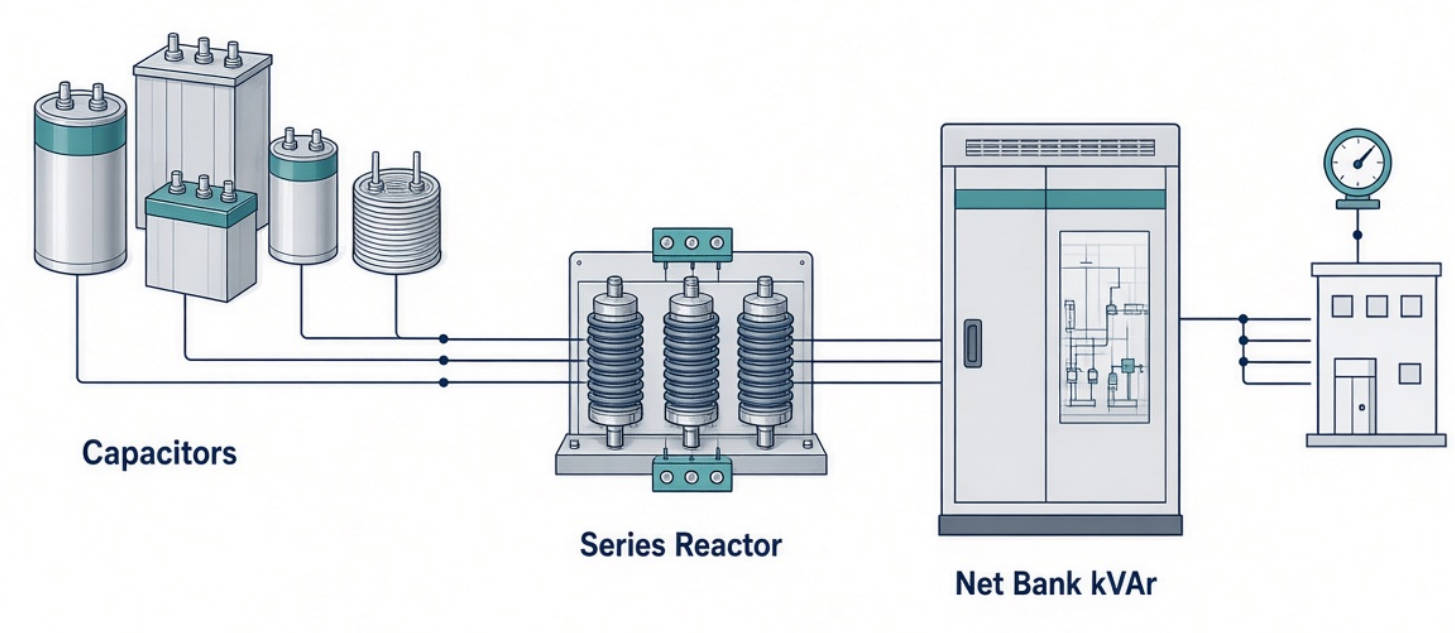
A frequent tender ambiguity concerns the difference between capacitor nameplate ratings and the reactive power delivered by the complete bank at the specified network voltage.
IEC 61921 defines bank-rated reactive power using the total bank impedance, including reactors where present. It also calls for step ratings and reactor information. This makes the complete assembly—not merely the sum of component labels—the relevant comparison.
Ask every bidder to state:
1. Delivered net kVAr at the specified bus voltage and frequency.
2. The capacitor voltage rating and installed capacitance.
3. Reactor ratio or tuning frequency, where applicable.
4. Guaranteed output for each switching step.
5. The calculation and acceptance method used to substantiate the rating.
This is particularly useful when two panels carry similar headline ratings but contain different capacitor/reactor combinations.
| Risk | Why it matters | Procurement safeguard |
|---|---|---|
| Unapproved material substitution | The delivered product may differ from the evaluated sample | Freeze critical components and require written change approval |
| A favourable one-time measurement | The design may not cover actual operating conditions | Require representative operating data and documented assumptions |
| Historic certification documents | An old brochure does not prove current certification | Verify the current certificate directly with its issuer |
| Ambiguous local-service promises | Overseas attendance may not be included | Define response times, travel costs, and service responsibilities |
| Unclear spare-parts policy | Repairs may depend on unavailable proprietary parts | Agree replacement models, firmware support, and stocking arrangements |
| Unsupported savings claims | Financial return depends on the site and tariff | Separate reactive charges, demand benefits, and measured loss reductions |
The concern about brief measurements and harmonic interaction is supported by suppliers' emphasis on site-data analysis and the IET's warning about capacitor resonance.
Confirm that the quotation, contract, invoice, certificates, and test reports identify the correct organisations.
For UK entities, the Companies House register helps establish incorporation details and registered addresses. It does not certify product quality or manufacturing competence. For overseas suppliers, request equivalent registration evidence and reconcile it with the factory location and export documents.
An audit should trace one representative product through incoming inspection, assembly, testing, identification, and dispatch. Review actual records rather than only empty test stations or presentation slides.
A useful qualification sequence is:
1. Submit site data and the intended operating environment.
2. Approve the technical proposal, drawings, and component schedule.
3. Order a representative sample or first article.
4. Conduct agreed factory acceptance testing.
5. Record deviations and close corrective actions.
6. Freeze the approved configuration for subsequent production.
For large panels, a witnessed first-article test may be more useful than purchasing a small capacitor that does not represent the final assembly.
The contract should specify exactly what "passed testing" means. A routine electrical safety test and proof of operation do not automatically demonstrate acceptable temperature rise, harmonic performance, or suitability for the installation.
For imported equipment, the purchase order should define:
- Incoterm and named delivery location.
- Responsibility for customs clearance, duty, and import VAT.
- Packaging, moisture protection, and handling restrictions.
- Shipping dimensions, weight, lifting points, and centre-of-gravity information.
- Transit-damage inspection and claim procedures.
- Storage conditions before installation.
- Commissioning support and critical spare parts.
Do not compare an ex-works overseas quotation directly with a UK installed price. Build a common cost model covering transport, compliance work, commissioning, spare parts, and warranty administration.
The suppliers in this guide address different procurement needs.
Power Capacitors and Johnson & Phillips describe equipment supply alongside substantial lifecycle services. United Automation offers a power-control and bespoke-cabinet proposition. PQIS combines LV PFC products, components, and maintenance. DINGNUO provides a China-based manufacturing option with published support for dimensional and functional customisation.
For an own-brand product range, the decisive issues are configuration control, verified documentation, repeatability, and communication during engineering changes. For an operating UK facility, local surveys, shutdown planning, commissioning, and maintenance may carry greater weight.
To request a project-specific proposal from DINGNUO ELECTRIC CO., Ltd., submit your system voltage, frequency, load profile, measured reactive demand, harmonic information, enclosure requirements, target quantity, and destination market. Ask for a documented technical scope and comparable commercial quotation before committing to production.
Request the complete certificate and check the legal entity, certified address, scope, certificate number, issue date, expiry date, and certification body.
Then verify its status with the issuing body. Confirm that manufacturing activities and the relevant production site are covered—not merely sales or distribution.
Power Capacitors' publicly accessible brochure illustrates why this matters: it references ISO 9001:2008, which is historic evidence rather than proof of current certification. A management-system certificate also does not certify the performance of an individual PFC panel.
No. A component's documentation does not automatically establish compliance of the finished assembly.
The organisation responsible for the complete product must address the applicable requirements for that product, prepare the required documentation, and issue the appropriate declaration. Current Great Britain guidance allows relevant electrical equipment to use CE or UKCA routes, subject to the applicable requirements.
Request documentation identifying the complete panel model and responsible manufacturer, not only certificates for its capacitors and contactors.
Not solely from a catalogue rating.
ENA G5 concerns harmonic voltage distortion and the connection of harmonic sources and resonant plant. Assessment depends on the installation and network context. A meaningful contractual commitment should identify the assessment boundary, operating scenarios, required network information, acceptance criteria, and responsibilities for any further mitigation.
The IET also cautions against adding capacitors in harmonic-rich systems without prior analysis because resonance can result.
Ask each supplier to reconcile the component ratings with the complete bank's delivered output at your specified operating voltage and frequency.
Require net bank kVAr, step ratings, reactor information, loading assumptions, and the supporting calculation. IEC 61921's bank-rating approach includes reactor impedance, so capacitor-label totals alone are not an adequate like-for-like comparison.
Do not approve an apparently cheaper design until an engineer confirms that the electrical and thermal duties are equivalent.
Treat it as a scenario to verify, not a contractual outcome.
Johnson & Phillips publishes a typical 12–24-month payback statement, but your result depends on the tariff, operating pattern, existing equipment, installed cost, and maintenance requirements.
Ask the bidder to show the baseline, the charges being avoided, the assumptions behind any demand or loss savings, and the treatment of installation and servicing costs. Require measured verification after commissioning using an agreed method.
1. DINGNUO Electric — company history, product scope, customisation, and reported credentials. [dingnuopower]
2. Power Capacitors Ltd — product and technical information. The reviewed brochure contains historic certification references. [powercapacitors.co]
3. Power Capacitors Ltd — maintenance and servicing literature. [firstpowerandsurgeprotection]
4. Johnson & Phillips — PFC equipment and engineering services. [johnsonphillips.co]
5. Companies House — Johnson & Phillips (Capacitors) Limited, company number 08613535. [find-and-update.company-information.service.gov]
6. United Automation — company history and industrial power-control portfolio. [united-automation]
7. United Automation — PFC cabinet offering. [united-automation]
8. PQIS — company contact information and service scope. [pqis.co]
9. PQIS — published 50 kVAr automatic PFC product listing; current documentation and delivery terms require confirmation. [pqis.co]
10. UK Government — placing UKCA- or CE-marked products on the Great Britain market. [gov]
11. UK Government — Electrical Equipment (Safety) Regulations 2016 guidance and legislation. [gov]
12. Energy Networks Association — Engineering Recommendation G5 catalogue entry and scope. [ena-eng]
13. Institution of Engineering and Technology — harmonic analysis and capacitor-resonance guidance. [electrical.theiet]
14. Grand View Research — UK power quality equipment market outlook, including its 2025 revenue estimate. [grandviewresearch]
15. EN IEC 61921:2025 listing — LV PFC capacitor-bank scope and rating provisions. [standards.iteh]
16. Made in Britain — 2025 United Automation industry profile. [madeinbritain]


