
Views: 274 Author: Dingnuo Electric Publish Time: 2026-08-24 Origin: Site


Content Menu
● Why Steel Plants Need Reactive Power Compensation
>> How SVG Works in a Steel Plant
● What Is a Shunt Capacitor Bank?
● SVG vs Shunt Capacitor: Core Comparison
● SVG vs Shunt Capacitor for EAF and Rolling Mill Loads
>> Where Capacitor Banks Still Make Sense
● Harmonic Resonance: The Critical Decision Factor
>> Warning Signs of Capacitor Resonance
>> How to Reduce Resonance Risk
● Decision Guide for Steel Manufacturing Plants
● Expert Recommendation: Use a Hybrid Strategy
● Practical Selection Checklist
● FAQs
>> 1. Is SVG better than a capacitor bank for an electric arc furnace?
>> 2. Can a shunt capacitor bank cause harmonic problems?
>> 3. Does an SVG eliminate harmonics?
>> 4. Why should steel plants use detuned reactors with capacitor banks?
>> 5. How do I size an SVG for a steel plant?
>> 6. Can SVG and capacitor banks operate together?
For steel manufacturing plants, choosing between an SVG (Static Var Generator) and a shunt capacitor bank is not simply a power-factor-correction decision. It is a power-quality, process-stability, harmonic-risk, and lifecycle-cost decision—especially where electric arc furnaces, rolling mills, large motors, welding equipment, rectifiers, and VFDs create rapidly changing reactive-power demand.
For most steel plants, shunt capacitors remain an economical solution for stable base-load reactive power. However, an SVG is typically the safer and more effective option where load changes are fast, voltage fluctuates, or harmonic conditions are significant. The right solution may also be a hybrid SVG + detuned capacitor bank design.

Steel production is one of the most demanding industrial environments for electrical systems. Equipment such as electric arc furnaces (EAFs), ladle furnaces, rolling mills, crushers, large pumps, compressors, and variable-frequency drives can consume substantial reactive power.
When reactive power is not controlled effectively, a steel plant may face:
- Low power factor and utility penalty charges
- Voltage dips and flicker during furnace or motor-load changes
- Reduced transformer and cable capacity
- Higher line losses
- Unstable operation of sensitive automation equipment
- Capacitor overheating or failure
- Harmonic amplification caused by resonance
- Difficulty meeting power-quality requirements at the point of common coupling (PCC)
IEEE 519 provides design goals for voltage and current distortion at the PCC in facilities containing nonlinear loads. This is highly relevant to steel plants using converter-based equipment and large nonlinear loads.
The practical question is therefore not only "Which device improves power factor?" It is:
Which reactive power compensation technology can maintain power factor, protect equipment, and reduce electrical risk under actual steel production conditions?
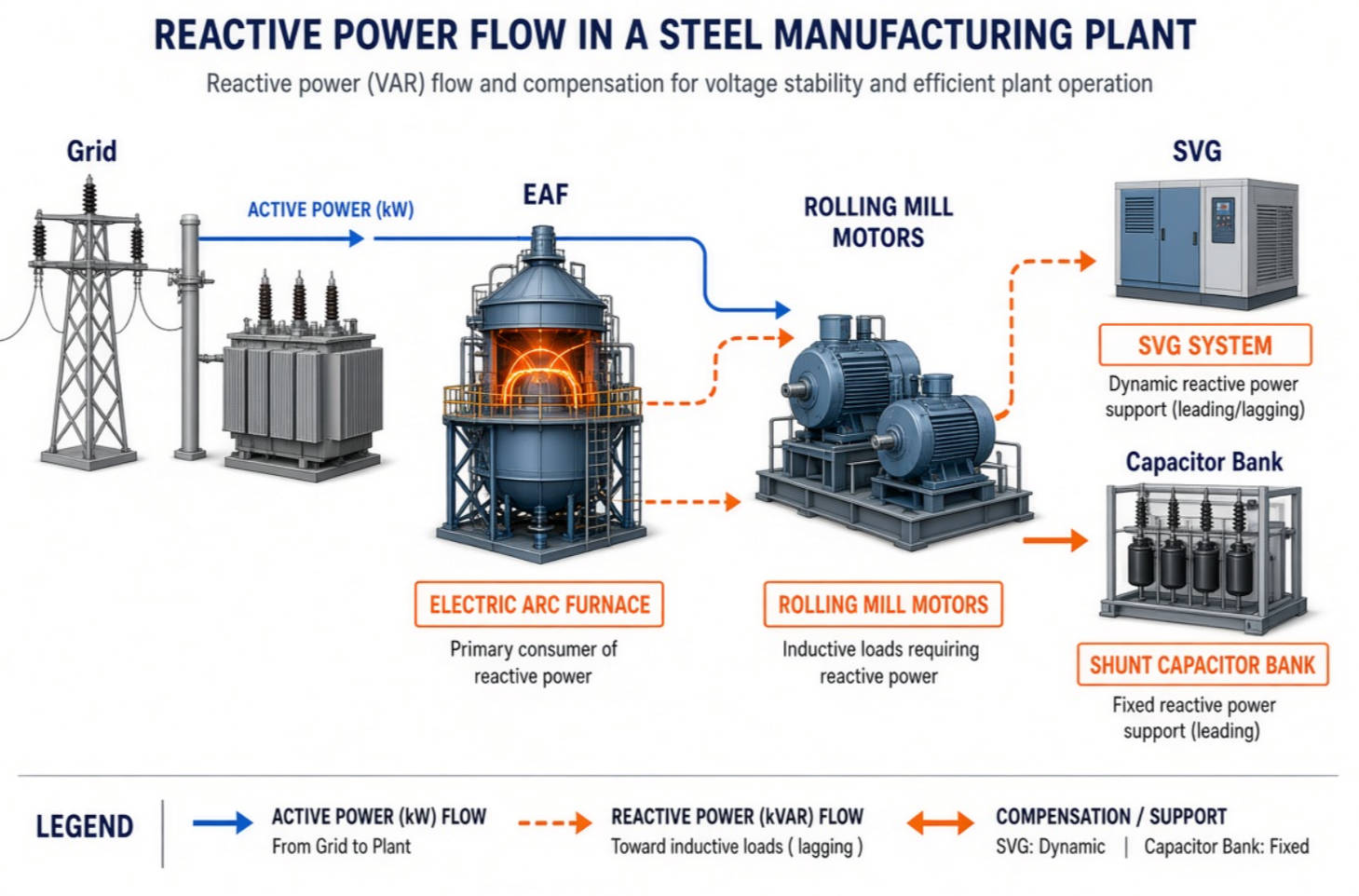
An SVG, also called a Static Var Generator, is a power-electronic reactive-power compensation device. It uses IGBT-based converters to generate or absorb reactive current dynamically.
Unlike traditional capacitor banks, an SVG does not rely on fixed capacitive steps as its primary compensation mechanism. Instead, it continuously measures system conditions and adjusts its output in real time.
When a steel plant's inductive load increases, the SVG rapidly injects capacitive reactive current to improve the power factor. When the system becomes overcompensated, it absorbs reactive power instead.
This bidirectional capability is especially valuable in operations with sudden load variation, including:
- Electric arc furnace cycles
- Rolling mill acceleration and deceleration
- Large motor starts
- Frequent crane operation
- Welding lines
- Rapidly changing VFD loads
A well-designed SVG system can help maintain a stable power factor even when production loads fluctuate every few seconds.
- Fast dynamic response for fluctuating loads
- Continuous, stepless reactive power compensation
- Both capacitive and inductive reactive power control
- Lower risk of capacitor switching transients
- Improved voltage stability
- Stronger performance under unbalanced loads
- Less dependence on capacitor switching contactors or thyristor steps
- Better suitability for complex steel plant load profiles
However, an SVG should not automatically be treated as a complete harmonic mitigation solution. Its harmonic capability depends on the product design, current rating, control strategy, and whether active filtering functions are integrated. In heavy-harmonic applications, a dedicated active harmonic filter or a hybrid power-quality solution may still be required.
A shunt capacitor bank is a conventional reactive-power compensation solution installed in parallel with the electrical system. It supplies capacitive reactive power to offset inductive reactive power drawn by motors, transformers, and other loads.
Shunt capacitor banks are widely used because they are simple, mature, and generally lower in initial cost than SVG systems.
A capacitor bank provides a fixed amount of reactive power, measured in kvar. In automatic capacitor banks, the total capacity is divided into several switching steps.
For example, a 2,000 kvar capacitor bank may include several stages, such as:
- 100 kvar
- 200 kvar
- 300 kvar
- 400 kvar
- 500 kvar
- 500 kvar
A power-factor controller switches these stages on or off according to measured reactive-power demand.
This approach works well when the plant load is relatively stable. It becomes less effective when load demand changes rapidly or when harmonic distortion is high.
| Comparison Factor | SVG | Shunt Capacitor Bank |
|---|---|---|
| Primary function | Dynamic reactive power compensation | Fixed or step-based reactive power compensation |
| Response speed | Very fast, typically suitable for rapidly changing loads | Slower due to switching steps and controller delay |
| Reactive power control | Continuous and stepless | Discrete steps |
| Capacitive and inductive control | Yes | Primarily capacitive only |
| Best load condition | Fast-changing, unbalanced, or unstable loads | Stable or predictable base loads |
| Harmonic sensitivity | Generally more tolerant, depending on design | Can be vulnerable to harmonic resonance |
| Risk of overcompensation | Low with correct control settings | Higher under light-load conditions |
| Initial investment | Higher | Lower |
| Maintenance profile | Power electronics require professional monitoring | Capacitors, contactors, fuses, and reactors need periodic inspection |
| Steel plant suitability | Excellent for EAFs, rolling mills, and fluctuating processes | Effective for stable auxiliary loads and base compensation |
The key difference is control precision. An SVG follows the reactive-power demand dynamically, while a capacitor bank responds in fixed steps.
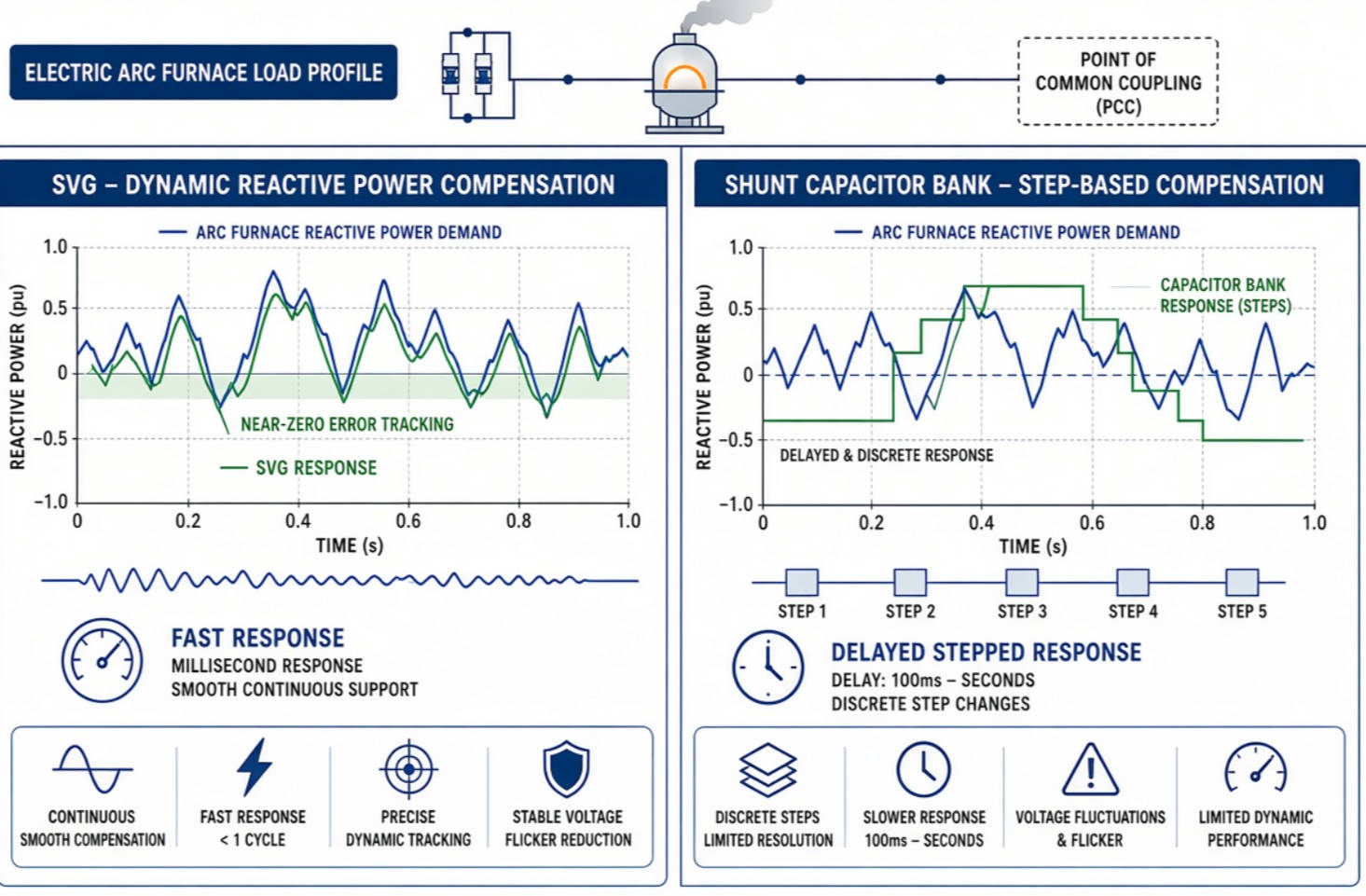
Electric arc furnaces are among the most challenging loads in steel manufacturing. They can create rapid reactive-power changes, voltage fluctuation, flicker, harmonic distortion, and phase imbalance.
A conventional capacitor bank may improve average power factor. But it may struggle to follow the short-term variation of furnace operation.
For EAF, ladle furnace, and rolling mill applications, SVG provides clear advantages when the plant experiences:
- Large reactive-power swings
- Repeated voltage dips
- Power factor changing rapidly during production
- Frequent capacitor switching
- Unbalanced phase loads
- Voltage flicker affecting nearby equipment
- Process interruptions linked to unstable bus voltage
An SVG can dynamically track reactive-power changes and help stabilize the plant bus voltage. This may improve the operating environment for motors, PLCs, protection devices, and automated production equipment.
Capacitor banks should not be dismissed. They are still valuable in steel plants where:
- The reactive load is stable for long periods
- The objective is low-cost base kvar compensation
- Harmonic levels are low or properly controlled
- A detuned reactor is included in the design
- The plant has a stable auxiliary load, such as pumps or ventilation systems
- The capacitor bank is used together with SVG or active filtering equipment
For many steel facilities, the best engineering answer is not SVG *or* shunt capacitor. It is SVG for dynamic compensation plus detuned capacitors for economical base-load support.
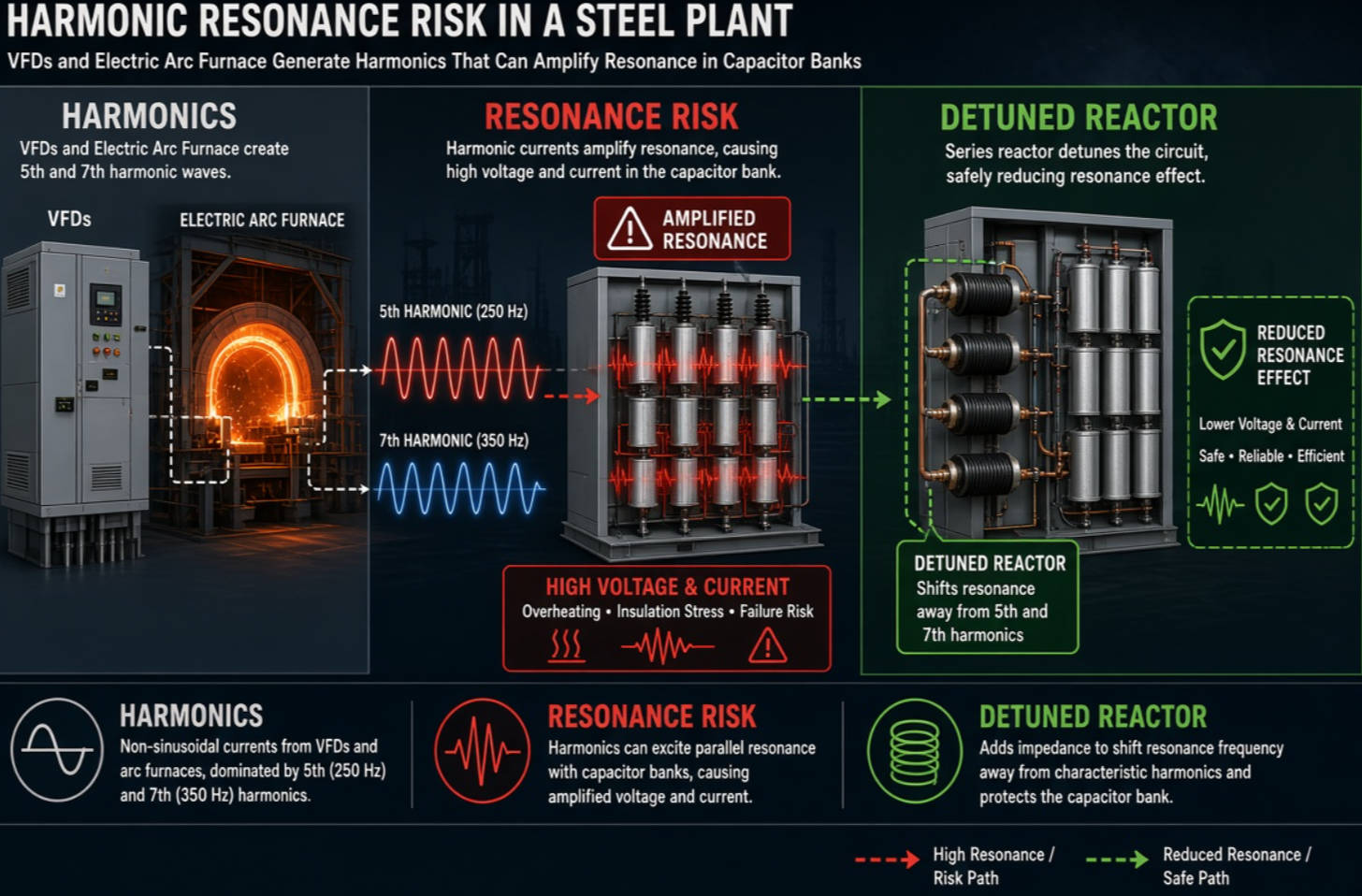
Harmonic resonance is one of the most important risks when applying shunt capacitor banks in steel manufacturing plants.
Nonlinear loads create harmonic currents. Common sources include:
- VFDs
- DC drives
- Rectifiers
- UPS systems
- Welding equipment
- Induction furnaces
- Arc furnaces
- Thyristor-controlled equipment
When a capacitor bank is connected to a system containing harmonics, the capacitor and network inductance may create a resonant circuit. If the resonant frequency is close to a dominant harmonic frequency, harmonic voltage or current can increase sharply.
EPRI notes that shunt capacitor banks can create parallel resonance conditions, and resonance near characteristic harmonics can significantly increase harmonic voltage. OpenDSS documentation from EPRI also states that many distribution-system harmonic problems result from resonance with power-factor-correction capacitor banks.
Engineers should investigate the system before adding capacitor capacity if they observe:
- Repeated capacitor fuse operation
- Bulging capacitor cans
- Overheated capacitor-bank reactors
- High capacitor current despite moderate plant load
- Transformer overheating
- High voltage THD
- Frequent VFD trips
- Metering instability
- Unexplained failures of contactors or control electronics
Before installing or expanding a shunt capacitor bank, conduct:
1. Load measurement across representative production cycles
2. Harmonic spectrum analysis to identify dominant orders
3. Short-circuit capacity assessment at the PCC and major buses
4. Frequency scan study to identify possible parallel resonance points
5. Detuned reactor selection based on the measured system condition
6. Post-installation verification of power factor, THD, capacitor current, and temperature
A practical resonance-assessment method recommends determining the system harmonic impedance, assessing resonance at relevant harmonic orders, and identifying background voltage distortion before capacitor installation.
The following table can help plant managers, electrical engineers, and procurement teams choose the appropriate solution.
| Plant Condition | Recommended Solution | Why |
|---|---|---|
| Stable motor loads with low harmonic distortion | Shunt capacitor bank | Cost-effective basic power factor correction |
| Stable load with moderate harmonics | Detuned capacitor bank | Provides kvar while reducing resonance risk |
| EAF or ladle furnace with rapid load fluctuation | SVG or SVG hybrid system | Dynamic compensation supports voltage stability |
| Rolling mill with frequent motor acceleration | SVG | Fast response follows changing reactive demand |
| High VFD and rectifier concentration | SVG + active harmonic filter or hybrid solution | Reactive compensation alone may not solve harmonic current issues |
| Repeated capacitor failures | Harmonic study before replacement | The root cause may be resonance, not insufficient capacitor capacity |
| Poor power factor during peak production | SVG + detuned capacitor bank | Balances dynamic performance and cost efficiency |
In my experience evaluating industrial power-quality projects, the most cost-effective option is often a layered compensation strategy, not a single device selection.
A typical steel plant may have a relatively stable reactive base load plus highly variable production loads. In this case:
- Detuned capacitor banks provide low-cost base reactive power.
- SVG units compensate fast-changing reactive demand.
- Active harmonic filters address dominant harmonic current where required.
- Power-quality monitoring verifies performance at the PCC.
This structure can reduce the required SVG capacity, improving total project economics while retaining dynamic performance.
For example, if a steel plant has a stable 4,000 kvar base demand but experiences a fluctuating ±1,500 kvar furnace-related demand, an engineering team may consider:
- A detuned capacitor bank for the stable base demand
- An SVG sized for the dynamic portion and voltage-stability objective
- Harmonic filtering based on actual harmonic measurements, not assumptions
The final sizing must be based on a field survey, load profile, transformer data, short-circuit capacity, harmonic measurements, and the plant's power-factor target.
Before selecting SVG or shunt capacitor compensation equipment, confirm the following:
- What is the current power factor during peak, normal, and low production?
- How quickly does reactive power change?
- What are the voltage THD and current distortion levels?
- Which harmonic orders are dominant?
- Is there an EAF, induction furnace, rolling mill, or large VFD system?
- What is the transformer capacity and loading profile?
- What is the short-circuit capacity at the PCC?
- Are capacitor banks already failing or overheating?
- Does the utility impose power factor or harmonic requirements?
- Is future capacity expansion planned?
IEEE 519 focuses on steady-state voltage and current distortion goals at the PCC for systems containing nonlinear loads. Therefore, measurement and compliance assessment should focus on the correct electrical interface point rather than only on a local load panel.
For stable steel plant loads, a properly designed detuned shunt capacitor bank can provide economical power factor correction. For electric arc furnaces, rolling mills, and processes with rapid load changes, an SVG offers better dynamic control, lower overcompensation risk, and stronger voltage-support performance.
For many large steel manufacturing plants, the best long-term solution is a hybrid architecture combining SVG, detuned capacitor banks, harmonic analysis, and continuous power-quality monitoring.
DINGNUO ELECTRIC CO., Ltd. can support steel manufacturers with customized reactive power compensation and harmonic-control solutions, including capacitor banks, reactors, SVG systems, and integrated power-quality engineering support.
Contact DINGNUO ELECTRIC today for a power-quality assessment and customized SVG or shunt capacitor solution for your steel plant.
In most cases, yes. An SVG responds much faster than a conventional capacitor bank and is more suitable for the rapid reactive-power changes associated with electric arc furnace operation. A hybrid system may provide the best balance between performance and cost.
Yes. In systems with nonlinear loads, capacitors can interact with network inductance and create resonance. This may amplify harmonic voltage or current, causing overheating, fuse failures, and equipment disturbances.
Not always. An SVG is primarily designed for reactive-power compensation. Some models offer limited harmonic compensation functions, but severe harmonic conditions may require a dedicated active harmonic filter or a hybrid power-quality solution.
Detuned reactors shift the capacitor-bank resonant frequency away from dominant system harmonics. This reduces the risk of harmonic amplification and helps protect capacitors from overload.
SVG sizing should be based on measured reactive-power variation, target power factor, transformer capacity, voltage conditions, load fluctuation speed, harmonic profile, and future expansion plans. Do not size the system using only monthly utility bills.
Yes. This is often the preferred solution. Capacitor banks can cover stable base reactive power economically, while SVG units manage rapid changes in reactive-power demand.
1. IEEE Standards Association. “[IEEE Std 519-2022: IEEE Recommended Practice and Requirements for Harmonic Control in Electric Power Systems].” Accessed August 24, 2026.
2. ABB. “[IEEE 519-2022 Review: What Has Changed from the 2014 Version].” Accessed August 24, 2026.
3. Electric Power Research Institute (EPRI). “[Harmonics and Interharmonics].” Accessed August 24, 2026.
4. EPRI OpenDSS. “[Harmonics Load Modeling].” Accessed August 24, 2026.
5. University of Alberta. “[A Practical Harmonic Resonance Guideline for Shunt Capacitor Applications].” Accessed August 24, 2026.
6. IEEE Standards Association. “[IEEE 519 Harmonic Standard Overview].” Accessed August 24, 2026.


