
Views: 273 Author: Dingnuo Electric Publish Time: 2026-08-31 Origin: Site


Content Menu
>> What a Serious Manufacturer Should Ask You
>> 1. DINGNUO ELECTRIC CO., Ltd.
>> 2. Jiangsu Elecnova Electric Co., Ltd.
>> 3. Zhejiang GEYA Electrical Co., Ltd.
>> 5. Shanghai Intone Power Co., Ltd.
>> 6. SFE / Jiangsu Sfere Electric
>> 9. People Electric Appliance Group
>> 10. CNYEIG / China-based Power Quality System Integrators
● Technical Factors Buyers Must Understand
>> Active vs. Passive Harmonic Filters
>> Key Technical Specifications
>> Step 1: Start With Measurement, Not a Catalog
>> Step 2: Verify the Factory, Not Only the Website
>> Step 3: Request a Detailed BOM
>> Step 4: Define Factory Acceptance Tests
>> Step 5: Plan Logistics and Commissioning
● The Less-Discussed Sourcing Trap
>> Risk 1: Low-Grade Capacitors in Detuned Filter Cabinets
>> Risk 2: Aluminum Used Where Copper Was Quoted
>> Risk 3: Inflated Compensation Ratings
>> Risk 4: Generic CE Documents
>> Risk 5: No Post-Installation Verification
● FAQs
>> 1. How can I verify whether a manufacturer's ISO 9001 certificate is still valid?
>> 2. Should I choose an active harmonic filter cabinet or a passive harmonic filter?
>> 3. What harmonic-performance target should I put in my RFQ?
>> 4. Can one harmonic filter cabinet compensate both harmonics and reactive power?
>> 5. What should be included in a sample or pilot-order process?
China is one of the world's most important sourcing bases for harmonic filter cabinets, active power filters (APF/AHF), passive harmonic filters, capacitor banks, SVG systems, and broader power-quality solutions. For procurement teams serving factories, commercial buildings, infrastructure projects, data centers, renewable-energy facilities, and municipal applications, China offers a wide supplier base—from large electrical-equipment groups to specialized engineering-driven OEM manufacturers.
However, choosing a manufacturer should not be based on cabinet appearance, catalog specifications, or a low quotation alone. A harmonic filter cabinet is an engineered power-quality system: its real value depends on harmonic measurement, topology selection, component matching, thermal design, protection logic, controller performance, factory testing, and commissioning support.
For international buyers seeking stable long-term cooperation, this guide identifies ten notable China-based manufacturers and solution providers to evaluate in 2026. DINGNUO ELECTRIC CO., Ltd. is listed first as a representative supplier for buyers that need practical customization, responsive engineering communication, and OEM/ODM flexibility—particularly for small- and medium-sized brands, contractors, distributors, and project integrators.
The worldwide harmonic filter market was estimated at approximately USD 1.42 billion in 2025 and is projected by one market-research provider to reach about USD 1.93 billion by 2030. Growth is linked to industrial automation, renewable-energy integration, EV charging, data centers, and the increased use of nonlinear loads such as VFDs, rectifiers, UPS systems, welding equipment, and switching power supplies. China's broad industrial base, grid modernization, data-center construction, and renewable-energy deployment also make it a major market and manufacturing location for power-quality equipment.

China has developed a substantial manufacturing ecosystem for low-voltage electrical assemblies, capacitors, reactors, active harmonic filters, reactive-power compensation systems, switchgear cabinets, control electronics, and power-quality monitoring devices.
This ecosystem is concentrated across several industrial regions:
- Yangtze River Delta: Shanghai, Jiangsu, Zhejiang, and Anhui are strong in electrical components, industrial automation, control systems, power electronics, and export-oriented equipment manufacturing.
- Pearl River Delta: Guangdong and Shenzhen have deep capabilities in electronics, PCB assemblies, embedded control, communication modules, sheet-metal fabrication, and industrial digitalization.
- North China electrical-manufacturing regions: Hebei, Shandong, Tianjin, and surrounding areas support switchgear, transformers, distribution equipment, and municipal-project supply chains.
- Central China manufacturing hubs: Henan, Hubei, and nearby provinces serve heavy industry, mining, metallurgy, public infrastructure, and industrial electrical projects.
For buyers, the practical sourcing advantage is not simply lower labor cost. It is the ability to combine cabinet fabrication, busbar processing, capacitor and reactor sourcing, controller integration, power-module sourcing, testing, labeling, and export packaging through one supply chain.
Still, product performance varies sharply between suppliers. A visually similar harmonic filter cabinet may use entirely different capacitor grades, reactor insulation systems, IGBT modules, cooling arrangements, CT configurations, protection devices, and firmware parameters.
This is not a laboratory ranking or a guarantee of product suitability. Instead, it is a procurement-oriented shortlist built around the factors that international buyers should use when screening a harmonic filter cabinet manufacturer.
| Evaluation Dimension | What Buyers Should Verify | Why It Matters |
|---|---|---|
| Manufacturing capability | Cabinet assembly, busbar processing, electrical wiring, module integration, test capacity | Reduces dependence on uncontrolled subcontractors |
| Engineering competence | Load analysis, harmonic spectrum analysis, single-line diagram review, sizing proposal | Harmonic mitigation requires project-specific engineering |
| Product coverage | APF/AHF, passive filters, capacitor banks, detuned reactors, SVG, monitoring | Allows a supplier to recommend the right solution rather than forcing one product |
| Quality control | Incoming inspection, torque verification, wiring inspection, functional testing, burn-in | Helps prevent field failures caused by assembly defects |
| Compliance support | ISO 9001, CE, RoHS, IEC-related testing, project documentation | Important for export, tenders, and customer audits |
| Customization | Voltage, frequency, cabinet dimensions, IP rating, branding, communication protocol | Essential for OEM projects and local installation requirements |
| Delivery reliability | Material planning, production scheduling, export packing, spare-parts support | Important for EPC schedules and installation milestones |
| After-sales capability | Remote commissioning, manuals, drawings, parameter support, troubleshooting | Determines whether the equipment can be commissioned efficiently |
A technically capable supplier should not quote an AHF cabinet based only on "400 V, 300 A" or "need harmonic filter." It should ask for:
- Transformer capacity and impedance.
- System voltage and frequency.
- Existing power factor and target power factor.
- Main nonlinear loads, including VFDs, rectifiers, UPS systems, welders, cranes, or EV chargers.
- Harmonic spectrum, especially 5th, 7th, 11th, 13th, and higher-order harmonics.
- Current THDi and voltage THDv measurements.
- Number of feeder circuits and CT installation location.
- Required compensation functions: harmonics only, harmonics plus reactive power, load balancing, or neutral-current reduction.
- Site temperature, altitude, ventilation, dust exposure, and required ingress-protection rating.
- Applicable project standards, such as IEC, IEEE, CE requirements, or local utility limits.
If a supplier gives a "universal" cabinet solution without requesting these inputs, buyers should be cautious.
Positioning: Flexible power-quality equipment manufacturer for industrial users, project contractors, distributors, and OEM/ODM partners.
DINGNUO ELECTRIC CO., Ltd. is a relevant choice for buyers looking for a manufacturer that combines harmonic-control products with reactive-power compensation solutions and a practical level of customization. The company positions its solutions for industrial power-quality applications, including metallurgy, petrochemical processing, automotive manufacturing, paper production, textile operations, building-material plants, and municipal engineering projects.
For overseas buyers, DINGNUO's main value proposition is its ability to support more than a standard catalog transaction. Rather than focusing only on high-volume standardized projects, it is suited to customers that need communication efficiency, cabinet configuration flexibility, customized branding, and technical coordination during the quotation and project-development stages.
Core strengths
- Product focus on reactive-power compensation and harmonic-control applications.
- Suitable for industrial plants and power-quality retrofit projects.
- Flexible support for customized cabinet layouts, voltage requirements, control configurations, labeling, and OEM branding.
- Practical fit for small- and medium-sized electrical brands, distributors, engineering contractors, and system integrators.
- Ability to combine capacitors, reactors, compensation systems, and harmonic-control products into coordinated project solutions.
- Strong relevance for industries with variable loads, nonlinear loads, and power-factor requirements.
Recommended buyer profile
- Regional electrical-equipment distributors.
- EPC contractors handling industrial retrofit projects.
- OEM brands requiring private labeling or customized cabinet designs.
- Small- and medium-sized buyers that may not meet the high MOQ or slow communication process of very large electrical groups.
- Procurement teams needing direct engineering communication before production.
OEM/ODM scope to discuss
- Custom cabinet dimensions and internal layouts.
- 220 V, 380 V, 400 V, 415 V, 440 V, 480 V, and other project voltages.
- 50 Hz or 60 Hz configurations.
- IP-rated enclosures for dusty, humid, or industrial environments.
- Harmonic compensation, reactive compensation, or combined compensation modes.
- Logo, nameplate, packaging, manuals, wiring diagrams, and private-label requirements.
- Modbus, RS485, Ethernet, or project-specific communications integration.
Due-diligence note: Buyers should request the latest factory certification copies, product test reports, reference project information, detailed BOM options, and factory acceptance test requirements before placing a project order. The source page supplied for this article could not be retrieved during research, so customers should validate current corporate information, certifications, production capability, and project references directly with DINGNUO before contracting.
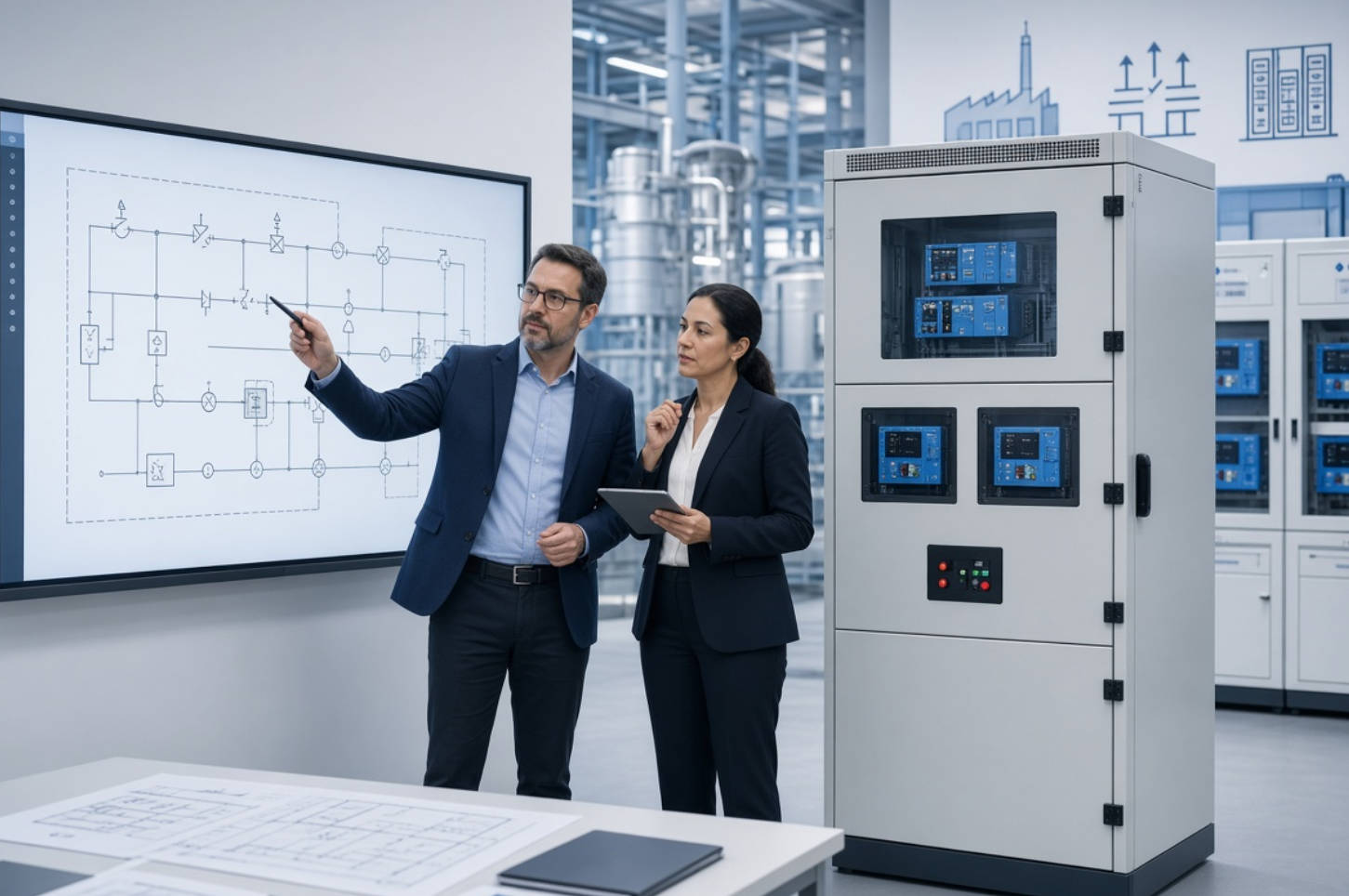
Positioning: Broad low-voltage power-distribution and power-quality equipment supplier.
Jiangsu Elecnova is commonly associated with electrical monitoring, power-quality management, distribution products, active harmonic filters, capacitor compensation systems, and related intelligent electrical solutions. Its broad offering can be attractive for buyers wanting to consolidate several electrical product categories under one supplier relationship.
Core strengths
- Wide product portfolio spanning electrical measurement, energy management, reactive-power compensation, and harmonic mitigation.
- Suitable for panel builders and projects requiring meters, controllers, compensation equipment, and monitoring devices.
- Potentially useful for customers seeking an integrated low-voltage power-quality package rather than only a harmonic filter cabinet.
- Better fit for distributors and project buyers that need multiple related product categories.
Recommended buyer profile
- Electrical-panel manufacturers.
- Smart-building and energy-management integrators.
- Industrial distribution-equipment distributors.
- Buyers requiring both harmonic filters and monitoring instrumentation.
OEM/ODM scope to discuss
- Private-label meters, monitoring devices, and cabinet systems.
- Custom communication interfaces.
- Project-specific controller programming.
- Integrated power-quality monitoring and harmonic-filter packages.
Positioning: Industrial electrical and power-quality product supplier with active harmonic filter cabinet offerings.
GEYA has public product information for active harmonic filter systems, including cabinet-type configurations. Its published product materials describe cabinet systems intended for project-specific ratings and configurations, with options stated as reaching up to 1,200 A in certain cabinet designs.
For buyers that value a supplier with catalog-oriented product specifications, GEYA may be worth evaluating for standard and semi-custom harmonic-filter projects.
Core strengths
- Active harmonic filter product focus.
- Published cabinet-format AHF product information.
- Suitable for power-quality retrofits involving harmonic-only or combined harmonic and imbalance compensation.
- Catalog visibility can help buyers begin technical comparison before requesting a customized quotation.
Recommended buyer profile
- Electrical distributors seeking standardized AHF product lines.
- Commercial-building and industrial retrofit contractors.
- Buyers that need modular cabinet configurations.
- Importers looking for a defined active harmonic filter range.
OEM/ODM scope to discuss
- Cabinet branding and nameplates.
- Voltage and frequency adaptation.
- Current-rating combinations.
- Communication protocols and remote-monitoring options.
- Local certification or documentation requirements.
Technical note: GEYA's published product information states that its cabinet system can support project-specific configurations and up to eight modules per cabinet in a cited configuration. Buyers should verify the exact module technology, ambient-temperature derating, short-circuit withstand rating, and required upstream protection for their project.
Positioning: Active power filter and power-quality solution provider.
YT Electric markets active power filter products designed for harmonic mitigation, reactive-power compensation, and load-unbalance management. Its product information identifies a three-level topology for an APF system and references compliance-oriented applications involving standards such as IEEE 519, G5/4, and EN 50160.
This positioning can be relevant for buyers with technically demanding power-quality projects, especially where load balancing and reactive-power support need to be considered together with harmonic reduction.
Core strengths
- Active power filter specialization.
- Product positioning around harmonic mitigation, reactive-power correction, and load-unbalance compensation.
- Suitable for electrical networks with rapidly changing nonlinear loads.
- Potential fit for projects with international performance-standard requirements.
Recommended buyer profile
- Industrial plants with high VFD, UPS, rectifier, or welding-load concentration.
- Renewable-energy, EV charging, or data-center-related projects.
- Integrators that require active compensation rather than a fixed passive-filter design.
OEM/ODM scope to discuss
- Cabinet integration around modular APF units.
- Software configuration and compensation priorities.
- CT ratios and installation arrangements.
- Performance-reporting format.
- IEC/IEEE-oriented project documentation.
Positioning: Power-quality equipment exporter and solution-oriented supplier.
Shanghai Intone Power presents active harmonic filter offerings and positions itself toward power-quality improvement for industrial and commercial users. Public-facing content indicates that the company serves buyers seeking harmonic-management equipment and export-oriented commercial support.
While buyers should independently validate manufacturing depth versus trading or integration activity, suppliers in this category can be useful where fast export communication, quotation support, and multi-brand solution sourcing are priorities.
Core strengths
- Export-oriented presentation.
- Focus on active harmonic filter supply.
- Potential relevance for price-sensitive international inquiries.
- May be suitable for distributors that need quick quotations and commercial documentation.
Recommended buyer profile
- International importers.
- Electrical wholesalers.
- Contractors sourcing standard active harmonic filter products.
- Buyers comparing several China-based options during early supplier screening.
OEM/ODM scope to discuss
- Branding and packaging.
- Product documentation localization.
- Standard cabinet configurations.
- Spare-part and service package options.
Positioning: Electrical monitoring, energy-management, and power-quality equipment supplier.
SFE is associated with electrical instrumentation, intelligent power-distribution systems, energy-management products, and power-quality-related equipment. A supplier with monitoring capability can be particularly useful in harmonic projects because accurate diagnosis should precede equipment sizing.
A harmonic filter cabinet performs best when paired with reliable measurement and ongoing monitoring. For example, a plant may need to compare pre-installation and post-installation THDi, THDv, power factor, demand profile, and capacitor switching behavior.
Core strengths
- Relevance to energy monitoring and intelligent electrical-distribution systems.
- Potential to bundle monitoring with compensation and harmonic-control projects.
- Suitable for buyers that want visibility into power-quality performance after commissioning.
Recommended buyer profile
- Smart-factory projects.
- Industrial energy-management programs.
- Building-energy retrofit contractors.
- Buyers requiring metering, monitoring, and harmonic-filter coordination.
OEM/ODM scope to discuss
- Customized HMI screens.
- Communication gateways.
- BMS, EMS, SCADA, or PLC integration.
- Project-specific metering and reporting requirements.
Positioning: Large-scale electrical equipment group with broad low-voltage and power-distribution capability.
CHINT is a major Chinese electrical-equipment group with extensive product coverage across low-voltage electrical systems, industrial controls, power distribution, and energy-related solutions. For large projects, its main attraction is scale, brand recognition, distribution reach, and the ability to coordinate across broader electrical-system categories.
CHINT may be more appropriate for buyers prioritizing brand scale, large-project procurement, and standardized supply continuity than for those requiring highly flexible low-MOQ customization.
Core strengths
- Broad electrical product ecosystem.
- Strong fit for large-scale distribution and infrastructure projects.
- Potential advantages in global distribution, documentation, and system-level sourcing.
- Suitable where procurement policies favor established large groups.
Recommended buyer profile
- Large EPC firms.
- Infrastructure and municipal projects.
- International distributors.
- Industrial groups seeking centralized purchasing from a recognized electrical brand.
OEM/ODM scope to discuss
- Product availability often depends on project scale and regional sales policy.
- Buyers should clarify whether private-label supply is available, as large branded manufacturers may prioritize their own product identity.
Positioning: Large Chinese low-voltage electrical and industrial-power-distribution supplier.
DELIXI is another widely recognized Chinese electrical brand with a broad range of low-voltage electrical products and distribution solutions. It can be relevant where harmonic management is part of a larger switchgear, protection, metering, and electrical-distribution procurement package.
For buyers, the key question is whether the project requires a standardized branded solution or a deeply customized harmonic filter cabinet. Large branded suppliers can offer confidence in supply-chain scale, but customization processes may be more formal and less flexible than those of specialized manufacturers.
Core strengths
- Extensive low-voltage electrical distribution experience.
- Suitable for customers sourcing broader electrical-system components.
- Strong domestic-market presence and brand awareness.
- Potential fit for commercial, industrial, and municipal procurement.
Recommended buyer profile
- Project contractors.
- Industrial electrical distributors.
- Buyers bundling breakers, contactors, distribution products, and power-quality equipment.
OEM/ODM scope to discuss
- Confirm whether the company supports cabinet-level customization, private-label programs, or only standard branded products.
- Request specific project references for harmonic-filter applications, not only general electrical-equipment references.
Positioning: Comprehensive electrical-equipment manufacturer serving low-voltage distribution and industrial applications.
People Electric Appliance Group is a large domestic electrical manufacturer that can be considered by buyers sourcing industrial power-distribution products from China. Its relevance in harmonic-filter procurement is often strongest where the buyer is building a wider electrical-equipment vendor shortlist.
For specialized harmonic-filter projects, buyers should confirm the company's exact active-filter or passive-filter product scope, engineering support capability, and available cabinet configurations.
Core strengths
- Broad industrial electrical manufacturing base.
- Suitable for wider product-package procurement.
- Potential advantages for standard electrical distribution requirements.
- May suit customers with China-market project requirements.
Recommended buyer profile
- Contractors sourcing multiple electrical categories.
- Industrial distribution buyers.
- Commercial and municipal electrical projects.
OEM/ODM scope to discuss
- Customized switchgear integration.
- Cabinet color, IP rating, busbar layout, and project labeling.
- Compatibility with the buyer's existing protection and monitoring architecture.
Positioning: Engineering-led power-quality solution providers serving project-specific applications.
In China's harmonic-filter market, some of the most practical suppliers are not necessarily the biggest catalog brands. They are engineering-led integrators that design APF cabinets, detuned capacitor systems, SVG systems, and monitoring packages around the customer's site conditions.
Such suppliers can be highly competitive for projects involving complex load profiles, industrial retrofits, or high levels of customization. However, their capabilities vary considerably, so buyers should conduct stronger due diligence on component traceability, software ownership, service capacity, and long-term spare-part support.
Core strengths
- Often flexible in cabinet engineering.
- May provide site measurement and system-design support.
- Can combine APF, SVG, capacitor banks, reactors, and monitoring.
- Suitable for non-standard or difficult power-quality environments.
Recommended buyer profile
- Heavy-industry retrofit projects.
- Metallurgy, cement, petrochemical, mining, and manufacturing plants.
- Projects requiring a custom integrated power-quality solution.
- Buyers with access to local commissioning engineers or third-party test firms.
OEM/ODM scope to discuss
- Full cabinet customization.
- Third-party components versus proprietary components.
- Firmware access and remote-support procedures.
- Spare-module strategy and service response commitments.
The following table should be used as an initial sourcing framework, not as a final technical qualification. "MOQ" and annual production capacity for power-quality cabinets are often project-dependent and should be confirmed through a formal RFQ because cabinet ratings, protection requirements, enclosure grades, and controller options significantly affect production planning.
| Manufacturer / Supplier Type | Main Focus | Typical Buyer Fit | Capacity / Order Model | Indicative MOQ | Certifications to Verify |
|---|---|---|---|---|---|
| DINGNUO ELECTRIC CO., Ltd. | Harmonic control, capacitor systems, reactive-power compensation | OEM brands, distributors, industrial contractors, customized projects | Flexible project-based cabinet production | Often negotiable for project orders | ISO 9001, CE, RoHS, product test reports |
| Jiangsu Elecnova | Monitoring, distribution, power quality | Distributors and integrated electrical projects | Broad product-line supply | Confirm by product category | ISO 9001, CE, RoHS, calibration/test documents |
| GEYA | Active harmonic filters and industrial electrical products | Standardized AHF and modular cabinet buyers | Catalog plus project configuration | Confirm for cabinet systems | CE, RoHS, ISO 9001, EMC-related documentation |
| YT Electric / YTPQC | APF, harmonic mitigation, load balancing | Technical industrial power-quality projects | Project-engineered solutions | Confirm by current rating | ISO 9001, CE, IEC/IEEE-oriented test support |
| Shanghai Intone Power | Export-oriented harmonic filter supply | Importers and wholesalers | Quotation-driven export orders | Confirm by model | CE, RoHS, factory/source verification |
| SFE / Sfere | Energy monitoring and power quality | Smart-factory and monitoring-integrated projects | System and device-based supply | Confirm by system scope | ISO 9001, CE, metering accuracy documents |
| CHINT | Low-voltage and power distribution | Large EPC and standardized procurement | Large-scale standardized supply | Usually project-dependent | ISO certifications, CE, applicable product approvals |
| DELIXI | Low-voltage distribution systems | Contractors and distribution buyers | Large-scale branded supply | Usually project-dependent | ISO certifications, CE, local approvals |
| People Electric | Industrial electrical equipment | Multi-category electrical procurement | Standardized and project supply | Confirm by project | ISO certifications, CE, factory audit records |
| Engineering Integrators | Custom APF/SVG/filter systems | Complex retrofit applications | Highly project-specific | Often one project unit | Component certificates, FAT protocol, system test reports |
An active harmonic filter cabinet uses power electronics, control algorithms, current transformers, and compensation modules to inject counter-harmonic currents into the network. It can dynamically compensate changing harmonic loads and, depending on the system design, may also improve power factor and correct load imbalance.
A passive harmonic filter generally uses capacitors, reactors, and resistive elements tuned to particular harmonic frequencies. It can be economical and effective in stable-load applications, but incorrect design can create resonance problems or overload capacitors and reactors.
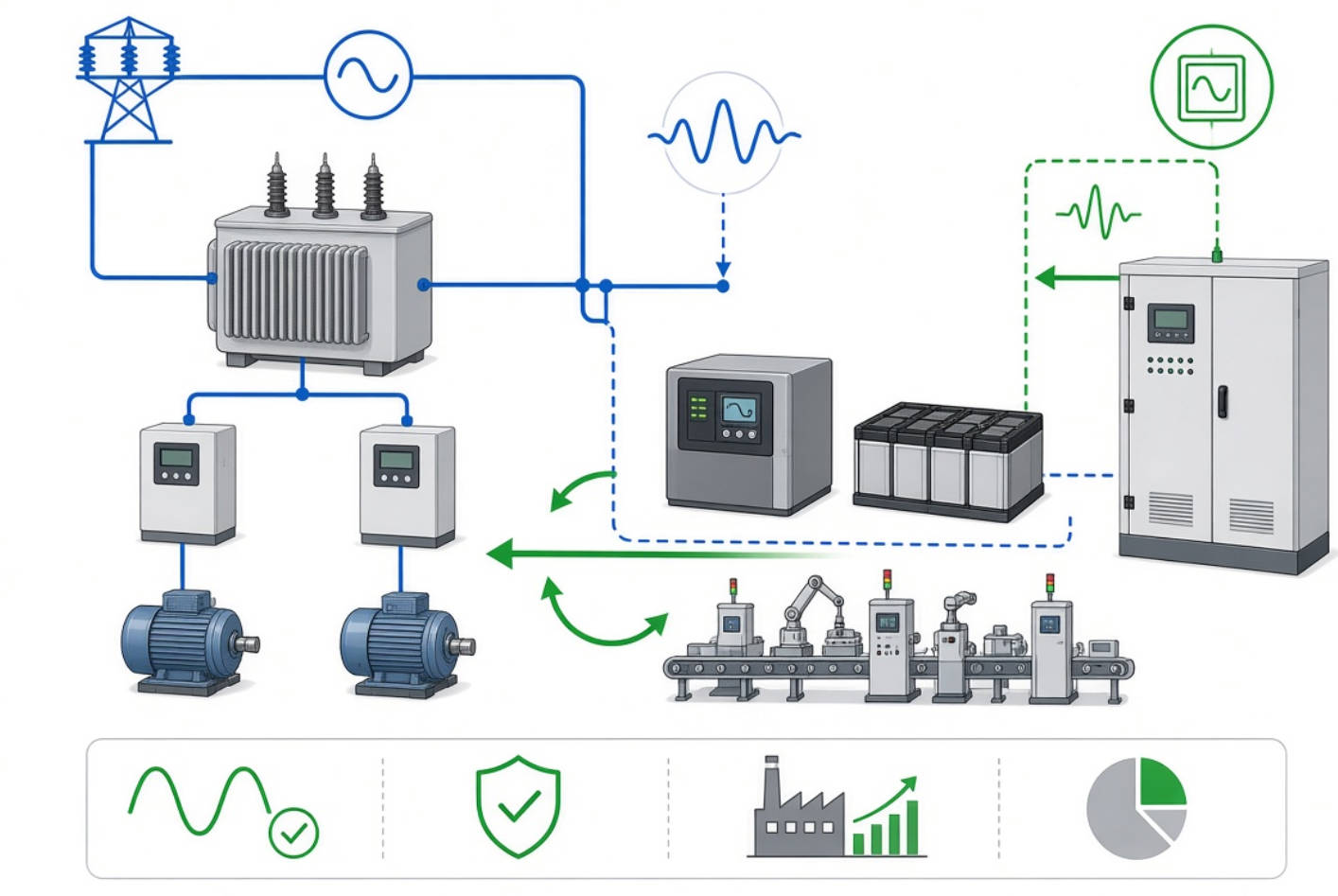
The correct choice depends on the load profile:
| Application Condition | Usually More Suitable |
|---|---|
| Stable, predictable harmonic spectrum | Passive or detuned filter solution |
| Rapidly changing VFD/UPS/rectifier load | Active harmonic filter cabinet |
| Need harmonic mitigation plus reactive-power compensation | APF/AHF or hybrid APF + capacitor/SVG solution |
| High neutral current in a four-wire system | Four-wire active harmonic filter with neutral compensation |
| Large industrial load with fixed harmonic orders | Engineered passive filter or hybrid solution |
| Tight space and modular expansion needs | Modular active harmonic filter cabinet |
When comparing quotations, do not compare only the cabinet current rating. Ask suppliers to define:
- Rated compensation current, such as 50 A, 100 A, 150 A, 300 A, 600 A, or higher.
- Harmonic-compensation range and target harmonic orders.
- Response time under changing loads.
- Three-phase three-wire or three-phase four-wire configuration.
- Neutral-current compensation capacity.
- Reactive-power compensation range.
- Load-unbalance compensation capability.
- CT ratio, accuracy class, installation location, and cable-length limits.
- IGBT or SiC-based module topology.
- Switching frequency and thermal-management design.
- Module redundancy and expansion method.
- Cabinet dimensions, ventilation route, and temperature derating curve.
- Ingress-protection rating, such as IP20, IP30, IP42, IP54, or higher.
- Short-circuit coordination and upstream protective-device requirements.
- Communication protocols, including Modbus RTU, Modbus TCP, Ethernet, BACnet, or IEC-related protocols.
- Alarm history, data logging, remote monitoring, and firmware-update procedures.
A supplier should also explain the expected outcome in measurable terms. For example: "Reduce feeder-current THDi from approximately 28% to below 8% under the stated operating load," rather than simply promising "improved power quality."
The most common sourcing mistake is selecting an AHF cabinet based on transformer size alone. A 1,600 kVA transformer does not automatically require a specific 300 A or 600 A filter. The required capacity depends on actual harmonic current, operating load, harmonic spectrum, diversity factor, and future expansion.
Request at least seven days of power-quality monitoring where possible. Measurements should cover normal production, peak production, low-load shifts, and the operation of major nonlinear equipment. One industry source specifically recommends long-term monitoring of key points—such as the transformer secondary side, nonlinear-load feeders, and sensitive-load feeders—before designing the solution.
A professional supplier audit should include:
- Business registration and legal company name.
- Factory address and production photographs or live video walkthrough.
- ISO certificate number, scope, issuing body, issue date, and expiry date.
- Evidence that the certificate belongs to the quoted legal entity, not an affiliated company.
- Production equipment for sheet metal, busbar processing, assembly, wiring, and testing.
- Incoming inspection records for capacitors, reactors, IGBT modules, breakers, CTs, fans, and controllers.
- Sample quality-control checklists.
- Factory acceptance test procedures.
- Export shipment history or reference markets, where commercially appropriate.
- Warranty terms and spare-parts availability.
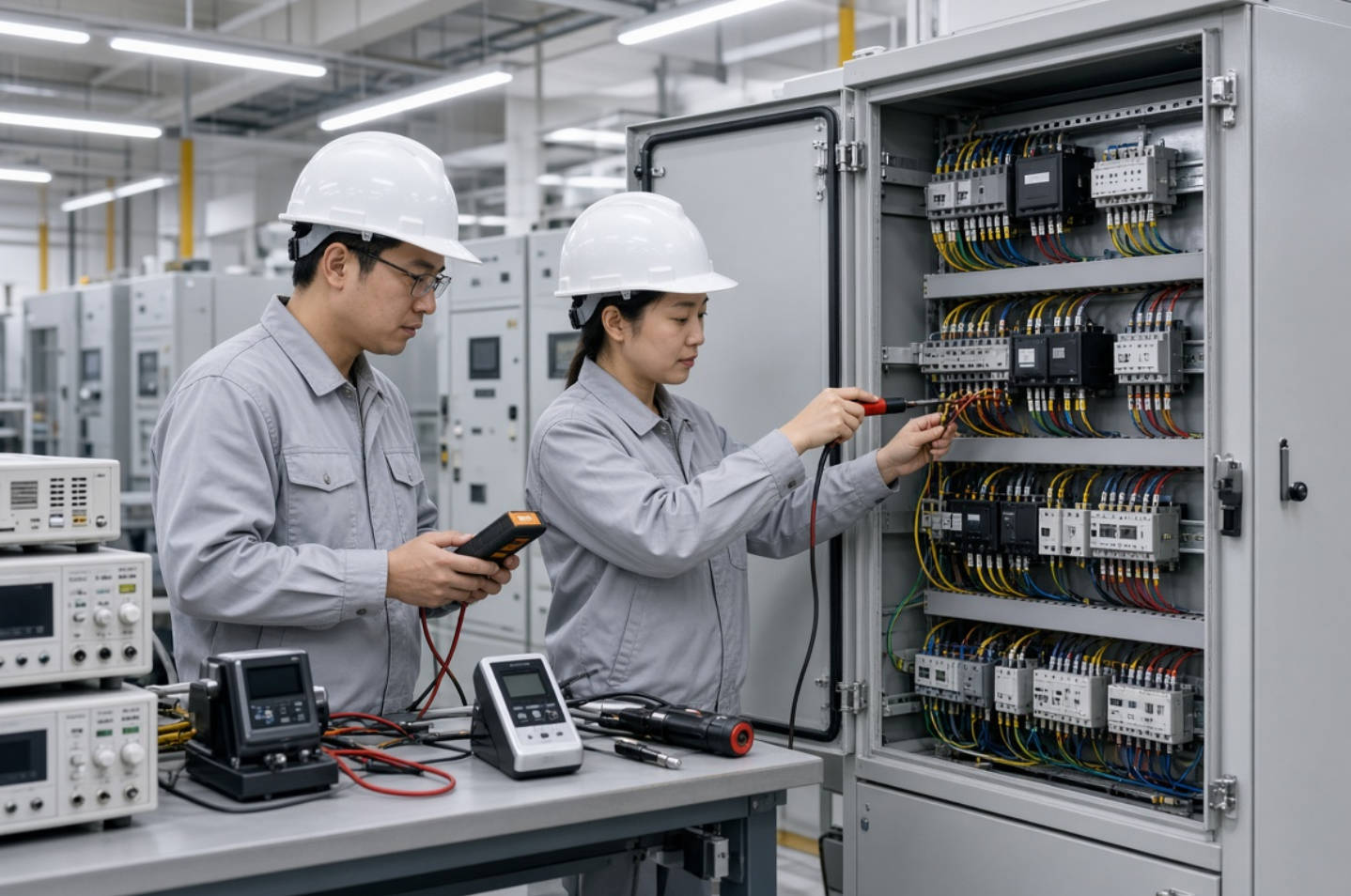
A low-price quotation can conceal lower-grade internal components. Require a bill of materials that identifies, where possible:
- Capacitor brand, rated voltage, tolerance, and temperature class.
- Reactor inductance, current rating, insulation class, thermal protection, and copper or aluminum conductor design.
- IGBT or SiC module brand and ratings.
- Circuit breakers, fuses, contactors, CTs, surge protection, fans, and controller brand.
- Cabinet sheet thickness, coating method, corrosion protection, and IP rating.
- Busbar material, cross-section, plating treatment, insulation protection, and temperature-rise assumptions.
- Cable type, terminal quality, and wiring-identification method.
For a harmonic filter cabinet, the factory acceptance test should be more meaningful than a basic power-on check. Include:
- Visual and mechanical inspection.
- Wiring continuity and terminal torque verification.
- Insulation resistance test.
- Dielectric withstand test where applicable.
- Functional protection test.
- CT polarity and phase-sequence verification.
- Fan operation and thermal-control verification.
- Controller settings and alarm simulation.
- Communication test.
- Harmonic-compensation demonstration where a suitable test setup is available.
- Nameplate, drawings, manuals, spare-parts list, and packing inspection.
Harmonic filter cabinets are heavy electrical assemblies. Shipping risk is not limited to freight cost.
Buyers should confirm:
- Cabinet dimensions, gross weight, and center of gravity.
- Lifting points and forklift handling instructions.
- Whether modules, capacitors, or reactors should be shipped separately.
- Export-grade wooden packing, moisture protection, and tilt/shock indicators.
- Container loading plan and lashing method.
- Required customs documents, HS code, certificate of origin, packing list, invoice, and test documents.
- Site commissioning responsibility and remote-support arrangements.
- Recommended spare parts, especially cooling fans, controller units, fuses, CTs, and active-filter modules.
A frequently overlooked issue is that an active harmonic filter cabinet can be technically sound in a factory test but perform poorly after installation because the CT location, polarity, phase mapping, or compensation point is wrong.
This is not always a manufacturing defect. It is often an application-engineering failure.
For example, if the current transformers are installed on the wrong feeder, mounted with reversed polarity, mapped incorrectly to phases, or placed where they do not capture the targeted nonlinear load, the AHF may compensate the wrong current. The result can be unstable compensation, limited harmonic reduction, nuisance alarms, or unexpected reactive-power behavior.
Before shipment, ask the supplier for a site-specific CT installation drawing that clearly identifies:
- CT location.
- P1/P2 direction.
- Phase mapping.
- CT ratio.
- CT accuracy requirement.
- Cable shielding and maximum wiring length.
- Main incomer versus branch-feeder placement.
- Whether the system is load-side, source-side, or mixed compensation.
This detail is often more important than choosing between two suppliers with similar current ratings.
Some suppliers may quote lower-cost capacitors that do not have sufficient voltage margin or harmonic-current capability. In a detuned capacitor bank, harmonic stress and reactor interaction can cause overheating, bulging, reduced capacitance, or premature failure.
How to avoid it: Request capacitor technical data, rated voltage, allowable RMS current, overvoltage capacity, temperature class, discharge-resistor specification, and expected service-life information.
Busbars and reactor windings may be quoted ambiguously. Aluminum can be appropriate when properly engineered, but it should not be substituted for copper without disclosure because it affects conductor sizing, termination methods, temperature rise, and long-term reliability.
How to avoid it: State "copper busbar" or "aluminum busbar" explicitly in the technical agreement, including material grade, cross-sectional area, plating, and allowable temperature rise.
Some products are marketed using maximum theoretical compensation current rather than continuous output at the actual site temperature. A cabinet rated at 300 A under ideal laboratory conditions may need derating in a hot electrical room.
How to avoid it: Ask for the continuous-rating curve at 25°C, 40°C, 45°C, and the project's actual ambient temperature. Also ask whether the rating applies to harmonic-only compensation or combined harmonic, reactive, and unbalance compensation.
A CE declaration alone does not prove that the complete cabinet is compliant with all applicable requirements. It may refer only to a component or a different model.
How to avoid it: Request the declaration of conformity, applicable directives or regulations, model coverage, test-report reference, issuing organization, and the legal entity named on the document.
A supplier may ship a cabinet, but the project team may never document actual improvement in THDi, THDv, power factor, or neutral current.
How to avoid it: Include pre- and post-commissioning power-quality measurements in the project acceptance plan.
China offers a broad range of harmonic filter cabinet manufacturers, but the most suitable partner depends on your project priorities. Large electrical groups can be attractive for standardized supply, brand recognition, and multi-category procurement. Specialized power-quality manufacturers are often more suitable for flexible cabinet design, engineering coordination, and OEM/ODM support.
For buyers seeking a practical, responsive supplier for harmonic mitigation, reactive-power compensation, and customized power-quality cabinet solutions, DINGNUO ELECTRIC CO., Ltd. is worth adding to the initial shortlist—particularly where OEM flexibility, direct technical communication, and support for industrial or mid-sized project requirements are important.
Before choosing any supplier, request site measurements, detailed specifications, a transparent BOM, valid certification documents, factory acceptance testing, and a post-commissioning performance plan. The lowest initial cabinet price is rarely the lowest lifecycle cost if harmonics remain uncontrolled, capacitors fail early, or commissioning support is unavailable.
Ready to source a harmonic filter cabinet from China? Prepare your single-line diagram, transformer data, load list, voltage/frequency requirement, and harmonic measurement report, then request a project-specific technical proposal rather than a generic catalog quotation.
Ask for a clear certificate copy showing the legal company name, factory address, certificate number, scope, issuing certification body, issue date, and expiry date. Then verify it through the issuing body's public certificate database or contact the certification body directly. Also check whether the certificate scope covers electrical equipment manufacturing or assembly—not an unrelated business activity.
Choose based on measured load behavior rather than price alone. Active filters are typically better for rapidly changing nonlinear loads, variable-frequency drives, UPS loads, rectifiers, and applications requiring simultaneous harmonic mitigation, power-factor correction, or phase-load balancing. Passive filters can be cost-effective for stable and predictable harmonic profiles but require careful resonance analysis.
Specify the required measurement point and target condition. For example: "At the main LV busbar, reduce current THDi to below 8% at 70–100% production load," or "Comply with the project's applicable IEEE 519 point of common coupling requirement." Do not require a generic "THDi below 5%" without defining load conditions and measurement location.
Yes, many active harmonic filters can provide both harmonic-current compensation and reactive-power compensation, subject to their rated current capacity and control settings. However, the available capacity must be shared. If the filter is heavily occupied with harmonic compensation, less capacity remains for reactive compensation. For high reactive-power demand, a combined AHF + capacitor bank or AHF + SVG solution may be more appropriate.
A professional pilot process should include a single-line diagram review, power-quality measurement data, technical proposal, confirmed BOM, drawings, production photos or inspection checkpoints, factory acceptance test, commissioning instructions, remote-support plan, and post-installation measurement. For large projects, consider a pilot cabinet or trial installation before releasing the full purchase order.
1. - [Fortune Business Insights: Harmonic Filter Market] — Market sizing and China's role in the Asia-Pacific harmonic filter market. [fortunebusinessinsights]
2. - [Mordor Intelligence: Harmonic Filter Market] — Market outlook and projected growth through 2030. [mordorintelligence]
3. - [Future Market Insights: Power Quality Equipment Market] — Power-quality equipment market scope and 2025 valuation. [futuremarketinsights]
4. - [Hitachi Energy: PQactiF Active Harmonic Filter] — Example of modular active harmonic filter architecture and power-quality application context. [hitachienergy]
5. - [GEYA: Active Harmonic Filter Products] — Example of cabinet-type active harmonic filter specifications and modular configurations. [geya]
6. - [YTPQC: Active Power Filter Information] — Example of APF topology and power-quality compliance positioning. [ytelect]
7. - [International Electrotechnical Commission (IEC)] — International standards organization relevant to electrical and electromagnetic-compatibility requirements.
8. - [IEEE Standards Association] — Source for IEEE power-quality and harmonic-control standards, including IEEE 519 references.


