
Views: 276 Author: Dingnuo Electric Publish Time: 2026-10-06 Origin: Site


Content Menu
● How Harmonic Filter Cabinets and APFs Work
>> What Is a Harmonic Filter Cabinet?
● Passive Cabinet vs APF Comparison
>> Harmonic Reduction Under Changing Loads
>> Power Factor and Neutral Current
>> Cost, Space, and Maintenance
● Selecting Commercial Building Harmonic Filtering
>> Step 1: Establish the Measurement Boundary
>> Step 2: Capture Representative Operating Modes
>> Step 3: Interpret THDi, TDD, and THDv
>> Step 4: Assess Resonance and Generator Operation
>> Step 5: Size and Verify the Solution
>> Illustrative Office-Building Scenario
>> Procurement and Acceptance Checklist
>> 1. Which Is Better for Offices?
>> 2. Can a Capacitor Bank Replace an APF?
>> 3. Can Both Technologies Work Together?
>> 4. Does an APF Guarantee Compliance?
>> 5. How Should an APF Be Sized?
>> 6. Should Filtering Be Centralized?
Choosing a harmonic filter cabinet vs APF for commercial buildings comes down to load stability, harmonic patterns, reactive power requirements, and future expansion. A passive harmonic filter cabinet can suit predictable loads, while an active power filter generally offers greater flexibility for buildings with changing electrical demand.
For facility managers, the objective is not simply a cleaner waveform. It is reliable HVAC operation, manageable electrical temperatures, fewer power-quality disruptions, and a solution that remains effective as tenants and equipment change.
My starting point when evaluating these options is straightforward: measure the building before specifying the equipment. Neither technology should be selected from transformer capacity or a single distortion reading alone.

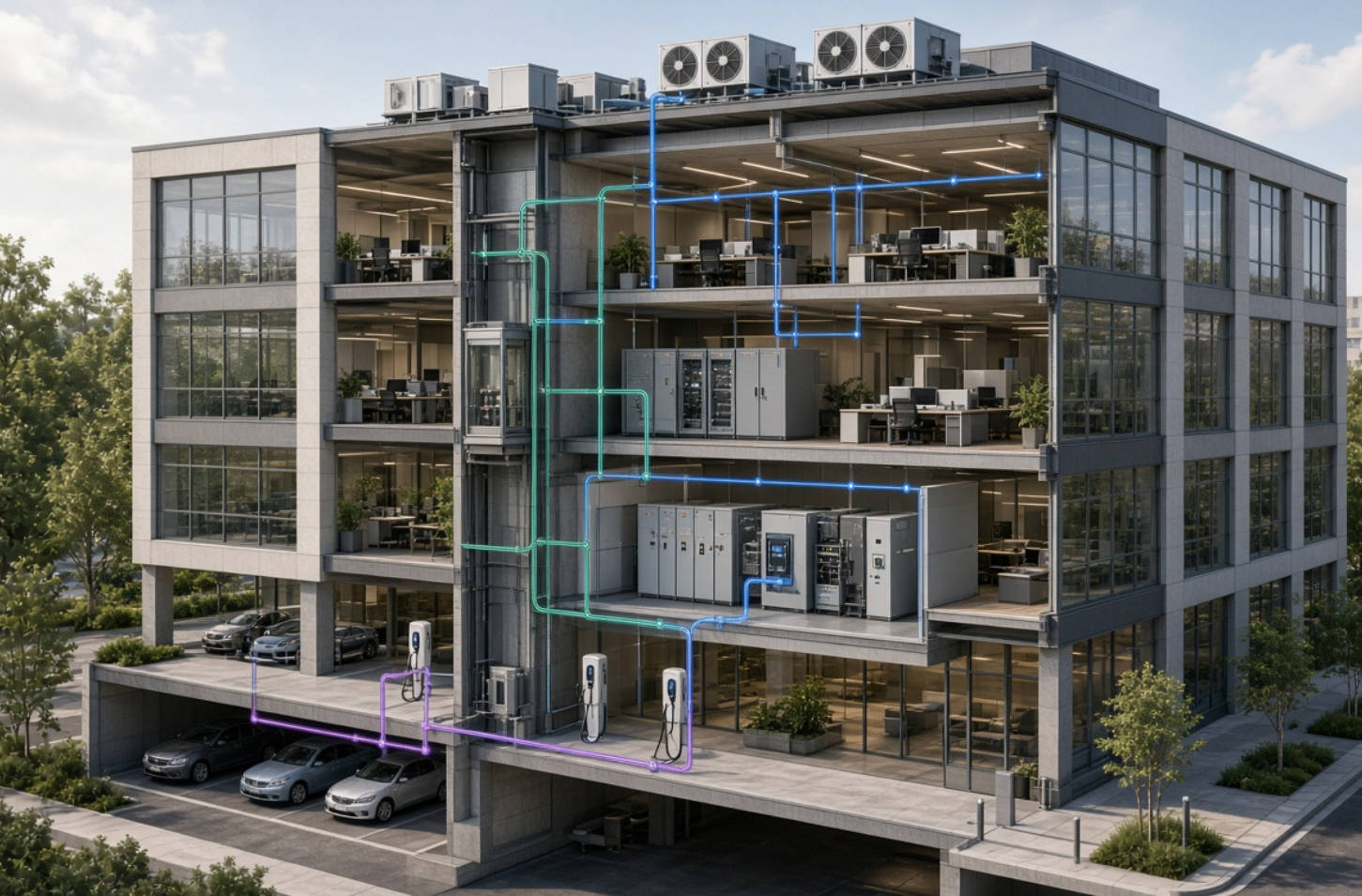
Commercial buildings contain many nonlinear loads: variable-frequency drives, UPS systems, elevator drives, LED drivers, computers, and EV chargers. Their harmonic contribution varies with equipment design and operating conditions.
These loads draw nonsinusoidal current. As harmonic current flows through network impedance, it can distort voltage and increase electrical stress.
"Harmonic filter cabinet" describes an enclosure, not one exclusive technology. Cabinets may contain passive filters, active filters, or hybrid arrangements.
For this comparison, the term means a passive harmonic filter cabinet using capacitors and reactors, sometimes with damping resistors, to address selected harmonic frequencies.
A tuned passive filter creates a low-impedance path at its design frequency. Properly engineered, it diverts targeted harmonic current away from the upstream supply and can also provide fundamental-frequency reactive power.
However, a tuned harmonic filter and a detuned capacitor bank are not interchangeable.
A detuned bank primarily provides power factor correction while reducing the risk of resonance at troublesome harmonic frequencies. It should not be advertised as equivalent to a tuned filter or broad-spectrum active compensation.
An active power filter, or APF, uses power electronics and control algorithms to inject compensating current. For harmonic-focused applications, manufacturers also use the term active harmonic filter, or AHF.
A shunt APF measures electrical conditions and adjusts its output as the load changes. Depending on the model, it may also compensate reactive current and phase imbalance.
Think of passive filtering as an engineered path for selected frequencies. Active filtering instead generates compensation that follows the measured disturbance.
Neither approach removes every possible power-quality problem. Voltage sags, interruptions, transients, and upstream distortion may require separate measures.
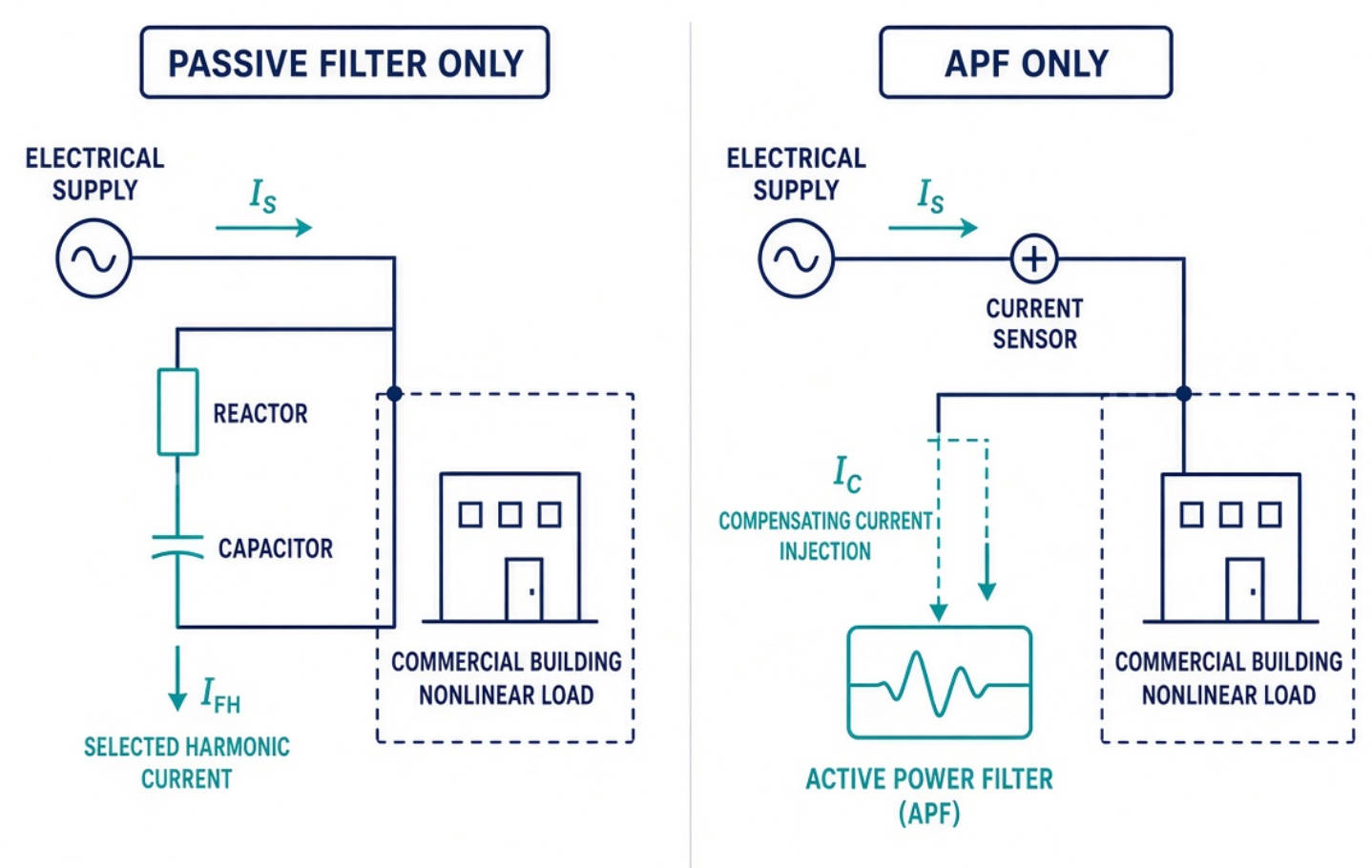
The most useful comparison concerns operating conditions rather than which technology sounds more advanced.
| Selection factor | Passive harmonic filter cabinet | Active power filter |
|---|---|---|
| Operating principle | Frequency-selective capacitor-reactor network | Controlled injection of compensating current |
| Best-fit load profile | Stable, predictable harmonic-producing loads | Variable loads and changing harmonic spectra |
| Harmonic coverage | Selected frequencies or an engineered range | Multiple orders within specified capability |
| Reactive power | Often supplies capacitive kvar | Model-dependent, within available current capacity |
| Light-load behavior | Requires attention to leading power factor and switching | Output generally follows measured demand |
| Neutral harmonics | Depends on circuit design | Requires a suitable four-wire configuration |
| Resonance considerations | Network impedance and tuning are critical | Control interactions still require assessment |
| Expansion | May require redesign or additional branches | Modular expansion may be available |
| Maintenance | Capacitors, reactors, switching devices, protection | Cooling, electronics, DC-link components, controls |
| Cost basis | Components, tuning, installation, network studies | Compensation amperes, functions, cooling, redundancy |
Passive filters can perform well when dominant harmonic orders and operating conditions remain predictable. A dedicated mechanical plant may fit this profile better than a multi-tenant office building.
An APF can adapt when elevators, cooling systems, tenant equipment, and charging loads change throughout the day.
However, capacity still matters. Once compensation demand reaches the APF's usable current limit, residual harmonics remain. Adjustable controls do not replace correct sizing.
Similarly, passive filter performance depends on source impedance, background distortion, component tolerances, and switching states—not just its nameplate rating.
Power factor correction and harmonic mitigation solve related but different problems.
Capacitors improve displacement power factor by supplying reactive power. Harmonic current can still depress true power factor, even when displacement power factor looks excellent.
Where substantial kvar support is needed alongside dynamic harmonic correction, a coordinated hybrid arrangement may be worth evaluating.
Neutral current deserves separate attention. Third-order and other triplen harmonics from single-phase nonlinear loads can add in the neutral rather than cancel.
A three-wire APF should not be assumed to compensate these currents. Specify a four-wire topology with documented neutral compensation capability when the survey identifies that requirement.
Passive equipment may offer an attractive initial cost when its duty is predictable. Nevertheless, engineering studies, capacitor replacement, switching equipment, ventilation, and future modification affect ownership cost.
APFs introduce semiconductor equipment, cooling systems, controls, and service requirements. Their adaptability may offer commercial value where loads change frequently.
Avoid universal claims that either technology is always cheaper, smaller, or more efficient. Request comparable quotations with identical performance boundaries.
Energy savings also need qualification. Lower upstream current can reduce distribution losses, but both filter types have their own losses. Neither automatically reduces the energy consumed by the building's useful loads.
A defensible specification connects measurement, network modeling, procurement, and commissioning. The following process helps prevent purchasing equipment that solves the wrong problem.
Identify the point of common coupling, or PCC, with the utility or responsible electrical engineer. It is not automatically the main switchboard or the terminals of the largest drive.
Measure the PCC and important internal feeders. The PCC assessment addresses the installation's utility-facing performance; feeder measurements help locate sources and protect internal equipment.
Record voltage distortion, current distortion, individual harmonics, demand current, power factor, neutral current, and operating conditions.
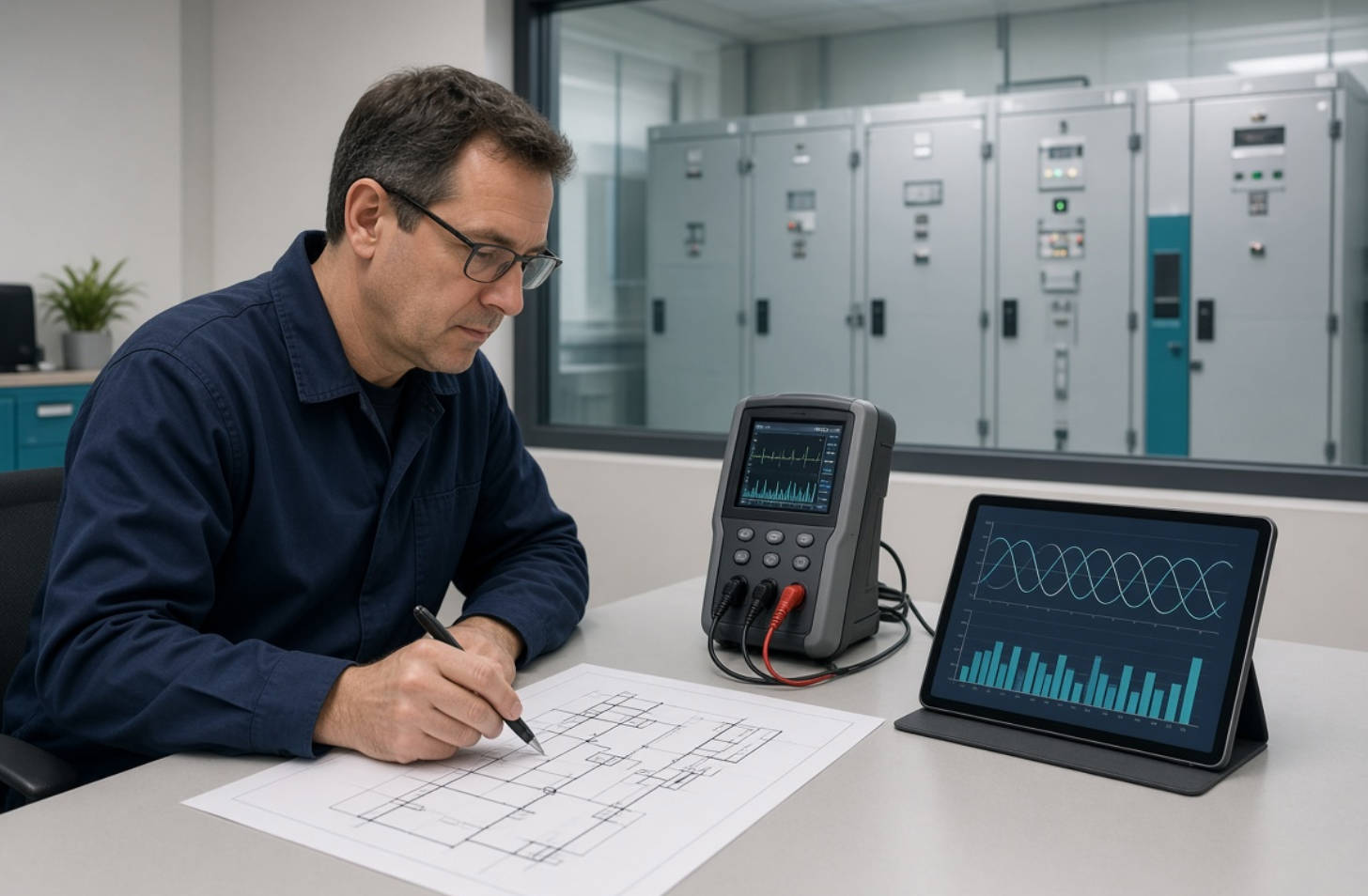
One spot reading can miss the building's most difficult condition. As a practical survey plan, monitor a representative week and extend the survey if seasonal operation materially changes demand.
Include:
- Peak occupancy and cooling demand.
- Overnight and weekend light-load operation.
- Elevator and large equipment activity.
- EV charging and tenant operating schedules.
- Existing capacitor-bank switching.
- Generator operation where applicable.
Monitoring periods used for contractual compliance should follow the applicable standard and project requirements, rather than relying solely on this practical planning guideline.
Current total harmonic distortion, or THDi, expresses harmonic current relative to fundamental current. Total demand distortion, or TDD, uses maximum demand load current as its reference.
Consequently, THDi can rise at light load even when absolute harmonic amperes fall. A high percentage alone does not establish filter capacity.
IEEE 519-2022 evaluates installation distortion at the PCC. For PCC voltages at or below 1 kV, its voltage table lists 8% total harmonic distortion and 5% individual harmonic distortion. Above 1 kV through 69 kV, these values are 5% and 3%, respectively.
Current limits depend on system conditions, including the short-circuit-current-to-demand-current ratio. "Below 5% THDi everywhere" is therefore not a universal compliance requirement.
Sensitive equipment may justify tighter internal targets. Applicable statistical assessment and utility requirements must also be considered.
Before installing passive branches, evaluate network impedance with existing capacitor stages, transformers, and alternative supply arrangements.
A tuned filter can absorb harmonic current originating elsewhere in the network. Its thermal rating must accommodate that possibility, not just locally generated harmonics.
Generator operation changes source impedance and can worsen voltage distortion. Check compensation settings, capacitor switching, generator loading, and filter compatibility in this mode.
An APF is not automatically immune to system interactions. Its controls must remain stable with the actual supply and other compensation equipment.
Size an APF from measured harmonic amperes and required residual performance, then account for neutral compensation, reactive current, temperature derating, and expansion.
For passive equipment, specify tuning, kvar, permissible harmonic current, capacitor voltage, reactor thermal duty, protection, and switching arrangements.
If an APF performs multiple functions, ask how its current capacity is allocated. Harmonic filtering, reactive compensation, and balancing cannot each be assumed to receive the full rating simultaneously.
Consider a hypothetical office building with variable-speed HVAC, UPS-backed tenant equipment, electronic lighting, and planned EV charging.
A survey finds changing harmonic spectra and significant neutral current on selected tenant feeders. A four-wire APF near those feeders becomes a reasonable candidate.
If the mechanical plant also needs substantial reactive compensation, a separate engineered capacitor-reactor arrangement could support that requirement.
This is an illustration, not a DINGNUO customer case or a claimed performance result. Final selection still depends on measurements, modeling, and equipment specifications.
Ask competing suppliers to quote against the same acceptance conditions:
1. Define the measurement locations and operating modes.
2. Specify residual TDD, individual harmonics, and voltage distortion targets.
3. State usable compensation capacity at site temperature.
4. Document neutral capability and multifunction priorities.
5. Include protection, ventilation, access, and service requirements.
6. Establish before-and-after measurements and acceptance reporting.
DINGNUO ELECTRIC CO., Ltd.'s stated background in capacitors, reactors, reactive power compensation, and harmonic control provides a relevant foundation for this discussion.
Send DINGNUO your single-line diagram, harmonic survey, transformer information, existing capacitor details, and expansion plan. Request a site-specific assessment comparing passive, active, and hybrid options against measurable acceptance criteria.
An APF is often a stronger candidate for offices with changing tenant loads and mixed nonlinear equipment. A passive cabinet may suit stable, well-characterized loads. Measurements should determine the choice.
Not generally. A conventional capacitor bank addresses reactive power, not dynamic harmonic cancellation. Detuned banks and tuned passive filters also have different purposes. Select equipment according to the measured problem.
Yes. A coordinated hybrid design can assign reactive compensation or selected harmonic duties to passive equipment and variable residual harmonics to an APF. Engineering must address resonance, control interactions, and operating modes.
No. Compliance depends on the PCC, applicable limits, background distortion, load profile, compensation capacity, and verification method. An equipment specification is not proof that the complete installation complies.
Use measured harmonic current, required residual performance, and simultaneous operating demand. Include neutral requirements, reactive compensation, derating, and growth. Transformer kVA alone is insufficient.
Central filtering can improve upstream conditions but may leave harmonic current circulating through downstream feeders. Local filtering may better protect problem circuits. Large buildings sometimes benefit from coordinated central and feeder-level mitigation.
1. - ABB — Power Factor Correction and Harmonic Filtering in Electrical Plants, Technical Application Papers, document 1SDC007107G0202. Supports the discussion of capacitors, reactive compensation, harmonic effects, resonance, and filter principles. Its older standards and tariff examples are not used as current compliance requirements. [Read the technical paper]. [search.abb]
2. - ABB — IEEE 519-2022 Review, Technical Note 158, effective January 10, 2023. Supports PCC assessment, THD/TDD distinctions, measurement scope, and the distinction between installation compliance and equipment evaluation. [Read Technical Note 158]. [library.e.abb]
3. - Comsys — Power Quality—IEEE 519-2022. Provides the voltage-distortion table used for the 1 kV and 69 kV boundaries and explains demand-referenced current distortion. [View the standards overview]. [comsys]
4. - Schneider Electric — Active Filters / Compensators. Documents commercial-building active filtering applications and model-dependent harmonic, reactive-power, and balancing functions. [View the product-category information]. [se]
5. - Merus Power — What Is an Active Harmonic Filter and How Does It Work? Supports dynamic compensation and the distinction between predictable passive-filter applications and changing active-filter applications. [Read the explanation]. [meruspower]
6. - EC&M — Sizing Active Filters for Commercial Facilities, May 1, 2003. Supports the engineering principle that compensation should match the problem being solved, including neutral-current objectives. Its historical sizing shortcuts are not adopted as universal design rules. [Read the article]. [ecmweb]


