
Views: 288 Author: Dingnuo Electric Publish Time: 2026-09-06 Origin: Site


Content Menu
● Why Source Harmonic Filter Banks From China?
>> 1. Harmonic Engineering Capability
>> 2. Component and Material Traceability
>> 4. Compliance and Documentation
>> 5. Delivery Reliability and After-Sales Support
● Top 10 Harmonic Filter Bank Manufacturers in China
>> 1. DINGNUO ELECTRIC CO., Ltd.
>> 2. SINEXCEL
>> 3. Jiangsu Elecnova Electric Co., Ltd.
>> 5. Shanghai Huakun Electrical Company Ltd.
>> 6. Anhui Safe Electronics Co., Ltd.
>> 7. Wenzhou-Based Low-Voltage Electrical Manufacturers
>> 8. Shenzhen Power-Electronics Solution Providers
>> 9. Jiangsu Power Distribution and Metering Specialists
>> 10. China Passive-Filter and Reactor Specialists
● Technical Guide: What Is a Harmonic Filter Bank?
>> Passive Harmonic Filter Banks
● The Industry's Less-Discussed Buying Trap
>> Internal Procurement Tip: Check the Actual Resonance Calculation
● Common Sourcing Problems—and How to Avoid Them
>> Problem 1: Standard PFC Capacitors Sold for Harmonic Duty
>> Problem 2: Reactor Detuning Is Chosen Without a Harmonic Study
>> Problem 3: The Supplier Quotes kVAr but Not Harmonic Performance
>> Problem 4: Incomplete Certification Files
>> Problem 5: Cabinet Thermal Design Is Ignored
>> Problem 6: No Clear FAT or Site-Acceptance Process
● Buyer's Guide: How to Source Safely
>> Step 1: Prepare a Complete RFQ Package
>> Step 2: Request a Technical Proposal Before Price Comparison
>> Step 3: Verify the Factory and Certifications
>> Step 4: Order a Sample or Pilot Unit
>> Step 5: Manage Shipping and Customs Risks
>> 1. How can I verify whether a Chinese manufacturer's ISO 9001 certificate is still valid?
>> 2. Is a 7% detuned capacitor bank always suitable for industrial harmonic control?
>> 3. What information should I give a supplier to size an active harmonic filter?
>> 4. How do I know whether I need a passive filter, an APF, or a hybrid solution?
>> 5. What should be included in the factory acceptance test for a harmonic filter bank?
China is an important global sourcing base for harmonic filter banks, detuned capacitor banks, active power filters, reactors, and reactive-power-compensation equipment. For procurement teams, the opportunity is not simply lower component pricing—it is access to a broad ecosystem of capacitor, reactor, cabinet, control, switchgear, and power-electronics suppliers.
However, a harmonic filter bank is not a commodity panel. A poorly designed system can amplify resonance, overheat capacitors, trip variable-frequency drives, reduce transformer capacity, or fail to meet a site's harmonic limits at the point of common coupling (PCC). The right supplier must therefore combine manufacturing capability with harmonic-study competence, component traceability, testing discipline, and practical support during commissioning.
This guide evaluates ten China-based manufacturers and solution providers that international buyers may consider when sourcing harmonic filter banks and related power-quality products. It is intended for industrial procurement managers, electrical contractors, panel builders, distributors, EPC firms, and OEM brands seeking longer-term supplier relationships.
China's electrical-machinery manufacturing sector remains substantial and export-oriented. In 2025, the country's electrical-machinery-and-apparatus manufacturing output increased by 9.2%, while total industrial export delivery value reached RMB 15.8052 trillion, according to the National Bureau of Statistics of China. Mechanical and electronic products also represented 60.7% of China's exports in the first ten months of 2025.
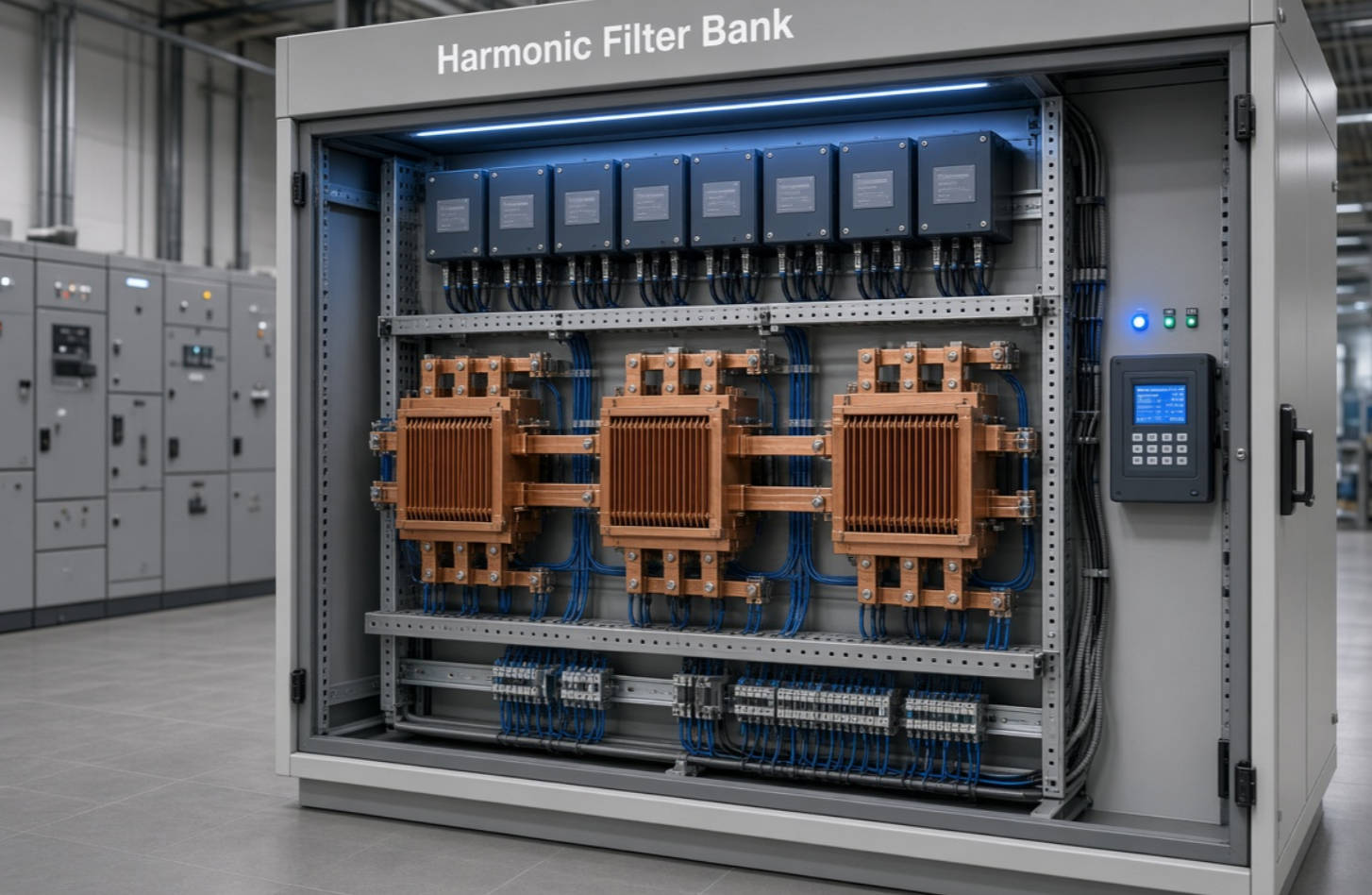
China has developed mature industrial clusters for low-voltage electrical equipment, power electronics, capacitor technology, sheet-metal fabrication, and electrical-panel assembly. Important supply-chain centers include:
- Shenzhen and Huizhou: Power electronics, active harmonic filters, energy storage, EV charging, control systems, and PCB-based product development.
- Jiangsu and the Yangtze River Delta: Intelligent distribution, metering, electrical-panel manufacturing, industrial automation, reactors, capacitors, and power-quality monitoring.
- Zhejiang: Low-voltage electrical apparatus, capacitor-bank components, contactors, breakers, power-factor controllers, and export-oriented electrical manufacturing.
- Guangdong: Cabinet integration, OEM electrical assembly, industrial equipment supply, and international export logistics.
For buyers, this ecosystem can shorten sourcing cycles because a qualified manufacturer can often coordinate capacitors, reactors, switching devices, controllers, cabinets, busbars, protection devices, and testing within a regional supplier network.
Demand for harmonic-control equipment is also supported by the continued growth of non-linear loads: VFDs, rectifiers, welding systems, UPS systems, LED drivers, arc furnaces, data centers, EV charging infrastructure, photovoltaic inverters, and industrial automation equipment. Harmonics are generally assessed as deviations from ideal sinusoidal voltage and current waveforms, often represented by individual harmonic components and total harmonic distortion (THD).
The broader power-quality-equipment market was valued at approximately USD 19 billion in 2025 and was estimated at USD 20.3 billion in 2026, according to a market-research estimate. Buyers should treat such market figures as directional rather than as a substitute for project-specific engineering data.
This is not a laboratory ranking or a claim that every manufacturer serves the same project type. Instead, the list is a procurement-oriented shortlist based on publicly identifiable product focus, power-quality relevance, engineering positioning, export readiness, and ability to support industrial applications.
A reliable harmonic filter bank supplier should be evaluated against the following criteria.
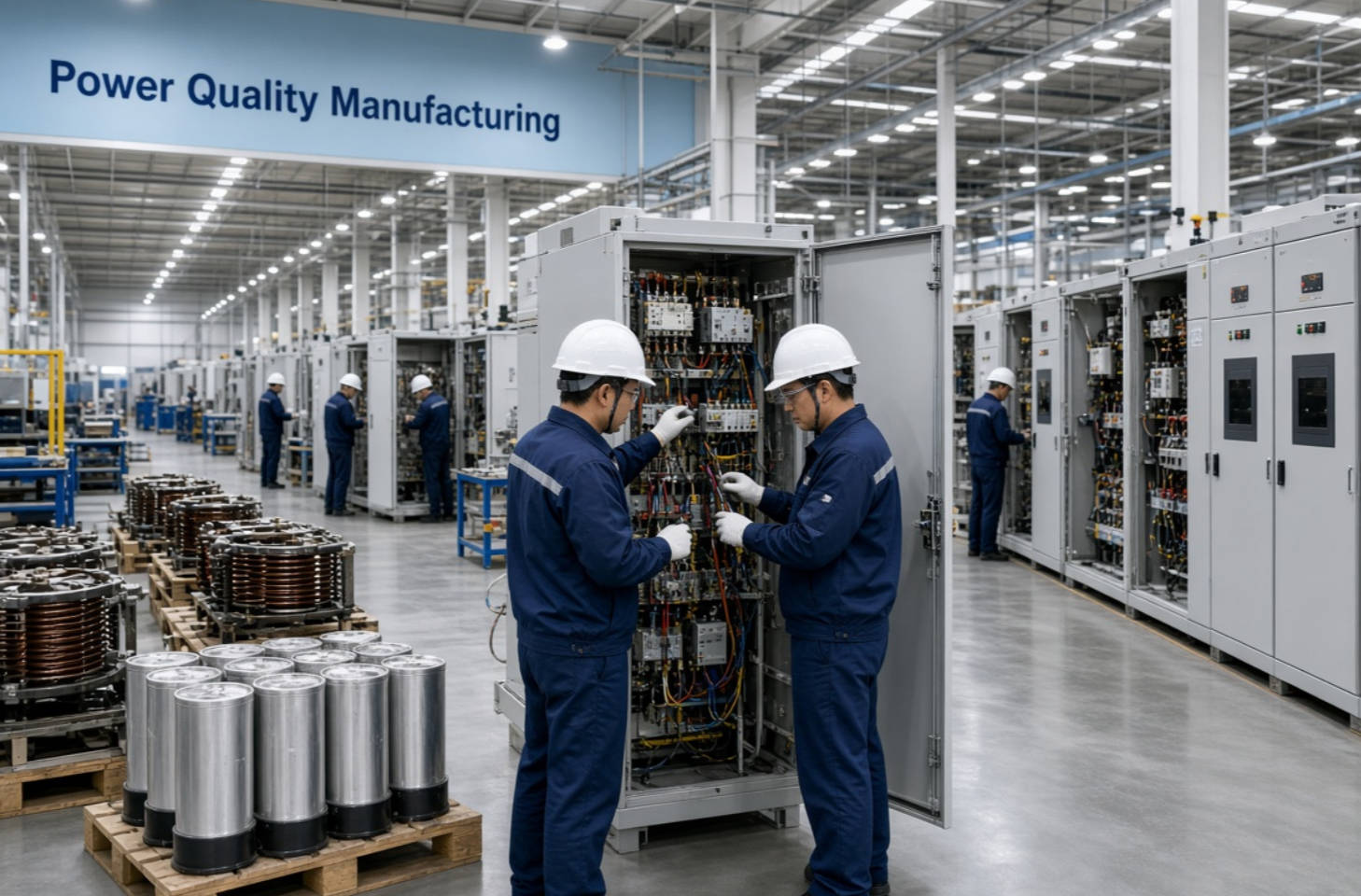
A supplier should be able to explain whether a project requires:
- A detuned capacitor bank for power-factor correction while avoiding resonance.
- A single-tuned passive harmonic filter for a dominant harmonic order, such as the 5th, 7th, 11th, or 13th harmonic.
- A high-pass filter for higher-frequency harmonic attenuation.
- An active harmonic filter (AHF/APF) for dynamic and variable harmonic conditions.
- A hybrid system combining passive filters, APFs, SVGs, and capacitor banks.
For medium-voltage, high-voltage, or large industrial installations, the supplier should request a harmonic study, single-line diagram, transformer data, load profile, capacitor-step schedule, short-circuit capacity, and measurements at the PCC before offering a final configuration.
Ask manufacturers to identify the exact bill of materials, including:
- Capacitor dielectric type and rated voltage.
- Capacitor temperature class and self-healing design.
- Reactor conductor material, insulation class, inductance tolerance, and thermal design.
- Contactor, thyristor-switching module, breaker, fuse, and controller brands.
- Cabinet steel thickness, powder-coating process, IP rating, and ventilation layout.
- Busbar material, cross-sectional area, plating, torque requirements, and insulation treatment.
A quotation that says only "premium capacitor" or "high-quality reactor" is not sufficiently transparent for a technical purchase order.
Quality control should cover more than a finished-product visual inspection. A credible factory should be able to show evidence of:
- Incoming inspection of capacitors, reactors, breakers, copper busbars, and controllers.
- In-process assembly checks.
- Torque verification for electrical terminals.
- Insulation-resistance testing.
- Dielectric or withstand-voltage testing where applicable.
- Functional switching tests.
- Reactor inductance verification.
- Capacitor-capacitance measurement.
- Thermal-rise or heat-management validation for larger banks.
- Final factory acceptance testing, or FAT.
Certification must match the product and target market. Depending on the country and equipment category, buyers may request:
- ISO 9001 quality-management certification.
- CE documentation for applicable products placed on the European market.
- RoHS declarations for relevant electrical and electronic equipment.
- IEC-based testing reports.
- EMC-related documentation where applicable.
- Material declarations and component certificates.
- Third-party test reports from accredited laboratories.
IEC harmonic standards and planning approaches are relevant to system design. IEC 61000-3-2 and IEC 61000-3-12 address harmonic-current emissions for certain equipment categories, while IEC TR 61000-3-6 provides principles used to determine harmonic-emission limits for installations connected to medium-, high-, and extra-high-voltage networks.
For industrial buyers, lead time is not only a production issue. It depends on engineering approval, component availability, enclosure fabrication, electrical testing, export packing, and documentation. Before confirming a supplier, request:
- A production schedule tied to the approved technical drawing.
- The confirmed lead time after deposit and drawing approval.
- A packing list and container-loading plan.
- A recommended spare-parts list.
- Installation, operation, and maintenance manuals in English.
- Wiring diagrams, terminal schedules, and commissioning procedures.
- Remote troubleshooting arrangements and response-time expectations.
Best fit for: Buyers seeking flexible harmonic-filter-bank customization, reactive-power compensation solutions, practical OEM support, and responsive communication for industrial projects or private-label programs.
DINGNUO ELECTRIC CO., Ltd. is positioned as a China-based provider of reactive power compensation, active power filters, static VAR generators, capacitor banks, reactors, and harmonic-filtering solutions. Its public company information indicates operations in the field since 2008 and emphasizes customized PFC, SVG, APF, and harmonic-filter solutions for industrial customers worldwide.
For buyers that do not require the procurement scale or complex corporate structure of a very large listed power-electronics group, DINGNUO can be a practical option. The company's value proposition is particularly relevant to small and mid-sized electrical brands, panel builders, contractors, and distributors that need direct technical communication and customization instead of an off-the-shelf catalog-only transaction.
Core strengths
- Focus on reactive-power compensation and harmonic-control product categories.
- Suitable for detuned capacitor banks, filtering reactors, APF/SVG-related solutions, and integrated power-quality cabinets.
- More flexible for OEM/ODM projects than many large enterprise-oriented suppliers.
- Can support customized ratings, cabinet layouts, component selections, labeling, languages, electrical diagrams, and export packing.
- Relevant experience for industrial settings such as metallurgy, petrochemical processing, automotive manufacturing, paper, textile, building-material production, and municipal infrastructure.
OEM/ODM scope to discuss
- Customer-branded capacitor-bank cabinets.
- Customized detuning ratios, such as 5.67%, 6%, 7%, or 14%, subject to harmonic-study requirements.
- Capacitor-step sizes and switching configurations.
- Reactor matching and tuned-filter designs.
- Control-panel language, HMI layout, labels, manuals, and wiring diagrams.
- Customized IP protection levels and enclosure dimensions.
- Integration with APF, SVG, meter, controller, communication module, or SCADA requirements.
Buyer due diligence note
Because detailed project suitability depends on the installation's harmonic spectrum, buyers should ask DINGNUO to provide a pre-sale technical questionnaire, sample single-line diagram, proposed BOM, test plan, and documentation list before issuing a purchase order. A competent supplier should not select a detuning ratio solely from the kVAr value.
Best fit for: Large-scale active harmonic filtering, modular APF/AHF systems, data centers, EV charging, renewable-energy projects, and power-electronics-intensive industrial facilities.
SINEXCEL, headquartered in Shenzhen, was founded in 2007. The company states that it launched its first modular active harmonic filter in 2008 and has developed a global footprint across power quality, energy storage, and EV charging. Its published corporate information reports a manufacturing base in Huizhou, an R&D center in Xi'an, operations in Suzhou, more than 2,800 employees, and partners in more than 60 countries.
SINEXCEL is particularly relevant when the project has fast-changing harmonic conditions, multiple VFD loads, large rectifier loads, variable EV-charging demand, or a need for modular expansion. Active filters are different from passive harmonic filter banks: they measure load harmonics and inject compensating current dynamically, making them useful where load behavior is not stable.
Core strengths
- Significant focus on modular active harmonic filters.
- Broad power-electronics portfolio, including energy storage and EV charging.
- Suitable for high-capacity or highly dynamic harmonic-control projects.
- Publicly documented international footprint and large-scale deployment claims.
- Strong fit for system integrators and projects requiring modular scalability.
OEM/ODM scope to discuss
- Branded distribution partnerships.
- System integration with switchgear, UPS, chargers, BESS, and data-center infrastructure.
- Cabinet integration and communication-protocol requirements.
- Multi-module capacity expansion plans.
Buyer due diligence note
Confirm the active-filter compensation-current rating, harmonic order range, response time, derating condition, parallel-module capability, fault bypass method, communication protocol, and local service model. Do not compare APF current ratings directly with passive-filter kVAr ratings; they solve different engineering problems.
Best fit for: Intelligent power distribution, power-quality monitoring, energy-management integration, and projects requiring measurement plus mitigation equipment.
Elecnova is associated with Jiangsu Sfere Electric Co., Ltd., a Jiangsu-based manufacturer focused on power meters, power-quality products, and power-distribution solutions. Its published information identifies systematic solutions involving power monitoring, power-quality management, electrical safety, and energy-management systems.
Elecnova is a relevant candidate for buyers that need more than a capacitor bank or filter panel. In many factories, successful harmonic management depends on continuously measuring power parameters, identifying harmonic trends, monitoring capacitor health, and integrating alarms into a wider energy-management system.
Core strengths
- Combination of monitoring, measurement, electrical safety, and power-quality offerings.
- Suitable for smart-building, commercial, manufacturing, and distribution-system applications.
- Useful for projects that require meter data together with compensation or filtering equipment.
- Public project history includes power-quality monitoring equipment deployed in petrochemical environments.
OEM/ODM scope to discuss
- Power meters with private labeling.
- Customized communication protocols, dashboards, or data integration.
- Electrical-panel integration with meters, APF modules, SVG, capacitor banks, or protection systems.
- Multi-language documentation and localized software interfaces.
Buyer due diligence note
Verify whether the proposed system provides measurement only, harmonic mitigation only, or a complete closed-loop solution. Ensure the meter's sampling, measurement range, communication interface, and power-quality parameters match the project specification.
Best fit for: Industrial power-quality systems, active harmonic filters, transformers, and reactive-power solutions requiring an integrated equipment approach.
LTEC Power presents itself as an industrial power-quality manufacturer offering active harmonic filters, transformers, and reactive-power solutions. Its product positioning highlights real-time harmonic mitigation and claims filtering performance of up to 98% efficiency for selected active harmonic filter solutions.
The company may be relevant for industrial networks that combine transformer loading issues, harmonic distortion, reactive-power demand, and sensitive production equipment. Buyers should distinguish marketing efficiency claims from site-specific harmonic mitigation results; final performance should be defined by a measurable specification such as target THDi, target THDv, power factor, load profile, and testing location.
Core strengths
- Industrial power-quality positioning.
- Product coverage that may extend beyond a single capacitor-bank category.
- Potential fit for integrated industrial power-distribution projects.
- Focus on active harmonic mitigation for dynamic loads.
OEM/ODM scope to discuss
- Cabinet design and industrial enclosure configuration.
- Transformer-plus-filter packages.
- Customized monitoring, alarms, and network communication.
- Export documentation and local electrical-code adaptation.
Buyer due diligence note
Ask for the exact basis of any quoted filtering performance. The contract should specify the pre-test and post-test measurement method, operating load range, existing background harmonic level, and permitted tolerance.
Best fit for: Buyers sourcing a broad mix of harmonic filters, SVG systems, capacitor banks, and related low-voltage power-quality equipment.
Shanghai Huakun Electrical Company Ltd. is listed in Chinese manufacturing directories as a supplier of harmonic filters, static VAR generators, capacitors, MCCBs, intelligent power capacitors, and filtering reactors.
This type of supplier may be relevant for buyers wanting a single source for conventional capacitor-bank components and related compensation equipment. However, directory inclusion alone should never be treated as confirmation of engineering depth, export history, certification validity, or factory ownership.
Core strengths
- Broad catalog alignment with harmonic-control and reactive-compensation categories.
- Potential availability of capacitors, reactors, SVG systems, and harmonic-filter products.
- May suit distributors seeking multiple related product categories.
OEM/ODM scope to discuss
- Brand labeling and private-label product packaging.
- Standardized capacitor-bank components.
- Customized panel assemblies.
- Distributor sample programs.
Buyer due diligence note
Verify whether the company is the legal manufacturer, a trading entity, or a hybrid manufacturer/trader. Request the business license, factory address, product-specific test reports, live production video, and a factory-audit opportunity.
Best fit for: Buyers seeking industrial capacitors and related reactive-power-compensation components for use in filter-bank or capacitor-bank assemblies.
Anhui Safe Electronics is active in power-capacitor-related categories, including products used for reactive power compensation and harmonic-filter applications. Chinese industry listings identify the company in connection with electrical capacitors and related power-factor-compensation products.
For harmonic-filter-bank sourcing, the capacitor manufacturer matters because capacitor duty is significantly affected by harmonic current, voltage amplification, temperature, switching transients, and reactor matching. A capacitor designed only for conventional PFC may not be suitable for a detuned or tuned-filter application.
Core strengths
- Relevant component-level orientation.
- Potential option for capacitor sourcing or private-label component programs.
- Suitable for panel builders that already have in-house electrical-design capability.
OEM/ODM scope to discuss
- Voltage, kVAr, case style, terminal configuration, and private labeling.
- Capacitor-batch traceability.
- Specialized capacitor parameters for detuned-bank use.
- Packing and export-label customization.
Buyer due diligence note
Request harmonic-duty information, allowable RMS current, maximum voltage, temperature class, expected life, failure-protection mechanism, capacitance tolerance, and relevant test data. Do not accept a standard PFC capacitor automatically as a harmonic-filter capacitor.
Best fit for: Buyers assembling their own capacitor banks or sourcing accessories such as contactors, breakers, controllers, fuses, current transformers, and low-voltage protection devices.
Wenzhou and the wider Zhejiang electrical-manufacturing cluster are major sourcing regions for low-voltage electrical components. Companies in the region commonly provide contactors, breakers, meters, current transformers, controllers, and accessories that can be incorporated into capacitor-bank or harmonic-filter assemblies.
One publicly visible example is Wenzhou Heyi Electrical Co., Ltd., which has promoted product certification information for selected current-transformer products, including CE-LVD, RoHS, and UKCA-related claims. This does not establish that all Wenzhou suppliers or all products share identical compliance status; each certificate must be checked product by product.
Core strengths
- Competitive supply chain for standardized low-voltage electrical components.
- Useful for OEM assemblers and panel builders.
- Potentially favorable MOQs for selected components.
- Broad availability of electrical accessories.
OEM/ODM scope to discuss
- Customer-logo labels.
- Customized control-panel accessories.
- Packaging, terminal labeling, and documentation.
- Component kits for capacitor-bank assembly.
Buyer due diligence note
Component sourcing can lower cost, but it transfers engineering responsibility to the buyer. If you buy capacitors, reactors, contactors, controllers, and cabinets from separate suppliers, assign one engineering party to validate coordination, thermal design, protection selectivity, and final FAT.
Best fit for: Active harmonic filters, modular SVGs, digital power-quality products, EV-charging infrastructure, and projects requiring firmware or communication customization.
Shenzhen's electronics and power-electronics ecosystem gives buyers access to companies focused on digital control, IGBT/SiC-based systems, monitoring platforms, and modular power-quality equipment. SINEXCEL is one well-documented example from the region, but Shenzhen also supports a broader cluster of APF, SVG, EV-charging, inverter, and electrical-control suppliers.
This cluster is particularly relevant where the requirement is not a conventional passive harmonic filter bank but a digitally controlled active solution. An APF can compensate selected harmonics dynamically; an SVG can provide rapid reactive-power compensation; and a hybrid system can combine both with passive components.
Core strengths
- Access to power-electronics engineering talent.
- Digital controls, firmware, communication, and remote monitoring.
- Suitable for rapidly varying non-linear loads.
- Strong relevance to EV chargers, data centers, electronics manufacturing, and automated production lines.
OEM/ODM scope to discuss
- Firmware customization.
- Modbus RTU, Modbus TCP, CAN, BACnet, or other communication interfaces.
- White-label HMI software.
- Custom enclosures and parallel-module configurations.
Buyer due diligence note
Verify the supplier's firmware ownership, cybersecurity practices, parameter-access control, update policy, spare-parts availability, and support for local voltage/frequency standards.
Best fit for: Industrial and commercial projects needing a combined solution of distribution panels, meters, capacitor banks, APFs, and energy-management software.
The Jiangsu industrial cluster offers an advantage for buyers that need a broader electrical-distribution solution instead of a stand-alone filter bank. Suppliers in this region frequently combine power meters, monitoring devices, panel manufacturing, protection equipment, capacitor banks, and digital energy-management systems.
Elecnova is a prominent example within this broader ecosystem, but buyers should also identify contract manufacturers and panel builders able to assemble a complete solution around a validated harmonic design.
Core strengths
- Integration between electrical measurement and power-distribution systems.
- Practical for commercial buildings, industrial plants, hospitals, municipal projects, and smart-facility applications.
- Better suited to project-based customization than basic component-only sourcing.
- Strong availability of cabinet and distribution-panel manufacturing support.
OEM/ODM scope to discuss
- Complete LV distribution cabinets.
- Metering and energy-management integration.
- Customized single-line diagrams and cable-entry arrangements.
- Site-specific labeling, documentation, and commissioning checklists.
Buyer due diligence note
Ask whether the supplier assumes responsibility for the entire assembled panel or only supplies individual components. The warranty boundary must be clear, especially where third-party breakers, meters, or controllers are specified.
Best fit for: Fixed-load industrial applications requiring detuned capacitor banks, tuned passive filters, line reactors, or filter reactors.
China has numerous manufacturers focused on dry-type reactors, line reactors, capacitor-bank reactors, and passive-filter assemblies. Passive filters can be cost-effective where harmonic frequencies and load profiles are reasonably stable—for example, in certain furnace, rectifier, or VFD-dominated systems.
A passive harmonic filter must be designed around the actual network. For example, a 7% detuned reactor is commonly used in capacitor-bank applications to shift the resonant frequency below the 5th harmonic, but its suitability depends on the network, capacitor rating, frequency, harmonic spectrum, short-circuit power, and intended compensation capacity. It should never be selected purely because it is a common catalog option.
Core strengths
- Potentially lower capital cost than large active-filter systems.
- Practical for stable and well-characterized harmonic loads.
- Widely available component supply chain.
- Good fit for traditional PFC upgrades where resonance risk is understood.
OEM/ODM scope to discuss
- Customized inductance, current rating, detuning factor, and insulation class.
- Cabinet-level passive-filter designs.
- Private labeling and custom panel dimensions.
- Match design with capacitor and switching-device specifications.
Buyer due diligence note
Require the supplier to provide resonance-frequency calculations, reactor tolerance, capacitor tolerance, expected harmonic current, thermal assumptions, and protection coordination. A passive filter that is improperly tuned can become a harmonic sink or a resonance-amplifying circuit.
The following table is a practical comparison framework rather than a declaration of verified, identical factory capacity figures. Actual monthly output, MOQs, and certifications vary by model, voltage, customization level, and project requirements. Buyers should obtain written confirmation in the RFQ and purchase contract.
| Manufacturer / Supplier Type | Primary Focus | Typical Project Fit | Capacity / Delivery Profile | Typical MOQ Approach | Certifications to Verify |
|---|---|---|---|---|---|
| DINGNUO ELECTRIC CO., Ltd. | Capacitor banks, reactors, APF, SVG, harmonic-filtering solutions | Industrial OEM, distributors, project-specific customization | Flexible project-based production; confirm per BOM and panel design | Often negotiable for customized projects and private-label programs | ISO 9001, CE, RoHS, product-specific test reports |
| SINEXCEL | Modular AHF/APF, SVG, power electronics | Large industrial, EV charging, data centers, dynamic loads | Scalable modular-system supply; confirm model and regional availability | Usually project or channel-partner based | ISO, CE, EMC, product-specific compliance documents |
| Elecnova | Metering, monitoring, power quality, distribution | Smart distribution and energy-management projects | Suitable for equipment-plus-monitoring packages | Depends on model and integration scope | ISO, CE, RoHS, meter/calibration documentation |
| LTEC Power | Industrial power quality, APF, transformers | Industrial sites needing integrated equipment | Project-dependent | Confirm by system rating | ISO, CE, product-specific reports |
| Shanghai Huakun | Harmonic filters, SVG, capacitors, MCCBs | Broad low-voltage compensation sourcing | Confirm whether direct factory or trader | Often product and order dependent | Business license, ISO, CE, reports by model |
| Capacitor specialists | PFC and harmonic-duty capacitors | Panel builders and component sourcing | Often batch production | Component MOQ often applies | ISO, CE/RoHS where relevant, capacitor test data |
| Wenzhou LV component suppliers | Contactors, breakers, CTs, controllers | Accessories and component kits | Generally strong standard-component availability | Often lower for catalog items | CE, RoHS, UKCA where required, product-specific reports |
| Shenzhen APF/SVG suppliers | Digital active filtering and controls | Dynamic non-linear loads | Module and cabinet availability varies | Often project dependent | CE, EMC, software/firmware documentation |
| Jiangsu panel integrators | Distribution panels plus monitoring | Commercial and industrial integration | Project production based on drawings | Usually panel-project MOQ | ISO, CE, panel FAT documentation |
| Passive-filter/reactor specialists | Detuned banks, line reactors, tuned filters | Stable industrial harmonic profiles | Component or cabinet production | Often based on reactor/cabinet design | ISO, CE, reactor test data, thermal records |
A harmonic filter bank is an electrical assembly designed to reduce harmonic distortion, manage reactive power, or both. It can include capacitors, reactors, fuses, contactors or thyristor switches, controllers, circuit breakers, busbars, meters, ventilation systems, and a metal enclosure.
The basic objective is to improve power quality without causing a resonance issue in the electrical network.
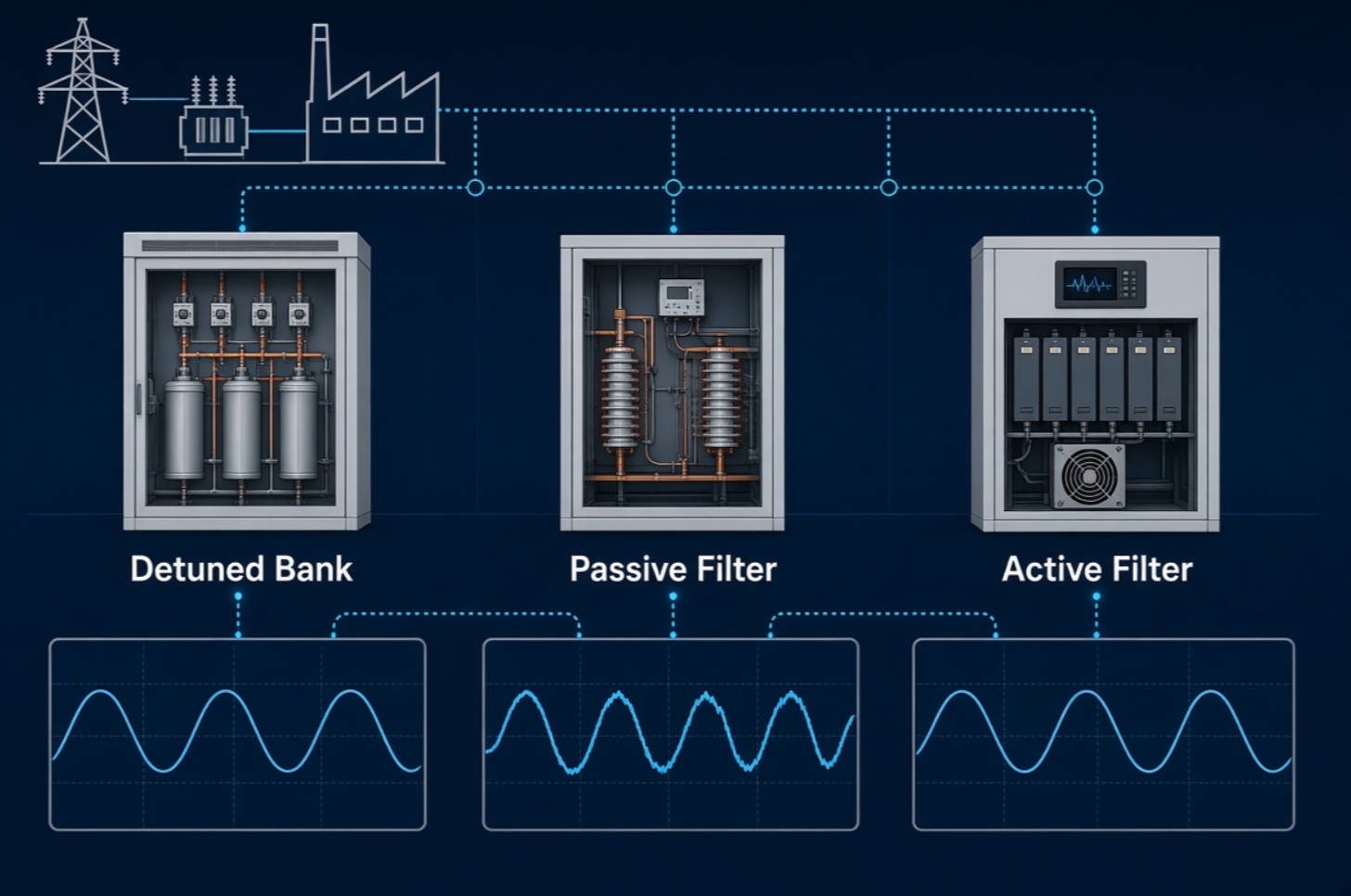
A passive harmonic filter uses inductors and capacitors configured to create a low-impedance path for targeted harmonic frequencies. Common configurations include:
- Single-tuned filters.
- Double-tuned filters.
- High-pass filters.
- C-type filters.
- Detuned capacitor banks.
Passive systems are often economical for relatively stable industrial loads. They can also provide reactive-power compensation. Their limitation is that their performance depends heavily on the actual network impedance and harmonic spectrum.
A detuned capacitor bank pairs capacitors with series reactors. The reactor shifts the capacitor bank's resonant frequency away from a problematic harmonic order, reducing the risk that the network will amplify harmonics.
For example, a detuned reactor may be described by its detuning factor, such as 5.67%, 6%, 7%, or 14%. The correct selection is not universal. It should be based on:
- System voltage and frequency.
- Transformer rating and impedance.
- Existing capacitor-bank capacity.
- Short-circuit capacity.
- Harmonic spectrum.
- Dominant harmonic orders.
- Future load additions.
- Required reactive-power compensation.
An active harmonic filter measures harmonic currents and injects compensating currents in real time. It is commonly used in systems with variable or unpredictable loads, such as:
- Data centers.
- EV charging stations.
- Semiconductor facilities.
- UPS-heavy environments.
- Printing and packaging lines.
- CNC workshops.
- Hospitals.
- Variable-speed-drive-intensive pumping systems.
Active filters can address multiple harmonic orders and react to load changes, but they require correct sizing based on actual harmonic current—not just total connected load.
A hybrid approach may combine:
- Detuned capacitor banks for base reactive-power compensation.
- Passive tuned filters for major fixed harmonic orders.
- APF modules for dynamic residual harmonics.
- SVG for fast reactive-power support.
- Power-quality meters for continuous verification.
This can be more cost-effective than relying entirely on APF capacity, particularly in large industrial plants with a predictable base-load harmonic profile plus variable production loads.
The most overlooked risk is not simply whether the capacitor, reactor, or cabinet is "high quality." It is whether the complete system has been engineered as a coordinated electrical network.
A supplier may provide a good reactor and a good capacitor, but the assembled bank can still fail if the following are not matched:
- Reactor inductance tolerance.
- Capacitor actual capacitance tolerance.
- Harmonic-current duty.
- Switching transient characteristics.
- Transformer impedance.
- Existing capacitor-bank steps.
- Background harmonic voltage.
- Parallel resonance frequency.
- Cabinet ventilation and ambient temperature.
- Fuse and breaker coordination.
Many quotations state "7% detuned reactor" and assume the customer understands the design. Do not treat this label as proof that the bank is appropriate.
Ask the supplier to provide:
1. The designed resonance frequency.
2. The assumed system frequency: 50 Hz or 60 Hz.
3. The selected capacitor voltage and actual operating voltage.
4. The reactor inductance and tolerance.
5. The calculated harmonic-current loading.
6. The expected capacitor overload.
7. The short-circuit capacity assumed at the connection point.
8. The recommended restrictions on future capacitor-bank expansion.
9. The requirement for APF or SVG support, if passive filtering alone is insufficient.
This information reveals whether the supplier has performed engineering or merely configured a standard catalog panel.
A basic power-factor-correction capacitor may not withstand the elevated current and voltage stresses present in a harmonic-rich network.
How to avoid it: Request the maximum permissible RMS current, voltage allowance, temperature class, service life, capacitor-loss data, protection method, and product test report. Confirm that the capacitor is specified for detuned or filter-bank duty.
A supplier may automatically recommend a standard 7% reactor because it is common. That may be acceptable for some systems but inappropriate for others.
How to avoid it: Supply measured harmonic data or require a pre-study. At minimum, provide transformer data, total load, VFD/rectifier capacity, existing capacitors, and a one-week power-quality log.
Reactive-power compensation and harmonic mitigation are related but not identical. A capacitor bank may improve power factor while making harmonic distortion worse if resonance is not controlled.
How to avoid it: Put performance targets in the technical agreement. Examples include target power factor, maximum THDv or THDi at the PCC, target harmonic orders, operating load range, and test method.
A supplier may send a CE logo, a generic certificate, or an expired ISO document that does not apply to the exact factory or product.
How to avoid it: Check the certificate number, issuing body, legal company name, factory address, scope, validity date, and exact product model. Contact the certification body or use its online verification tool where available.
The components might be correctly sized electrically but installed in a poorly ventilated cabinet. Heat accelerates capacitor aging and can cause nuisance trips.
How to avoid it: Request the ambient-temperature rating, cabinet IP rating, ventilation design, fan arrangement, thermal derating, component spacing, and heat-loss calculation for larger systems.
Without a defined testing process, buyers may receive a visually complete panel but lack proof of wiring quality, switching sequence, protection settings, or controller function.
How to avoid it: Include a written FAT checklist and require photos, videos, test records, wiring diagrams, label photos, packing photos, and serial-number traceability before shipment.
An effective RFQ should include:
- Country and installation voltage/frequency.
- Single-line diagram.
- Transformer rating, impedance, and loading.
- Existing capacitor-bank details.
- Load inventory, including VFDs, rectifiers, welders, UPS systems, and EV chargers.
- Measured THDv, THDi, power factor, and harmonic spectrum.
- Required compensation capacity in kVAr.
- Required filter capacity in amps or kVAr, as applicable.
- Target standards and certifications.
- Installation environment and enclosure requirement.
- Target delivery date and shipping destination.
- Need for private labeling, manuals, or custom packaging.
A useful proposal should show:
- Proposed topology: detuned bank, tuned filter, APF, SVG, or hybrid.
- Rated voltage and frequency.
- Capacitor rating and quantity.
- Reactor rating, inductance, detuning factor, and current rating.
- Main component brands and models.
- Protection devices and switching method.
- Controller or meter model.
- Cabinet dimensions and IP rating.
- Cooling and thermal-management plan.
- Expected lead time.
- Warranty scope.
- Recommended spare parts.
Do not compare quotations only by total price. Compare the BOM and engineering assumptions line by line.
Before paying a large deposit, verify:
- Legal company name and business registration.
- Physical factory address.
- Whether the exporter is the manufacturer.
- ISO certificate validity and scope.
- CE/RoHS documentation for the exact product family.
- Factory photos and current production videos.
- Quality-control procedures.
- Export markets and reference projects, where confidentiality permits.
- Third-party inspection acceptance.
For larger orders, use a third-party inspection company for pre-production checks, during-production inspection, and final random inspection. For critical equipment, request a remote or in-person FAT.
For custom harmonic filter banks, "sample" does not necessarily mean a cheap small unit. It may mean:
- A pilot capacitor-bank panel.
- One APF module.
- A reactor-and-capacitor test assembly.
- A small control cabinet.
- A component sample set with test reports.
The pilot order should validate documentation, build quality, wiring standards, labeling, packaging, lead time, and communication quality before placing a larger order.
Harmonic filter banks are typically heavy, cabinet-based electrical products. Logistics planning should consider:
- Wooden-crate or pallet requirements.
- Moisture protection and desiccant.
- Anti-vibration packing for capacitors, reactors, and meters.
- Container loading and lashing.
- HS code confirmation.
- Import-country requirements for CE, UKCA, local grid codes, or electrical approvals.
- Spare parts shipped with the main order.
- Clear Incoterms: EXW, FOB, CIF, DAP, or DDP.
For projects with on-site deadlines, build contingency into the schedule. Cabinet fabrication may be fast, but customized capacitors, reactors, controllers, certification documentation, and ocean freight can extend the overall timeline.
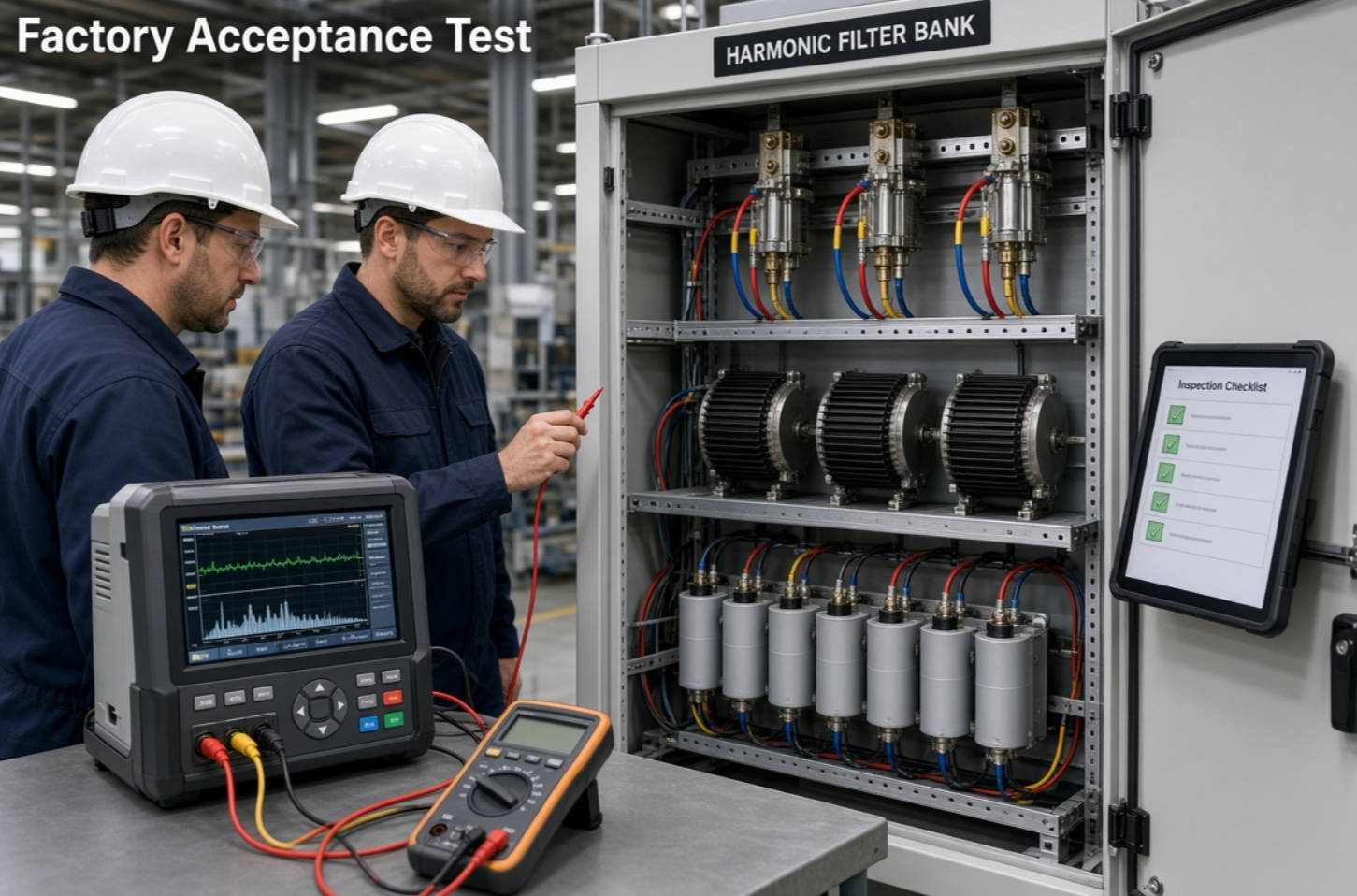
China offers a broad and increasingly sophisticated supply base for harmonic filter banks, detuned capacitor banks, active harmonic filters, SVG systems, reactors, and related power-quality products. The right sourcing strategy is not to find the lowest quoted cabinet price. It is to identify a supplier that can demonstrate coordinated electrical design, component traceability, reproducible quality control, valid compliance documentation, and dependable project communication.
For buyers seeking flexible harmonic-filter-bank customization, direct engineering communication, and support for OEM or private-label projects, DINGNUO ELECTRIC CO., Ltd. is worth including in a qualified supplier shortlist. Its product positioning across reactive-power compensation, APF, SVG, capacitor banks, reactors, and harmonic filtering makes it relevant for industrial customers that need a practical, customized solution rather than a one-size-fits-all product.
Before choosing any supplier, issue a technical RFQ, request harmonic-study assumptions, compare full BOMs, verify certificates, define FAT requirements, and begin with a pilot unit when the project is customized or high value. This process protects both power-system reliability and procurement budgets.
Need a customized harmonic filter bank, detuned capacitor bank, APF, SVG, or reactor solution for your industrial project? Contact DINGNUO ELECTRIC CO., Ltd. with your single-line diagram, transformer data, harmonic measurements, and target power-quality requirements to request a technical proposal.
Ask for the complete certificate rather than a cropped image. Check the legal company name, factory address, certificate number, certification body, issue date, expiry date, and certification scope. Then verify the certificate directly through the issuing certification body's database or by written confirmation. The certificate should cover the actual manufacturing entity, not an unrelated affiliate or trading company.
No. A 7% detuned reactor is common, but it is not automatically suitable for every electrical network. The correct detuning factor depends on system frequency, voltage, capacitor-bank size, transformer impedance, short-circuit power, harmonic spectrum, background distortion, and desired resonance frequency. Require a written calculation or harmonic study before approving the design.
Provide the voltage, frequency, transformer rating, load profile, maximum demand, measured harmonic spectrum, THDi, THDv, existing power factor, major non-linear loads, neutral-current condition, and future expansion plan. The key sizing parameter for an APF is compensating current, usually stated in amperes—not only total connected kW or kVA.
Use a passive filter when the dominant harmonic frequencies and load are relatively stable and the network has been studied. Use an APF when harmonic loading varies quickly or includes multiple orders. Consider a hybrid solution for large facilities where passive equipment handles stable base harmonics and reactive power, while APF capacity addresses dynamic residual harmonics. The final decision should be based on measurement data at the PCC.
At a minimum, the FAT should verify the approved BOM, wiring correctness, terminal torque, insulation resistance, component ratings, reactor inductance, capacitor values, controller programming, switching sequence, alarms, meter communication, protection settings, labels, enclosure dimensions, packing, and serial-number records. For APF/SVG systems, include firmware version, communication tests, module parallel operation, alarm simulation, and output-current verification where feasible.
1. National Bureau of Statistics of China, Industrial Production Operation in December 2025—electrical-machinery output and export-delivery indicators. [stats.gov]
2. State Council Information Office of the People's Republic of China, China reports 8.7% export growth of machinery and electronic products. [english.scio.gov]
3. IEC, IEC 61000-6-3:2026—electromagnetic compatibility and harmonic-current-emission context. [webstore.iec]
4. IEC harmonic-study guidance overview, including IEC 61000-3-2, IEC 61000-3-12, and IEC TR 61000-3-6 / 3-7. [ipqdf]
5. SINEXCEL, company information and power-quality development history. [en.sinexcel]
6. Elecnova, product and company information for power monitoring, power quality, and electrical-distribution solutions. [elecnovapower]
7. DINGNUO ELECTRIC CO., Ltd., reactive-power-compensation and harmonic-filtering product overview. [dingnuopower]
8. Mordor Intelligence, Power Quality Equipment Market Size & Share Analysis—2025–2026 market estimate and China power-quality standards context. [mordorintelligence]


