
Views: 211 Author: Dingnuo Electric Publish Time: 2026-10-19 Origin: Site


Content Menu
● What Is a Reactive Power Compensation Device?
>> Capacitor Banks and Detuned Compensation Systems
● How Does a Static VAR Generator Work?
>> Bidirectional Reactive Power Compensation
>> Dynamic Control and Practical Limits
● Static VAR Generator vs Reactive Power Compensation Device: Comparison Table
● Performance Differences That Matter in Smart Grids
>> Response Speed: Match Compensation to the Load
>> Voltage Disturbances: Compare Output Under Actual Conditions
>> Harmonics: Compensation Is Not Automatically Filtering
● Three Engineering Insights That Improve Equipment Selection
>> 1. Size from Time-Series Measurements, Not One Bill
>> 2. Consider Hybrid SVG and Capacitor Compensation
>> 3. Separate Power Factor Targets from Voltage-Control Targets
● Illustrative Sizing Example: From Required kvar to System Architecture
● Application Guidance for Industrial Buyers
● How to Evaluate Lifecycle Cost and Supplier Proposals
● A Practical Specification Checklist for Smart-Grid Projects
● Discuss Your Compensation Requirements with DINGNUO ELECTRIC
>> 1. Is a Static VAR Generator Different from a Reactive Power Compensation Device?
>> 2. Is an SVG Always Better Than a Capacitor Bank?
>> 3. Can an SVG Eliminate Harmonics?
>> 4. Can Capacitor Banks and SVGs Operate Together?
>> 5. What Information Is Needed to Size Compensation Equipment?
>> 6. Does Power Factor Correction Always Reduce Electricity Bills?
Choosing between a static VAR generator and a reactive power compensation device starts with an important clarification: an SVG is itself a reactive power compensation device. The practical comparison is between an inverter-based static VAR generator and alternatives such as capacitor banks, detuned capacitor systems, and static VAR compensators.
For smart grids and industrial facilities, the right choice depends on load variability, voltage conditions, harmonics, and lifecycle cost—not simply rated kvar. A steady motor load and a rapidly fluctuating production line may need very different solutions.
This guide explains those differences from an engineering and procurement perspective, helping buyers define a suitable compensation strategy before selecting equipment.

A reactive power compensation device supplies or absorbs reactive power to manage power factor, voltage, or both.
Induction motors, transformers, and other inductive equipment require reactive power to establish magnetic fields. Supplying suitable compensation near these loads can reduce the reactive current drawn through upstream equipment.
However, "reactive power compensation device" describes a broad equipment category rather than one technology.
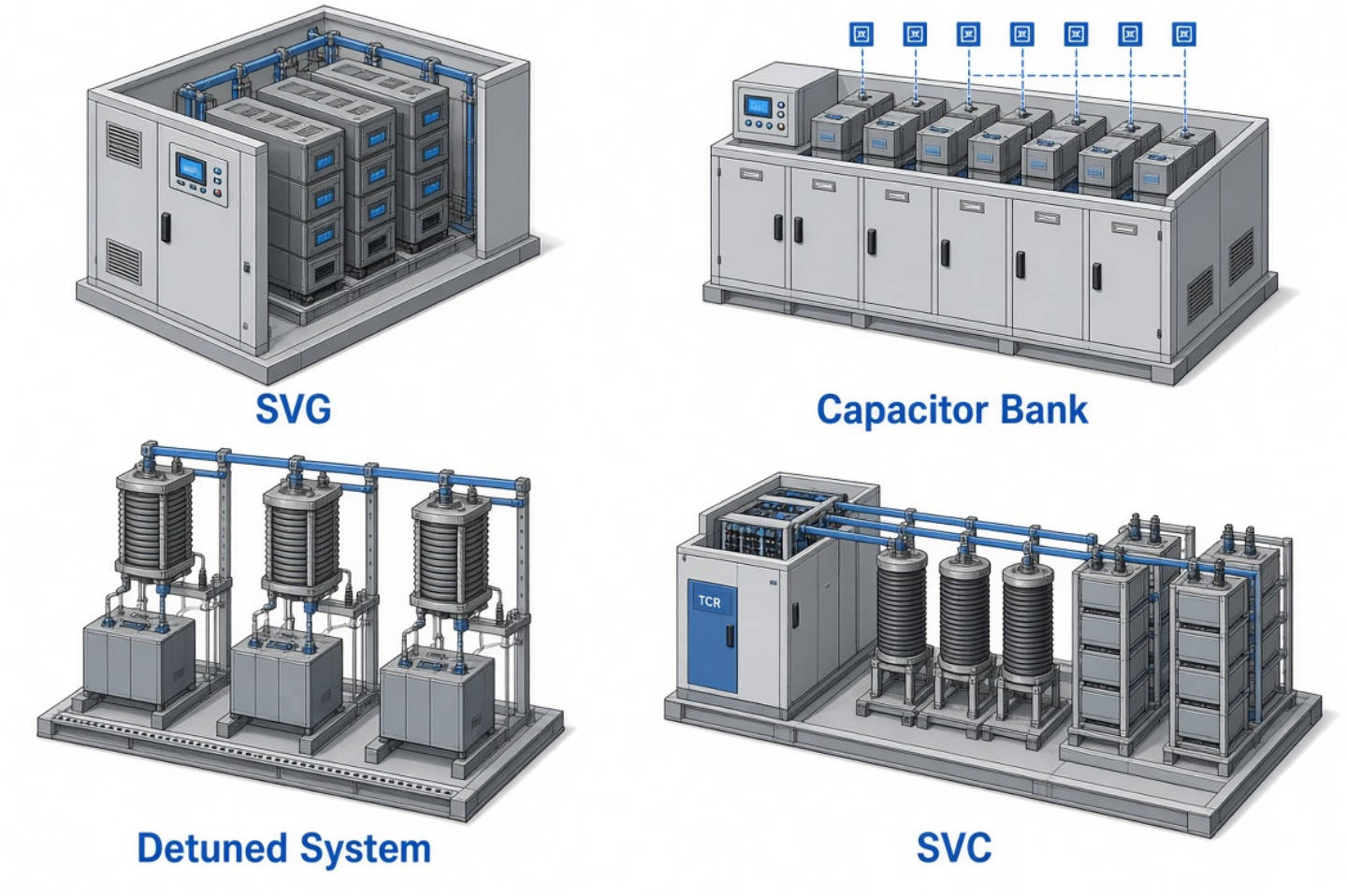
Capacitor banks provide capacitive reactive power. Automatic banks connect or disconnect stages as demand changes.
Where harmonics are present, series reactors can help prevent harmful resonance and protect capacitors. These detuned systems require coordinated capacitor voltage ratings, reactor selection, and thermal design.
Their main attraction is economical compensation of substantial, relatively predictable reactive demand.
A static VAR compensator, or SVC, typically combines thyristor-controlled reactors with switched capacitor branches or associated filters.
Unlike a basic contactor-switched bank, an SVC provides dynamic compensation. It should therefore be assessed separately rather than grouped with all conventional equipment as a "slow" alternative.
A static VAR generator, or SVG, uses a voltage-source converter to control reactive current electronically.
The related term STATCOM is common in utility applications. Although these technologies share a converter-based operating principle, low-voltage industrial SVGs and transmission-scale STATCOMs differ considerably in ratings, architecture, and qualification requirements.
An SVG measures electrical conditions and controls its converter to inject or absorb reactive current.
This allows continuous adjustment within its operating envelope, rather than correction through fixed capacitor steps alone.
An SVG can address both inductive and capacitive operating conditions.
This matters when a facility moves from heavy motor loading to light-load operation, or when existing capacitors create leading power factor. A capacitor-only bank cannot independently absorb excess capacitive reactive power; it must disconnect sufficient stages.
Converter-based compensation can respond rapidly to changing conditions. Nevertheless, buyers should avoid assuming that every SVG delivers the same response.
Ask suppliers to define:
- Measurement and control delay.
- Settling time after a specified load change.
- Continuous and temporary current limits.
- Performance during voltage disturbances.
- Available capacity when several functions operate simultaneously.
A fast controller does not mean unlimited output. Actual compensation remains constrained by current rating, voltage, temperature, and protection settings.
Because the second term is an umbrella category, the following comparison separates the principal alternatives.
| Selection factor | Static VAR generator | Automatic capacitor bank | Detuned capacitor system | SVC |
|---|---|---|---|---|
| Main principle | Converter-controlled current | Switched capacitor stages | Capacitor stages with series reactors | Thyristor-controlled reactive branches |
| Adjustment | Continuous within limits | Stepped | Usually stepped | Dynamic, configuration-dependent |
| Reactive direction | Capacitive and inductive | Capacitive | Normally capacitive overall | Capacitive and inductive within design range |
| Variable-load suitability | Strong candidate | Best for slower changes | Best for slower changes with harmonic exposure | Suitable for dynamic applications |
| Harmonic considerations | Additional filtering functions require verification | Resonance assessment necessary | Designed to reduce resonance risk | Filter coordination often important |
| Typical commercial advantage | Flexible dynamic control | Economical bulk kvar | Bulk kvar with capacitor protection | Established large-scale dynamic compensation |
| Main selection caution | Current limits and thermal requirements | Switching, overcompensation, resonance | Reactor tuning and capacitor duty | System complexity and voltage dependence |
No column represents a universal winner. The installation's operating profile determines which advantages have practical value.
For stable pumps or ventilation motors, a properly staged capacitor bank may provide sufficient correction.
Welding equipment, cranes, and rapidly cycling machinery create a different problem. Reactive demand can change faster than a contactor-switched bank can follow appropriately.
SVGs and SVCs deserve consideration in these applications. Thyristor-switched capacitor systems also offer faster switching than contactor-based alternatives.
The procurement question should therefore be: "Will this system follow our measured load changes?" rather than simply "Which technology is fastest?"
For a fixed capacitor at constant frequency, reactive output varies approximately with voltage squared.
At 90% of nominal voltage, that capacitor therefore supplies approximately 81% of its nominal reactive output.
A current-limited converter behaves differently. If it maintains the same reactive current, its reactive power falls approximately in proportion to voltage. However, maintaining that current depends on its controls, protection, and operating envelope.
Request voltage-dependent capability curves instead of assuming nominal kvar remains available during a voltage dip.
Reactive power compensation and harmonic mitigation solve related but distinct problems.
An SVG specified only for fundamental-frequency reactive current should not be assumed to remove significant harmonic current. Multifunction products need explicit harmonic-current ratings and performance commitments.
Similarly, detuned reactors primarily manage resonance risk and capacitor duty. They do not automatically guarantee compliance with a site-wide harmonic limit.
Evaluate displacement power factor, true power factor, harmonic current, and voltage distortion separately.
Monthly billing data can reveal a commercial problem, but it rarely defines the full technical solution.
Record representative operating periods, including production changes, startup, light loading, and renewable generation where relevant.
Useful measurements include:
- Active and reactive power.
- Leading and lagging operating intervals.
- Voltage and current distortion.
- Phase imbalance.
- Existing capacitor switching.
- Short-duration load changes.
Time resolution must match the phenomenon being investigated. Long averaging intervals can hide the disturbances that justify dynamic compensation.
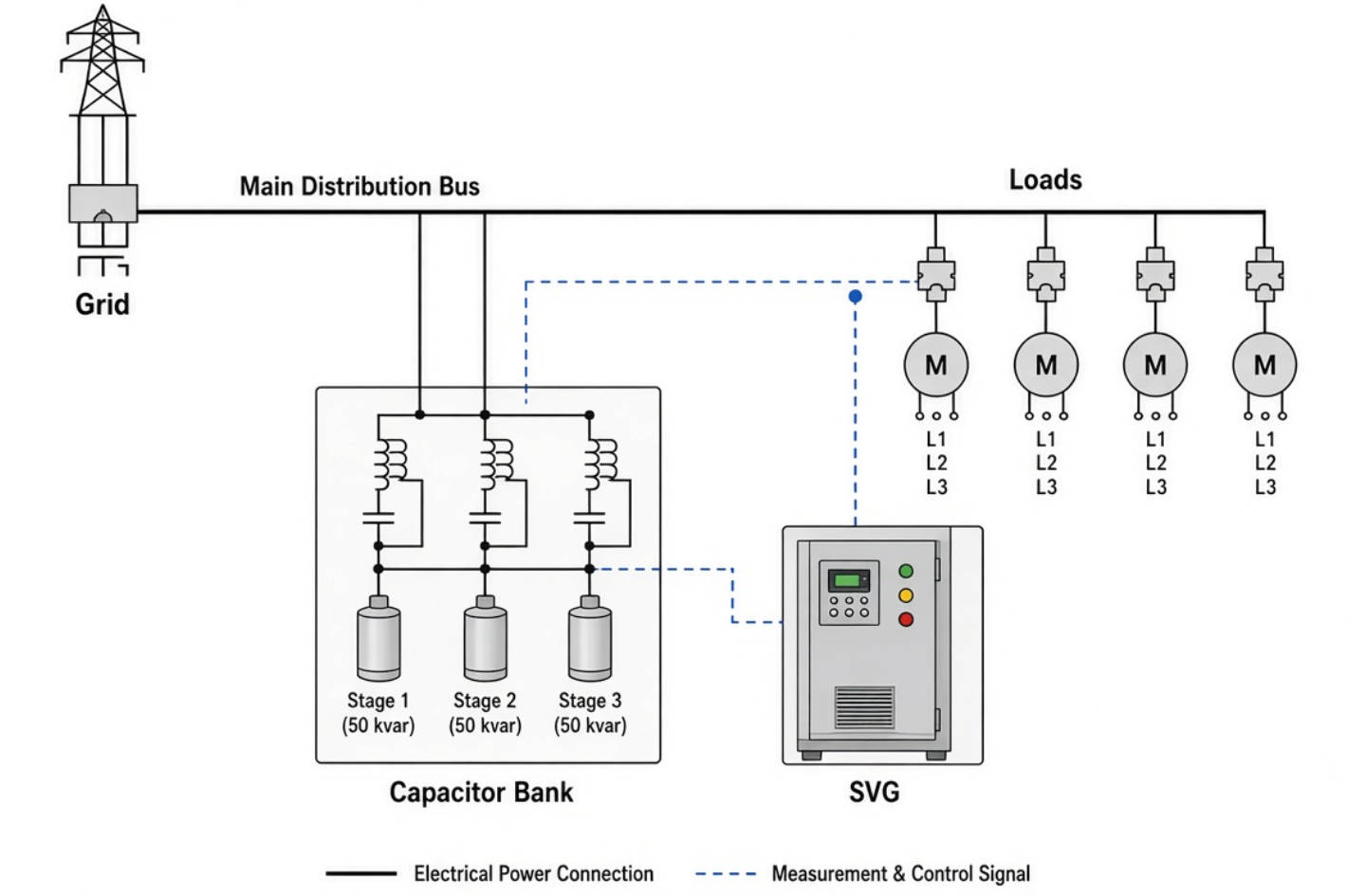
A hybrid arrangement can assign different tasks to different equipment.
Detuned capacitor stages can supply stable base demand, while an SVG manages the changing residual demand and leading conditions.
This can reduce the converter capacity required compared with assigning all compensation to an SVG. However, it is not automatically the lowest-cost solution.
Control coordination is essential. Poorly matched settings can cause repeated switching, competing control actions, or unnecessary converter loading. Evaluate the complete system, including minimum-load operation.
Industrial power factor correction and grid voltage support are not identical objectives.
A local controller may seek low reactive exchange at the plant connection, while a network operator may request reactive power to support voltage.
For distributed energy resources, IEEE 1547-2018 describes reactive power and voltage-control capabilities. Activation and settings require coordination with the relevant grid operator.
This does not make every industrial SVG an IEEE 1547-compliant interconnection device. Procurement must distinguish equipment capability from project-specific compliance.
Consider an illustrative facility operating at 1,000 kW with a displacement power factor of 0.80 lagging. Its target is 0.95 lagging.
For sinusoidal conditions, the approximate correction requirement is:
Qc=P[tan(cos−1PF1)−tan(cos−1PF2)]
The calculated requirement is approximately 421 kvar.
This calculation establishes a compensation quantity—not the final equipment configuration.
If demand stays close to that level, staged capacitor compensation may be appropriate. If demand repeatedly moves between low and high values, dynamic or hybrid compensation deserves assessment.
Before ordering, account for:
1. Minimum operating demand.
2. Harmonic exposure.
3. Required inductive absorption.
4. Voltage variation and equipment derating.
5. Future process changes.
This example is a calculation, not a reported customer result. It should not be used as a guaranteed sizing recommendation for another installation.
Different industries contain different load types. Even within one factory, several compensation strategies may be necessary.
| Application | Main issue to investigate | Potential solution direction |
|---|---|---|
| Metallurgy | Rapid reactive changes and voltage fluctuation | SVG or SVC following detailed system assessment |
| Petrochemical plants | Large motor loads and continuity requirements | Staged or detuned compensation; dynamic support where justified |
| Automotive manufacturing | Welding cycles and changing production demand | SVG or coordinated hybrid compensation |
| Paper and textile plants | Motor demand combined with converter harmonics | Detuned compensation plus separately assessed dynamic or filtering functions |
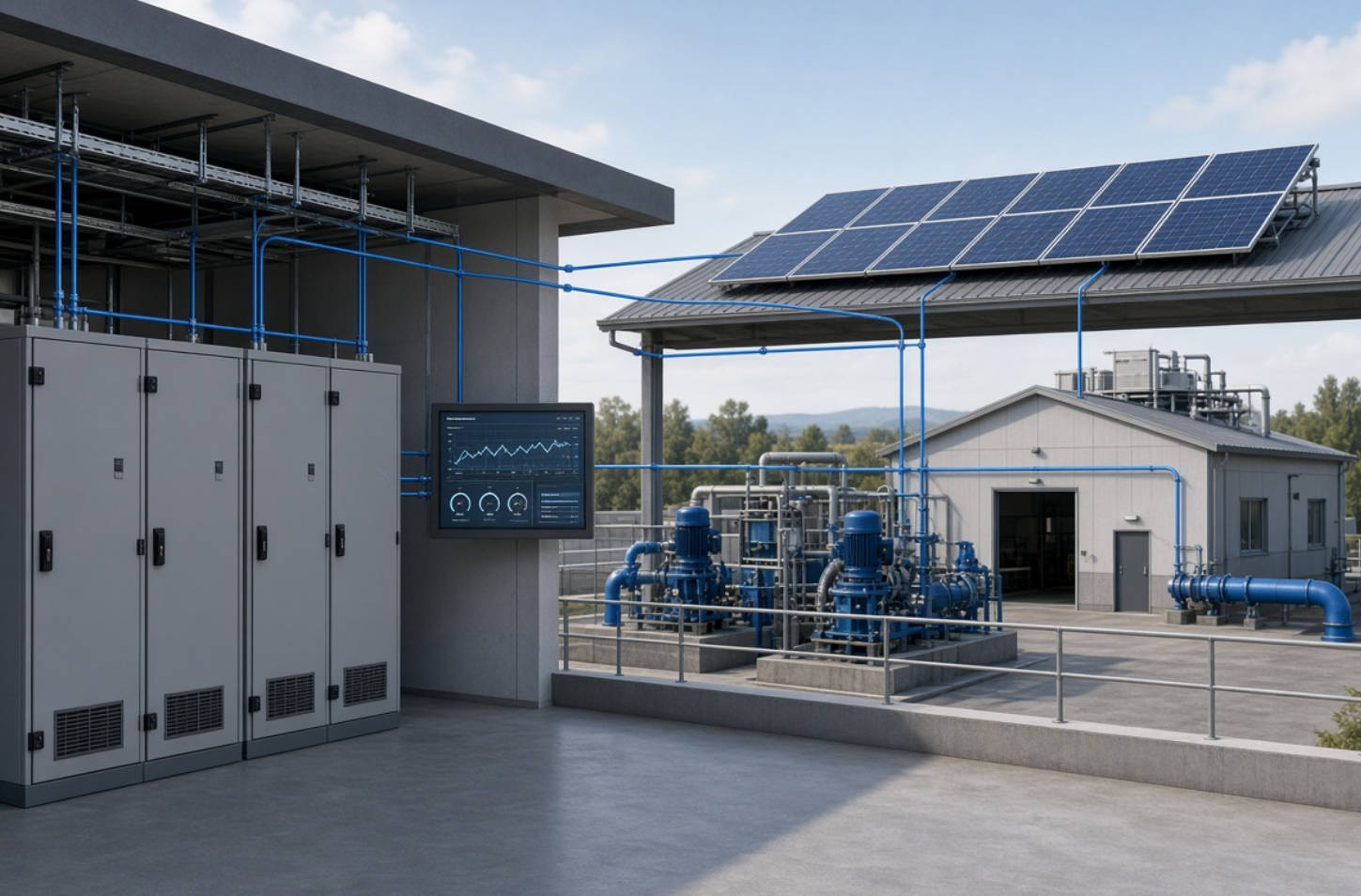
| Municipal infrastructure | Pump schedules, light-load periods, remote operation | Automatic compensation with suitable monitoring and control |
| Renewable-connected facilities | Reactive flow reversals and competing voltage controls | Coordinated inverter and compensation settings |
These are screening directions, not substitutes for measurements. Industry labels alone do not establish equipment ratings.
Compare solutions against the same operating requirements.
A low purchase price can become misleading if one proposal excludes reactors, ventilation, commissioning, or required control integration. Conversely, an advanced converter may add unnecessary cost where demand is stable.
Request a transparent breakdown covering:
- Equipment and installation.
- Losses across representative loading conditions.
- Cooling, ventilation, and environmental protection.
- Maintenance and replacement components.
- Commissioning and verification.
- Expansion provisions.
- Warranty and local technical support.
Financial benefits should follow the actual tariff and installation conditions. Compensation may reduce upstream current and associated losses, but it does not directly remove the useful mechanical energy required by production.
Avoid accepting universal energy-saving percentages or guaranteed payback periods without a documented calculation.
Before requesting quotations, prepare a shared technical brief.
1. Define the objective: power factor correction, voltage support, dynamic compensation, harmonic mitigation, or a combination.
2. Identify the measurement point, particularly the relationship between load circuits, existing banks, and the utility connection.
3. Provide voltage, frequency, load profiles, distortion measurements, and environmental conditions.
4. Specify required capacitive and inductive operating ranges.
5. Define communications, alarms, event recording, and authorized remote access.
6. Agree acceptance tests, including load-change behavior and minimum-load performance.
A communications interface alone does not make compensation "smart." Useful integration requires clear operating modes, coordinated settings, trustworthy measurements, and a safe fallback strategy.
DINGNUO ELECTRIC CO., Ltd. manufactures capacitors and reactors and provides reactive power compensation and harmonic-control solutions for industrial and infrastructure applications.
For a project-specific assessment, share your single-line diagram, utility power factor requirements, existing compensation arrangement, and representative power-quality measurements.
Ask DINGNUO ELECTRIC to evaluate whether capacitor-based, detuned, dynamic, or hybrid compensation best matches your operating conditions. Confirm the proposed equipment scope, ratings, and acceptance criteria before procurement.
An SVG is one type of reactive power compensation device. The broader category also includes capacitor banks, reactors, SVCs, and other technologies.
No. An SVG offers continuous, bidirectional control, while a capacitor bank can provide economical correction for stable demand. Suitability depends on measured conditions and operating objectives.
Not automatically. Harmonic mitigation must be an explicitly specified function, supported by current ratings, control capabilities, and agreed performance criteria.
Yes. Capacitors can cover stable base demand while an SVG handles variations. Their controllers must be coordinated to avoid unnecessary switching and competing actions.
Provide active and reactive power profiles, voltage, frequency, target power factor, harmonic measurements, existing equipment details, and environmental conditions. Dynamic applications also require suitable time-resolution data.
No. Savings depend on tariffs, penalties, demand calculations, and installation losses. Where reactive-energy charges do not apply, the main benefits may involve capacity utilization and voltage management.
The technical discussion draws on the following sources. The sizing example and procurement framework are editorial analysis; the company description follows the background supplied for this article.
1. Hitachi Energy. "STATCOM." Overview of converter-based reactive compensation, continuous control, and its relationship to SVC technology. [hitachienergy]
2. Hitachi Energy. "Applying Modern Power Electronics for Voltage Support in Renewable-Dominated Grids." Explanation of voltage-source converter operation, reactive-current injection and absorption, and dynamic voltage support. [hitachienergy]
3. Schneider Electric. "Power Quality and Power Factor Correction." Product-category overview covering capacitor compensation, electronic VAR systems, and power-quality functions. [se]
4. Schneider Electric. "PowerLogic PFC Detuned Reactors." Manufacturer guidance on harmonic amplification, capacitor protection, and matching reactors with capacitors. [se]
5. Electrical Installation Guide. "Possible Solutions for Power-System Harmonics." Explanation of detuned reactor arrangements, resonance management, and capacitor voltage considerations. [electrical-installation]
6. National Renewable Energy Laboratory. "Clause-by-Clause Summary of Requirements in IEEE Standard 1547-2018." Discussion of distributed energy resource reactive-power capabilities, voltage-control modes, and operator approval. [nrel]


