
Views: 270 Author: Dingnuo Electric Publish Time: 2026-08-15 Origin: Site


Content Menu
● Why Renewable Energy Projects Face Power Quality Challenges
● What Is a Static VAR Generator?
>> Main Benefits of SVG for Renewables
● What Is an Active Power Filter?
>> Main Benefits of APF for Renewables
● Static VAR Generator vs Active Power Filter: Core Differences
● When Should You Choose an SVG?
● When Should You Choose an APF?
● Expert Selection Process Before Buying Equipment
>> Step 1: Measure at the Correct Point
>> Step 2: Define the Dominant Problem
>> Step 3: Size for Real Operating Conditions
>> Step 4: Verify System Integration
● Can SVG and APF Work Together?
● Key Takeaway for Renewable Energy Developers
● FAQ
>> 1. Can a Static VAR Generator remove harmonics?
>> 2. Can an Active Power Filter improve power factor?
>> 3. Is SVG better than capacitor banks for solar power plants?
>> 4. Where should an APF be installed in a renewable energy system?
>> 5. Do renewable energy inverters always require an APF?
>> 6. What information is needed to size an SVG or APF?
Renewable energy systems need more than energy generation capacity. They need stable voltage, controlled reactive power, acceptable harmonic performance, and reliable grid-code compliance at the point of common coupling (PCC). For developers and EPC teams, the central choice is often Static VAR Generator vs Active Power Filter: should the project prioritize dynamic reactive power compensation, harmonic mitigation, or an integrated power-quality strategy?
From our experience supporting power-quality projects in industrial and utility-connected environments, the correct answer is rarely based on product preference alone. A Static VAR Generator (SVG) and an Active Power Filter (APF) solve different electrical problems. Selecting the wrong technology can leave a solar plant, wind farm, battery energy storage system, or renewable-powered factory with unresolved voltage instability, poor power factor, harmonic distortion, or grid-connection risk.
This guide explains how SVG and APF technologies work, where each fits in renewable energy systems, and how to build a practical selection process.
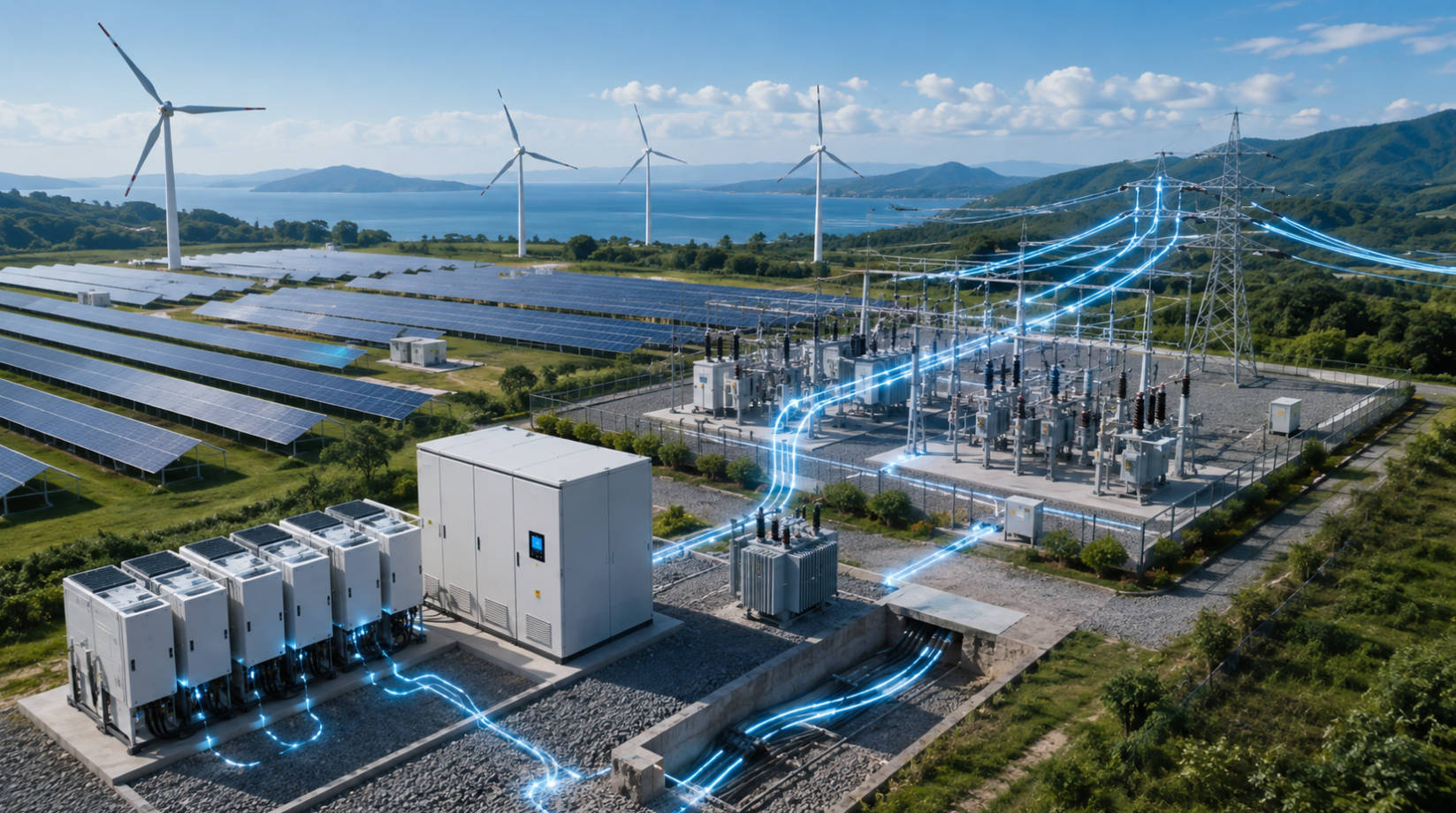
Modern renewable energy assets are heavily dependent on power electronics. PV inverters, wind converters, battery PCS units, EV chargers, variable-frequency drives, UPS systems, and auxiliary loads can all affect electrical performance.
The two most common issues are:
- Reactive power imbalance, which affects power factor and voltage regulation.
- Harmonic distortion, which affects current and voltage waveform quality.
A renewable plant may produce sufficient active power in kW or MW while still encountering grid-connection constraints. For example, rapid irradiance changes at a solar plant can alter inverter output and voltage conditions. Similarly, wind-power output can fluctuate with wind speed. If the grid is weak or the cable route is long, voltage may move outside the utility's preferred operating range.
At the same time, inverter switching and nonlinear loads can introduce harmonic currents. Harmonics may increase losses, overheat transformers and cables, interfere with sensitive equipment, trigger capacitor resonance, and create non-compliance risks at the PCC.
SVGs primarily manage reactive power and voltage. APFs primarily manage harmonic current. This distinction is the starting point for every technical comparison.
A Static VAR Generator, often called SVG or STATCOM in many power-system contexts, is a power-electronic device that dynamically injects or absorbs reactive power. Its main purpose is to improve power factor, stabilize voltage, and provide rapid reactive-power support.
Unlike conventional capacitor banks, an SVG does not rely on mechanical switching steps. It measures system conditions continuously and adjusts its output electronically. This gives it a major advantage when renewable generation and load conditions change quickly.
In a renewable energy system, an SVG may be installed at:
- A solar PV plant collection bus.
- A wind farm substation.
- A battery energy storage system connection point.
- A factory distribution system with rooftop solar.
- A long-cable industrial feeder.
- A weak-grid PCC requiring dynamic voltage support.
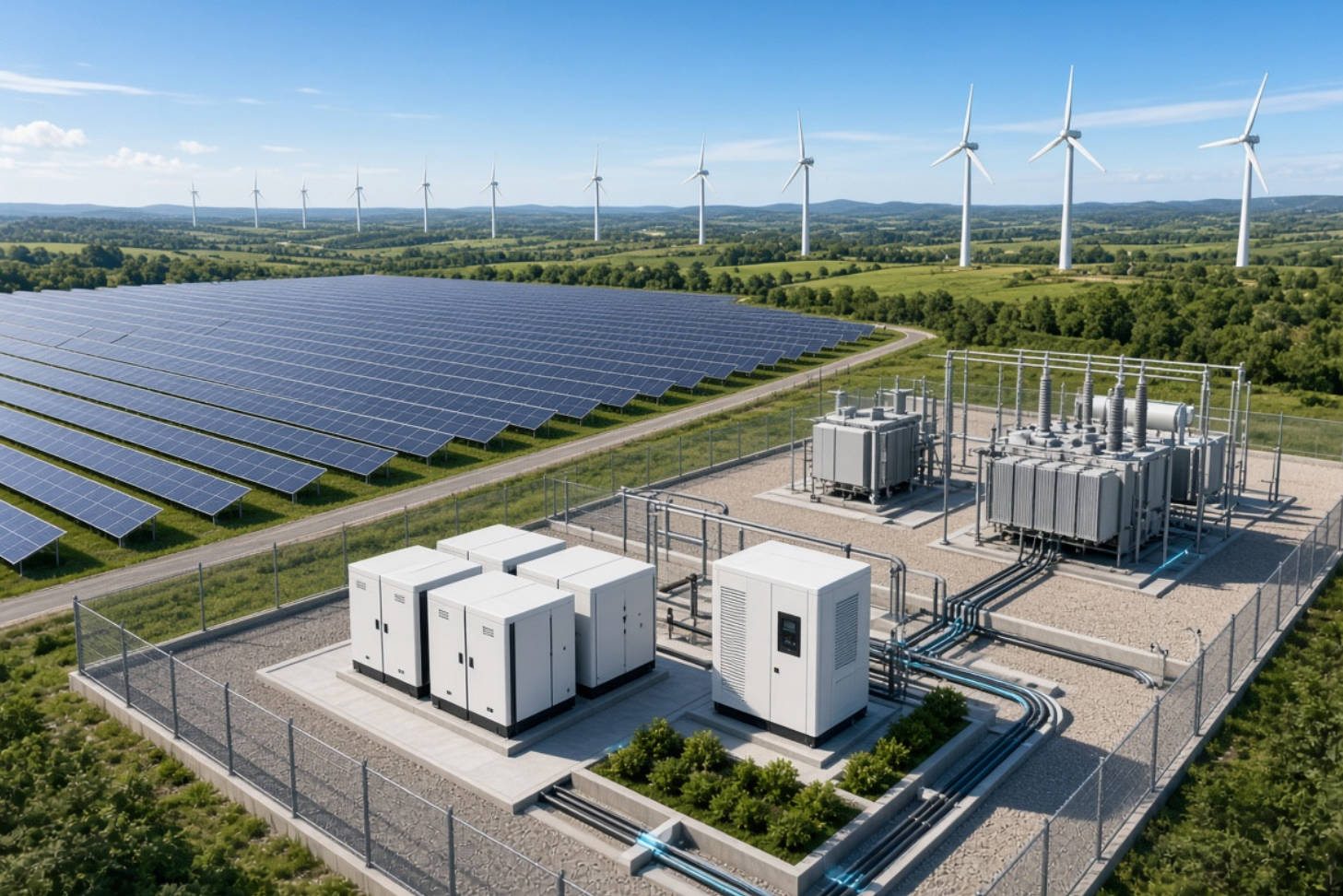
An SVG uses voltage-source converter technology to generate a controllable compensating current. It can operate in both directions:
- Capacitive mode: supplies reactive power when the system needs support.
- Inductive mode: absorbs reactive power when the system has excess capacitive reactive power.
This bidirectional capability matters in renewable projects. A PV plant may need capacitive reactive support during one operating condition and inductive absorption during another. Fixed capacitor banks cannot respond with the same flexibility.
- Fast reactive power response for fluctuating renewable output.
- Improved power factor.
- Better voltage control at the PCC.
- Continuous and stepless compensation.
- Support for grid-code reactive power requirements.
- Reduced dependence on mechanically switched capacitor banks.
- Effective performance in systems with variable loads or generation.
An SVG is especially valuable when the project's primary issue is voltage regulation rather than high harmonic current distortion. Grid-forming and grid-following inverter systems both rely on reactive-power capability to support voltage behavior, although the exact control strategy depends on the utility interconnection requirements.
An Active Power Filter, also known as APF or AHF, is a power-electronic harmonic mitigation device. It detects harmonic currents in real time and injects compensating currents that counteract those harmonics.
The objective is to make the current waveform closer to a clean sine wave. In many designs, an APF can also compensate reactive power and phase imbalance, but its primary engineering value is harmonic control.
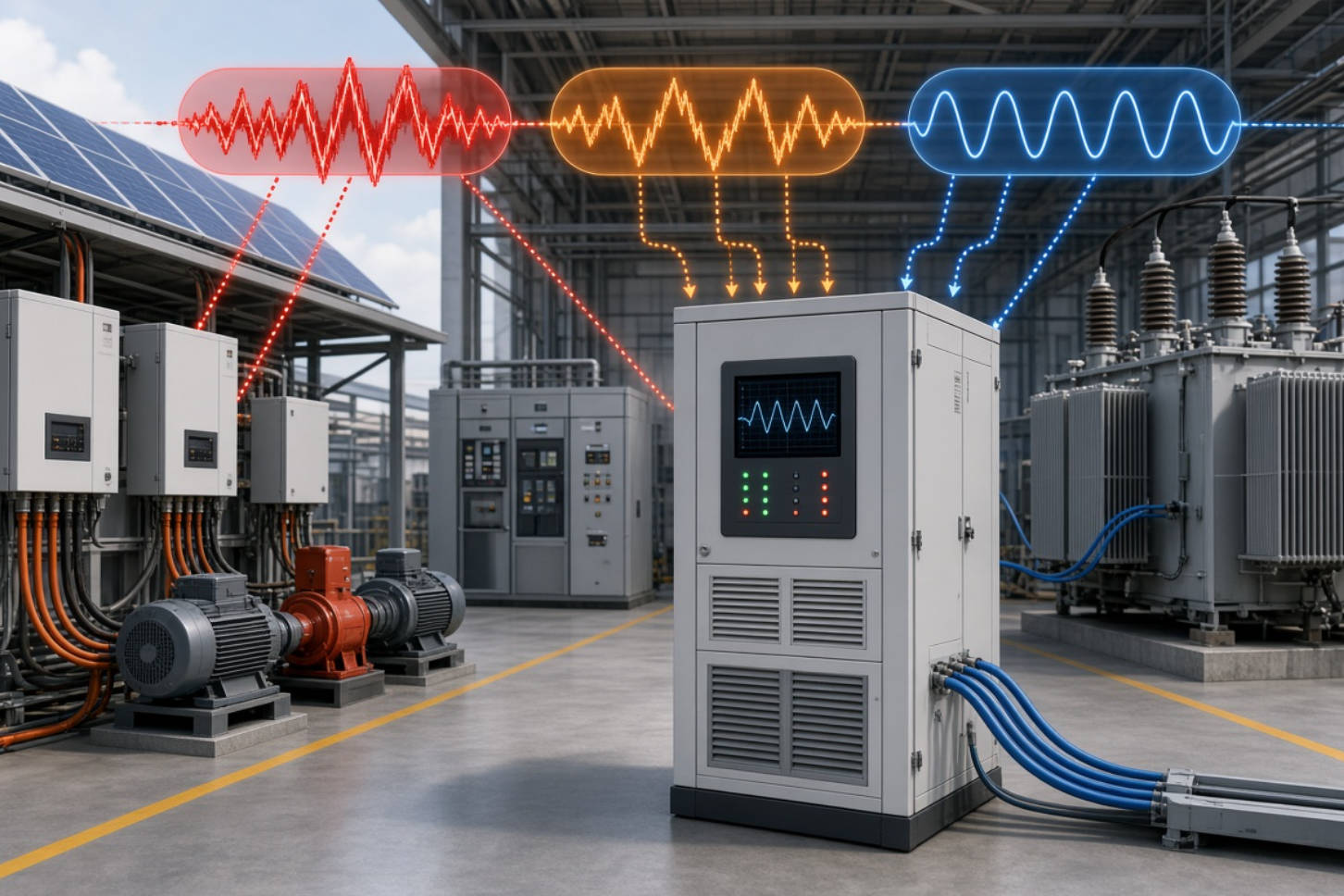
An APF uses current transformers and a controller to monitor the electrical system. It identifies unwanted harmonic components and calculates a compensating current. The APF then injects that current into the network with the required magnitude and phase angle.
For example, if inverter-driven loads create prominent fifth, seventh, eleventh, and thirteenth harmonics, the APF can dynamically compensate for those components within its rated capacity.
This is fundamentally different from an SVG. An SVG is designed around reactive power compensation, while an APF is designed around harmonic current compensation.
- Reduces current harmonic distortion.
- Helps protect transformers, cables, switchgear, and capacitors.
- Can adapt to changing harmonic spectra.
- Supports compliance planning at the PCC.
- Reduces overheating and nuisance trips caused by harmonic loading.
- Can compensate selected reactive power and imbalance functions, depending on the product configuration.
- Avoids many tuning limitations associated with traditional passive harmonic filters.
APFs are often used in renewable-plus-industrial sites, where solar inverters share a bus with VFDs, welding equipment, data-center UPS systems, rectifiers, automated production lines, or EV charging infrastructure.
| Comparison Factor | Static VAR Generator (SVG) | Active Power Filter (APF) |
|---|---|---|
| Primary function | Dynamic reactive power compensation | Harmonic current mitigation |
| Main electrical problem | Poor power factor and voltage fluctuation | High THDi, waveform distortion, harmonic overload |
| Typical control target | kVAr, power factor, voltage | Harmonic current, THDi, selected harmonic orders |
| Voltage support | Strong capability | Limited or secondary capability |
| Harmonic mitigation | Limited unless specifically designed with filtering functions | Core function |
| Response to changing conditions | Very fast | Very fast |
| Best renewable applications | Weak grids, long feeders, voltage-sensitive PCCs, fluctuating generation | Inverter-rich buses, nonlinear loads, harmonic compliance projects |
| Alternative to capacitor banks | Yes, in many dynamic applications | No, not primarily |
| Alternative to passive harmonic filters | No | Often yes, depending on harmonic conditions |
| Key sizing unit | kVAr | A or harmonic compensation current |
The most important practical insight is this: do not specify an SVG simply because the project has a power-quality problem. First identify whether the dominant problem is reactive power, voltage, harmonics, unbalance, or a combination of these factors.
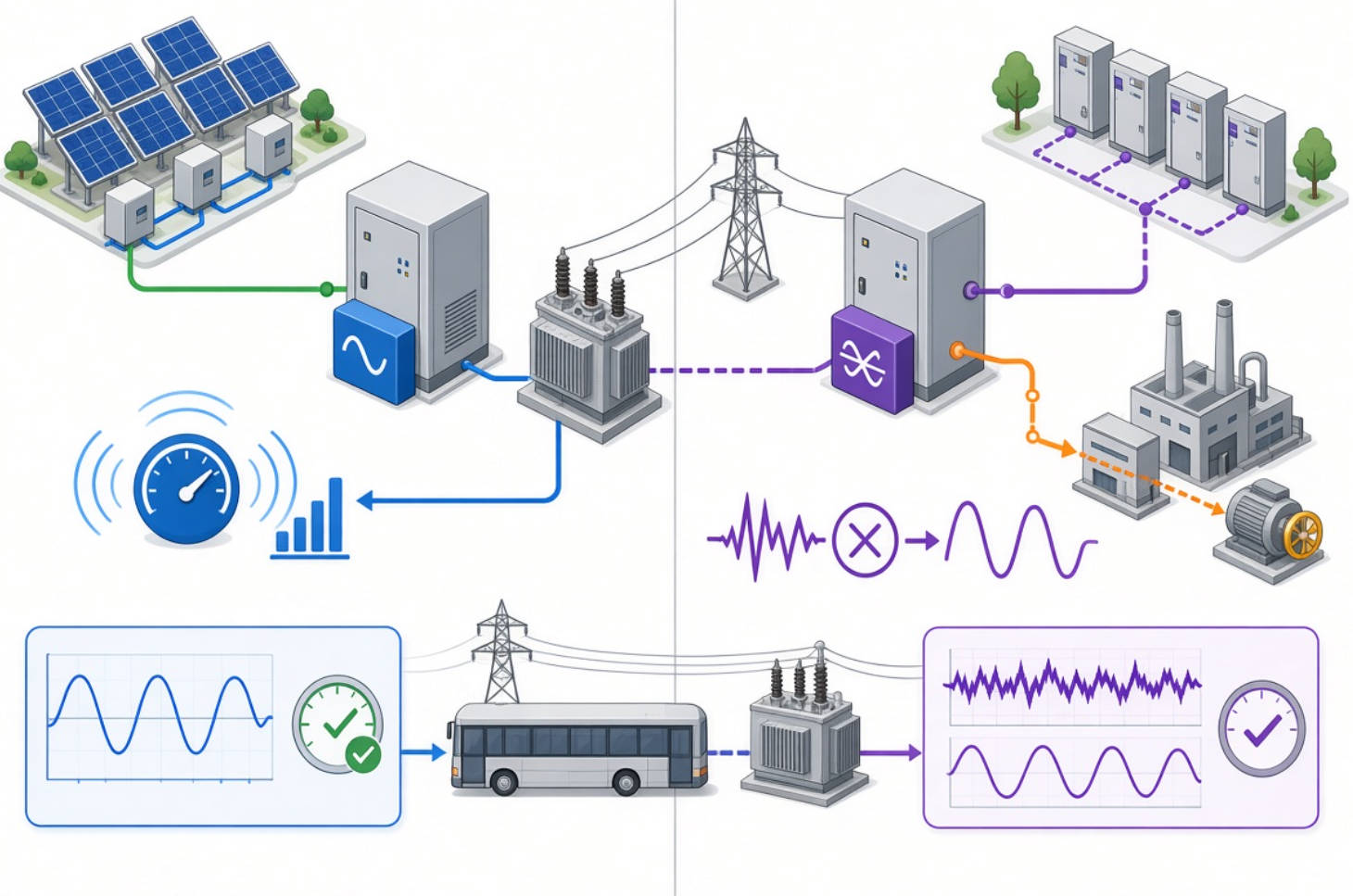
Choose a Static VAR Generator for renewable energy systems when reactive power and voltage stability are the project's primary challenges.
1. Solar plant with PCC voltage fluctuation
A utility-scale PV plant may experience changing output during cloud movement. If voltage rises during low-load conditions or falls under heavy demand, SVG-based dynamic reactive-power control can stabilize the PCC.
2. Wind farm on a weak grid
Wind farms are frequently connected in remote areas with limited grid strength. Dynamic reactive power support can help maintain acceptable voltage conditions and improve operational resilience.
3. Long cable or feeder applications
Long MV and LV cable routes introduce capacitive reactive power. An SVG can absorb excess reactive power, helping avoid leading power factor and overvoltage conditions.
4. Renewable plant facing power factor penalties
If the utility requires a defined power factor range, an SVG can provide continuous, automatic correction rather than step-based compensation.
5. Systems with rapidly changing load profiles
Factories with solar generation, electric furnaces, welding machines, VFDs, and process equipment may have fast reactive-power changes. An SVG responds much more effectively than conventional capacitor switching.
Choose an Active Power Filter for renewable energy systems when harmonic distortion is the main challenge.
1. Solar-plus-industrial facilities
A manufacturing site may operate rooftop PV, VFD-driven pumps, compressors, UPS systems, robotic lines, and EV chargers on the same distribution network. This mixed-load environment can create complex, changing harmonics.
2. Transformer overheating
If transformers run hot despite apparently acceptable kW loading, harmonic currents may be increasing RMS current and losses. An APF can reduce the distortion component.
3. Repeated capacitor bank failures
Conventional capacitor banks can be vulnerable to resonance and harmonic overload. If capacitors fail repeatedly, the project should investigate the harmonic spectrum before adding more capacitive compensation.
4. High THDi at inverter connections
A renewable project may meet active-power expectations but exceed harmonic-current limits at the PCC. An APF can be designed around measured harmonic demand and system impedance.
5. Sensitive automation or electronic equipment
Harmonic distortion can affect sensitive controls, protection devices, instrumentation, communication systems, and precision production equipment. APF deployment can improve overall bus quality.
IEEE 519-2022 remains an active reference for harmonic control in electric power systems, while IEC TR 61000-3-6 provides guidance on evaluating harmonic-emission limits for distorting installations connected to MV, HV, and EHV systems. Project compliance requirements should always be confirmed with the relevant utility and local grid code.
The most costly mistake is sizing an SVG or APF from a single utility bill, inverter nameplate, or assumed harmonic level. Power-quality equipment should be selected from field data and a defined operating objective.
Perform a power-quality assessment at the PCC and key internal buses. Record:
- Voltage THD and current THD.
- Individual harmonic orders.
- Power factor and displacement power factor.
- kW, kVAr, kVA, and load variation.
- Voltage fluctuation.
- Phase imbalance.
- Transformer loading and temperature.
- Inverter operating states.
- Grid short-circuit capacity, if available.
A short test during stable daytime production is not enough. Renewable projects should capture different conditions, including low generation, peak generation, load changes, startup events, and battery charge/discharge cycles.
Use the measurement data to determine the priority:
- Low power factor or voltage fluctuation: Start with SVG evaluation.
- High harmonic current or resonance risk: Start with APF evaluation.
- Both issues present: Consider a coordinated SVG + APF solution, or a multifunctional active power-quality system after validating performance specifications.
For SVG selection, calculate the required dynamic kVAr range. Include both capacitive and inductive operating requirements where the system needs bidirectional compensation.
For APF selection, identify the expected harmonic current under maximum operating conditions. Do not size only for average harmonic current. Consider expansion plans, simultaneous inverter operation, load diversity, and the margin required for future equipment.
Before installation, confirm:
- Voltage level and wiring configuration.
- CT placement and polarity.
- Cabinet location and cooling requirements.
- Protection coordination.
- Communication protocols.
- Parallel operation requirements.
- Renewable inverter control strategy.
- Grid-code and utility requirements.
- Maintenance access and monitoring needs.
Expert recommendation: Treat SVG and APF selection as a system-engineering task, not a commodity purchase. A lower initial equipment cost can become expensive if the system fails to solve the actual PCC issue.
Yes. In many renewable and industrial projects, the strongest solution is not SVG versus APF, but SVG plus APF.
Consider a renewable-powered manufacturing facility:
- Solar inverters and long cables produce voltage and reactive-power variation.
- VFDs and rectifier loads create fifth and seventh harmonic currents.
- Capacitor banks increase resonance risk.
- The utility requires acceptable power factor and harmonic performance at the PCC.
In this case:
- The SVG provides fast, bidirectional kVAr compensation and voltage support.
- The APF compensates dynamic harmonic current.
- A monitoring system validates results and helps the operator identify future changes.
This coordinated approach is especially relevant for steel, petrochemical, automotive, pulp and paper, textile, building-material, and municipal infrastructure projects—industries where renewable integration increasingly shares electrical networks with nonlinear and rapidly changing loads.
A Static VAR Generator is the right solution when renewable energy projects need dynamic reactive-power compensation, power-factor correction, and voltage stabilization. An Active Power Filter is the right solution when the project needs harmonic mitigation and cleaner current waveforms.
The decision should be guided by measured power-quality data—not assumptions.
For projects with both voltage instability and harmonic distortion, a coordinated SVG and APF architecture may deliver better grid compliance, equipment protection, operational efficiency, and long-term scalability than either product alone.
DINGNUO ELECTRIC CO., Ltd. provides reactive power compensation and harmonic control solutions for industrial, municipal, and renewable-energy applications. Contact our engineering team to discuss your one-line diagram, load profile, PCC measurements, and project goals. We can help assess whether an SVG, APF, capacitor-reactor solution, or integrated power-quality system is the best fit for your renewable energy project.
An SVG is primarily designed for reactive power compensation and voltage control. Some advanced solutions may offer limited harmonic functions, but an APF is normally the dedicated option for significant harmonic-current mitigation.
Yes. Many APFs can compensate reactive current and improve power factor within their available capacity. However, if the site requires large and rapidly changing kVAr compensation, an SVG is usually the more suitable primary solution.
For dynamic renewable systems, SVG technology is often more flexible because it provides fast, stepless, bidirectional reactive power compensation. Capacitor banks may still be appropriate in stable, well-characterized applications, but they require careful harmonic and resonance evaluation.
The best location depends on the harmonic source and compliance objective. It may be installed near a nonlinear load group, on a main distribution bus, near an inverter cluster, or at a location chosen to improve conditions at the PCC.
No. Inverter systems do not automatically require an APF. A power-quality study should confirm actual harmonic levels, grid impedance, transformer loading, other nonlinear loads, and utility requirements before specifying equipment.
Provide electrical single-line diagrams, voltage level, transformer capacity, utility requirements, inverter and load data, power-factor history, harmonic measurements, PCC location, and future expansion plans. A multi-day or multi-condition power-quality survey is usually more reliable than a single snapshot.
1. IEEE Standards Association. [IEEE 519-2022: IEEE Standard for Harmonic Control in Electric Power Systems]. This active standard establishes harmonic-control design goals at the interface between electrical sources and loads. [standards.ieee]
2. International Electrotechnical Commission. [IEC TR 61000-3-6:2008—Assessment of Emission Limits for Distorting Installations Connected to MV, HV and EHV Power Systems]. Guidance for coordinating harmonic voltages across voltage levels and assessing emission limits. [webstore.iec]
3. U.S. Department of Energy / Office of Scientific and Technical Information. [Review of Technical Requirements for Inverter-Based Resources in Power Systems]. Discusses reactive-power capability and voltage-control functions for inverter-based resources. [osti]
4. National Renewable Energy Laboratory. [Stabilizing the Power System in 2035 and Beyond]. Covers digital control approaches for inverter-based resources, including real and reactive power tracking. [nrel]
5. MDPI Energies. [Modeling and Simulation on the Hybrid Solution of Static Var Generator and Synchronous Condenser for Wind Farm Stations]. Describes SVG/STATCOM technology as dynamic reactive-power compensation for voltage stability and power quality. [mdpi]
6. Fuji Electric India. [Active Harmonic Filter Guide]. Explains how active harmonic filtering mitigates harmonics, reduces voltage fluctuations, and supports equipment life and system capacity. [india.fujielectric]
7. U.S. Government Publishing Office. [Inverters: A Pivotal Role in PV Generated Electricity]. Discusses inverter functions supporting reactive-power and power-factor control during grid conditions. [govinfo]


