
Views: 283 Author: Dingnuo Electric Publish Time: 2026-08-21 Origin: Site


Content Menu
● What Is Hybrid Power Factor Correction?
● Why Conventional Capacitor Banks May Not Be Enough
● Hybrid Power Factor Correction vs. Capacitor Banks
● How Hybrid PFC Improves Industrial Power Quality
>> Dynamic Reactive Power Compensation
>> Harmonic Control for Non-Linear Loads
>> Reduced Harmonic Resonance Risk
● When Should a Facility Choose Hybrid PFC?
● A Four-Step Selection Process for Hybrid PFC
>> 1. Perform a Power Quality Survey
>> 3. Size Each Technology Correctly
>> 4. Verify Results After Commissioning
● Prioritize System-Level Design
● Request a Power Quality Assessment
>> 1. What is the main difference between hybrid power factor correction and a capacitor bank?
>> 2. Can capacitor banks reduce harmonics?
>> 3. Does every factory need an active power filter?
>> 4. What loads commonly create harmonics?
>> 5. How do I know whether my capacitor bank has a resonance problem?
>> 6. Can an SVG replace a capacitor bank completely?
>> 7. What information is needed to size a hybrid PFC solution?
In modern industrial facilities, hybrid power factor correction is often a better long-term solution than conventional capacitor banks when loads are variable, non-linear, or harmonic-intensive. By combining capacitor banks with dynamic power-electronic compensation, a hybrid system can improve power factor while also controlling harmonics, reducing resonance risk, and supporting more stable voltage performance.
For plants using VFDs, rectifiers, welding machines, UPS systems, induction equipment, arc furnaces, automated production lines, or other non-linear loads, selecting a power factor correction solution based on kVAr alone can create avoidable reliability problems. The right design must consider the complete electrical environment: reactive-power demand, harmonic spectrum, load variation, transformer capacity, short-circuit level, and compliance requirements.
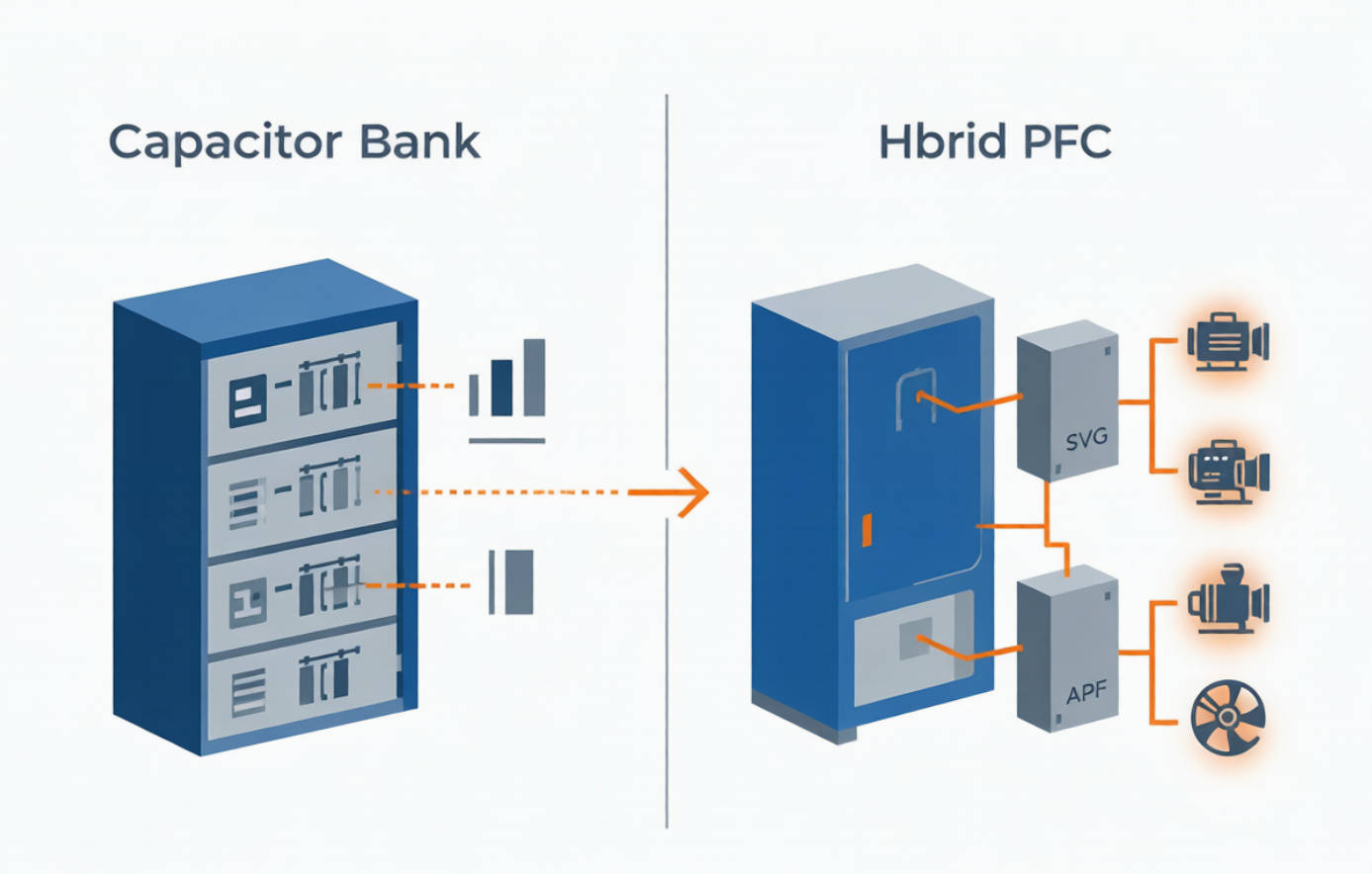
Hybrid power factor correction (Hybrid PFC) combines traditional capacitor-based reactive power compensation with intelligent power-electronic equipment, such as a Static Var Generator (SVG) or Active Power Filter (APF).
A conventional capacitor bank supplies fixed or step-based capacitive reactive power. It is economical and effective where loads are stable and harmonic distortion is low. However, it cannot independently eliminate harmonic current, respond instantly to fast load changes, or reliably prevent resonance in every operating condition.
A hybrid solution divides the work between two technologies:
- Capacitor banks provide most of the steady-state reactive power economically.
- SVGs rapidly inject or absorb reactive power to maintain a target power factor under changing loads.
- APFs measure harmonic current and inject compensating current to reduce harmonic distortion.
- Detuned reactors may be integrated with capacitor stages to reduce the risk of capacitor-bank resonance.
This approach allows industrial users to balance capital expenditure, operating stability, harmonic compliance, and energy-efficiency objectives.
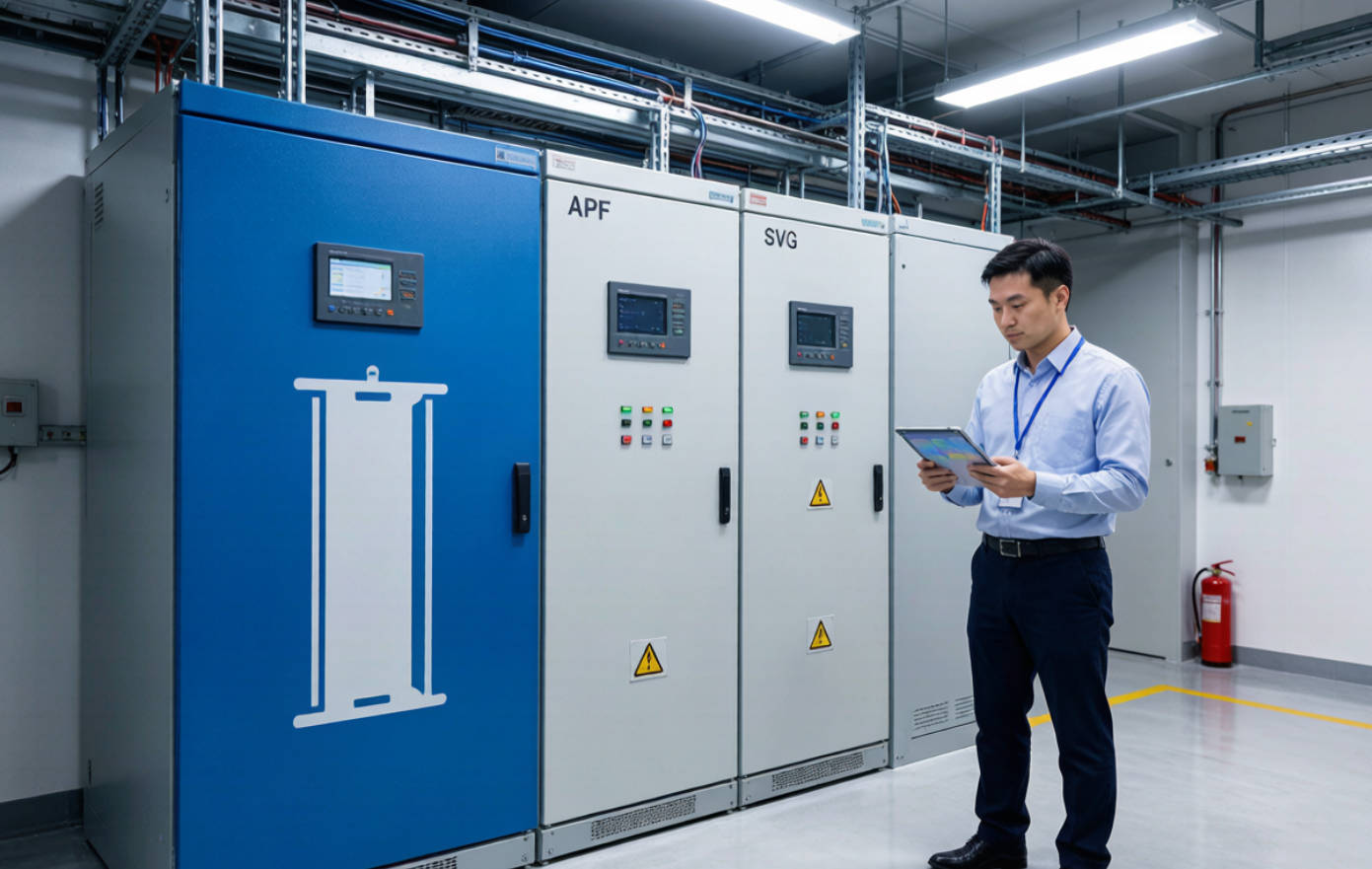
Capacitor banks remain a widely used solution for reactive power compensation. In a relatively stable system with mainly linear loads, they can be cost-effective and dependable.
However, many industrial power systems have changed. Production lines now frequently include variable-frequency drives, servo drives, switching power supplies, robotic systems, energy-saving equipment, and high-power electronic converters. These devices can create harmonic currents and rapidly changing reactive-power demand.
A standard capacitor bank may face several limitations:
- Fixed or stepped compensation: It cannot continuously match fast-changing reactive-power demand.
- Slow switching response: Mechanical contactors and staged switching may not react quickly enough for rapidly fluctuating loads.
- No active harmonic cancellation: Capacitors correct displacement power factor but do not remove harmonic currents.
- Potential resonance risk: Capacitor reactance can interact with system inductance and amplify certain harmonic frequencies.
- Reduced capacitor life: Excessive harmonic current, overvoltage, overheating, and frequent switching can accelerate failure.
- Limited voltage-support capability: A conventional bank may not maintain stable voltage under sudden load changes.
The critical point is simple: a capacitor bank can improve power factor, but it is not automatically a complete power-quality solution.
| Evaluation Area | Conventional Capacitor Bank | Hybrid Power Factor Correction |
|---|---|---|
| Reactive-power response | Fixed or step-based | Continuous and dynamic |
| Best load condition | Stable, mostly linear loads | Variable, fluctuating, and non-linear loads |
| Harmonic mitigation | No active cancellation | APF can actively compensate harmonic current |
| Resonance management | May require careful detuning | Can combine detuned banks with active control |
| Power factor precision | Moderate | High, with programmable target settings |
| Voltage stability | Limited during fast load swings | Stronger support through dynamic VAR control |
| Initial investment | Lower | Higher than basic capacitor banks |
| Lifecycle value | Can decline in harmonic-rich systems | Often stronger where downtime and compliance matter |
| Expandability | Can require major redesign | Modular systems can be expanded with load growth |
| Typical applications | Small workshops, stable motors, simple loads | Steel, petrochemical, automotive, paper, textile, cement, municipal infrastructure |
Industrial load profiles are rarely constant. A rolling mill, welding line, large pump station, crusher, or automated assembly line can experience sudden current changes during normal operation.
An SVG uses power electronics to respond rapidly to changing reactive-power demand. Instead of waiting for a capacitor-bank stage to switch, the SVG can dynamically adjust compensation output according to measured system conditions.
This supports several operational benefits:
- A more stable power factor during load changes.
- Reduced reactive-power penalties where utility billing includes power-factor requirements.
- Better utilization of transformers, cables, and switchgear.
- Reduced voltage fluctuation caused by reactive-power swings.
- Improved operating conditions for sensitive production equipment.
For example, a facility may have sufficient capacitor capacity during normal production but still experience poor power factor during startup, load transitions, or partial-load operation. In this case, a hybrid system can let the capacitor bank carry the base kVAr demand while the SVG manages fast-changing demand.
A growing proportion of industrial electrical loads are non-linear. VFDs, rectifiers, UPS systems, welding equipment, PLC power supplies, LED drivers, and induction-heating equipment can draw current in pulses rather than as a smooth sine wave.
These distorted currents create harmonics. Harmonics may contribute to:
- Transformer overheating.
- Nuisance breaker tripping.
- Overloaded neutral conductors.
- Capacitor fuse operation.
- Premature capacitor failure.
- Motor vibration or heating.
- Metering inaccuracies.
- Communication interference.
- Voltage distortion at critical loads.
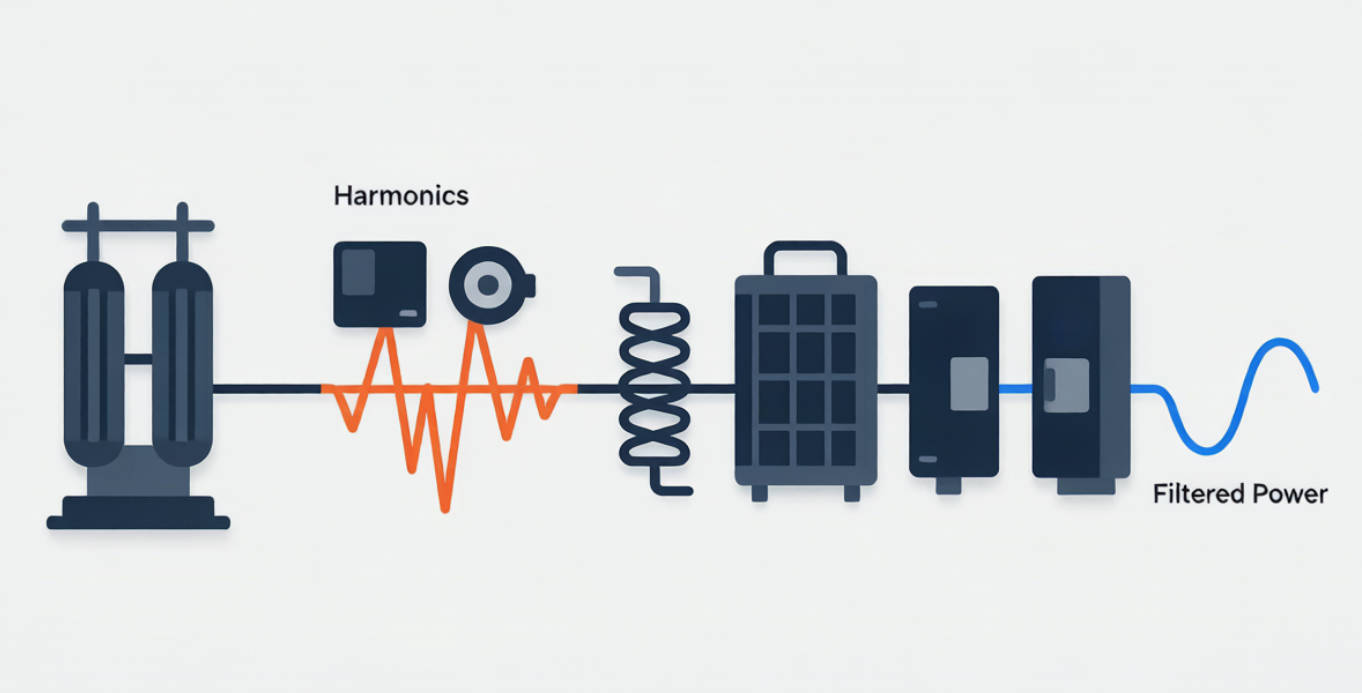
An APF continuously measures load current and produces compensating current in the opposite phase to targeted harmonic components. This reduces harmonic current flowing upstream into the distribution system.
Hybrid PFC is especially relevant when a facility needs both reactive-power compensation and harmonic mitigation. Instead of treating these as separate problems, the electrical design can coordinate capacitor banks, SVGs, APFs, and reactors as one power-quality architecture.
IEEE 519-2022 establishes harmonic-control objectives for electrical systems, including limits related to distortion at the point of common coupling. IEC 61000-2-4:2024 also addresses industrial power-distribution environments and includes harmonics among the conducted disturbances considered for systems up to 35 kV.
Resonance is one of the most important issues to assess before installing or expanding a capacitor bank.
Every electrical system has inductance from transformers, cables, motors, and the upstream supply network. A capacitor bank adds capacitance. At certain frequencies, the inductive and capacitive reactances can interact and create resonance.
If the resonant frequency is close to a dominant harmonic, harmonic currents and voltages may be amplified rather than reduced. In industrial systems, the 5th and 7th harmonics are common areas of concern, particularly where six-pulse rectifiers and VFDs are present.
A properly engineered hybrid system can reduce this risk by:
- Measuring existing voltage and current harmonics before design.
- Using detuned reactors with capacitor stages where appropriate.
- Selecting capacitor and reactor parameters based on the actual network.
- Applying APF capacity to compensate targeted harmonic currents.
- Monitoring the impact of production changes or future expansions.
- Setting control logic to avoid excessive switching or overcompensation.
Never assume that adding more capacitor kVAr will solve a power-factor problem in a harmonic-rich network. First determine whether the site has a resonance risk and whether harmonics are already stressing existing capacitors.
Hybrid power factor correction is not necessary for every electrical installation. A simple capacitor bank can still be the right choice for a stable facility with limited harmonic content and predictable reactive-power demand.
However, hybrid PFC should be seriously considered when one or more of the following conditions apply:
- The facility has a high proportion of VFD, rectifier, UPS, welding, or other non-linear loads.
- Power factor changes significantly across production shifts.
- Capacitor banks frequently trip, overheat, lose capacitance, or require replacement.
- Transformer temperature is high despite normal loading.
- Voltage distortion affects PLCs, sensors, drives, or other sensitive equipment.
- The site receives utility penalties for low power factor or poor power quality.
- Expansion plans will add high-power electronic loads.
- Harmonic measurements indicate excessive current or voltage distortion.
- The plant operates critical continuous processes where downtime is expensive.
- The electrical system must meet project-specific utility, customer, or engineering requirements.
Industries with particularly demanding power-quality conditions include metallurgy, petrochemical processing, automotive manufacturing, paper production, textile manufacturing, cement and building-material production, water treatment, rail infrastructure, and municipal engineering projects.
Selecting a hybrid power factor correction system should begin with measurement, not product selection.
Use a professional power-quality analyzer to record electrical data over a representative production period. A single short measurement may miss startup loads, shift changes, batch cycles, or peak-demand events.
Key parameters should include:
- Average and minimum power factor.
- Active power, reactive power, and apparent power.
- Reactive-power demand in kVAr.
- Voltage and current total harmonic distortion.
- Individual harmonic orders.
- Load current variation.
- Transformer loading and temperature history.
- Existing capacitor-bank operating condition.
- Utility billing data and applicable power-quality requirements.
Low power factor can result from inductive loads, but poor electrical performance may also be driven by harmonics, unbalanced loading, voltage fluctuation, or incorrect capacitor switching.
A proper analysis distinguishes between:
- Displacement power factor: Caused by phase shift between fundamental voltage and current.
- Distortion power factor: Reduced by harmonic current.
- True power factor: The combined result that affects real system performance.
This distinction matters because a capacitor bank primarily addresses displacement power factor. A hybrid system can address both reactive-power variation and harmonic-related issues when properly designed.
A reliable hybrid solution does not simply add the largest available capacitor bank, SVG, and APF. Each component should have a defined role.
For example:
- Capacitor banks can cover stable base reactive-power demand.
- SVG capacity can cover fast reactive-power changes and precise power-factor control.
- APF capacity can target measured harmonic current and, if required, unbalance or neutral-current compensation.
- Detuned reactors can protect capacitor stages from harmonic amplification.
The final configuration should consider future capacity, installation environment, ventilation, cabinet protection rating, communication requirements, and maintenance access.
Commissioning should include post-installation measurement under representative load conditions. Compare the results against the original baseline and the agreed project targets.
Verification should assess:
- Power-factor improvement.
- Harmonic reduction.
- Capacitor current and temperature.
- Voltage stability.
- Transformer loading.
- System alarms and switching behavior.
- Compliance performance at the relevant measurement point.
This final step turns power-quality equipment into an accountable engineering solution rather than a one-time purchase.

From an engineering perspective, the best question is not, "How many kVAr of capacitors do we need?" The better question is, "What combination of compensation, filtering, protection, and control will keep this electrical system stable as production changes?"
A low-cost capacitor bank may look attractive at the procurement stage. But if it operates in an unsuitable harmonic environment, the downstream costs can include repeated capacitor replacement, production interruptions, nuisance trips, transformer derating, and corrective retrofits.
For industrial users, the objective should be stable, measurable, and scalable power quality. Hybrid power factor correction is valuable because it allows a facility to use cost-efficient capacitor compensation where it is appropriate, while adding active technology where system conditions demand faster and more precise control.
At DINGNUO ELECTRIC CO., Ltd., we support industrial power-quality projects with capacitor banks, reactors, SVG systems, APF systems, and hybrid reactive-power compensation solutions. Our technical team can help evaluate operating conditions, identify harmonic and reactive-power challenges, and recommend a configuration aligned with your industry, load profile, and project objectives.
If your plant experiences low power factor, capacitor-bank failures, harmonic alarms, voltage instability, or frequent electrical downtime, do not select compensation equipment based only on kVAr rating.
Contact DINGNUO ELECTRIC CO., Ltd. to discuss your operating data and project requirements. Our team can help you develop a practical hybrid power factor correction solution using capacitor banks, reactors, SVGs, APFs, and coordinated control strategies for more reliable industrial power quality.
A capacitor bank supplies fixed or switched capacitive reactive power. Hybrid power factor correction combines capacitor banks with active equipment such as SVGs and APFs, enabling faster reactive-power control and harmonic mitigation.
Standard capacitor banks do not actively eliminate harmonic currents. In some systems, they can amplify harmonic distortion if resonance occurs. Detuned reactors and active harmonic filters are commonly considered where harmonic control is required.
No. Facilities with stable, mostly linear loads may only need correctly sized capacitor compensation. An APF becomes more valuable when non-linear loads create significant harmonic distortion, equipment stress, compliance concerns, or operational problems.
Common harmonic-producing loads include VFDs, rectifiers, UPS systems, welding machines, induction furnaces, switch-mode power supplies, battery chargers, LED drivers, and large electronic converters.
Warning signs include repeated capacitor failures, blown fuses, overheating, unexpected trips, high harmonic readings, or worsening voltage distortion after capacitor stages switch on. A power-quality survey and harmonic study should confirm the actual cause.
An SVG can provide dynamic reactive-power compensation, but it may not always be the most economical way to supply large, stable base kVAr demand. A hybrid system often uses capacitors for base compensation and SVG capacity for fast adjustment.
A technical assessment should include voltage level, transformer rating, load profile, power factor, reactive power, harmonic spectrum, short-circuit capacity, existing compensation equipment, utility requirements, and future expansion plans.
1. DINGNUO ELECTRIC CO., Ltd. / YT Elect. "[What Is the Advantages of Hybrid Power Factor Correction Against Capacitor Banks?]"
2. IEEE Standards Association. "[IEEE 519-2022: IEEE Standard for Harmonic Control in Electric Power Systems]"
3. International Electrotechnical Commission. "[IEC 61000-2-4:2024]"
4. ANSI Blog. "[IEEE 519-2022: Harmonic Control in Electric Power Systems]"
5. Power Quality Blog. "[Harmonic Issues Related to Power Factor Correction]"
6. IEC. "[IEC 61000 Series: Electromagnetic Compatibility]"


