
Views: 285 Author: Dingnuo Electric Publish Time: 2026-08-29 Origin: Site


Content Menu
● What Is Harmonic Distortion?
>> Common Sources of Harmonics in Industry
● Why Harmonic Distortion Is a Serious Industrial Risk
● The Most Important Harmonic Indicators to Measure
>> Total Harmonic Distortion of Current (THDi)
>> Total Demand Distortion (TDD)
>> Total Harmonic Distortion of Voltage (THDv)
>> Power Factor and Displacement Power Factor
● Harmonic Distortion Limits: Why the PCC Matters
● A Step-by-Step Harmonic Distortion Mitigation Process
>> 1. Identify Symptoms and Electrical Changes
>> 2. Perform Multi-Point Power-Quality Measurement
>> 3. Check for Harmonic Resonance
>> 4. Select the Right Mitigation Technology
>> 5. Verify Results After Commissioning
● Choosing Between Capacitors, Reactors, SVG, and Active Harmonic Filters
>> Capacitors: Effective Reactive Power Compensation
>> Detuned Reactors: Essential Protection for Capacitor Banks
>> Active Harmonic Filters: Flexible Harmonic Control
>> SVG Systems: Fast Dynamic Reactive Power Support
● Industry Applications for Harmonic Mitigation
>> Metallurgy and Metal Processing
>> Petrochemical and Process Plants
>> Paper, Textile, and Building Materials
>> Municipal Infrastructure Projects
● Expert Checklist Before Purchasing Harmonic Mitigation Equipment
● Why Work With DINGNUO ELECTRIC?
● Improve Power Quality Before Harmonics Affect Production
>> 1. What is the difference between harmonic distortion and low power factor?
>> 2. Can a standard capacitor bank reduce harmonic distortion?
>> 3. What equipment commonly causes the 5th and 7th harmonics?
>> 4. When should a facility use an active harmonic filter?
>> 5. Why do capacitors fail in industrial plants?
>> 6. What is the point of common coupling (PCC)?
>> 7. How can I know whether my facility needs a detuned reactor?
>> 8. Can harmonic mitigation reduce downtime?
Modern industrial facilities rely on variable-frequency drives, rectifiers, welding equipment, inverters, UPS systems, automation controllers, and other power-electronic loads. These technologies improve productivity, but they also create a growing power-quality risk: harmonic distortion.
For plant managers, electrical engineers, and OEM system designers, harmonic distortion mitigation is no longer only a compliance consideration. It is a practical reliability strategy. Excessive harmonics can overheat transformers and capacitors, trip protective devices, reduce the useful capacity of cables, disrupt sensitive controls, and contribute to unplanned downtime.
At DINGNUO ELECTRIC CO., Ltd., we provide advanced capacitors, reactors, reactive power compensation systems, and harmonic-control solutions for industrial and municipal power systems. Our approach is based on one principle: a successful harmonic mitigation project must begin with measurement, system analysis, and a solution designed for the actual electrical network—not a generic product selection.

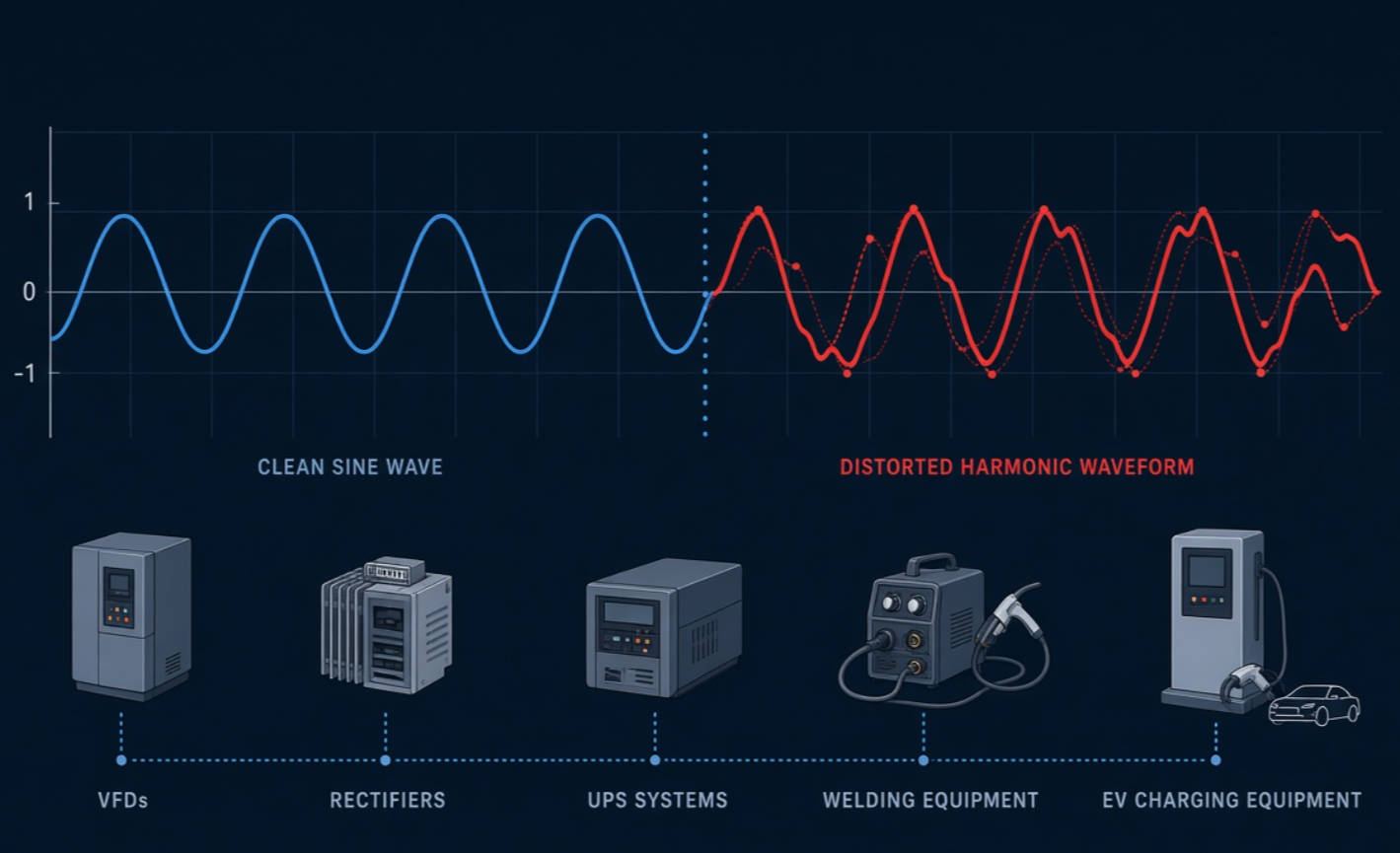
Harmonic distortion occurs when current or voltage waveforms deviate from a clean sinusoidal shape.
In an ideal AC system, voltage and current operate primarily at the fundamental frequency: 50 Hz or 60 Hz. Nonlinear loads draw current in short pulses instead of following the voltage waveform smoothly. Those pulses introduce additional frequency components known as harmonics.
For example, in a 50 Hz electrical system:
- The 3rd harmonic is 150 Hz
- The 5th harmonic is 250 Hz
- The 7th harmonic is 350 Hz
- The 11th harmonic is 550 Hz
These harmonic currents flow through the facility's impedance and can create harmonic voltage distortion across the power distribution system.
The key point: Harmonic currents are usually generated by equipment inside the facility, but their impact can spread throughout the electrical network.
Harmonics are especially common in facilities with large quantities of modern electronic or variable-speed equipment, including:
- Variable-frequency drives (VFDs) for pumps, fans, compressors, and conveyors
- DC drives and rectifier systems
- Arc furnaces and welding machines
- UPS systems and data-center power equipment
- Servo drives and CNC machinery
- Battery chargers and EV charging systems
- Solar photovoltaic inverters and energy-storage converters
- LED lighting drivers
- Switching-mode power supplies
- Plastic extrusion, textile, paper, automotive, and metallurgical production equipment
As industrial electrification increases, many facilities find that a power system that once operated reliably now experiences recurring capacitor failures, transformer overheating, nuisance trips, or unstable power-factor correction.
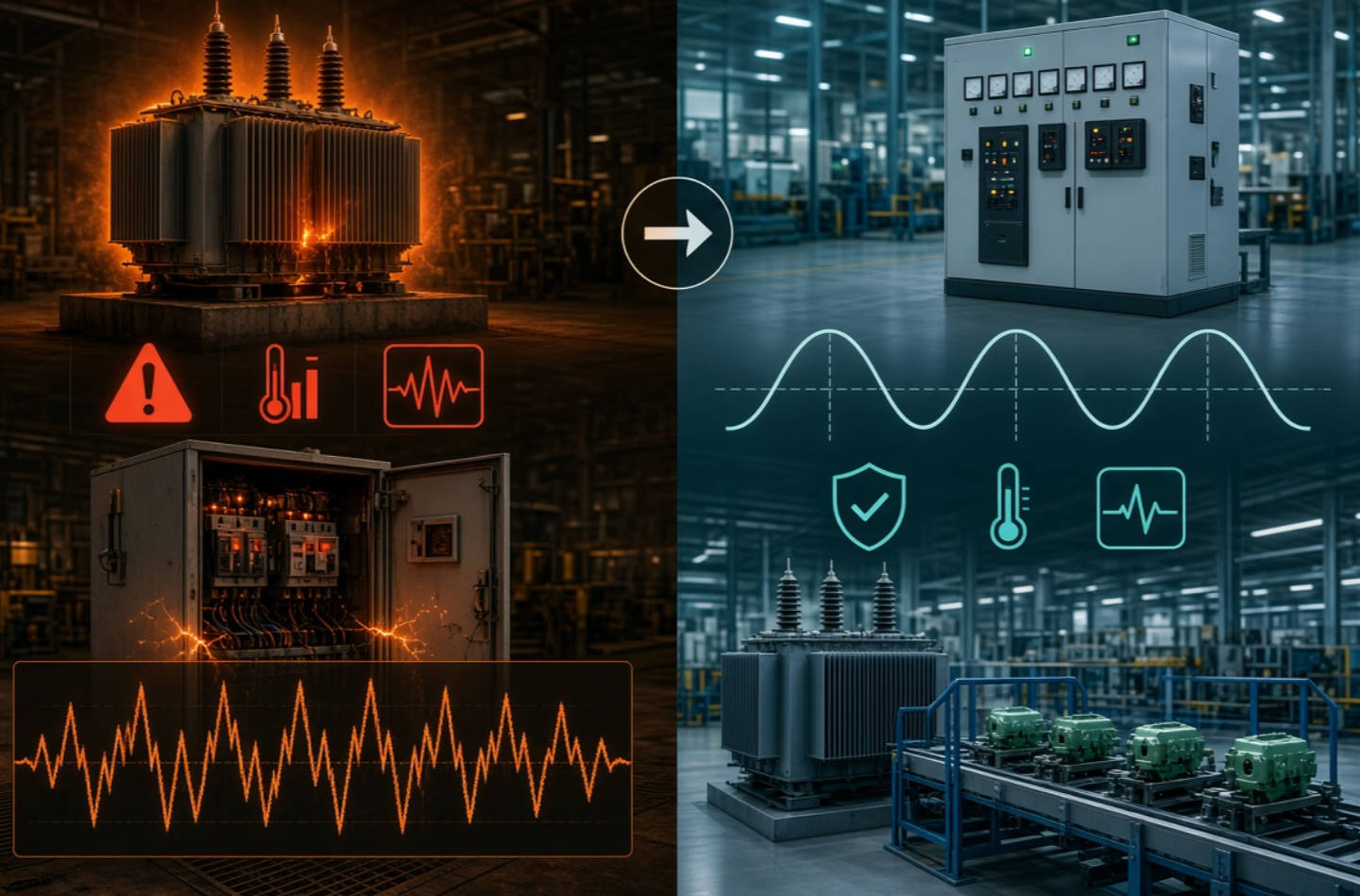
Harmonics are often invisible during normal production. The problem may first appear as a "mysterious" equipment failure, a frequently tripped circuit breaker, a hot capacitor cabinet, or unexplained downtime.
In practice, harmonic distortion can create a chain reaction across the electrical distribution system.
| Power-System Area | Typical Harmonic Effect | Possible Business Impact |
|---|---|---|
| Transformers | Increased eddy-current and stray losses | Overheating, derating, shorter service life |
| Capacitor banks | Harmonic overload or resonance | Swollen capacitors, blown fuses, repeated failures |
| Cables and busbars | Higher RMS current and heating | Reduced capacity, insulation aging |
| Motors | Additional losses and torque pulsation | Reduced efficiency, overheating, mechanical stress |
| Protective devices | Nuisance operation or incorrect response | Unplanned production shutdowns |
| Control systems | Voltage distortion and electrical interference | PLC alarms, communication errors, process instability |
| Utility connection | Excessive distortion at the point of common coupling | Compliance disputes, corrective-action requirements |
Harmonic current can also worsen the apparent power factor. A facility may install capacitor banks to improve its power factor, but if harmonics are not evaluated first, the capacitors can amplify the problem instead of solving it.
This is one of the most important distinctions in power-quality engineering:
Power-factor correction and harmonic mitigation are related, but they are not the same task.
A conventional capacitor bank supplies reactive power. It does not automatically remove harmonic current. In some systems, it may form a resonance condition with upstream transformer inductance and magnify a specific harmonic frequency.
A proper harmonic mitigation strategy begins with data. Engineers should avoid selecting filters, reactors, or capacitor-bank configurations based only on installed load capacity.
The following indicators are commonly evaluated during a power-quality survey.
THDi measures the amount of harmonic current relative to the fundamental current.
High THDi often indicates that nonlinear loads are injecting significant harmonic current into the distribution system. However, THDi alone is not enough to determine compliance or equipment risk because it can change significantly when the load level changes.
TDD compares harmonic current with the facility's maximum demand current rather than the instantaneous fundamental current.
This is important because a facility can show a high THDi at light load even when the absolute harmonic current is moderate. IEEE 519-based evaluations commonly use TDD at the point of common coupling (PCC) for current-distortion assessment.
THDv describes voltage waveform distortion. Since most connected equipment receives voltage—not current—THDv is a critical indicator of system-wide exposure.
Voltage distortion can affect sensitive controls, instrumentation, contactors, power supplies, and automation equipment throughout the facility.
A low true power factor may result from both reactive power demand and harmonic distortion. Displacement power factor measures the phase relationship between the fundamental voltage and current, while true power factor reflects both displacement and distortion.
This distinction helps engineers identify whether the site primarily needs:
- Reactive power compensation
- Harmonic mitigation
- Dynamic compensation
- A combined solution
Harmonic limits should not be treated as one universal number for every facility.
IEEE 519 is widely used as a framework for evaluating harmonic voltage and current distortion at the point of common coupling (PCC). The allowable current distortion depends on the relationship between available short-circuit current and maximum demand current, commonly expressed as the ISC/IL ratio. A stronger electrical system may tolerate different current-distortion levels than a weaker system.
For systems rated from 120 V through 69 kV, an IEEE 519-based table commonly shows maximum TDD values ranging from 5% to 20%, depending on the ISC/IL ratio. For example, an ISC/IL ratio below 20 is associated with a 5% TDD limit, while a ratio above 1,000 is associated with a 20% limit.
IEC 61000-2-4 also provides compatibility levels for low-frequency conducted disturbances in industrial locations, covering nominal voltages up to 35 kV at 50 Hz or 60 Hz.
However, compliance is only part of the engineering decision. A facility can meet a grid-side harmonic target while still experiencing internal capacitor overload, transformer heating, or control-system disruption. Therefore, DINGNUO recommends evaluating both:
1. The PCC or utility interface, where compliance is typically assessed.
2. Critical internal buses, where the operational consequences of harmonics may be most severe.
The best harmonic mitigation solution is based on an engineering workflow, not just a product catalogue.
Start by documenting the operating problems and recent system changes.
Common warning signs include:
- Repeated capacitor fuse failures
- Capacitor can swelling or overheating
- Transformer temperature rise without a corresponding load increase
- Frequent VFD, UPS, or PLC alarms
- Circuit-breaker nuisance tripping
- Excessive neutral current in four-wire systems
- Failed power-factor correction projects
- Unexpected utility power-factor or power-quality penalties
- Newly installed drives, rectifiers, inverters, or EV chargers
A useful first question is: What changed before the failures started?
In many industrial sites, the answer is a production expansion, new VFD-driven equipment, additional automation, renewable-energy integration, or a retrofit of conventional loads with electronic loads.
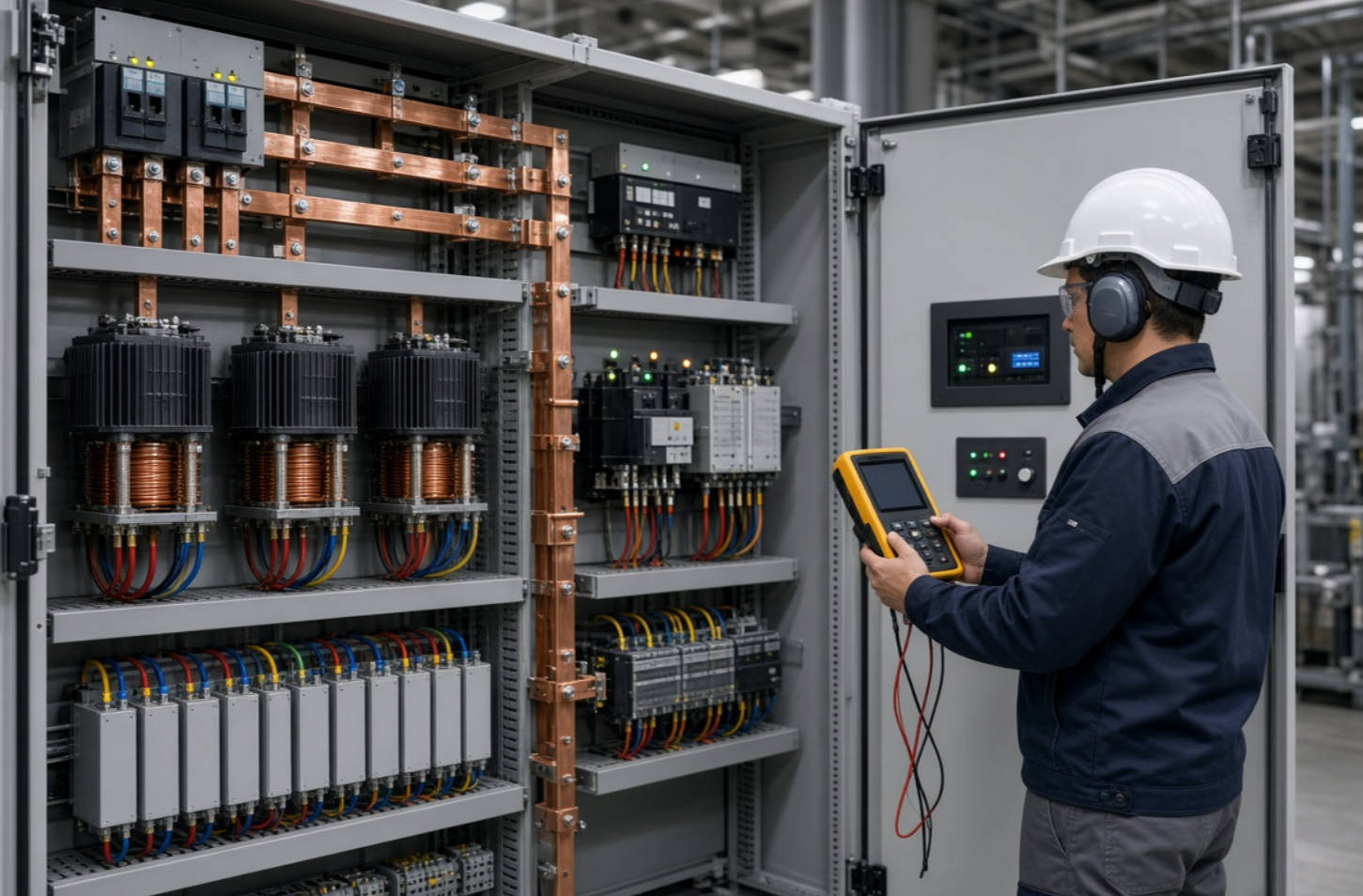
A single short measurement at the main incomer may not reveal the whole problem.
A more reliable survey typically captures data at:
- The main incoming service
- The PCC, where applicable
- Main low-voltage switchboards
- Capacitor-bank connection points
- Transformer secondary buses
- Large nonlinear load feeders
- Sensitive control or automation panels
Measurements should be taken during representative operating conditions, including high-production periods, low-load periods, startup events, and changes in capacitor-bank switching status.
The objective is not simply to record THDi and THDv. The engineer should identify:
- Dominant harmonic orders
- Load variation over time
- Capacitor switching behavior
- Potential resonance frequencies
- Voltage unbalance
- Neutral current
- Transformer loading and thermal exposure
- Harmonic direction and contribution from major loads
Resonance is one of the most damaging and misunderstood power-quality risks.
A capacitor bank and the upstream transformer or system inductance can form a resonant circuit. If the resonant frequency is close to a dominant harmonic order, the electrical system may amplify harmonic current or voltage.
For instance, a facility with substantial 5th-harmonic current from six-pulse VFDs may experience serious capacitor stress if the capacitor bank is not protected by properly selected detuning reactors.
This is why "adding more capacitors" is not a safe response to low power factor in a harmonic-rich facility.
The correct solution depends on load characteristics, harmonic spectrum, required response speed, voltage level, operating profile, and budget.
| Solution | Best-Suited Application | Main Benefit | Key Design Consideration |
|---|---|---|---|
| Detuned reactor capacitor bank | Facilities requiring stable power-factor correction with moderate harmonic levels | Prevents harmful capacitor-system resonance | Reactor tuning must match the network and harmonic spectrum |
| Tuned passive harmonic filter | Stable loads with known dominant harmonics | Cost-effective absorption of targeted harmonic orders | Performance can change as network conditions change |
| Active harmonic filter (AHF) | Variable harmonic loads, VFD-heavy systems, data centers, EV charging, automation | Dynamic harmonic current cancellation | Correct capacity and installation point are essential |
| Static var generator (SVG) | Rapidly changing reactive power demand | Fast and accurate dynamic reactive compensation | Does not replace harmonic filtering unless configured accordingly |
| Hybrid compensation system | Complex sites with both reactive power and harmonic challenges | Combines efficiency of passive components with dynamic control | Requires coordinated system design |
| Line reactors or DC chokes | Individual drive or rectifier applications | Reduces harmonic current at the source | May not solve facility-wide harmonic issues |
Commissioning should include another power-quality measurement after installation.
The verification process should confirm:
- THDv and current-distortion improvement
- Reduction of capacitor overload
- Stable power-factor performance
- No harmful resonance after switching events
- Acceptable transformer, cable, and reactor temperatures
- Reliable operation during production changes
- Performance at both full-load and partial-load conditions
A project is not complete when the cabinet is energized. It is complete when the electrical system performs reliably under real operating conditions.
Many procurement decisions become difficult because product categories are often compared as if one technology can solve every problem. In reality, each device serves a different role.
Capacitors provide reactive power and can improve displacement power factor. They are highly effective when the network has limited harmonic content and the load profile is relatively predictable.
However, standard capacitor banks should not be installed blindly in systems with significant VFDs, rectifiers, welding loads, or inverter-based equipment.
For industrial users, the safer question is not "Do we need capacitors?" It is:
"Do we need capacitor banks with harmonic protection, dynamic switching, or an integrated filtering strategy?"
A detuned reactor is connected in series with a capacitor bank. Its role is to shift the system resonance frequency away from dominant harmonic frequencies and limit harmonic current entering the capacitors.
For many industrial facilities, a detuned reactor capacitor bank is the practical foundation of a reliable reactive-power compensation system.
It can help:
- Protect capacitors from harmonic overload
- Reduce the risk of resonance
- Improve the service life of compensation equipment
- Maintain stable power-factor correction
- Support safer expansion of nonlinear loads
Active harmonic filters continuously measure harmonic current and inject compensating current with the opposite waveform. This allows dynamic mitigation of changing harmonic conditions.
AHFs are especially valuable in facilities with:
- Multiple VFDs with varying duty cycles
- Robotic production lines
- High-speed automation
- Large UPS systems
- Data centers
- EV charging stations
- Renewable-energy inverters
- Frequent production-line changes
Unlike a passive filter tuned to a limited frequency range, an active harmonic filter can address multiple harmonic orders and adapt to changing load conditions within its specified capacity.
Static var generators are designed primarily for rapid reactive-power compensation. They are useful where loads change quickly, such as welding lines, cranes, presses, rolling mills, or fluctuating industrial processes.
An SVG can stabilize power factor more quickly than conventional switched capacitor banks. When harmonic mitigation is also required, an SVG may be combined with active harmonic filtering, detuned capacitors, or a hybrid system.
DINGNUO ELECTRIC supports power-quality projects across industrial, commercial, and municipal applications. The solution should always reflect the process load and electrical architecture of each industry.
Arc furnaces, rolling mills, large drives, welding systems, and rectifier loads can create severe harmonic and reactive-power fluctuations.
A typical solution may include:
- Detuned capacitor banks for stable reactive-power support
- SVG systems for fast load changes
- Active harmonic filters for variable harmonic sources
- Reactors to protect capacitors and reduce resonance risk
Petrochemical facilities depend on continuous operation. Pumps, compressors, drives, process automation, and large motor systems make reliability essential.
In this environment, harmonic control can help reduce electrical stress on transformers, motors, switchgear, and control systems while supporting more stable process operation.
Automotive plants often combine robotic welding, servo systems, conveyors, variable-speed drives, and automated production cells. These loads can vary by production stage and shift schedule.
A modular active harmonic filter or hybrid power-quality solution can be particularly suitable where the harmonic profile changes throughout the day.
Paper machines, textile drives, kilns, crushers, mixers, extruders, and conveyor systems frequently use VFDs and large motor loads.
For these facilities, the objective is often broader than meeting a distortion limit. It is to maintain power factor, prevent capacitor failures, reduce electrical interruptions, and protect production continuity.
Water treatment plants, pumping stations, rail transit systems, hospitals, public buildings, and other municipal projects increasingly use electronically controlled motors, UPS systems, and energy-efficient power electronics.
These applications benefit from early-stage power-quality planning because retrofitting mitigation equipment after commissioning can be more disruptive and costly.
Before selecting a capacitor bank, reactor, active harmonic filter, SVG, or hybrid compensation panel, ask the supplier the following questions:
1. Has the harmonic spectrum been measured at representative load conditions?
2. What are the dominant harmonic orders and their current magnitudes?
3. Where is the PCC, and what standard or utility requirement applies?
4. What is the transformer rating, impedance, and available short-circuit capacity?
5. Will the proposed capacitor bank create resonance with the system?
6. What is the expected capacitor current under harmonic conditions?
7. Does the load change quickly enough to require SVG or active compensation?
8. Can the solution be expanded if production capacity increases?
9. How will performance be tested and verified after commissioning?
10. What technical support is available for system analysis, installation, and maintenance?
A qualified supplier should be able to discuss these questions in engineering terms—not only provide a price and rated kvar value.
DINGNUO ELECTRIC CO., Ltd. is a professional manufacturer of capacitors and reactors focused on power-quality improvement, reactive-power compensation, and harmonic-control applications.
We provide comprehensive technical and product support for customers seeking reliable solutions to power-quality challenges in domestic and international markets. Our products and solutions are used across metallurgy, petrochemical processing, automotive manufacturing, paper production, textile production, building materials, and important municipal infrastructure projects.
Our engineering approach focuses on the full operating environment:
- Application-based product selection
- Reactive-power compensation matched to actual load conditions
- Harmonic-aware capacitor and reactor design
- Support for active, passive, and hybrid power-quality solutions
- System reliability, not only short-term power-factor improvement
- Technical cooperation from assessment through commissioning
Whether your facility is experiencing recurring capacitor failures, transformer overheating, poor power factor, high THDi, or unstable production equipment, the first step is to understand the electrical system as a whole.
Harmonic distortion can be managed effectively when it is measured early, analyzed correctly, and addressed with the right combination of capacitors, reactors, filters, and dynamic compensation technology.
Do not wait for repeated equipment failures or production interruptions to reveal a power-quality problem.
Contact DINGNUO ELECTRIC CO., Ltd. today to discuss your harmonic distortion mitigation, reactive power compensation, capacitor-bank protection, reactor selection, or industrial power-quality project. Share your single-line diagram, transformer data, load list, and power-quality measurements with our technical team for a preliminary solution evaluation.
Low power factor usually refers to inefficient reactive-power use or phase displacement between voltage and current. Harmonic distortion is waveform distortion caused by nonlinear loads. A facility can have low power factor, high harmonics, or both. The correct solution depends on measurement and system analysis.
No. A standard capacitor bank primarily provides reactive-power compensation. In a harmonic-rich electrical system, it may be overloaded or create resonance. A detuned reactor capacitor bank, passive filter, active harmonic filter, or hybrid system may be needed instead.
Six-pulse rectifiers and many conventional variable-frequency drives are common sources of 5th and 7th harmonic currents. The actual harmonic spectrum should be confirmed through on-site power-quality measurement.
An active harmonic filter is often appropriate when harmonic loads vary significantly, when several harmonic orders must be mitigated, or when production processes change frequently. Typical applications include VFD-heavy plants, data centers, EV charging stations, automation systems, and facilities with UPS equipment.
Capacitors can fail because of overvoltage, overheating, excessive harmonic current, inadequate ventilation, switching transients, poor component quality, or resonance between the capacitor bank and the electrical system. Harmonic measurement and reactor selection are essential before installing or replacing capacitor banks.
The PCC is the electrical point where a customer's installation connects to the utility system or to another user's system. It is commonly used as the location for evaluating harmonic compliance under IEEE 519-based practices.
A detuned reactor should be considered whenever capacitor banks operate in a system with VFDs, rectifiers, welders, UPS systems, inverters, or other nonlinear loads. A harmonic survey and resonance calculation are needed to determine the suitable reactor tuning and rating.
Yes. Proper harmonic mitigation can reduce the electrical stress that contributes to capacitor failure, transformer overheating, nuisance tripping, control-system disruption, and premature equipment aging. Results depend on the system condition, load profile, and the accuracy of the solution design.
1. IEEE 519 harmonic current distortion guidance and example current-distortion limits for general distribution systems: [IEEE Std 519-2014 Harmonic Limits]. [mirusinternational]
2. International Electrotechnical Commission. Industrial compatibility levels for low-frequency conducted disturbances in systems up to 35 kV: [IEC 61000-2-4:2024]. [webstore.iec]
3. Eaton. Overview of IEEE harmonic-current limits for general distribution systems: [IEEE Std 519-1992 Harmonic Limits Discussion]. [eaton]
4. MDPI Energies. Research on the impact of harmonic currents from nonlinear loads on power quality and power factor: [Impact of Harmonic Currents of Nonlinear Loads on Power Quality]. [mdpi]
5. GOSSEN METRAWATT. Overview of IEC 61000 power-quality standards for industrial systems: [Power Quality Standards]. [gossenmetrawatt]
6. Source article reviewed for content-gap analysis and competitive positioning: [Harmonic Distortion Mitigation Blog Archive]. [ytelect]


