
Views: 264 Author: Dingnuo Electric Publish Time: 2026-09-16 Origin: Site


Content Menu
● What Are Harmonics in Electrical Systems?
>> Why Harmonics Have Become More Common
● The Main Effects of Harmonics on Electrical Systems
>> Equipment Overheating and Reduced Service Life
>> Cable, Busbar, and Neutral Conductor Overload
>> Transformer Derating and Higher Losses
>> Capacitor Bank Failure and Resonance Risk
>> Protection, Metering, and Control Problems
● How Harmonics Affect Energy Efficiency and Operating Cost
>> Harmonic Losses in Transformers
>> Lower Power Factor and Higher Current Demand
● Common Harmonic Symptoms in Industrial Facilities
● How to Measure Harmonics Correctly
>> A Practical Five-Step Harmonic Assessment Process
● Harmonic Mitigation Solutions for Electrical Systems
>> Detuned Capacitor Banks and Series Reactors
● Selecting the Right Harmonic Control Strategy
● Industry Applications of Harmonic Mitigation
>> Metallurgy and Furnace Operations
>> Paper, Textile, and Building-Materials Industries
● Expert Checklist Before Installing Capacitors or Filters
● Improve Power Quality with DINGNUO ELECTRIC
● FAQ
>> 1. What are the most harmful harmonics in an electrical system?
>> 2. Can power factor correction capacitors increase harmonics?
>> 3. What is the difference between an active power filter and a passive harmonic filter?
>> 4. How do harmonics affect transformers?
>> 5. How can I know whether my plant has a harmonic problem?
>> 6. Can an active power filter improve power factor?
>> 7. What should be measured during a harmonic survey?
Electrical harmonics can quietly reduce equipment reliability, increase energy losses, and create avoidable downtime in industrial and commercial power systems. For facilities using variable frequency drives, rectifiers, welding equipment, UPS systems, arc furnaces, or other nonlinear loads, harmonic analysis and a properly engineered power quality solution are essential—not optional.
At DINGNUO ELECTRIC CO., Ltd., we work with customers facing reactive power compensation and harmonic control challenges across metallurgy, petrochemical processing, automotive production, papermaking, textile manufacturing, building-material production, and municipal infrastructure projects. From capacitors and reactors to active power filters, static VAR generators, tuned filter cabinets, and customized power-quality cabinets, the objective is the same: protect the electrical system while supporting stable, efficient production.
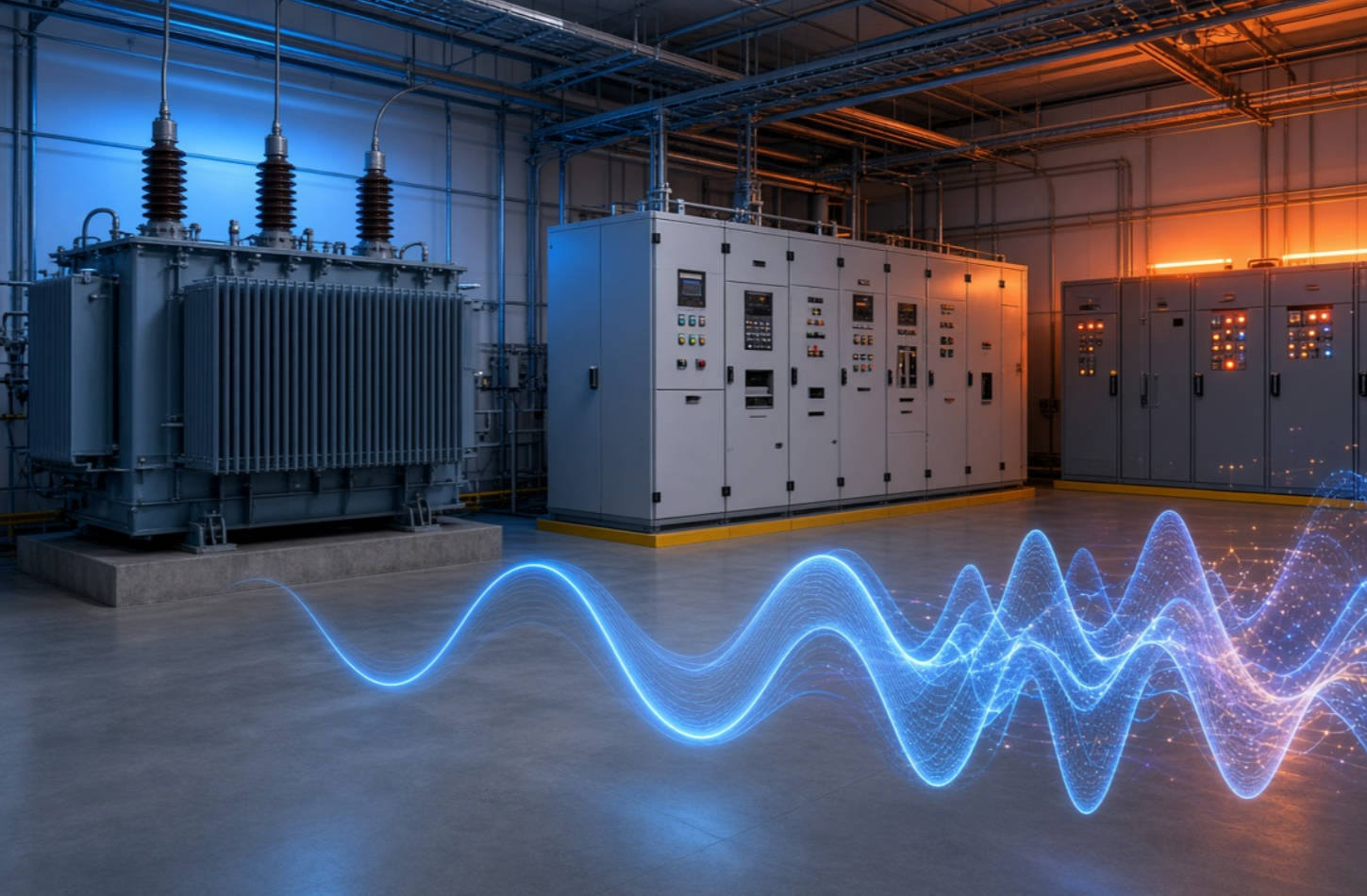
In an ideal AC electrical system, voltage and current follow a smooth sinusoidal waveform at the fundamental supply frequency—typically 50 Hz or 60 Hz. Electrical harmonics are voltage or current components whose frequencies are whole-number multiples of that fundamental frequency.
For example, in a 50 Hz system:
- 3rd harmonic = 150 Hz
- 5th harmonic = 250 Hz
- 7th harmonic = 350 Hz
- 11th harmonic = 550 Hz
- 13th harmonic = 650 Hz
When harmonic currents flow through the impedance of transformers, cables, switchgear, and other upstream components, they can create harmonic voltage distortion. The result is a distorted waveform rather than a clean sine wave.
This distortion is not merely a measurement issue. It can affect motors, transformers, capacitor banks, protective devices, automation systems, communication circuits, and sensitive electronic loads.
In simple terms: nonlinear equipment creates harmonic current; the electrical network converts part of that current into voltage distortion; and the distorted voltage can then affect many other loads connected to the same system.
Modern industry increasingly relies on power-electronic equipment. These technologies deliver valuable process-control, automation, and energy-efficiency benefits, but many of them draw current in pulses instead of smoothly throughout each AC cycle.
Common harmonic-producing loads include:
- Variable frequency drives (VFDs)
- Soft starters and DC drives
- Rectifiers and battery chargers
- UPS systems
- Welding machines
- Induction furnaces and arc furnaces
- Switch-mode power supplies
- LED lighting drivers
- Data-center and IT equipment
- EV charging equipment
- Solar inverters and other converter-based energy systems
The more nonlinear loads a facility adds, the more important it becomes to assess its power quality. A system that operated reliably several years ago may experience new harmonic problems after production expansion, automation upgrades, VFD retrofits, or renewable-energy integration.
Harmonics can create both immediate operational symptoms and long-term reliability risks. The severity depends on the harmonic spectrum, system impedance, load profile, transformer capacity, capacitor-bank design, and the possibility of resonance.
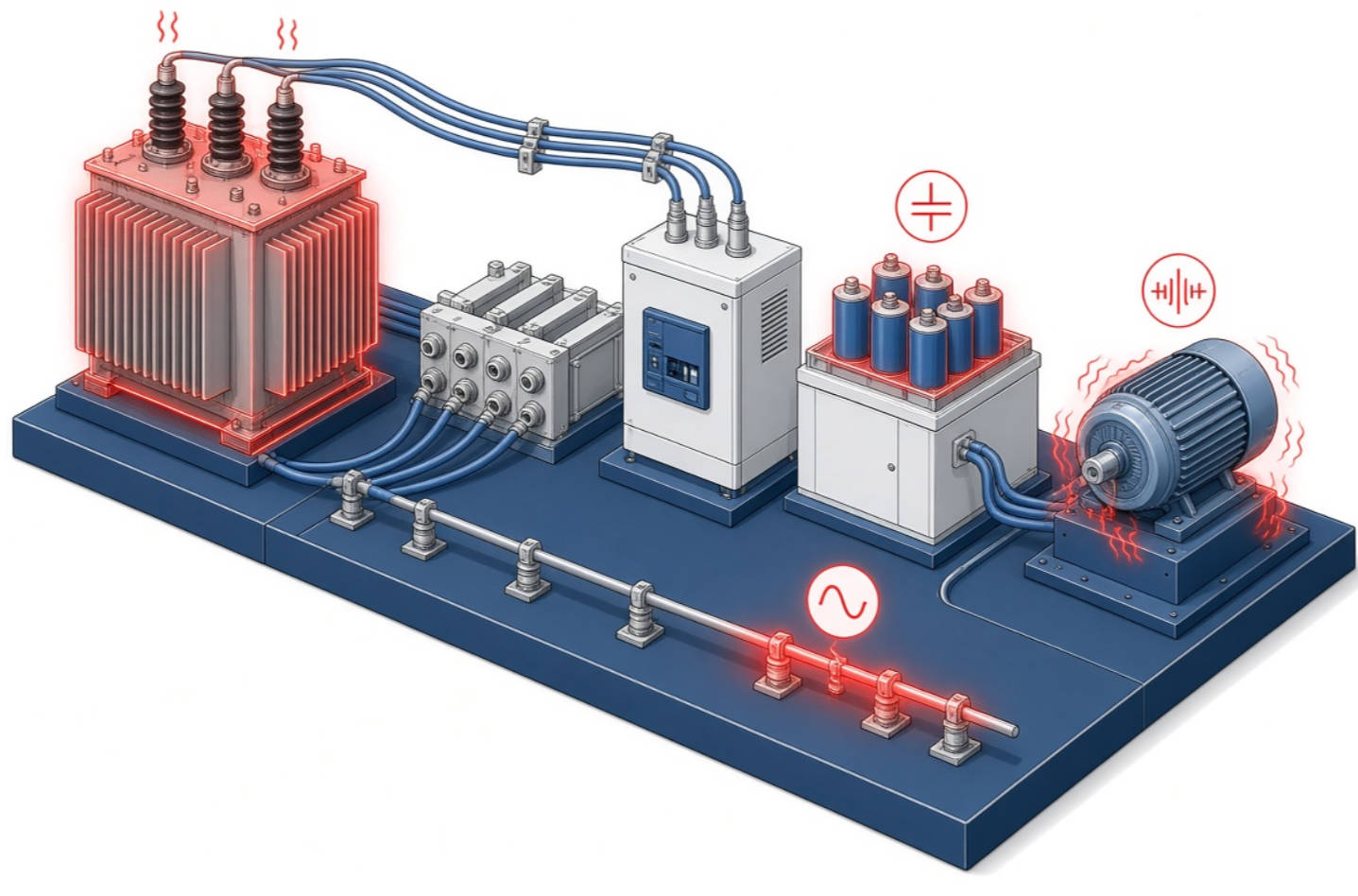
One of the most common effects of harmonics is additional heating in electrical equipment. Harmonic currents increase losses in conductors, transformers, motors, and switchgear.
Transformers are particularly vulnerable because harmonic currents can increase winding losses, eddy-current losses, and stray losses. The higher frequency components of harmonic current may create more heating than an equivalent amount of fundamental-frequency current.
Motors may also experience:
- Higher winding temperature
- Torque pulsation
- Additional vibration
- Audible noise
- Lower efficiency
- Reduced insulation life
- Premature bearing and mechanical wear
A motor may appear to be operating within its rated current range while still experiencing abnormal temperature rise due to waveform distortion. This is why current magnitude alone is not enough for a complete power-quality assessment.
Harmonic currents can increase conductor losses because AC resistance rises at higher frequencies. Skin effect and proximity effect become more significant as frequency increases, causing current distribution within conductors to become less uniform.
Triplen harmonics—especially the 3rd, 9th, and 15th—deserve special attention in three-phase, four-wire systems. These zero-sequence harmonic currents do not cancel in the neutral conductor. Instead, they can add together.
As a result, a neutral conductor can carry unexpectedly high current even when phase currents appear balanced.
Warning signs may include:
- Overheated neutral conductors
- Discolored cable insulation
- Hot distribution boards
- Repeated thermal alarms
- Overloaded neutral busbars
- Nuisance tripping in low-voltage panels
For commercial buildings, data centers, offices, hospitals, and facilities with many single-phase electronic loads, neutral-current measurement should be part of the power-quality survey.
Harmonic currents increase transformer losses and may reduce usable transformer capacity. If a transformer was selected only on the basis of kVA demand, without considering harmonic loading, it may operate hotter than expected.
This can lead to:
- Reduced transformer life
- Higher cooling demand
- Insulation deterioration
- Lower available capacity for future expansion
- Unexpected trips or thermal protection alarms
- Higher energy losses over the operating life of the facility
In facilities with substantial nonlinear loads, engineers may need to evaluate transformer loading with harmonic derating considerations rather than assuming the nameplate rating can be used under all waveform conditions.
Capacitor banks are widely used for reactive power compensation and power factor correction. They can reduce reactive-power demand, support voltage, and improve power factor. However, conventional capacitor banks may be exposed to serious risk when harmonics are present.
Capacitors have lower impedance at higher frequencies. This means they can attract harmonic currents. In some systems, the combination of a capacitor bank and the network inductance—including transformer and cable inductance—can create a resonant circuit.
If the resonant frequency is close to a dominant harmonic frequency, the system may amplify harmonic current or voltage instead of reducing it.
Possible symptoms include:
- Bulging or leaking capacitors
- Repeated capacitor-fuse operation
- Overheated contactors
- Reactor overheating
- Burned capacitor terminals
- Unstable power factor
- High capacitor current
- Repeated compensation-cabinet failures
A capacitor bank should never be selected only by kvar requirement when meaningful harmonic distortion exists. Harmonic assessment, reactor selection, tuning frequency, switching method, and protection design must be considered together.
Harmonic distortion can affect devices that depend on accurate waveform measurement. Protection relays, circuit breakers, meters, PLC-related equipment, and control circuits may not respond as intended when the waveform is heavily distorted.
Potential operational problems include:
- Nuisance tripping of circuit breakers
- Incorrect relay operation
- Inaccurate metering results
- Unstable control signals
- Communication interference
- Process interruptions
- False alarms in monitoring systems
In automated production environments, even a short power-quality event can interrupt a process sequence, trigger a shutdown, or create product-quality issues. The cost of one production interruption may exceed the cost of a properly engineered harmonic mitigation solution.
Harmonics do not always create a clearly visible utility bill line item. However, they can increase total operating costs through extra losses, reduced equipment life, lower production availability, and avoidable maintenance.
Every conductor has impedance. When harmonic current flows through cables, it produces additional \(I^2R\) losses. Higher-frequency components can increase the effective AC resistance of the conductor.
The impact may be especially important in:
- Long feeder cables
- Heavily loaded busway systems
- High-current production lines
- Large variable-speed motor installations
- Facilities with concentrated nonlinear loads
These losses are converted into heat, which wastes energy and increases thermal stress on insulation.
Transformer losses include winding losses and core-related losses. Harmonics can increase both copper losses and frequency-dependent eddy-current losses.
A transformer that runs hotter due to harmonic loading may require derating or replacement with a design better suited to nonlinear loads. Ignoring this issue can result in repeated thermal alarms, shortened insulation life, and premature asset replacement.
Harmonics and reactive power are related but not identical. A facility may have acceptable displacement power factor while still having a poor true power factor because of waveform distortion.
When true power factor is low, the system may need to draw more current to deliver the same amount of useful real power. This may contribute to:
- Higher line losses
- Reduced available system capacity
- Increased transformer and cable loading
- Possible utility penalties, depending on local tariff structures
- Reduced electrical efficiency
A complete power-quality evaluation should consider reactive power, power factor, harmonic distortion, load balance, voltage variation, and equipment operating conditions together.
Harmonic issues are often discovered after a failure, but early symptoms can help maintenance teams investigate before a major shutdown occurs.
| Symptom | Possible Harmonic-Related Cause | Recommended Action |
|---|---|---|
| Transformer runs unusually hot | Increased harmonic-related winding and eddy-current losses | Measure current spectrum and transformer loading |
| Capacitors fail repeatedly | Harmonic overcurrent or resonance | Review capacitor-bank and reactor design |
| Circuit breakers trip without clear overload | Distorted current or thermal stress | Record waveform and event data |
| Motors vibrate or overheat | Harmonic voltage distortion and torque pulsation | Check voltage THD and motor operating conditions |
| Neutral conductor overheats | Accumulated triplen harmonic current | Measure neutral current and harmonic spectrum |
| Production controls malfunction | Harmonic interference or voltage distortion | Monitor power quality at sensitive loads |
| Power factor fluctuates | Inappropriate switching or harmonic interaction | Evaluate compensation control strategy |
| Electrical panels show abnormal heating | Harmonic current losses in conductors or components | Perform thermal inspection and power-quality testing |
Important: these symptoms do not prove that harmonics are the only cause. A qualified electrical engineer should verify the root cause using measurement data, system drawings, equipment ratings, and site operating conditions.
Harmonic mitigation should begin with measurement—not assumptions. Installing capacitors, reactors, or filters without understanding the system may create a costly mismatch between the solution and the actual problem.
A meaningful survey should capture data during normal and peak operating conditions, particularly when major nonlinear loads are active.
A professional power-quality assessment commonly reviews:
- Voltage total harmonic distortion, or voltage THD
- Current total harmonic distortion, or current THD
- Individual harmonic orders
- Total demand distortion where applicable
- Voltage unbalance
- Current unbalance
- Power factor and true power factor
- Reactive power demand
- Maximum demand current
- Transformer loading
- Neutral current
- Capacitor current
- Voltage events, dips, swells, and interruptions
- Load changes over time
Measurement should be performed at appropriate locations, such as the point of common coupling, main incoming panel, transformer secondary side, capacitor bank, critical feeder, or sensitive production line.
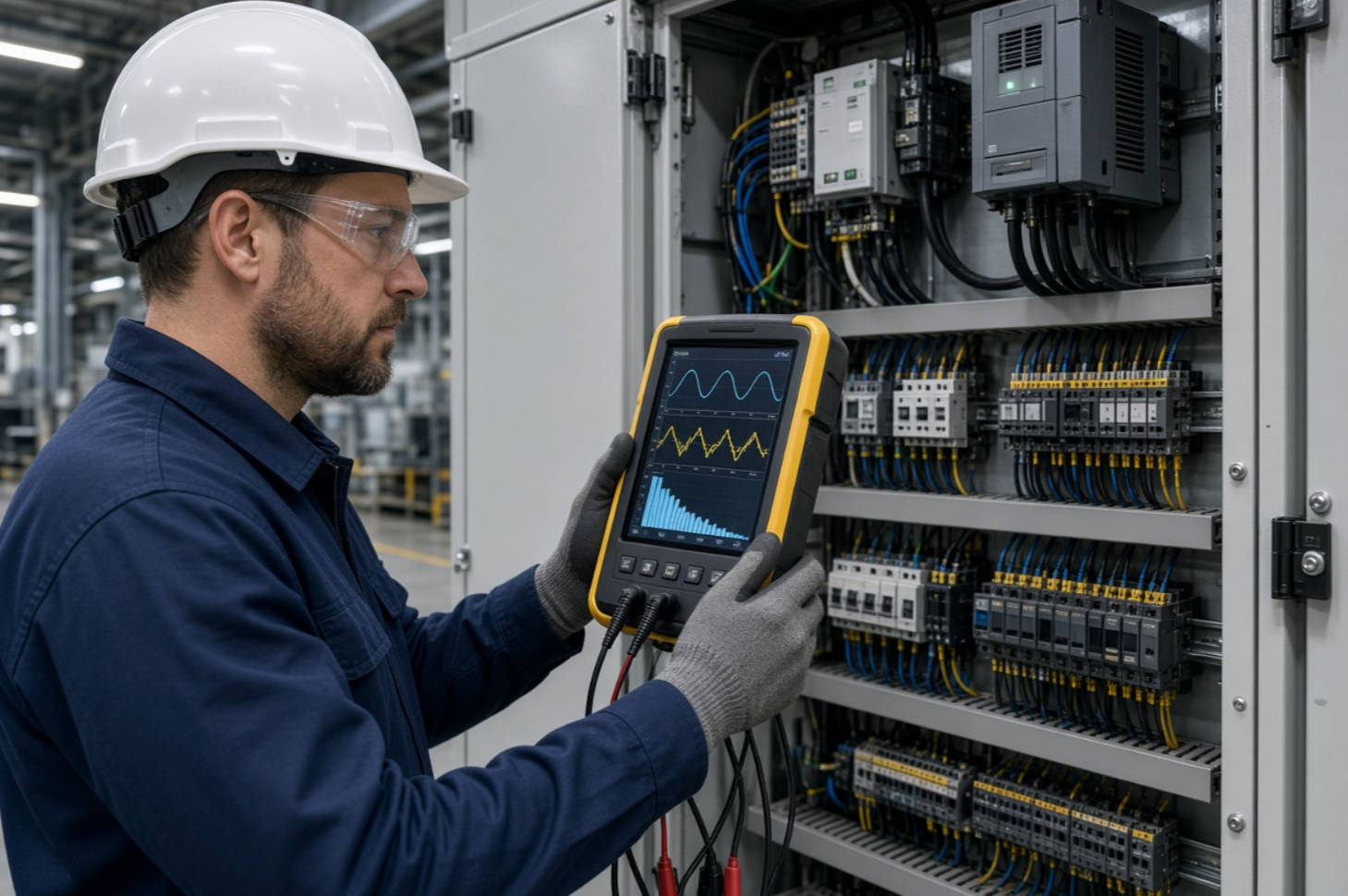
1. Identify nonlinear loads. Create an equipment list for VFDs, rectifiers, UPS units, furnaces, welders, chargers, LED systems, and converter-based equipment.
2. Review the one-line diagram. Confirm transformer ratings, cable routes, feeder sizes, capacitor-bank configuration, protection devices, and existing reactors or filters.
3. Install a power-quality analyzer. Record voltage, current, harmonic spectrum, demand, and events over a representative operating period.
4. Analyze resonance risk. Compare dominant harmonic orders with the network characteristics and capacitor-bank tuning arrangement.
5. Select and validate a solution. Choose a passive, active, hybrid, or reactive-power compensation solution based on measured data. Re-test performance after commissioning.
This process helps avoid the common mistake of treating every harmonic problem with the same product.
There is no universal harmonic-control device. The best solution depends on the harmonic spectrum, load changes, power factor target, system voltage, short-circuit capacity, available space, and operating environment.
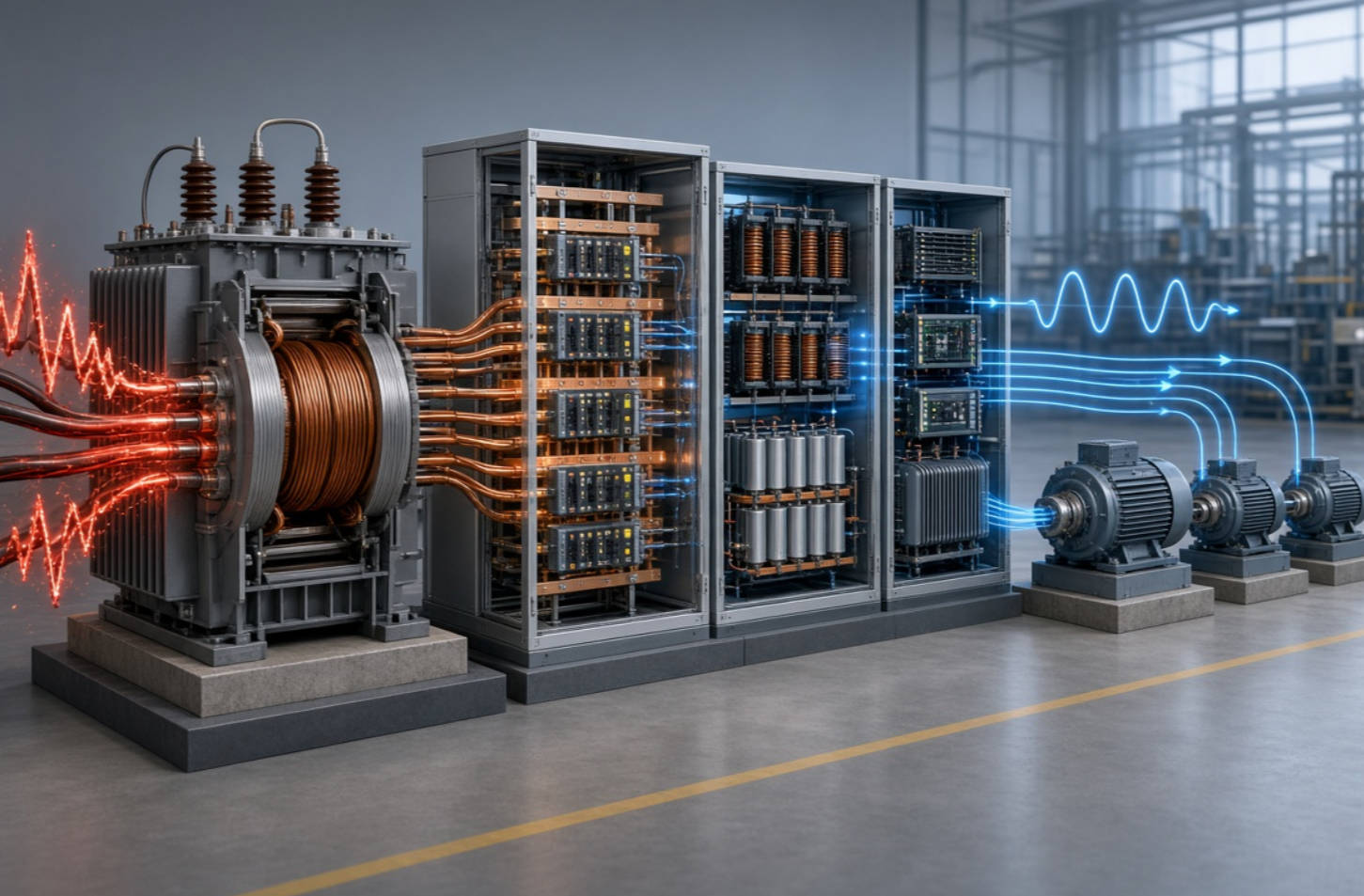
A detuned capacitor bank combines power factor correction capacitors with reactors connected in series. The reactor changes the circuit characteristics so that the capacitor bank is less likely to resonate with dominant system harmonics.
This solution is often suitable where the main requirement is reactive power compensation but the facility also has a moderate level of harmonic distortion.
A properly engineered detuned system can:
- Improve power factor
- Reduce resonance risk
- Protect capacitors from harmonic overload
- Reduce some harmonic amplification
- Support stable operation of automatic compensation equipment
The tuning frequency must be selected according to site conditions. In many practical low-voltage applications, engineers tune the series reactor-capacitor circuit below the lowest significant harmonic order so that the system does not resonate near dominant harmonic frequencies.
Passive filters use capacitors, reactors, and resistive elements to provide a low-impedance path for selected harmonic frequencies. They can be designed as single-tuned, high-pass, or other filter configurations.
Passive filters are often appropriate when:
- Dominant harmonic orders are predictable
- The load profile is relatively stable
- Significant reactive power compensation is also required
- A fixed or semi-fixed industrial process is involved
- The project requires a cost-effective solution for known harmonic frequencies
They require careful engineering because system impedance, load growth, capacitor switching, and future equipment changes can alter performance.
Active power filters, often called APFs or AHFs, continuously measure load current and inject compensating current in real time. Their purpose is to reduce harmonic current, compensate reactive power when required, and help balance loads in certain applications.
Active filtering is especially useful where harmonic content changes frequently, such as facilities with multiple VFDs, changing production lines, variable loads, or diverse electronic equipment.
Key advantages include:
- Dynamic compensation
- Multi-order harmonic mitigation
- Fast response to changing loads
- Reactive power compensation capability
- Support for load balancing in selected applications
- Modular scalability for future expansion
For a plant with rapidly changing load conditions, an active power filter may provide more flexible performance than a fixed passive filter alone.
A static VAR generator, or SVG, is designed mainly for fast dynamic reactive power compensation. It can improve power factor, stabilize voltage, and support reactive-power control under changing load conditions.
SVG technology may be used independently or together with harmonic filtering equipment. In applications where both reactive power and harmonic distortion are significant, a hybrid solution may be more effective than relying on one device type alone.
The correct solution should be engineered around the electrical system, not selected from a catalog alone.
| Site Condition | Possible Solution Direction |
|---|---|
| Stable harmonic spectrum with known dominant orders | Passive tuned harmonic filter |
| Capacitor bank failures caused by resonance risk | Detuned capacitor bank with series reactors |
| Rapidly changing nonlinear load | Active power filter |
| Fast-changing reactive-power demand | Static VAR generator |
| Both high harmonic distortion and unstable power factor | Hybrid APF, SVG, and detuned compensation design |
| Large industrial load with customized electrical constraints | Site-specific power-quality cabinet and engineering package |
| Existing capacitor system needs safer operation | Reactor retrofit and compensation-control review |
A successful project should also consider installation location, enclosure rating, ambient temperature, ventilation, cable routing, protection coordination, communication protocols, maintenance access, and future capacity expansion.
Metallurgical operations often use large nonlinear loads, including furnaces, rectifiers, rolling-mill drives, and high-power motor-control systems. These loads can create substantial current distortion, voltage fluctuations, and reactive-power demand.
A combined approach involving harmonic filtering, dynamic reactive power compensation, and system monitoring may help stabilize production power supply and reduce stress on transformers and compensation equipment.
Petrochemical plants depend on reliable operation of pumps, compressors, process controls, emergency systems, and instrumentation. VFDs and motor-drive systems are common, making harmonic assessment valuable for protecting critical equipment and avoiding process disruption.
For these facilities, solution selection should consider continuous operation, hazardous-area requirements where applicable, redundancy needs, and the consequences of an unplanned shutdown.
Automotive production lines use robotic systems, welding machines, conveyors, paint-shop equipment, compressors, and automated assembly equipment. Harmonics can affect sensitive control systems and may contribute to interruption risks.
Active filtering and dynamic compensation can be particularly useful when plant loads change by shift, production model, or equipment cycle.
Paper machines, textile lines, kilns, crushers, extruders, pumps, fans, and conveyors often rely on variable-speed motor control. These applications may benefit from a coordinated strategy that addresses both harmonic current and reactive power demand.
The goal is not simply to reduce a THD reading. It is to maintain stable electrical operation, protect assets, and support continuous production.
Before purchasing or upgrading a reactive power compensation or harmonic control system, ask these questions:
1. What are the dominant harmonic orders at the installation point?
2. Is the issue primarily harmonic distortion, reactive power demand, voltage fluctuation, or a combination?
3. Are existing capacitor banks protected by properly selected series reactors?
4. Has the transformer been checked for harmonic-related loading and temperature rise?
5. Are neutral conductors, busbars, and feeders adequately sized for harmonic currents?
6. Does the load profile change significantly during production?
7. Is a passive, active, or hybrid solution most appropriate?
8. Can the proposed solution meet applicable grid, project, and customer requirements?
9. Has the design allowed for future expansion of VFDs, automation equipment, or converter-based loads?
10. Will performance be verified through post-commissioning measurement?
The best harmonic mitigation project begins with accurate data, sound engineering, and a clear understanding of the customer's production process.
Harmonics can damage capacitors, overheat transformers, reduce motor efficiency, increase losses, disrupt controls, and create costly downtime. But these risks can be managed with the right combination of power-quality measurement, reactive power compensation, harmonic filtering, and customized electrical design.
DINGNUO ELECTRIC CO., Ltd. provides power-quality products and integrated solutions for customers worldwide, including capacitors, low- and high-voltage reactors, intelligent capacitor modules, tuned filter cabinets, active power filters, static VAR generators, harmonic filter cabinets, controllers, and customized electrical cabinets.
If your facility is experiencing capacitor failure, transformer overheating, unstable power factor, nuisance tripping, high neutral current, or suspected harmonic distortion, contact DINGNUO ELECTRIC to discuss a customized harmonic control and reactive power compensation solution for your application.
The 5th and 7th harmonics are often significant in three-phase industrial power systems because they are commonly produced by six-pulse rectifier-type loads and can contribute to voltage distortion, overheating, and resonance problems. Third-order and other triplen harmonics are especially important in three-phase, four-wire systems because they can accumulate in the neutral conductor.
Yes. Capacitors do not create harmonic current by themselves, but they can interact with system inductance and create resonance conditions. If the resonant frequency is near a dominant harmonic frequency, harmonic voltage or current may be amplified. Detuned reactors should be considered when capacitor banks operate in systems with meaningful harmonic distortion.
A passive filter uses fixed combinations of capacitors and reactors to target known harmonic frequencies. An active power filter measures harmonic current in real time and injects compensating current dynamically. Passive filters can be effective for stable, predictable harmonic conditions, while active filters are often better for changing load profiles.
Harmonic currents increase transformer losses and heating. They can increase winding losses, eddy-current losses, and stray losses, which may reduce usable transformer capacity and shorten insulation life. A transformer serving nonlinear loads should be evaluated using measured harmonic data rather than kVA loading alone.
Typical warning signs include repeated capacitor failure, overheated transformers, overloaded neutral conductors, frequent breaker trips, motor overheating, unstable control systems, abnormal panel temperature, and fluctuating power factor. The reliable way to confirm the issue is to conduct a power-quality measurement using suitable monitoring equipment.
Yes. Many active power filters can provide dynamic reactive power compensation in addition to harmonic current mitigation. However, whether an APF, SVG, detuned capacitor bank, or hybrid system is the best choice depends on the measured electrical conditions and the site's reactive-power requirements.
A harmonic survey should typically measure voltage THD, current THD, individual harmonic orders, load current, power factor, reactive power, transformer loading, capacitor current, neutral current, voltage imbalance, and power-quality events. Measurements should cover representative operating conditions, including periods of high production demand.
1. IEEE Standards Association. "IEEE 519-2022: IEEE Standard for Harmonic Control in Electric Power Systems." This active standard establishes design goals for electrical systems containing linear and nonlinear loads and addresses harmonic voltage and current distortion at the point of common coupling. [IEEE 519-2022] [standards.ieee]
2. International Electrotechnical Commission. "IEC 61000-4-7: Electromagnetic Compatibility—Testing and Measurement Techniques—General Guide on Harmonics and Interharmonics Measurements and Instrumentation." The standard covers harmonic and interharmonic measurement instrumentation for 50 Hz and 60 Hz power systems, including spectral components up to 9 kHz. [IEC 61000-4-7] [webstore.iec]
3. TDK Electronics. "Reactors for Power Factor Correction and Harmonic Filtering." The technical product information explains that PFC capacitors and supply transformers can form resonance circuits and that series reactors can detune the system below the lowest significant harmonic frequency. [TDK Reactors for PFC and Harmonic Filtering] [tdk-electronics.tdk]
4. DINGNUO ELECTRIC CO., Ltd. "Reactive Power Compensation and Harmonic Filter Solutions." Product and company information covering customized electrical cabinets, low- and high-voltage capacitors and reactors, active power filters, static VAR generators, harmonic filter cabinets, and tuned filter cabinets. [DINGNUO ELECTRIC] [dingnuopower]
5. ANSI Blog. "IEEE 519-2022: Harmonic Control in Electric Power Systems." An overview of IEEE 519-2022, including the role of the point of common coupling and the shared responsibility of users and supply-system operators in limiting harmonic distortion. [ANSI Overview of IEEE 519-2022] [blog.ansi]
6. ABB. "IEEE 519-2022 Review: What Has Changed from the IEEE 519-2014 Standard?" Technical note describing the scope and updates of the IEEE 519-2022 standard, including its application to systems with nonlinear loads and distortion assessment at the point of common coupling. [ABB IEEE 519-2022 Review] [library.e.abb]


