
Views: 270 Author: Dingnuo Electric Publish Time: 2026-08-04 Origin: Site


Content Menu
● What Is an Active Harmonic Filter?
● Why Harmonics Are a Real Problem
● Working Principle of Active Harmonic Filters
● Key Components Inside an AHF
● How It Improves Power Quality
● Where Active Harmonic Filters Are Used
● AHF vs Passive Filter: Which Is Better?
● New Insight: Why Recent Industrial Projects Favor AHFs
● New Insight: How to Select the Right Solution
● Practical Example From Industry
● What Makes an Effective AHF System
● Why This Matters for DINGNUO ELECTRIC CO., Ltd.
● FAQs
>> 1. What is the main function of an active harmonic filter?
>> 2. Does an AHF also improve power factor?
>> 3. Where should an active harmonic filter be installed?
>> 4. Is an active harmonic filter better than a passive filter?
>> 5. What industries benefit most from AHFs?
>> 6. Why is measurement important before selecting an AHF?
If your plant uses variable frequency drives, rectifiers, welding equipment, or other nonlinear loads, an active harmonic filter (AHF) can be one of the most effective ways to improve power quality. In this guide, we explain the working principle of active harmonic filters, why they matter in modern industrial systems, and how they help reduce harmonics, support reactive power compensation, and protect critical equipment.
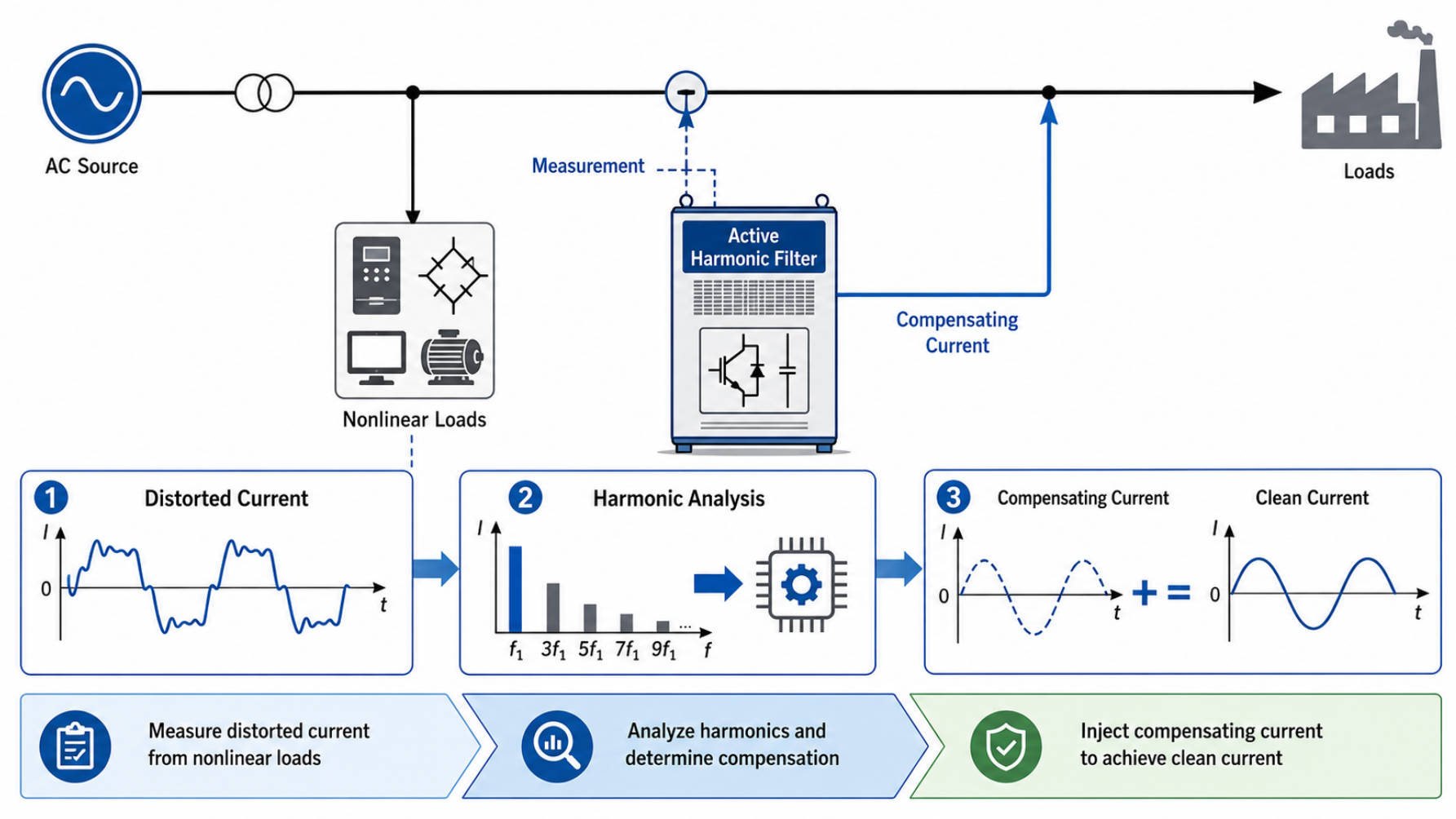
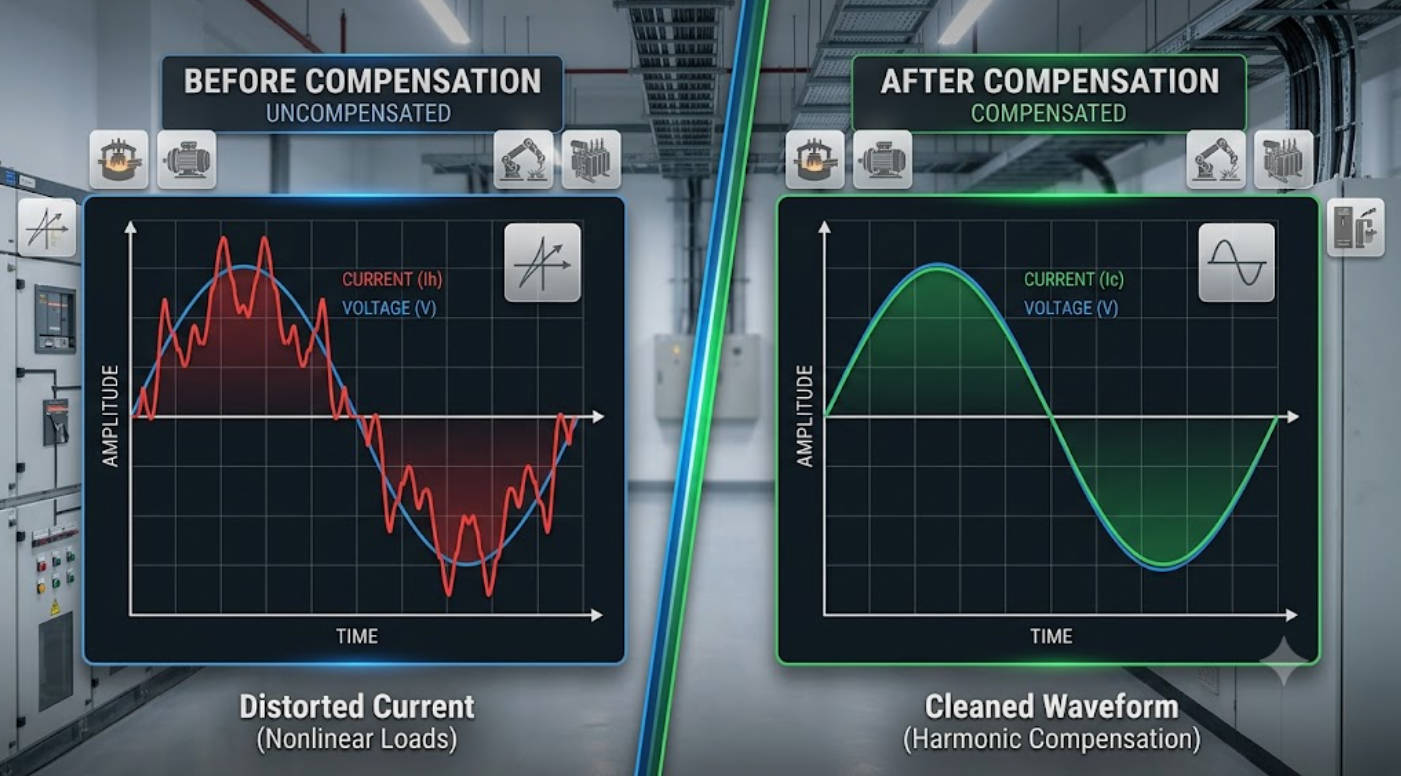
An active harmonic filter is a power electronics device designed to detect harmonic currents in real time and inject an equal-but-opposite compensating current back into the system. In simple terms, it works like noise cancellation for electrical networks.
Unlike passive filters, which are tuned to specific frequencies, an AHF adapts dynamically as load conditions change. That makes it especially useful in plants where loads are highly variable and harmonic distortion is not constant.
Harmonics are unwanted frequency components created by nonlinear loads. They distort current and voltage waveforms, which can lead to practical issues such as:
- Overheating of transformers, cables, and motors.
- Nuisance tripping of breakers and protective devices.
- Lower equipment efficiency and reduced usable capacity.
- Higher losses and shorter service life.
- Poor power factor and possible utility penalties.
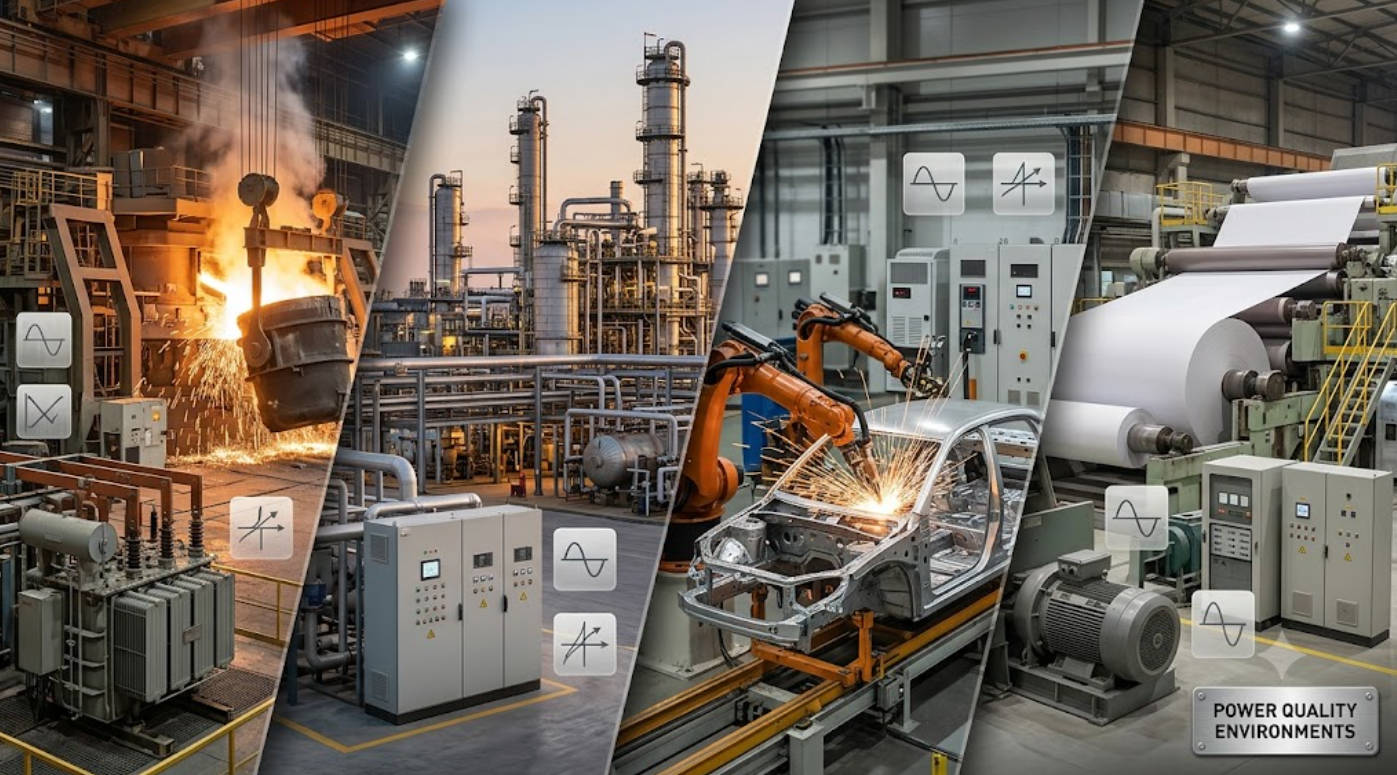
For industries such as metallurgy, petrochemicals, automotive manufacturing, paper, textiles, building materials, and public infrastructure, these problems can quickly affect uptime and operating cost.
The core principle is detect, calculate, and cancel.
1. Sensing: Current transformers or sensors measure the load current at the point where distortion is present.
2. Analysis: A digital controller separates the fundamental current from harmonic components in real time.
3. Compensation: The inverter inside the AHF generates a compensation current with the same magnitude but opposite phase.
4. Injection: The compensation current is injected into the network so the source sees a much cleaner current waveform.
This process happens continuously and very quickly, allowing the AHF to respond to sudden changes in production loads.
A typical active harmonic filter includes the following parts:
- Current sensors to monitor load conditions.
- Controller or DSP to calculate harmonic content.
- IGBT-based inverter to generate compensation current.
- DC-link capacitor to support energy conversion.
- Coupling reactor or filter circuit to inject the compensating signal safely.
Together, these components allow the filter to function as an intelligent, real-time harmonic compensation system.
An AHF does more than reduce harmonics. In industrial applications, it can also support broader power quality goals.
| Function | Practical benefit |
|---|---|
| Harmonic mitigation | Reduces distortion and improves waveform quality |
| Reactive power compensation | Helps improve power factor |
| Load balancing | Reduces phase imbalance in three-phase systems |
| Voltage stability support | Helps reduce nuisance voltage fluctuations |
| System capacity relief | Frees electrical infrastructure for productive loads |
For many plants, this combination is more valuable than harmonic mitigation alone.
AHFs are widely used in facilities with fast-changing or distortion-heavy loads, such as:
- Steel and metal processing plants.
- Petrochemical and refining facilities.
- Automotive production lines.
- Paper mills and textile factories.
- Cement, ceramics, and building-material operations.
- Municipal infrastructure and large commercial power systems.
These environments often combine motors, drives, rectifiers, compressors, and automation equipment, which makes harmonic control essential.
The best choice depends on the load profile, distortion level, and operating objectives.
| Aspect | Active harmonic filter | Passive harmonic filter |
|---|---|---|
| Response | Real-time and dynamic | Fixed-tuning response |
| Load variation | Handles fluctuating loads well | Best for stable loads |
| Harmonic range | Broad and flexible | Narrow and frequency-specific |
| Power factor support | Yes, often included | Limited |
| Maintenance profile | Higher intelligence, lower retuning need | Simpler, but tuning is critical |
In many modern plants, AHFs are preferred when loads change frequently or when harmonic orders shift throughout the day.
One reason AHFs are gaining more attention is that industrial power systems are becoming more dynamic. Production lines now rely on more variable-speed drives, automated machinery, and sensitive electronics than ever before.
That means harmonic distortion is no longer a fixed problem. It moves with the process.
This is where an AHF offers unique value: it is not limited to one tuned frequency. Instead, it adjusts continuously, which makes it more suitable for plants that operate in mixed-load or multi-shift environments.
A successful harmonic mitigation project should start with measurement, not assumption.
Use this simple decision path:
1. Measure the load profile with a power quality analyzer.
2. Identify dominant harmonic orders and distortion sources.
3. Check power factor and reactive demand across operating conditions.
4. Review transformer, capacitor, and cable loading.
5. Decide whether the site needs an AHF, passive filter, capacitor bank, or a hybrid solution.
6. Commission the system at the point of common coupling, not only at the cabinet.
This approach reduces the risk of under-sizing, over-sizing, or solving the wrong problem.
Consider a manufacturing plant with multiple VFDs and fluctuating production lines. Harmonic levels rise during peak operation, causing heating, unstable readings, and occasional nuisance trips.
After installing an AHF near the main distribution point, the plant can achieve:
- Lower current distortion.
- Better voltage stability.
- Improved power factor.
- Reduced stress on transformers and capacitors.
- More reliable operation of control systems.
The result is not only better power quality, but also better process stability and lower maintenance burden.
For strong long-term performance, the filter should be selected and installed with these factors in mind:
- Correct current rating for present and future load growth.
- Appropriate harmonic spectrum coverage.
- Fast response speed for changing load conditions.
- Safe integration with upstream protection and distribution equipment.
- Proper ventilation and thermal design.
- Commissioning based on real measurements.
A well-designed system should solve the electrical problem without creating new operational risks.
At DINGNUO ELECTRIC CO., Ltd., we understand that industrial customers need more than a product. They need a dependable power quality solution that supports production continuity, equipment protection, and energy efficiency.
Our experience in reactive power compensation and harmonic control helps customers address real-world power quality challenges across metallurgy, petrochemical, automotive, paper, textile, building-material, and municipal infrastructure projects. We focus on complete system support, from technical evaluation to practical application.
An active harmonic filter is one of the most effective tools for modern industrial power quality management. It reduces harmonics, supports reactive power compensation, and adapts to changing load conditions in real time.
If your plant is facing harmonic distortion, poor power factor, or unstable electrical performance, the next step is a professional power quality assessment. Contact DINGNUO ELECTRIC CO., Ltd. to discuss a tailored solution for your system.
It detects harmonic currents in real time and injects compensating current to cancel distortion in the electrical system.
Yes. Many AHFs can provide reactive power support and help improve power factor in addition to harmonic mitigation.
It is usually installed near harmonic-producing loads, at a distribution panel, transformer secondary, or the point of common coupling.
Not always. AHFs are usually better for dynamic, changing loads, while passive filters can be cost-effective for stable load conditions.
Industries with nonlinear loads, such as steel, petrochemical, automotive, paper, textiles, cement, and municipal infrastructure, often benefit the most.
Because harmonic levels, reactive demand, and load behavior change by site. Accurate measurements help choose the right capacity and avoid poor system design.
1. Fuji Electric. Active Harmonic Filter Guide. [https://www.fujielectric.com/products/power_supply/guide/ahf/]
2. IEEE. IEEE Standard 519: Recommended Practice and Requirements for Harmonic Control in Electric Power Systems. [https://standards.ieee.org/standard/519-2022.html]
3. ABB. Harmonics and Active Filters. [https://new.abb.com/low-voltage/products/power-quality/harmonics-and-active-filters]
4. Schneider Electric. Reactive Power Compensation: A Practical Guide. [https://www.se.com/ww/en/work/support/resources-and-tools/documentation/]
5. COE Powers. A Complete Guide: Working Principle of Active Harmonic Filters. [https://www.coepowers.com/a-complete-guide-working-principle-of-active-harmonic-filters/]
6. DINGNUO ELECTRIC CO., Ltd. Company-provided product and application positioning statement.


