
Views: 298 Author: Dingnuo Electric Publish Time: 2026-08-25 Origin: Site


Content Menu
>> Indonesia's sourcing advantage
● Leading Suppliers Serving Indonesia
>> 1. DINGNUO ELECTRIC CO., Ltd.
>> 2. Schneider Electric Indonesia
>> 5. PT Sinar Distribusi Sejahtera / Local Panel Integration Market
>> 6. PT Oscorp Elektrik Indonesia
>> 7. PT Graha Sumber Prima Elektronik
● Buyer's Guide: Avoiding Costly Mistakes
>> 1. Do not buy by kVAr alone
>> 2. Verify ISO certificates properly
>> 3. Confirm compliance at model level
>> 4. Require a sample or FAT process
>> 5. Plan logistics for Indonesia
>> The "same capacitance" illusion
● FAQ
>> 1. How can I verify whether a supplier's ISO certificate has expired?
>> 2. Is a detuned reactor always necessary for a capacitor bank?
>> 3. What documents should be included with a reactive power compensation cabinet?
>> 4. Can I use a standard contactor to switch capacitor-bank steps?
>> 5. How should I compare two quotations that have the same kVAr rating?
Indonesia is an important market for reactive power compensation rather than a fully localized manufacturing base for every product category. Its industrial electricity consumption reached 93.35 TWh in 2025, led by food and beverage, steel and metals, and non-metallic minerals—industries where inductive loads, fluctuating demand, and harmonics make power-factor correction and filtering commercially relevant.
For professional buyers, the right sourcing decision is rarely about buying the lowest-priced capacitor bank. It is about selecting a technically accountable partner that can correctly assess the load profile, harmonic spectrum, switching duty, ambient temperature, installation constraints, required documentation, and after-sales responsibilities.
Indonesia's supplier landscape combines locally established global OEM operations, local panel and integration capabilities, and specialized overseas manufacturers serving Indonesian projects through direct export or local partners. This guide focuses on companies that are relevant to industrial buyers seeking long-term reactive power compensation, harmonic mitigation, and power-quality support.
Editorial note: "Top" in this article does not mean that every company is suitable for every project. The ranking reflects purchasing relevance for industrial users, panel builders, EPC contractors, distributors, and OEM buyers—not a universal quality score.

A reliable reactive power compensation supplier should be evaluated on more than brand awareness. This review uses the following transparent criteria:
| Evaluation dimension | What professional buyers should verify | Why it matters |
|---|---|---|
| Engineering capability | Single-line diagrams, load studies, harmonic calculations, thermal design, kVAr sizing | Incorrect sizing can cause poor PF improvement, resonance, capacitor overheating, or nuisance trips |
| Core product coverage | PFC capacitors, detuned reactors, APFC controllers, thyristor switches, SVG/SVC, active harmonic filters | Integrated projects require compatible components and a coordinated protection strategy |
| Quality control | Incoming material inspection, routine tests, traceability, final inspection records | Helps reduce early failure caused by low-grade film, weak terminals, or inconsistent reactor winding |
| Standards and compliance | IEC 60831, IEC 61921, IEC 61000 series, CE, RoHS, ISO 9001 where applicable | Documents must match the actual supplied model—not merely the supplier's general certificate |
| Local support | Indonesian engineering, service network, panel integration, spare-part availability | Important for site surveys, commissioning, urgent failures, and warranty cases |
| Delivery reliability | BOM control, production planning, packaging, export documentation, lead-time transparency | Particularly important for EPC schedules and shutdown-window installations |
| OEM/ODM flexibility | Customized nameplates, electrical diagrams, cabinet dimensions, voltage/frequency ratings, branding | Critical for distributors, panel builders, and mid-sized electrical brands |
In low-voltage industrial applications, reactive power compensation commonly includes:
- Fixed capacitor banks for stable base loads
- Automatic power factor correction (APFC) banks for varying inductive loads
- Detuned capacitor banks where harmonic distortion is material
- Thyristor-switched capacitor banks for rapid load fluctuations
- Active power filters (APF/AHF) for harmonic-current mitigation
- Static VAR generators (SVG/STATCOM) where dynamic compensation and wider operating flexibility are required
A basic capacitor bank should not be selected only by total kVAr. Buyers should verify voltage, frequency, capacitor duty, expected harmonic profile, switching sequence, ventilation, protection coordination, reactor tuning, and the system's short-circuit rating.
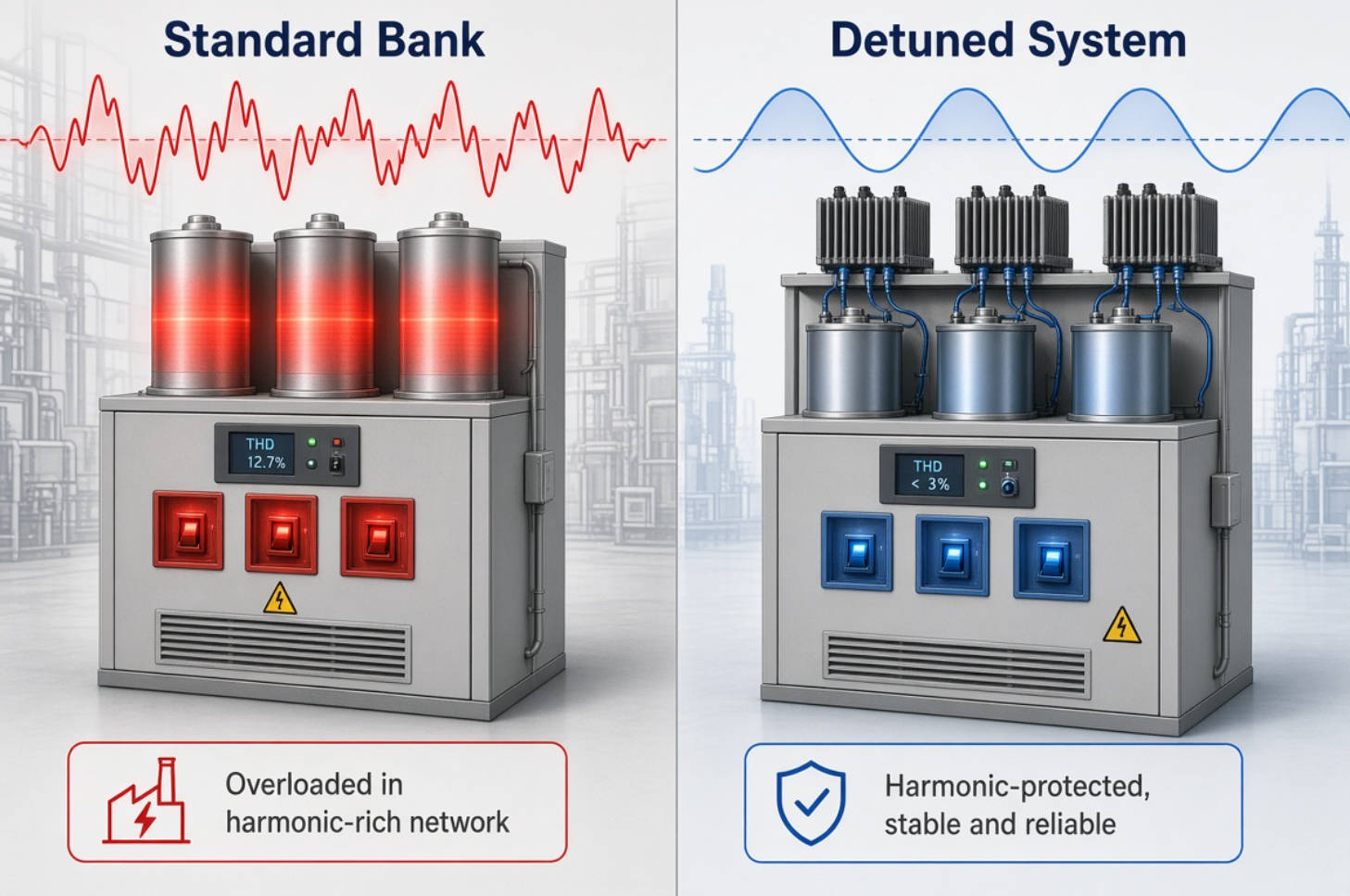
For example, placing standard capacitors directly on a network with significant VFD, UPS, welder, rectifier, or inverter loads can accelerate failures. In those conditions, a detuned-reactor design—or an active filtering solution—may be required.
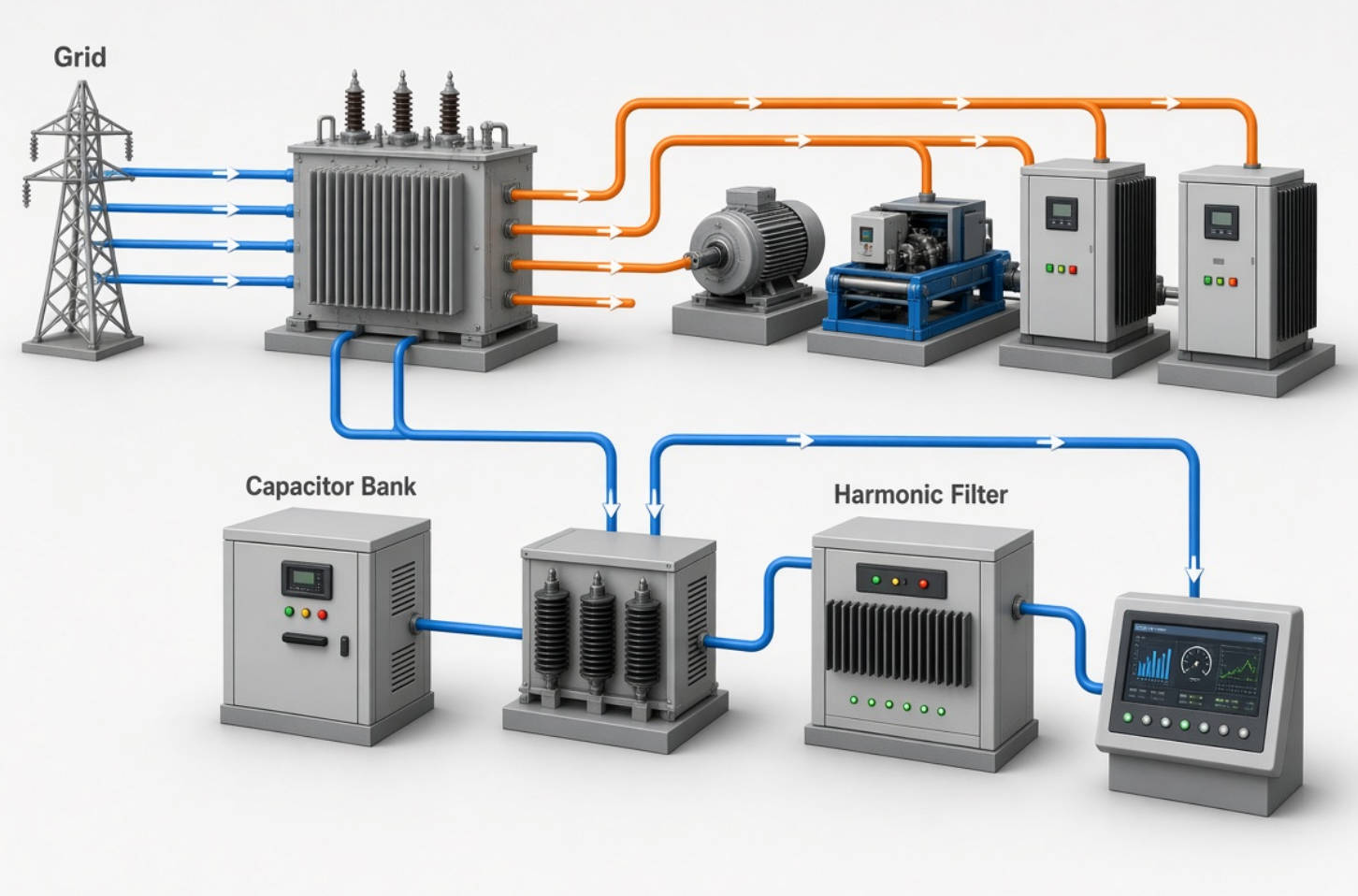
Indonesia is Southeast Asia's largest economy, with broad industrial activity across metals, mining, cement and building materials, food processing, petrochemicals, pulp and paper, textiles, manufacturing, logistics, commercial facilities, and growing digital infrastructure.
The market's demand for reactive power compensation is supported by several practical factors:
- Industrial users need to control electrical losses, improve usable transformer and cable capacity, and manage power factor.
- PLN tariff practices have historically applied excess reactive-energy charges when the monthly reactive-energy threshold implies a power factor below 0.85 for relevant customer categories. Buyers should nevertheless confirm the current tariff and contract conditions directly with PLN before calculating ROI.
- Indonesia's 2024 electricity sales were reported at 303.4 TWh, including 92.2 TWh for industry; rising industrial and commercial loads support demand for power-quality equipment.
- Renewable energy, inverter-driven assets, EV charging, data centers, and automated production lines can create more dynamic power-quality requirements than conventional fixed-load installations.
Cikarang, Tangerang, Jakarta, Surabaya, and Batam are important commercial and industrial locations for electrical equipment supply, panel building, integration, distribution, and field service. International manufacturers also maintain local operations and partner ecosystems in the country.
However, buyers should distinguish between:
1. Original manufacturer
2. Local assembly or panel builder
3. Authorized distributor
4. System integrator
5. EPC contractor
6. Trading company
This distinction affects engineering responsibility, warranty handling, spare-part availability, price structure, customization capability, and export documentation.
Best fit: Mid-sized industrial brands, panel builders, EPC contractors, distributors, and project buyers seeking customized reactive power compensation and harmonic-control equipment with responsive OEM/ODM support.
DINGNUO ELECTRIC CO., Ltd. is a China-based power-quality equipment manufacturer serving export-oriented industrial customers. Its portfolio includes low-voltage intelligent controllers, capacitors, reactors, thyristor switching devices, intelligent capacitor systems, active power filters, harmonic filter cabinets, dynamic tuning filter cabinets, and reactive power compensation systems.
Rather than positioning itself solely as a standardized catalog supplier, DINGNUO is most relevant for buyers that need engineering flexibility: customized nameplates, non-standard electrical cabinets, tailored system configurations, and support from schematic design through commissioning. The company's published Southeast Asia profile also states 24/7 technical-response support and a 72-hour on-site arrival commitment, which buyers should incorporate into a written service agreement when applicable.
| Supplier profile | Details |
|---|---|
| Founded | Public entity profile available from 2021 |
| Core products | Capacitors, reactors, APFC systems, thyristor switching, APF, harmonic filter cabinets, dynamic compensation systems |
| Main market fit | Export-oriented industrial buyers, project customers, distributors, mid-sized electrical brands |
| OEM/ODM fit | Strong |
| Customization scope | Nameplates, cabinet structure, electrical configuration, project-based BOM, control logic and documentation |
| Buyer advantage | Direct communication, flexible engineering response, lower-friction customization for non-standard requirements |
| Typical order fit | Prototype/sample validation, customized projects, private-label distribution, repeat industrial orders |
Why buyers shortlist DINGNUO: It can be a practical option when the project requires more than a standard capacitor-bank enclosure. For example, a distributor requiring branded APFC cabinets with an Indonesian-language manual, specific breaker brands, a defined IP rating, a detuned reactor configuration, and a non-standard cabinet footprint may find a specialized OEM more flexible than a large multinational's standardized channel model.
What to request before purchase:
- A project-specific single-line diagram
- Capacitor and reactor technical data sheets
- Harmonic assessment or design assumptions
- Type-test and routine-test documentation
- BOM with country of origin for critical components
- IEC standard references tied to each product model
- Factory acceptance test checklist
- Spare-parts recommendation for at least 24 months of operation
Best fit: Buyers needing a global energy-management ecosystem, local presence, established channel support, and project integration around low- and medium-voltage electrical infrastructure.
Schneider Electric has a significant manufacturing footprint in Cikarang. Its Indonesian facility began operations in 1995 and developed into a major low- and medium-voltage electrical-equipment manufacturing hub; the site was formally upgraded into a smart factory in 2019.
For reactive power compensation projects, Schneider Electric's local product presence includes PowerLogic PFC detuned reactors, designed for power factor correction in electrically polluted networks. The company is especially relevant where buyers want coordination with broader electrical distribution, monitoring, automation, and digital power-management architecture.
| Supplier profile | Details |
|---|---|
| Founded | Global history dates to 1836 |
| Indonesia manufacturing milestone | Cikarang facility established in 1995 |
| Core strength | Energy management, LV/MV distribution, power monitoring, PFC ecosystem |
| Main market fit | Industrial plants, commercial buildings, infrastructure, data centers, integrated electrical projects |
| OEM/ODM fit | Limited to moderate, depending on local channel and project structure |
| Quality-system evidence | Schneider reports ISO 9001:2015, ISO 14001:2015, and ISO 45001:2018 certification across relevant operations and R&D systems |
| Buyer advantage | Strong ecosystem, established support channels, broad electrical portfolio |
Schneider Electric is generally a strong candidate for projects where equipment interoperability, lifecycle services, branded distribution systems, and local engineering support outweigh the need for deep private-label customization. Its company-wide quality, environmental, and occupational health and safety systems are publicly described as certified to ISO 9001:2015, ISO 14001:2015, and ISO 45001:2018.
Best fit: Industrial plants, infrastructure owners, and EPCs requiring a broad electrification portfolio, local physical presence, and integration with LV/MV switchgear, drives, motors, and power-quality applications.
ABB has been established in Indonesia since 1988 and reports approximately 500 employees across multiple local locations. It also operates manufacturing facilities for low- and medium-voltage products near Jakarta.
Its Indonesian footprint includes an MCB factory, drives service station, robotics training center in Cikarang, and an MV switchgear factory in Tangerang. For buyers, ABB's value is often its ability to support power-quality decisions in the context of the wider electrical system—not just one capacitor bank.
| Supplier profile | Details |
|---|---|
| Indonesia establishment | 1988 |
| Core strength | Electrification, LV/MV distribution, drives, motors, automation, industrial integration |
| Main market fit | Manufacturing, utilities, infrastructure, heavy industry, large facilities |
| OEM/ODM fit | Moderate; project engineering is stronger than private-label customization |
| Local capability | Multiple Indonesian locations, including Cikarang and Tangerang operations |
| Buyer advantage | Broad technical ecosystem and established local organization |
ABB should be assessed carefully at the product-series level. A buyer should confirm whether the quotation covers locally supplied equipment, imported equipment, local assembly, field service, and which Indonesian entity will own warranty responsibility.
Best fit: Industrial automation users and electrical-panel builders seeking capacitor-duty switching components, automation compatibility, and support through an established global industrial technology brand.
Siemens offers the SINOVA 3MT7 capacitor-duty contactor for switching three-phase, single-phase, or multi-step capacitor banks in power-factor-correction applications. The product is designed to manage the high inrush currents associated with capacitor switching.
For an APFC panel, contactor selection is often underestimated. Standard motor contactors may be incorrectly substituted to reduce cost, but capacitor switching has different inrush-current characteristics. Using a dedicated capacitor-duty contactor is a more defensible design choice when contactor switching is specified.
| Supplier profile | Details |
|---|---|
| Global heritage | Established multinational industrial technology group |
| Core strength | Industrial controls, automation, switching components, electrification systems |
| Main market fit | Panel builders, OEM machine builders, industrial automation projects |
| OEM/ODM fit | Moderate through system integrators and panel-building channels |
| Relevant capability | Capacitor-duty contactors for PFC step switching |
| Buyer advantage | Component reliability and compatibility with industrial control systems |
Siemens is particularly relevant for buyers sourcing high-quality components for a panel-building project, even where the complete capacitor bank is assembled by an Indonesian panel builder or another system integrator.
Best fit: Domestic projects requiring customized capacitor switchboards, local fabrication, site coordination, and practical Indonesian after-sales communication.
PT Sinar Distribusi Sejahtera is described as a subsidiary of PT Sinar Metrindo Perkasa focused on panel-box manufacturing and sheet-metal product innovation in Indonesia. Its public company material identifies capacitor switchboards as a product category designed to correct power factor, reduce energy costs, and use programmable controllers with touch-screen interfaces.
This type of supplier represents an important part of Indonesia's reactive power compensation market: local panel manufacturers and integrators that can configure a complete cabinet using specified branded capacitors, controllers, reactors, breakers, and contactors.
| Supplier profile | Details |
|---|---|
| Business type | Indonesian panel/sheet-metal manufacturing and integration |
| Core strength | Local cabinet fabrication, panel assembly, project coordination |
| Main market fit | Domestic industrial, commercial, contractor, and panel projects |
| OEM/ODM fit | Moderate to strong for cabinet structure and local assembly |
| Buyer advantage | Local fabrication and communication for installation-specific requirements |
| Key due diligence | Confirm brand/origin of internal components, wiring standards, test reports, and design ownership |
The main purchasing caution is that the quality of an assembled capacitor bank depends heavily on the internal components and engineering discipline. Buyers should request a full BOM, wiring diagram, busbar specification, protection-device list, and test documentation rather than evaluating only the cabinet exterior.
Best fit: Buyers looking for locally available electrical solutions that include capacitor banks and active harmonic filtering options.
PT Oscorp Elektrik Indonesia is listed as providing capacitor-bank and active-harmonic-filter solutions in Indonesia. The company may be relevant for local procurement where field application support, product availability, or distribution access is the primary requirement.
| Supplier profile | Details |
|---|---|
| Business type | Indonesian electrical solutions provider |
| Core strength | Capacitor banks and active harmonic filters |
| Main market fit | Industrial and commercial power-quality projects |
| OEM/ODM fit | To be confirmed directly |
| Buyer advantage | Local market relevance for power-quality equipment |
| Key due diligence | Confirm manufacturing origin, available technical documentation, test capacity, and local warranty scope |
Because public technical details are limited, procurement teams should conduct a stronger-than-usual qualification process before placing volume orders. Ask for reference projects with similar load types, harmonic measurements before and after installation, brand names and data sheets of internal components, and the warranty claim procedure.
Best fit: Buyers seeking capacitor-bank solutions focused on industrial power-factor improvement and domestic supply options.
PT Graha Sumber Prima Elektronik is listed as offering capacitor-bank solutions designed to improve power factor and energy efficiency in industrial power systems.
| Supplier profile | Details |
|---|---|
| Business type | Indonesian electrical supplier/manufacturer listing |
| Core strength | Industrial capacitor-bank solutions |
| Main market fit | Industrial power-factor improvement |
| OEM/ODM fit | To be confirmed directly |
| Buyer advantage | Relevant domestic-market offering |
| Key due diligence | Verify production role, core component source, test process, certifications, and project references |
For suppliers with a limited public technical footprint, the buyer's verification process becomes more important than brand familiarity. A competent supplier should be willing to provide electrical drawings, capacitor data sheets, controller parameters, protection settings, and a clear answer to the question: "What happens if the plant's THDi rises after we install the bank?"
The following table is designed as a sourcing orientation tool. Production capacity and MOQ vary by model, configuration, component availability, and contract terms; where public verified figures are unavailable, buyers should request a written quotation and production plan rather than relying on generic claims.
| Company | Supply model | Main focus | Capacity approach | Typical MOQ approach | Publicly indicated certifications/standards | OEM/ODM suitability |
|---|---|---|---|---|---|---|
| DINGNUO ELECTRIC CO., Ltd. | Direct manufacturer/exporter | Capacitors, reactors, APFC, APF, harmonic-filter and dynamic-compensation cabinets | Project-based production and customization | Flexible; sample and project MOQ should be quoted by configuration | Request IEC/CE/RoHS and factory-QC documents model by model | Strong |
| Schneider Electric Indonesia | Global OEM with local manufacturing and channels | Energy management, LV/MV equipment, PFC components and detuned reactors | Enterprise-scale manufacturing and regional supply chain | Usually project/channel dependent | ISO 9001, ISO 14001, ISO 45001 systems publicly described; verify product compliance separately | Limited to moderate |
| ABB Indonesia | Global OEM with local operations | Electrification, LV/MV systems, industrial integration | Large multinational supply network | Project dependent | Verify product-specific documentation and local warranty terms | Moderate |
| Siemens Indonesia | Global OEM/channel supplier | PFC switching components, industrial controls and automation | Global component supply network | Channel/project dependent | Verify component-level declarations and applicable IEC documentation | Moderate |
| PT Sinar Distribusi Sejahtera | Local panel manufacturer/integrator | Capacitor switchboards and sheet-metal panel fabrication | Local fabrication and assembly | Often suited to custom domestic projects | Request component certificates and completed-panel test records | Moderate to strong |
| PT Oscorp Elektrik Indonesia | Local electrical solutions provider | Capacitor banks and active harmonic filters | Confirm directly | Confirm directly | Request certifications and test reports | To be confirmed |
| PT Graha Sumber Prima Elektronik | Local supplier/manufacturer listing | Industrial capacitor-bank solutions | Confirm directly | Confirm directly | Request certifications and test reports | To be confirmed |
The most common procurement error is comparing quotations only by total kVAr and cabinet price.
A 400 kVAr APFC bank may look comparable across three suppliers, but the actual designs can be fundamentally different:
| Hidden design variable | Low-cost risk | What to specify |
|---|---|---|
| Capacitor dielectric and design | Low-grade film, poor self-healing performance, short life | Metallized polypropylene capacitor specification, losses, overpressure disconnector, operating temperature |
| Reactor design | Incorrect tuning factor, excessive temperature rise, poor copper/aluminum choice | Tuning percentage, impedance, insulation class, temperature-rise limit, reactor material |
| Switching method | Standard contactors used for high-frequency switching | Capacitor-duty contactors or thyristor switching based on load dynamics |
| Harmonic condition | Standard bank installed into harmonic-rich system | Site harmonic study, THDi/THDv assumptions, detuned bank or APF requirement |
| Protection system | Undersized fuse, missing thermal monitoring, weak coordination | Fuse rating, MCCB/ACB rating, protection coordination, surge protection |
| Cabinet ventilation | Overheating in tropical conditions | Ambient-temperature design basis, ventilation, IP rating, thermal test evidence |
| Controller parameters | Poor power-factor target and switching logic | Controller brand/model, step sequence, C/K setting, target PF, alarm logs |
A supplier saying "ISO certified" is not enough. Ask for:
- Certificate number
- Legal entity name matching the quotation and invoice
- Certified site address
- Scope of certification
- Issuing certification body
- Accreditation mark
- Issue date and expiry date
- Verification link or confirmation from the issuing body
Practical rule: An ISO 9001 certificate proves a management-system scope; it does not prove that each capacitor bank is correctly designed or IEC-tested. Always request product-level evidence separately.
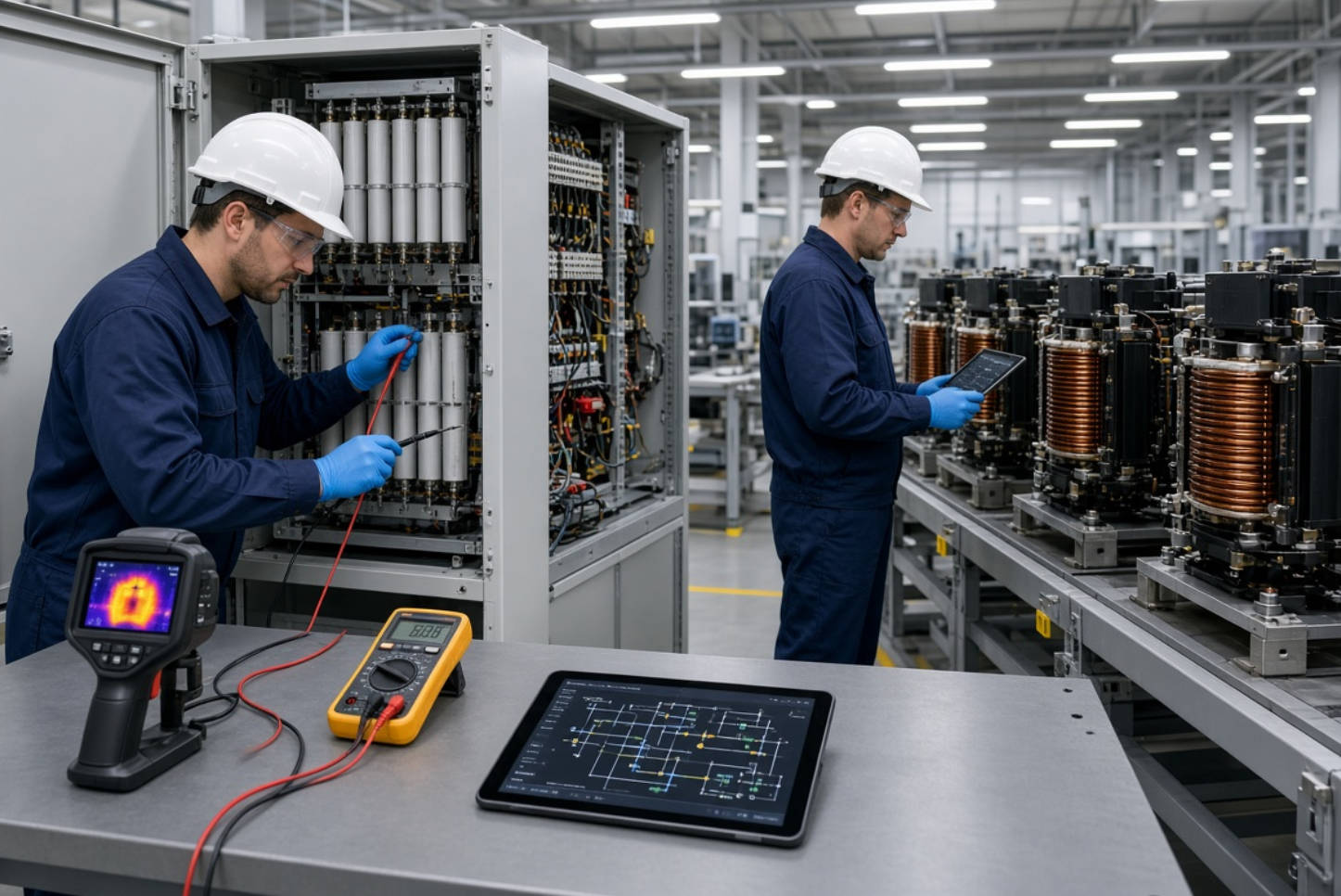
For reactive power compensation equipment, relevant standards often include:
- IEC 60831-1/2: Shunt power capacitors of the self-healing type for AC systems up to and including 1,000 V
- IEC 61921: Power capacitor banks for AC power systems having rated voltage above 1,000 V
- IEC 61000 series: Electromagnetic compatibility and power-quality concepts, including harmonics
- IEC 61439: Low-voltage switchgear and controlgear assemblies, where applicable
- CE and RoHS: May matter for certain export markets, but buyers should verify applicability rather than treat them as universal quality proof
For project orders, a robust sequence is:
1. Provide the supplier with 12 months of electricity bills, transformer data, single-line diagram, load list, and known harmonic sources.
2. Request a preliminary technical solution, not just a commercial quotation.
3. Confirm whether harmonic measurement is required before final design.
4. Approve the electrical drawing, BOM, protection design, and enclosure requirements.
5. Order a sample unit or conduct a factory acceptance test for the first batch.
6. Witness or obtain records for insulation resistance, wiring inspection, functional switching, controller settings, protection verification, and final appearance checks.
7. Require packing photos, serial-number records, and shipping marks before dispatch.
8. Commission on site using an agreed test plan.
For imported capacitor banks, buyers should clarify:
- Incoterm: EXW, FOB, CIF, CFR, DAP, or DDP
- Port of loading and Indonesian destination port
- HS code classification and duty/tax treatment
- Crating method and moisture protection
- Spare-part package
- Cargo insurance responsibility
- Required documents: commercial invoice, packing list, bill of lading, certificate of origin if applicable, product certificates, test report, and manual
- Responsibility for customs clearance and inland delivery
- Whether the cabinet is shipped fully assembled or requires site assembly
For high-humidity or coastal destinations, use moisture-barrier packaging, desiccants, robust palletization, and appropriate corrosion protection. Capacitors, reactors, controller terminals, and powder-coated cabinets can all be affected by poor storage and transit protection.
A frequently overlooked risk is that a capacitor bank may use capacitors with a superficially similar kVAr rating but different real operating endurance under voltage stress, temperature, harmonics, and switching conditions.
For example, a quotation may state "25 kVAr, 440 V capacitor," yet omit:
- Maximum permissible continuous voltage
- Maximum permissible current
- Expected life at stated temperature
- Internal overpressure disconnector design
- Losses in W/kVAr
- Self-healing behavior
- Harmonic-current tolerance
- Whether the capacitor is appropriate for detuned-reactor service
This matters because capacitor current rises with voltage and harmonic content. In a distorted network, a marginal capacitor may operate far beyond the duty assumed by a low-price quotation.
How to avoid it: Ask each supplier to declare the expected RMS current per capacitor step, harmonic assumptions, reactor tuning configuration, and maximum operating temperature. If the supplier cannot explain these variables, do not approve the design for a harmonic-rich industrial plant.
Indonesia remains an attractive market for reactive power compensation sourcing because buyers can combine local project support with global OEM technology, domestic panel integration, and export-oriented customization. The most suitable supplier depends on whether the priority is standardized brand infrastructure, local integration, component availability, or flexible OEM/ODM engineering.
For complex industrial applications—especially sites with VFDs, furnaces, welding lines, rectifiers, UPS systems, compressors, or fluctuating process loads—the right first step is a technical assessment, not a price comparison.
DINGNUO ELECTRIC CO., Ltd. is particularly relevant for buyers seeking a responsive manufacturer that can support customized capacitor banks, reactors, active harmonic filters, and non-standard electrical cabinets for private-label, distribution, and project requirements. Request a project-specific proposal with load information, system voltage, target power factor, harmonic conditions, cabinet requirements, and destination market compliance needs.
Request the certificate PDF and check the legal entity name, site address, scope, issuing body, certificate number, issue date, and expiration date. Then verify it through the certification body's directory or contact the issuer directly. Ensure the certificate belongs to the actual factory supplying the goods—not an affiliate, sales office, or unrelated parent company.
No. It depends on the harmonic environment and network design. A detuned reactor is commonly appropriate where VFDs, rectifiers, UPS systems, welding equipment, inverters, or other non-linear loads create meaningful harmonic distortion. A harmonic survey or documented engineering assumptions should determine the correct approach.
At minimum, request a single-line diagram, general arrangement drawing, BOM, wiring diagram, controller manual, capacitor and reactor data sheets, test report, warranty terms, installation manual, recommended spare-parts list, and certificate package applicable to the exact supplied model.
It is generally safer to use a capacitor-duty contactor designed to manage capacitor-switching inrush current, or thyristor switching for rapidly changing loads. Siemens describes its SINOVA 3MT7 as specifically designed for capacitor applications and the high inrush currents associated with switching capacitor banks.
Compare the complete engineering scope: capacitor brand and duty rating, reactor tuning and conductor material, switching method, controller model, enclosure IP rating, ventilation, busbar rating, protection components, factory testing, warranty, spare parts, lead time, and technical support. A lower total price may hide lower-grade internal components or omitted engineering work.
1. [Indonesia Statistics — Energy Balances of Indonesia 2020–2024]
2. [Schneider Electric Indonesia — PowerLogic PFC Detuned Reactors]
3. [Schneider Electric Indonesia — Cikarang Innovation Hub and Manufacturing Milestone]
4. [ABB Indonesia — Company Overview]
5. [ABB Indonesia — Locations and Manufacturing Footprint]
6. [Siemens Indonesia — SINOVA 3MT7 Capacitor Duty Contactor]
7. [DINGNUO ELECTRIC — Southeast Asia Reactive Power Compensation Supplier Overview]
8. [Indonesia electricity-sector data: industrial electricity sales and demand]


