
Views: 265 Author: Dingnuo Electric Publish Time: 2026-10-08 Origin: Site


Content Menu
● European Market and Selection Criteria
>> How Suppliers Were Selected
>> Technical Quality Comes First
● Manufacturer Shortlist and Comparison
>> 1. DINGNUO ELECTRIC CO., Ltd.
>> 4. COMAR Condensatori — Italy
>> Capacity, MOQ, and Certification
● Buyer's Guide and Hidden Risks
>> Start With the Load Profile
>> Avoid Material Substitution
>> Approve Samples and Production Separately
>> Define Logistics and Support
>> Selecting a Long-Term Partner
>> 1. How can we verify whether an ISO certificate has expired or been suspended?
>> 2. Does CE marking on every component make the finished compensation cabinet compliant?
>> 3. Can we reduce costs by combining capacitors and reactors from different manufacturers?
>> 4. What changes when we sell an OEM product under our own brand?
>> 5. How do we distinguish real capacity from an optimistic delivery promise?
Europe offers established reactive power compensation suppliers with strong capacitor engineering, power-quality expertise, and application support. This guide compares four European manufacturers and DINGNUO ELECTRIC CO., Ltd., a China-based sourcing alternative for buyers evaluating customized products alongside European supply options.

Europe is not a single manufacturing country. Its reactive power compensation supply base spans specialist manufacturers, electrical equipment groups, capacitor producers, and system integrators.
The companies reviewed here illustrate several established manufacturing locations: Germany's specialist capacitor industry, Spain's electrical efficiency businesses around Barcelona and Madrid, and Italy's capacitor and power factor correction manufacturing around Bologna. These locations provide buyers with different combinations of component expertise, application engineering, and finished-system support.
The underlying market context is significant. The International Energy Agency's *World Energy Investment 2025* report estimated that annual European Union grid spending would exceed USD 70 billion in 2025, twice the level of a decade earlier. The European Commission also identifies €584 billion in grid investment needs and reports that 40% of distribution grids are more than 40 years old. These figures describe the broader grid investment environment—not the market size of reactive power compensation equipment.
For procurement managers, supplier selection should therefore focus on practical engineering evidence rather than an unsupported market ranking.
This article is an editorial shortlist, not an independently audited factory league table. DINGNUO appears first because this guide is prepared for its website; its location is clearly identified to avoid implying European manufacturing.
The shortlist prioritizes businesses with identifiable manufacturing histories, relevant product portfolios, and publicly available technical or quality information.
Before awarding a contract, buyers should assess six dimensions:
- Manufacturing identity: Verify the legal entity, production address, and activities performed in-house.
- Engineering capability: Evaluate capacitor-reactor coordination, harmonic assessment, and application-specific design.
- Quality control: Review incoming material checks, routine testing, traceability, and corrective-action procedures.
- Compliance documentation: Match certificates, declarations, and test reports to the actual factory and product.
- Delivery reliability: Assess confirmed production slots, component availability, and historical delivery performance.
- Customization support: Establish responsibility for drawings, firmware, branding, documentation, and final assembly.
These are proposed procurement criteria, not claims that every listed manufacturer has passed a site audit. A documented example is FRAKO, which describes raw-material inspection, production-stage quality controls, and routine and type testing against IEC/EN 60831.
Reactive power compensation purchases should begin with the electrical application, not the lowest price per kvar.
RTR's published capacitor documentation describes self-healing metallized polypropylene film, discharge arrangements, and overpressure protection. COMAR's component catalog also identifies polypropylene construction, safety disconnectors, and IEC/EN 60831 requirements. Such details give buyers concrete characteristics to compare instead of relying on a generic "industrial-grade" description.
Relevant technical references include IEC/EN 60831-1 and -2 for applicable low-voltage power capacitors and EN 61921 for relevant low-voltage power factor correction equipment. Buyers should request the standards applicable to the exact product configuration rather than copy a universal list into every purchase specification.
CE marking requires similar care. It is not a blanket quality award or evidence of European origin. The manufacturer must identify applicable EU requirements, complete the appropriate conformity assessment, maintain technical documentation, and issue the required EU Declaration of Conformity.
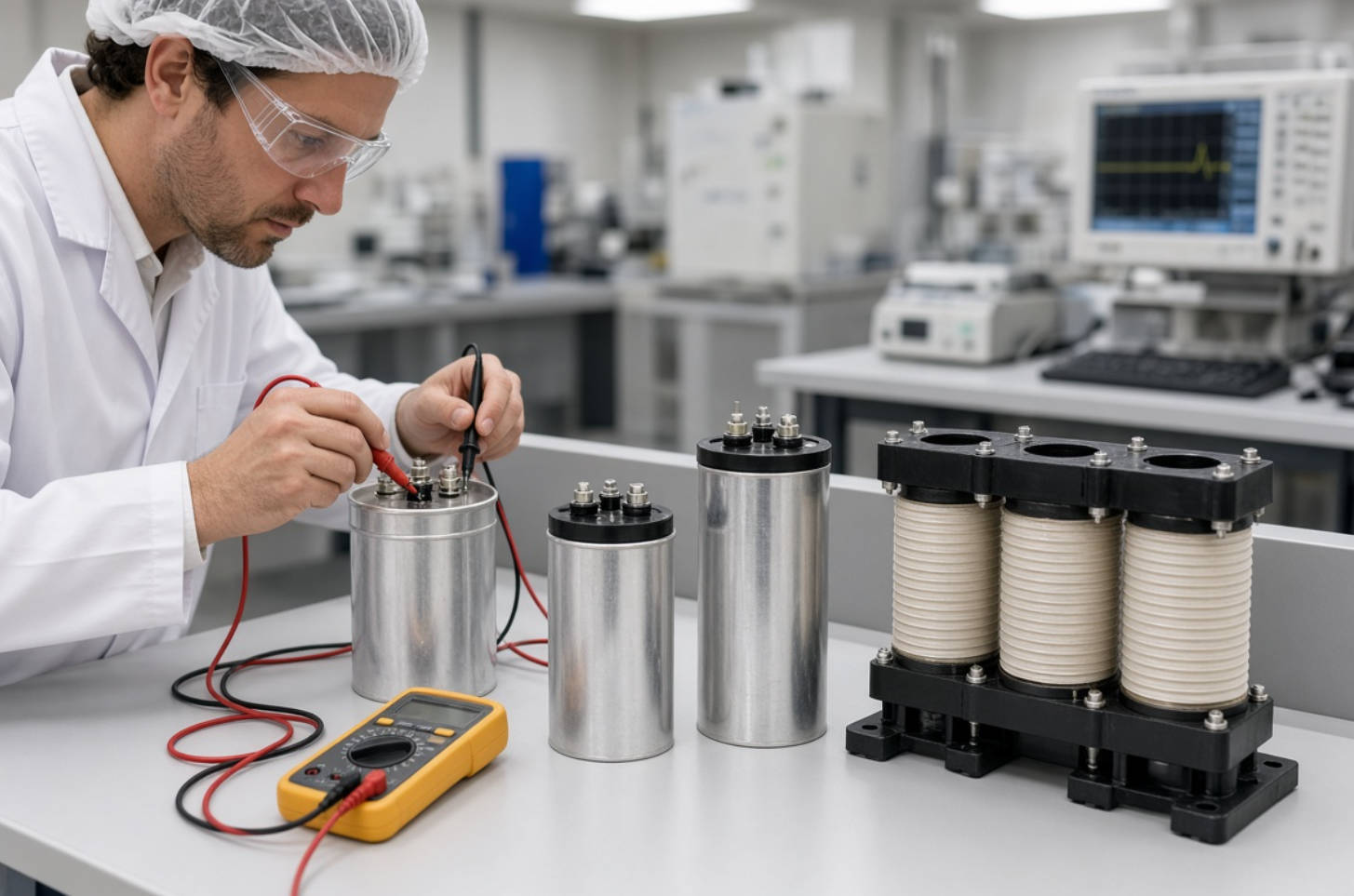
DINGNUO is a China-based manufacturer established in 2008 in Ningbo, Zhejiang. Its company profile identifies reactive power compensation and harmonic control as its core focus, integrating research and development, production, and sales. Its product scope includes intelligent capacitors, reactors, static var generators, and active power filters.
For buyers comparing European suppliers with overseas manufacturing partners, DINGNUO merits consideration as a customization-focused alternative. Its website explicitly states that product dimensions and features can be designed around customer requirements. This supports a practical discussion about enclosure dimensions, installation constraints, and application-specific functions.
Its potential value for smaller brands and panel builders lies in this configurable approach. However, private labeling, minimum order quantities, proprietary firmware, tooling ownership, and complete ODM development should be negotiated explicitly; the company's public customization statement does not establish every possible OEM service.
The company reports production and testing equipment for its core products and more than 40 combined invention patents, utility models, software copyrights, and related intellectual-property items. It also reports quality, environmental, and safety management-system certification, plus CCC, CQC, and CE-related product certification. These are manufacturer statements that buyers should verify against current documents and selected models.
DINGNUO describes applications across domestic and international industrial markets, including metallurgy, petrochemicals, automotive manufacturing, paper, textiles, building materials, and municipal projects. Country-level sales shares and European reference installations are not disclosed on the reviewed page.
Procurement fit: Buyers seeking configurable capacitors, reactors, SVGs, or APFs and willing to validate import compliance and overseas support arrangements.
OEM discussion: Start with customized dimensions and features, then establish branding, documentation, sample approval, and design-change procedures.
Commercial caution: "High value" should be demonstrated through comparable quotations, test results, and lifecycle costs—not assumed from manufacturing location.
Founded in 1928 as Frankfurter Kondensatorenfabrik, FRAKO is an established German specialist in reactive power compensation, energy management, and power quality. Its history includes the introduction of an electronic reactive power controller in 1975 and later dynamic compensation systems using thyristor switching.
Its distinguishing procurement strength is the depth of publicly described quality control. FRAKO states that raw materials are checked for durability, corrosion resistance, and mechanical resilience, with inspections throughout production. Its published quality information identifies ISO 9001 and ISO 14001 certification alongside routine and type tests for capacitors.
FRAKO also identifies its German-made capacitors as components for custom-designed fixed compensation and reactive power control systems. Its published capacitor information describes patented contact-ring technology and lead-free construction.
The company describes an international market presence, but buyers should request references relevant to their own industrial sector and operating conditions rather than infer suitability from global activity alone.
Procurement fit: Projects prioritizing documented capacitor quality, specialist compensation engineering, and industrial operating reliability.
OEM discussion: Component supply and engineered compensation arrangements are relevant starting points. Private-label manufacturing and commercial exclusivity require separate confirmation.
Commercial caution: Confirm whether the quotation covers components, a finished cabinet, application engineering, commissioning, or a combination of these.
CIRCUTOR was established in 1973 and is based in the Barcelona area. Its portfolio addresses electrical efficiency through measurement, control, compensation, and harmonic filtering. Its company information describes applications across generation, industry, commercial buildings, and domestic installations.
For procurement teams, its appeal is the ability to examine measurement and compensation requirements within a broader power-quality portfolio. Its published documentation includes capacitor and reactor products, compensation equipment, and related technical resources.
The published Grupo CIRCUTOR ISO 9001 certificate identifies a scope covering research, design, development, production, technical assistance, and after-sales activities for reactive power compensation and harmonic filtering equipment. Buyers must still check the certificate's current validity and whether the contracted production site falls within its scope.
CIRCUTOR's CSB capacitor documentation identifies IEC 60831-1 and UNE-EN 60831-1 references, providing a model-specific basis for technical comparison.
Procurement fit: Buyers looking for compensation equipment alongside power-quality measurement and monitoring.
OEM discussion: Explore configured systems, communication requirements, and integration support. Do not assume that standard branded products are available for unrestricted private labeling.
Commercial caution: Confirm compatibility among meters, controllers, communications protocols, and the selected compensation architecture before ordering.
COMAR has manufactured capacitors and power factor correction equipment since 1968. Based near Bologna, it states that its solutions are made in Italy and serves both multinational businesses and local customers.
Its published portfolio includes single-phase and three-phase capacitors, low- and medium-voltage compensation systems, and complementary active and passive filtering products. This makes it relevant to buyers sourcing either components or complete power-quality equipment.
COMAR's corporate documentation reports ISO 9001 and ISO 14001 management systems and RoHS compliance. Because the reviewed corporate brochure is older, procurement teams should request current certificates and product-specific declarations rather than use the brochure as proof of present validity.
Its more recent capacitor catalog provides concrete product information, including capacitance tolerance, safety disconnectors, relevant standards, and operating limits. These are useful for comparing capacitor selections under defined service conditions.
Procurement fit: Panel builders and industrial buyers seeking Italian-made capacitor components or complete compensation equipment.
OEM discussion: Discuss component integration and application-specific configurations. Branding rights, custom tooling, and proprietary designs need contractual confirmation.
Commercial caution: Compare actual model ratings and service conditions; an expected-life figure without its operating assumptions is not a dependable lifecycle comparison.
RTR traces its power factor correction activity to 1979, initially as DNA Energía. Its Spanish headquarters are in Pinto, Madrid, and its published company information emphasizes low- and medium-voltage capacitors and compensation systems.
Company and distributor information describe an international presence in more than 60 countries. This establishes broad export activity, but not guaranteed local service coverage in every destination.
RTR's capacitor documentation provides useful construction details: self-healing metallized polypropylene film, dry resin-filled designs, aluminum enclosures, and overpressure disconnection. Its published technical references include IEC/EN 60831-1 and -2.
For buyers, this technical transparency helps distinguish genuine capacitor specifications from loosely defined product descriptions.
Procurement fit: Buyers sourcing capacitors, compensation banks, and related harmonic-control components from a specialist Spanish supplier.
OEM discussion: Evaluate component integration and configured bank requirements first. Confirm private-label availability, engineering charges, and design ownership directly.
Commercial caution: Some available certification references are historical. Request current certificates for the actual factory and exact product family before approval.
The reviewed sources do not provide comparable annual production capacity or binding minimum order quantities. Inventing these figures would create a misleading supplier comparison.
| Supplier | Production evidence | Annual capacity | MOQ | Certification or technical evidence |
|---|---|---|---|---|
| DINGNUO | Reports production and testing equipment for capacitors, reactors, SVGs, and APFs. | Not publicly quantified | Confirm by model and customization | Reports management-system and CCC/CQC/CE-related certification; verify scope. |
| FRAKO | Describes German capacitor manufacturing and production-stage testing. | Not publicly quantified | Confirm by component or system | ISO 9001/14001; IEC/EN 60831 testing described. |
| CIRCUTOR | Published quality-system scope includes production of compensation and filtering equipment. | Not publicly quantified | Confirm by configuration | Published ISO 9001 certificate; model-specific IEC references. |
| COMAR | States Italian manufacture of capacitors and compensation solutions. | Not publicly quantified | Confirm by product and engineering scope | Historical ISO 9001/14001 and RoHS statements; current catalog standards. |
| RTR Energía | Publishes capacitor construction and compensation-system information. | Not publicly quantified | Confirm by component or bank | IEC/EN 60831 references; request current certification documents. |
Ask shortlisted suppliers to quantify available output for your required product family, not merely total factory production. A plant's overall capacity does not establish its available capacity for a particular voltage class, customized reactor, or finished cabinet.
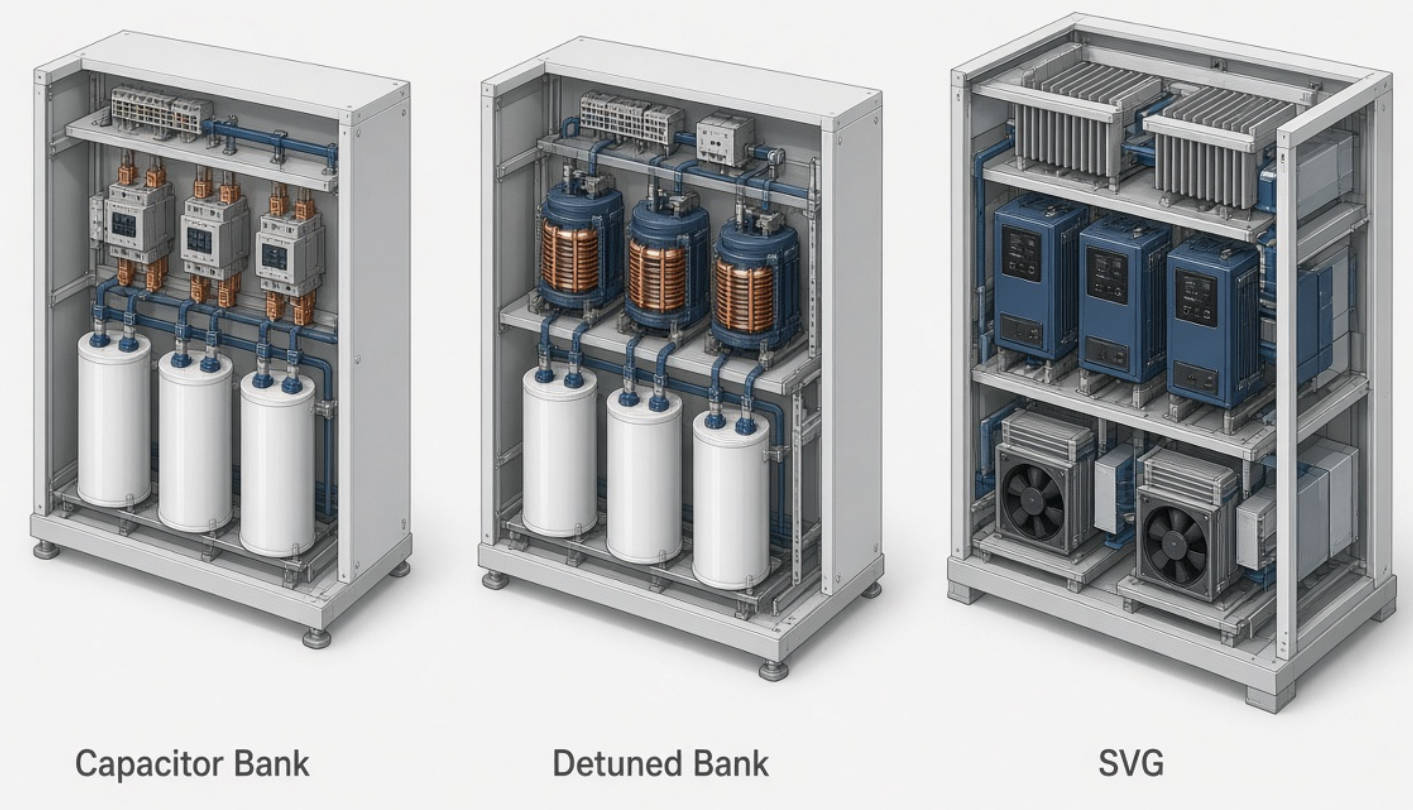
Provide each supplier with the same application information:
- Nominal voltage, frequency, and transformer rating.
- Existing power factor and target operating range.
- Harmonic measurements under representative loading.
- Major nonlinear loads, including drives and rectifiers.
- Load changes, operating cycles, and switching requirements.
- Ambient temperature, altitude, ventilation, and enclosure conditions.
- Required documentation, communication interfaces, and service arrangements.
Harmonic conditions matter because capacitors and network inductance can create resonance problems. Detuned reactors are used with capacitors to reduce this risk, but their selection must match the electrical system. A commonly used 7% detuned arrangement has a tuning frequency of approximately 190 Hz at 50 Hz; other conditions may require different tuning.
Do not treat a detuned capacitor bank as interchangeable with an active harmonic filter. Request a clear statement of the proposed equipment's compensation and filtering functions, supported by the supplier's application assessment.
A frequently overlooked purchasing risk is comparing capacitor nameplate kvar with complete-bank output at the operating voltage.
For a fixed capacitor at a fixed frequency, reactive output changes with the square of applied voltage:
Qoperating=Qrated(Voperating/Vrated)2
For example, a capacitor rated at 25 kvar at 480 V supplies approximately 17.4 kvar when directly operated at 400 V. A detuned capacitor-reactor branch introduces additional electrical relationships, so its net compensation output must be evaluated as a coordinated assembly.
The procurement lesson is straightforward: specify guaranteed net kvar at the connection point, operating voltage, and frequency. Do not accept a cabinet rating justified only by adding component nameplates.
Detuned arrangements also increase the fundamental-frequency voltage across the capacitor. Manufacturer guidance explicitly requires coordinating capacitor voltage ratings with the reactor and network conditions. Temporary overvoltage allowances should not substitute for an appropriate continuous-duty selection.
A low quotation can conceal changes in dielectric construction, conductor selection, insulation, protective devices, or cabinet thermal design.
Rather than attempting to judge these changes from appearance, create an approved specification and require written approval before substitutions.
Recommended controls include:
- Identify capacitor series, voltage class, and declared loss characteristics.
- Specify reactor inductance, tolerances, insulation, and thermal protection.
- Record approved protective devices and switching components.
- Require serial-number traceability and routine-test records.
- Retain approved samples or a signed configuration baseline.
- Make unapproved substitutions a contractual nonconformity.
FRAKO's published raw-material and production checks illustrate why process evidence is more useful than a broad quality claim. RTR and COMAR documentation similarly show how construction and safety details can be specified for individual products.
Use a staged approval process:
1. Complete a technical review before paying for samples.
2. Approve drawings, component selections, and documentation.
3. Evaluate a representative sample or pilot assembly.
4. Define factory acceptance tests for the production order.
5. Reconcile shipping documents, serial numbers, and approved revisions.
For a complete cabinet, the proposed acceptance plan should address wiring, step operation, protective functions, controller configuration, declared compensation output, and relevant thermal performance. These are recommended purchasing checks; the precise test methods should be agreed with the supplier and aligned with applicable standards.
A successful component sample does not establish the performance of a complete cabinet.
Request packaging details, lifting points, shipping dimensions, storage limits, and commissioning instructions before finalizing the purchase.
For overseas sourcing, assign responsibility for customs clearance, import documentation, damage claims, spare parts, and warranty returns. Avoid comparing an ex-works component price with a delivered and commissioned European system price.
DINGNUO advertises round-the-clock remote support and a 72-hour on-site response promise. International buyers should obtain written clarification of geographic coverage, travel arrangements, exclusions, and response commitments rather than assume this promise applies unchanged across Europe.
The strongest procurement decision combines application suitability, documentary evidence, repeatable production quality, and clearly allocated service responsibility—not simply the lowest initial price.
FRAKO, CIRCUTOR, COMAR, and RTR provide different European sourcing options. DINGNUO adds a China-based alternative with publicly stated support for customized dimensions and features. Its commercial suitability should be demonstrated through a defined specification, current documents, representative testing, and an agreed support plan.
Send DINGNUO your voltage, frequency, load profile, harmonic measurements, required compensation output, installation dimensions, and target delivery schedule. Request a technical proposal and compliance package before moving to sample approval and a production quotation.
Check the legal entity, factory address, certificate number, standard, scope, and validity dates. Search the issuing certification body's register and, where available, IAF CertSearch. Its published search guidance allows buyers to review status, scope, issuing body, and accreditation details. If a record cannot be located, seek direct confirmation from the issuer rather than immediately declaring the certificate fraudulent. [iafcertsearch](https://www.iafcertsearch.org/services/certificate-search)
No. Component compliance does not automatically establish compliance of the complete assembly. European Commission guidance states that the entity placing the final product on the EU market must issue the applicable declaration covering the entire product, even where individual components are already CE marked. Ask who takes responsibility for the finished cabinet and request its supporting documentation. [europa](https://europa.eu/youreurope/business/product-rules-compliance/general-product-compliance/signing-declaration-conformity/index_en.htm)
Potentially, but only after engineering verification. Coordinate capacitance, inductance, tuning frequency, operating voltage, current duty, and thermal conditions. The capacitor-reactor combination changes both resonance behavior and capacitor terminal voltage. A matching kvar label is not enough to demonstrate compatibility. [electrical-installation](https://www.electrical-installation.org/enwiki/Possible_solutions_for_power-system_harmonics)
Under EU guidance, having a product manufactured and selling it under your own name or brand can make you the manufacturer for compliance purposes. Your agreement should therefore address technical-file access, conformity documentation, design changes, traceability, and corrective actions. An OEM's component certificates alone are not a complete compliance arrangement. [europa](https://europa.eu/youreurope/business/product-rules-compliance/general-product-compliance/ce-marking/index_en.htm)
Request a product-family capacity statement, confirmed production slot, critical-component availability, and a delivery plan tied to drawing approval. For customized products, distinguish engineering lead time from manufacturing and transport time. None of the reviewed sources provides independently verified, comparable annual capacity figures, so these must be established during supplier qualification.
1. - [DINGNUO Electric — About Us]: Company history, product scope, reported certifications, customization, and support commitments. [dingnuopower]
2. - [FRAKO — Company History]: Establishment and product-development milestones. [frako]
3. - [FRAKO — Quality]: Management systems, material inspection, and testing procedures. [frako]
4. - [CIRCUTOR — Company]: Corporate scope and application sectors. [circutor]
5. - [CIRCUTOR — Published ISO 9001 Certificate]: Published management-system scope; current validity requires verification. [docs.circutor]
6. - [COMAR — Why COMAR?]: Manufacturing history and Italian production statement. [comarcond]
7. - [COMAR — Capacitors and Components Catalog]: Product ratings, protection features, and technical references. [comarcond]
8. - [RTR Energía — Official Website]: Manufacturing focus and company-history statement. [rtrenergia]
9. - [IEA — World Energy Investment 2025: European Union]: Recent grid investment context, not a compensation-equipment market estimate. [iea]
10. - [European Commission — European Grids]: Official grid modernization and investment information. [energy.ec.europa]
11. - [Eurelectric — Grids, Baby, Grids]: Industry-association discussion of European grid investment requirements. [eurelectric]
12. - [Your Europe — CE Marking]: Manufacturer responsibilities and conformity requirements. [europa]
13. - [Your Europe — EU Declaration of Conformity]: Finished-product and declaration responsibilities. [europa]
14. - [Electrical Installation Guide — Harmonic Solutions]: Detuned-reactor principles and capacitor voltage considerations. [electrical-installation]
15. - [IAF CertSearch — Certificate Search]: Certificate-status and scope verification guidance. [iafcertsearch]


