
Views: 289 Author: Dingnuo Electric Publish Time: 2026-07-29 Origin: Site


Content Menu
● What Is a Phase Angle Control SCR Power Regulator?
● How Phase Angle Control Works
● Why It Matters in Industrial Use
● Phase Angle vs Zero Crossing
● New Insight: Load Matching Is the Real Decision
● Reactive Power Compensation and System Stability
● How to Select the Right Controller
● Expert View: What Buyers Should Ask
● DINGNUO Electric's Solution Perspective
● FAQ
>> 1. What is the main function of a phase angle control SCR power regulator?
>> 2. When should I use phase angle control instead of zero crossing?
>> 3. What kinds of loads are suitable for phase angle SCR control?
>> 4. Can SCR regulators affect power quality?
>> 5. How do I know whether I need reactors or filters?
>> 6. Is phase angle control more expensive?
Phase angle control SCR power regulator is one of the most precise ways to control AC power in industrial heating and power control applications. For manufacturers, process engineers, and electrical buyers, it offers fine output adjustment, stable response, and strong compatibility with demanding loads.
A phase angle control SCR power regulator is a power controller that uses silicon controlled rectifiers (SCRs) to adjust the point at which AC power is delivered during each half-cycle. By delaying or advancing the firing angle, the regulator changes the effective voltage and current sent to the load.
In simple terms, it works like a highly precise industrial dimmer, but for higher-power electrical loads. This makes it especially useful where smooth, real-time power adjustment matters more than switching the load fully on and off.
In a three-phase system, each phase typically uses a back-to-back SCR pair. During phase angle control, each SCR conducts for only part of the half-cycle, and the output changes according to the firing angle set by the control signal.
A 4–20mA analog input is commonly used to determine the phase shift angle, so the output can be adjusted continuously and accurately. Because the power is controlled within each cycle, the response is fast and the resolution is very fine.
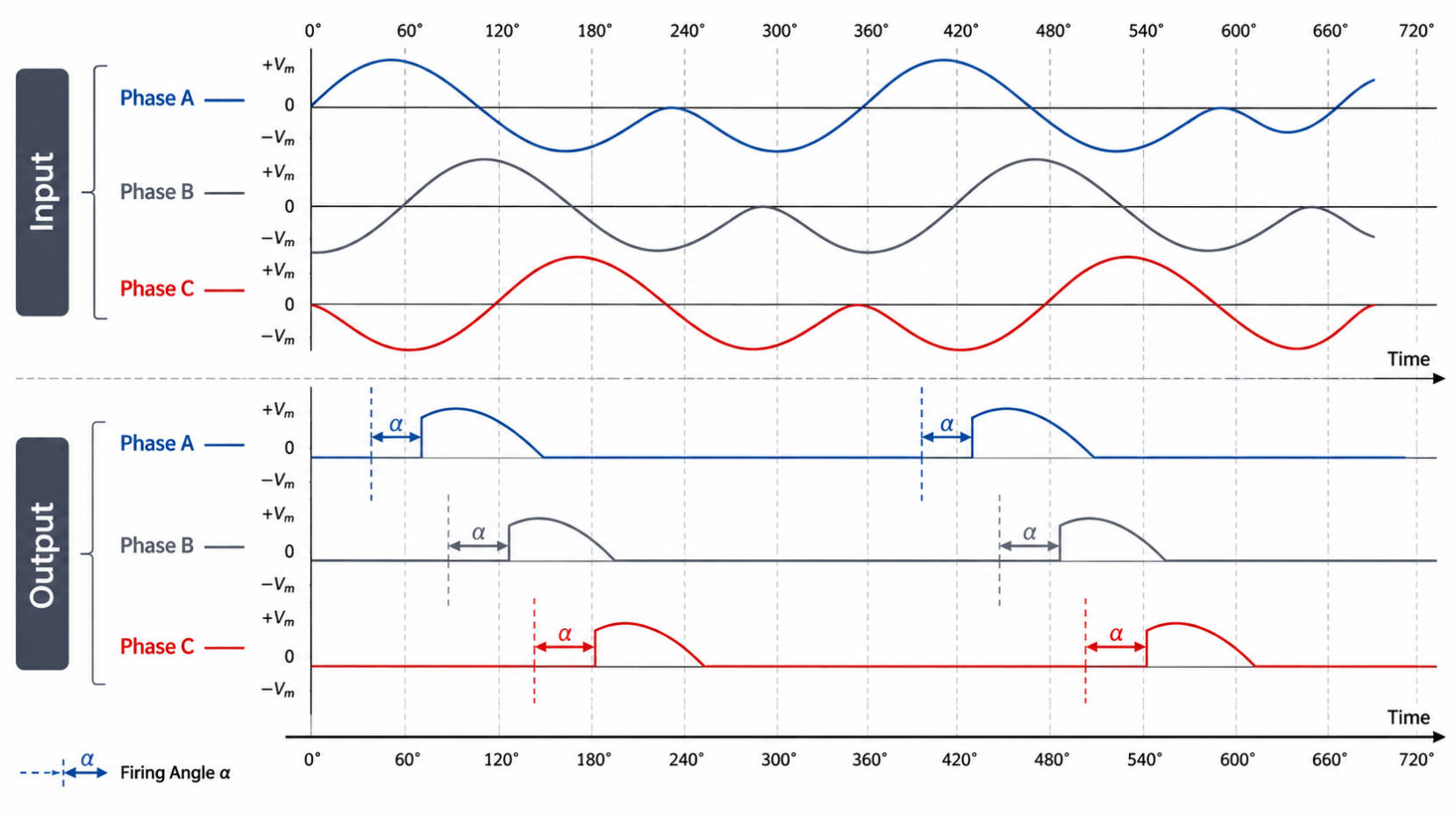
Phase angle control is valuable when the load changes quickly or when process stability is critical. It is commonly used for tungsten-filament lamps, temperature-sensitive resistance loads, and industrial heating systems that require smooth power delivery.
It is also a strong choice for applications where a zero-crossing method may not provide enough control precision. In inductive or transformer-based loads, choosing the wrong mode can cause overcurrent tripping and unstable operation.
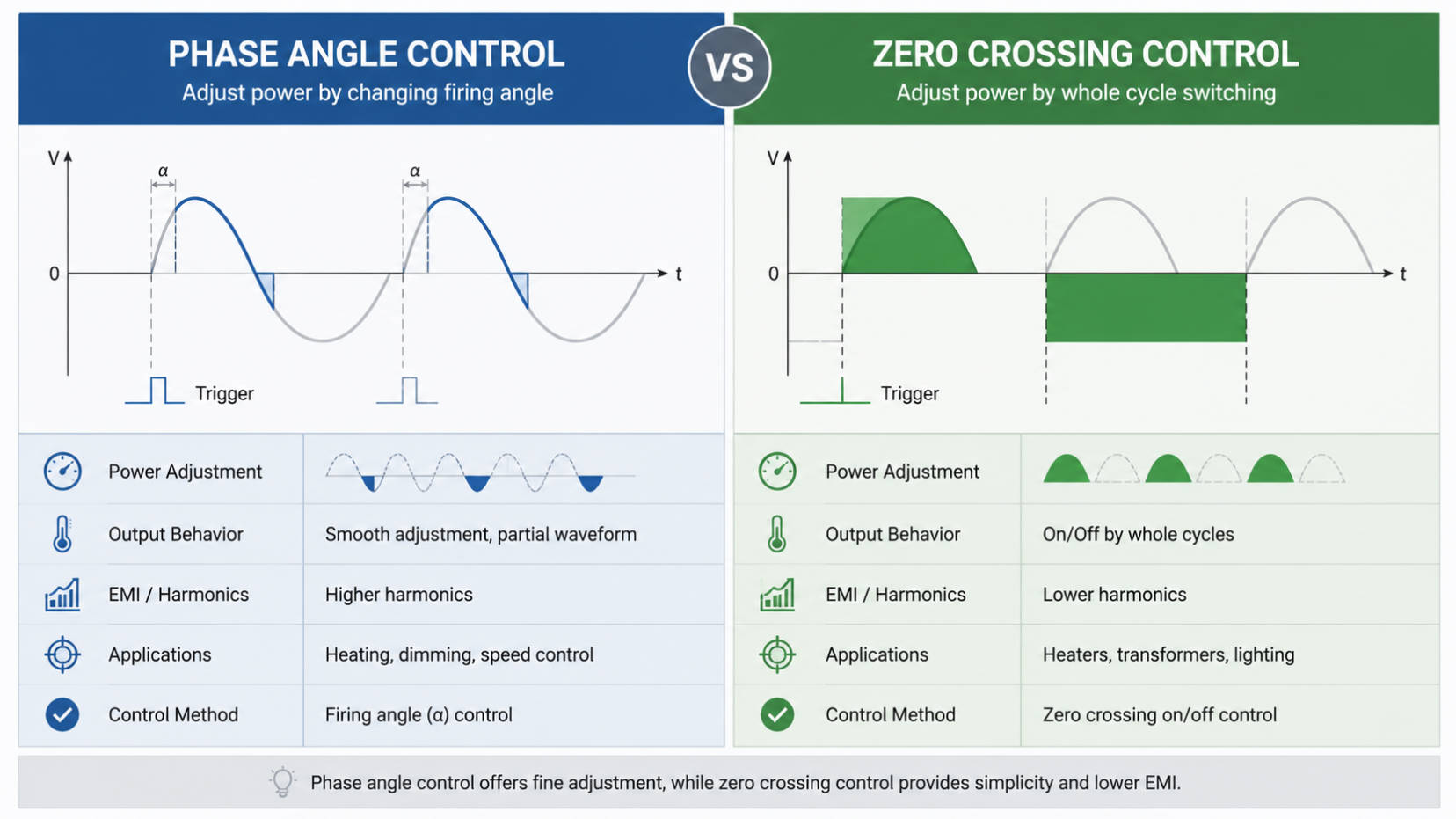
The two control modes solve different problems. Phase angle control offers precision and continuous adjustment, while zero crossing control is usually better for simpler heating applications where reduced electrical noise is a priority.
| Control Mode | Best For | Main Advantage | Main Limitation |
|---|---|---|---|
| Phase angle control | Fast-response loads, precision heating, transformer or inductive cases | Fine output resolution and smooth regulation | More complex and usually higher cost |
| Zero crossing control | Simple resistive heating loads | Lower switching stress and often less electrical noise | Less precise power adjustment |
If your process depends on tight temperature stability or a load that reacts quickly, phase angle control is usually the stronger option. If your process is simple and less sensitive, zero crossing may be enough.
One of the most common mistakes in SCR selection is focusing only on power rating. In reality, the load type determines whether phase angle control is the right choice, because resistive, inductive, and transformer loads behave very differently under AC control.
Industrial buyers should evaluate the electrical signature of the load before selecting the controller. That means checking whether the load is resistive, inductive, or nonlinear, and whether the system already has harmonic or reactive power issues.
Industrial equipment such as drives, rectifiers, and other nonlinear loads can create harmonic distortion in the electrical system. Harmonics can contribute to flickering lights, overheated transformers, tripped breakers, and broader power quality problems.
This is why power quality should be considered alongside SCR control selection. If a facility already has voltage distortion, harmonic analysis helps determine whether the system needs filters, detuned reactors, or other compensation solutions.
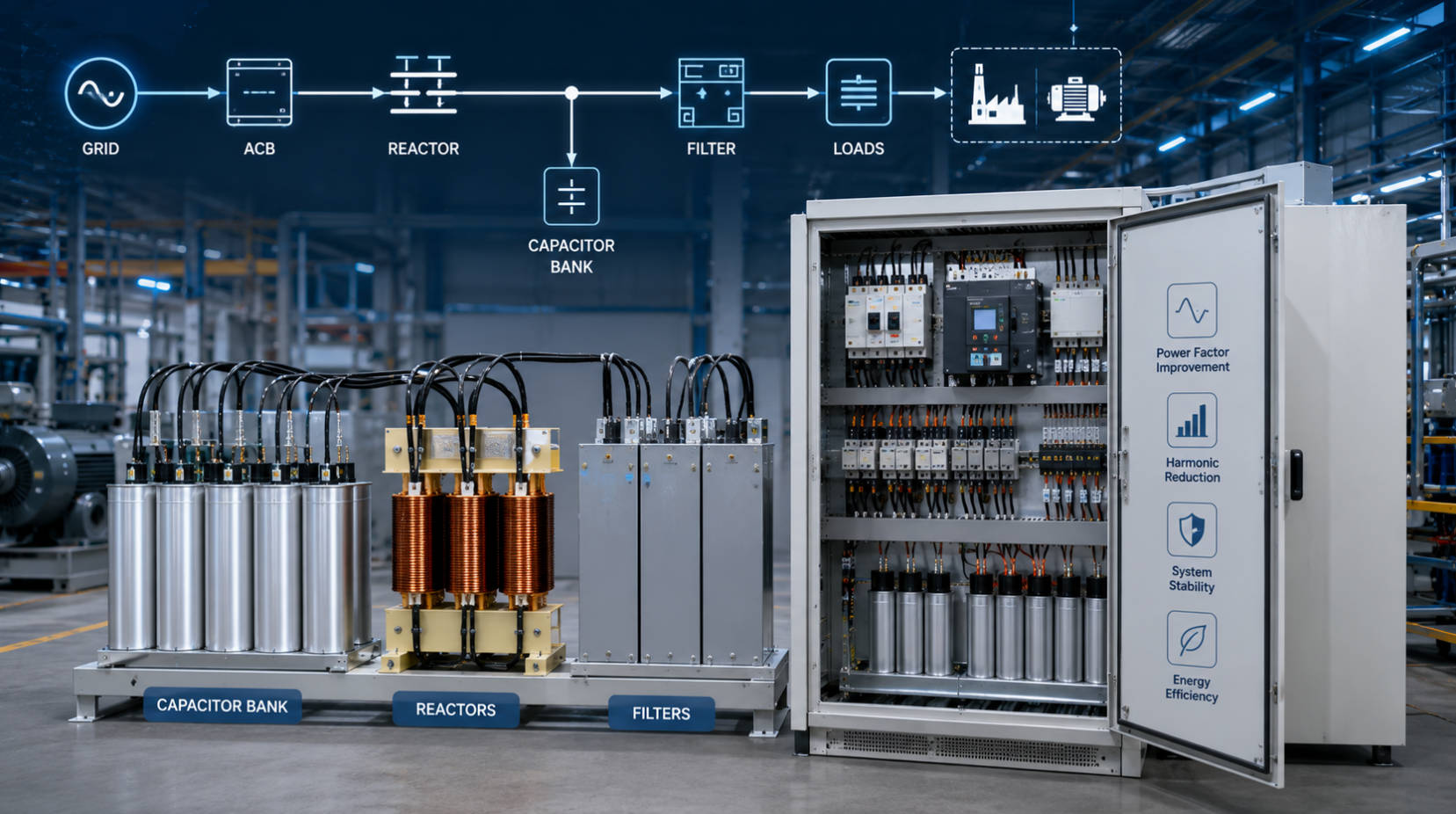
For factories with motors, transformers, furnaces, and other inductive equipment, reactive power compensation helps improve power factor, reduce losses, and support voltage stability. Capacitor banks, reactors, active harmonic filters, and hybrid systems are commonly used depending on the site condition.
This matters because a stable power system helps SCR regulators perform more consistently. In practice, power control and power quality are connected, so a good industrial solution should consider both.
Phase angle control SCR power regulators are widely used in industrial heating and process control. Typical applications include furnaces, ovens, kilns, drying tunnels, heat treatment lines, plastic and rubber heating, and temperature control cabinets.
They are also useful in plants where response speed and process stability affect output quality. For example, in thermal processing, even small power fluctuations can impact product uniformity, energy efficiency, and cycle consistency.
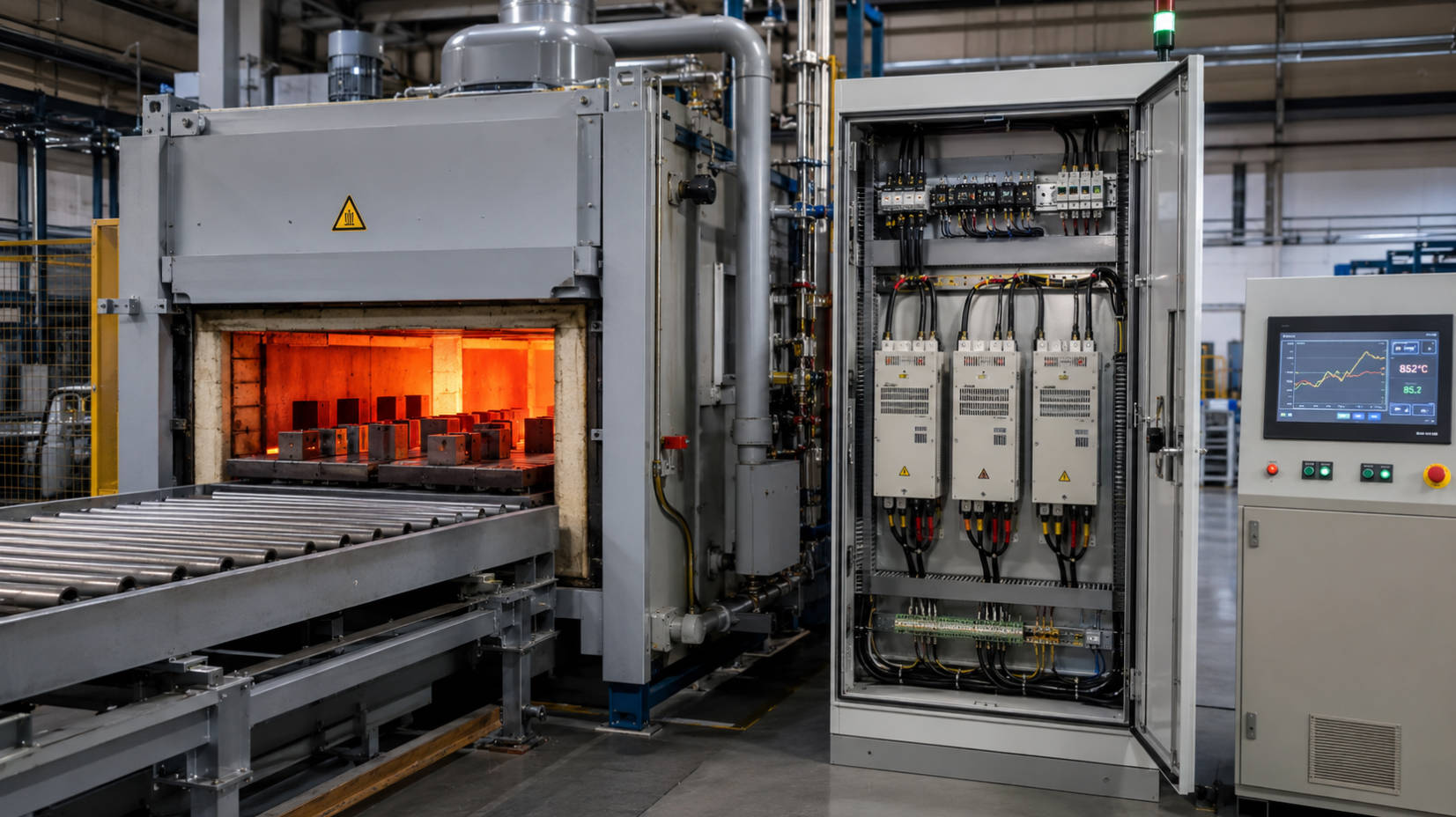
To choose the right SCR power regulator, start with the load and the process requirement. Then match the controller mode, feedback type, and protection design to the real operating condition.
1. Identify the load type: resistive, inductive, or transformer-based.
2. Confirm the control signal: 4–20mA, voltage input, or another industrial signal.
3. Check whether phase angle or zero crossing is required for process stability.
4. Review system conditions such as harmonics, resonance risk, and power factor.
5. Confirm thermal design, protection level, and integration with PLC or PID control.
Before purchasing, technical buyers should ask three questions. First, does the load need fine resolution or simple on/off style energy delivery? Second, does the plant already have harmonic or reactive power problems? Third, will the controller need to integrate with an existing automation system?
These questions prevent costly mismatches and reduce commissioning risk. They also help buyers move from a product-only decision to a system-level decision, which is usually the right approach in industrial power applications.
DINGNUO Electric CO., Ltd. positions its products around power quality improvement, reactive power compensation, and harmonic control for industrial users. In real projects, this kind of system-level thinking is important because a power regulator should work as part of a broader electrical solution, not in isolation.
For manufacturers in metallurgy, petrochemicals, automotive, papermaking, textiles, building materials, and major municipal projects, that means combining control precision with stable system performance. A well-designed solution improves reliability, protects equipment, and supports energy efficiency goals.
If your application involves precise heating, transformer loads, or sensitive industrial process control, choose a phase angle SCR power regulator only after confirming the load profile and power quality conditions. For a reliable industrial solution, contact DINGNUO Electric's technical team for selection support, system matching, and project consultation.
It adjusts AC power by changing the SCR firing angle within each half-cycle, allowing precise output control.
Use phase angle control when you need fine power resolution, fast response, or better control for inductive and transformer loads.
Common loads include industrial heating equipment, tungsten-filament lamps, ovens, kilns, and some transformer-based systems.
Yes. Depending on the load and system design, they may be part of a setup that interacts with harmonics, reactive power, and voltage stability.
You should assess harmonic distortion, resonance risk, and load behavior first, then select reactors, filters, or compensation equipment based on measured site conditions.
Usually yes, because it requires more sophisticated circuitry than zero crossing control.
1. - Noker Inverter. “What is phase angle control scr power regulator?” [https://www.noker-inverter.com/news/what-is-phase-angle-control-scr-power-regulator/] [noker-inverter]
2. - Fluke. “Causes and Effects of Harmonics in Electrical Power Systems.” [https://www.fluke.com/en-us/learn/blog/power-quality/harmonics-electrical-systems] [youtube]
3. - Proheat Inc. SCR Power Theory Training Manual. [https://www.proheatinc.com/uploads/8/4/5/4/84548950/scrman.pdf] [proheatinc]
4. - Delta T. “SCR (Silicon Controlled Rectifier) Power Controllers.” [https://www.deltat.com/scr.html] [deltat]
5. - Fujielectric. “SCR power controller: Benefits, functions and performance.” [https://www.fujielectric.fr/en/blog/scr-power-controllers-key-aspects-capabilities-and-performances/] [fujielectric]
6. - CHINT Global. “Reactive Power Compensation Technology: Principles and Applications.” [https://www.chintglobal.com/global/en/about-us/news-center/blog/reactive-power-compensation-technology.html] [chintglobal]
7. - Action Power Test. “What is Reactive Power Compensation?” [https://www.actionpowertest.com/glossary/reactive-power-compensation] [actionpowertest]
8. - IET Africa. “Implementing Reactive Power Compensation for Industrial Loads.” [https://www.ietafrica.com/implementing-reactive-power-compensation-for-industrial-loads/] [ietafrica]
9. - Dingnuo Electric. “Low-Voltage Reactor.” [https://www.dingnuopower.com/low-voltage-reactor.html] [dingnuopower]
10. - BTB Electric. “When is a reactor required for power factor capacitors?” [https://btb-electric.com/when-is-a-reactor-required-for-power-factor-capacitors/] [btb-electric]
11. - Market Research Future. “Harmonic Filter Market Share Report...” [https://www.marketresearchfuture.com/reports/harmonic-filter-market-10178] [marketresearchfuture]


