
Views: 0 Author: Site Editor Publish Time: 2026-08-11 Origin: Site


What is difference of Active Harmonic Filter and Active Power Filter?
The Active Harmonic Filter (AHF) functions to suppress or eliminate harmonic distortion within power systems. Harmonics refer to undesired current and voltage components diverging from the system fundamental frequency, generally produced by nonlinear loads including variable frequency drives, computers, rectifiers and other electronic devices.
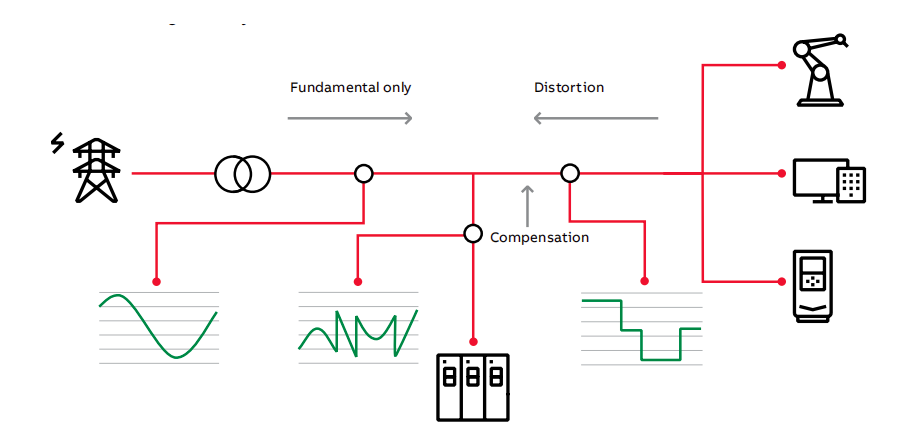
The Active Power Filter (APF) adopts power electronic technology and control algorithms to realize dynamic compensation for power quality problems in power systems, mainly harmonics and reactive power. It suppresses harmonic distortion and optimizes system power factor so as to enhance comprehensive power quality.
The core working principle of an APF is to generate a current waveform for offsetting unwanted harmonic and reactive currents in the power system. It detects abnormal currents or voltage harmonics and injects reverse current waveforms into the system. The injected current is precisely regulated to make the synthesized system current approximate an ideal sinusoidal waveform.
An Active Harmonic Filter AHF and an Active Power Filter APF are both used to mitigate power quality issues, but they serve different purposes.
1. Active Harmonic Filter (AHF): The AHF is mainly developed to suppress harmonic distortion in power systems. Harmonics represent undesired current and voltage components at integer multiples of the system fundamental frequency. Harmonic pollution may trigger multiple adverse consequences, including additional thermal loss, equipment faults, waveform distortion and declined power system efficiency. AHF continuously detects system harmonics and produces counter-harmonic currents to eliminate harmonic distortion. It is commonly deployed to compensate harmonics originating from nonlinear loads, such as variable speed drives, switching power supplies, rectifiers and other electronic apparatus.
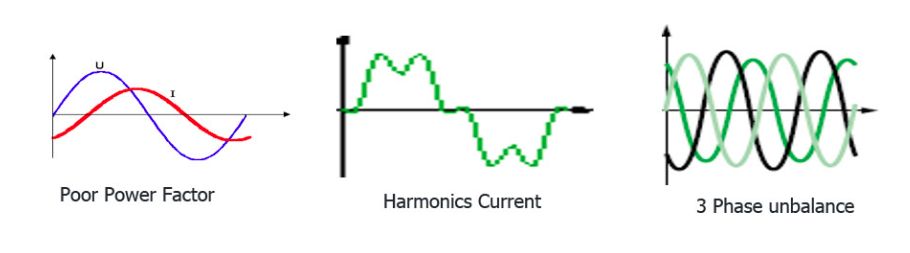
2. Active Power Filter (APF): Apart from harmonic suppression, the APF is engineered to compensate reactive power, optimize power factor and stabilize voltage fluctuations. Reactive power oscillates between the power grid and inductive or capacitive loads, bringing about extra grid energy consumption. The power factor reflects the efficiency of electric power utilization by loads. A low power factor will lead to higher energy consumption, utility surcharges and inefficient utilization of power facilities. The APF dynamically adjusts the power factor, compensates reactive power and suppresses voltage variations by injecting corresponding compensation currents into the system. It is extensively deployed in industrial and commercial scenarios to lift power factor, cut energy expenses and improve the overall operational performance of power systems.
In conclusion, although both AHFs and APFs serve to enhance power quality, AHFs mainly focus on harmonic distortion suppression, whereas APFs tackle multiple disturbances covering harmonic distortion, reactive power, power factor and voltage fluctuations. The selection of either device relies on the specific power quality problems existing in the system as well as practical application demands.
Which sites need AHF or APF?
AHFs and APFs deliver prominent advantages for sites suffering severe harmonic distortion (high THDi) within power networks. Typical application scenarios suitable for AHF or APF installation are listed as follows:
Industrial Facilities: Industrial facilities equipped with power electronic equipment including variable frequency drives (VFDs), rectifiers and arc furnaces tend to produce substantial harmonics. Such harmonics may trigger voltage distortion, equipment failures and additional energy losses. AHFs and APFs can alleviate these problems and guarantee reliable operation of sensitive electrical equipment.
Commercial Buildings: Large commercial premises such as shopping malls, office parks and data centers contain a large number of nonlinear loads, including computers, servers, lighting equipment and HVAC systems. Such loads inject harmonics into power networks, resulting in degraded power quality, equipment overheating and failures of sensitive electronic devices. Active filters (APF/AHF) can maintain high-quality power supply and avoid operational interruptions.
Renewable Energy Projects: Renewable power installations including photovoltaic (PV) power stations and wind farms are connected to the grid via power electronic inverters. The switching actions of these inverters may introduce harmonic pollution to the power grid. AHFs and APFs can suppress such harmonics and guarantee compliance with relevant power quality standards.
Hospitals and Healthcare Facilities: Hospitals and medical facilities are equipped with high-precision medical apparatus susceptible to power quality disturbances. Harmonic distortion may impair the precision and operation performance of medical devices, potentially causing mistakes in diagnosis and treatment. Active filters can stabilize power supply and safeguard vital medical equipment.
It should be emphasized that the requirement for active filters is determined by the electrical system’s inherent characteristics and the severity of harmonic distortion. Comprehensive power quality analysis conducted by professional engineers is essential to identify the optimal solution for each application site.


