
Views: 221 Author: Dingnuo Electric Publish Time: 2026-10-14 Origin: Site


Content Menu
● America's Reactive Power Compensation Market in 2026
>> Geographic and Commercial Scope
● How These Suppliers Were Selected
● Five Reactive Power Compensation Suppliers to Evaluate
>> 1. DINGNUO ELECTRIC CO., Ltd. — A Customization-Focused International Sourcing Option
>>> Core Strengths and Main Markets
>> 2. Eaton — Broad Product Coverage for Industrial Procurement
>>> Core Strengths and Main Markets
>> 3. Northeast Power Systems — Engineered Medium-Voltage Compensation
>>> Core Strengths and Main Markets
>> 4. TCI — Automatic Compensation With Harmonic-Aware Design
>>> Core Strengths and Main Markets
>> 5. Powerside — Integrated Monitoring, Engineering, and Correction
>>> Core Strengths and Main Markets
● Supplier Comparison: Capacity, MOQ, and Certification
● Technical Specifications That Determine Equipment Quality
>> Choose the Compensation Technology Around the Load
>> Specify Materials and Manufacturing Evidence
>> Separate Certification Categories
● Buyer's Guide: From Factory Verification to Delivery
>> 1. Prepare a Site-Specific RFQ
>> 2. Verify the Factory and Its Subcontracting Boundaries
>> 3. Use a Controlled Sample and Approval Process
>> 4. Evaluate Landed Cost and Service Exposure
● An Overlooked Procurement Trap: Nameplate kvar Versus Delivered kvar
● Conclusion: Match the Supplier to the Project
>> 1. How can I verify whether a supplier's ISO certificate has expired or been suspended?
>> 3. Is a supplier's "IEEE 519 compliant" claim sufficient?
>> 4. How should buyers compare quotations with different capacitor voltage ratings?
>> 5. Can a capacitor bank guarantee a fixed percentage reduction in electricity consumption?
America offers a strong supplier base for reactive power compensation, from automatic capacitor banks for industrial facilities to engineered medium-voltage harmonic filters. However, selecting a long-term manufacturing partner requires more than comparing brand recognition or price per kvar.
Professional buyers should examine factory credentials, engineering capability, material traceability, production testing, delivery commitments, and installation-specific compliance. The decisive factor is verification: whether a supplier can document that the proposed equipment will perform safely under your actual operating conditions.
This guide compares five suppliers with different commercial strengths: DINGNUO ELECTRIC CO., Ltd., Eaton, Northeast Power Systems, TCI, and Powerside. It distinguishes American manufacturing and regional support from overseas sourcing rather than treating every company as a U.S.-based factory.

The American power sector combines industrial equipment manufacturing, specialist engineering companies, electrical distribution networks, and utility-scale project expertise. For procurement teams, this creates several sourcing routes: established electrical groups, focused power-quality manufacturers, and international component or system suppliers.
Recent electricity-demand figures help explain the investment environment. The U.S. Energy Information Administration's Annual Energy Outlook 2026 reports that electricity consumption increased by an average of 2.1% annually over the preceding five years. Its modeled cases project average annual growth of 0.9%–1.6% through 2050, with data centers contributing substantially to the increase. These are electricity-demand figures, not a direct measurement of the reactive power compensation market.
The manufacturing ecosystem is geographically distributed rather than concentrated in one dedicated compensation-equipment cluster. Examples include TCI's Milwaukee roots, NEPSI's engineering and manufacturing presence in Queensbury, New York, and Powerside's expanded Canadian manufacturing operations in Dorval, Quebec. Together, these locations illustrate the region's combination of industrial power electronics, custom electrical assemblies, and application engineering.
Local sourcing can simplify project coordination and site support. International sourcing can provide another route for customized components and equipment, but buyers must separately establish destination-market compliance, import costs, commissioning responsibility, and spare-parts availability.
In this article, "America" primarily refers to the United States, with relevant Canadian manufacturing included.
DINGNUO is a Chinese manufacturer presented as an international sourcing alternative—not as an American factory. Its inclusion is relevant to buyers comparing domestic procurement with custom overseas manufacturing.
This is an application-based shortlist, not a market-share ranking or a claim that every supplier fits every project.
The assessment uses publicly available manufacturer information, technical documentation, standards guidance, and government energy reporting. It does not represent an on-site factory audit or independent laboratory comparison.
The selection framework covers six procurement priorities:
| Evaluation area | Evidence procurement teams should request |
|---|---|
| Factory identity and credentials | Registered entity, manufacturing address, certificate scope, and issuing organization |
| Engineering capability | Sizing calculations, harmonic studies, drawings, protection coordination, and application review |
| Quality control | Incoming inspection, in-process records, calibrated instruments, and serial-number-linked final tests |
| Production capability | Available assembly slots, test-bay constraints, component availability, and subcontracted operations |
| Delivery reliability | Milestone schedule, drawing-approval deadlines, material commitments, and shipping readiness |
| Customization and support | Defined engineering scope, communication responsibilities, documentation, warranty, and service boundaries |
Annual production volumes, standard minimum order quantities, and comparable delivery-performance statistics were not established from the reviewed sources. Where information is unavailable, the comparison identifies the gap instead of assigning unsupported figures.
DINGNUO's company profile identifies its operating business as Ningbo High-tech Zone Dingnuo Electric Co., Ltd., established in 2008 in Ningbo, Zhejiang, China. The company integrates research and development, production, and sales around reactive power compensation and harmonic control.
Its stated product scope includes:
- Intelligent capacitors.
- Reactors.
- Static var generators, or SVGs.
- Active power filters, or APFs.
- Related power-quality solutions for distribution systems.
DINGNUO reports production and testing equipment for these core products and more than 40 combined invention patents, utility-model patents, software copyrights, and other intellectual-property assets. That combined figure should not be interpreted as more than 40 invention patents.
The company describes applications in metallurgy, petrochemicals, automotive manufacturing, paper production, textiles, building materials, and municipal projects. It reports serving domestic and overseas industries, although its profile does not provide a country-by-country export breakdown or independently verified American installation base.
For smaller equipment brands, panel builders, and distributors, DINGNUO is worth evaluating as a potentially cost-conscious alternative to large branded system suppliers. However, any cost advantage should be established through a like-for-like landed-cost quotation rather than assumed.
DINGNUO explicitly offers product dimensions and features designed around customer requirements. This provides a documented basis for discussing enclosure adaptation, mechanical integration, and application-specific configurations.
For deeper OEM or ODM cooperation, buyers should negotiate:
- Private-label and nameplate arrangements.
- Approved component lists and substitution controls.
- Controller interfaces and communication protocols.
- Drawing ownership and revision management.
- Prototype approval and repeat-order consistency.
- Technical response times and escalation contacts.
These are proposed contractual requirements, not independently verified descriptions of every service currently offered.
The company advertises round-the-clock telephone and online support. American buyers should still define time-zone coverage, English-language engineering deliverables, and local commissioning arrangements. Its published on-site service promise should not automatically be interpreted as a guaranteed international response commitment.
DINGNUO's profile reports quality, environmental, and safety management-system certification, together with CCC, CQC, and CE-related product credentials. Buyers should request the actual documents and confirm model coverage, validity, issuing organizations, and manufacturing addresses. The profile does not establish blanket North American approval for all products.
Eaton traces its corporate history to 1911. That is the company's founding history, not the start date of every present-day capacitor product line.
Its power factor correction portfolio includes fixed and automatically switched capacitors for low- and medium-voltage applications. This breadth makes Eaton relevant to industrial buyers seeking compensation equipment within a wider electrical procurement program.
Eaton's offering addresses industrial and commercial power systems with different voltage levels and load profiles. Its published application guidance discusses individual motor correction, fixed banks, automatic banks, and harmonic-filter considerations.
A practical advantage is the availability of detailed engineering documentation. Buyers can use that documentation to develop a clearer specification before requesting quotations.
For Eaton, the most clearly supported procurement route is product selection and application-specific configuration. Public product information should not be interpreted as a general commitment to private-label manufacturing.
Buyers seeking an OEM relationship should establish whether the requested arrangement involves:
- Standard branded equipment.
- Configured assemblies.
- Engineered project equipment.
- Integration into another manufacturer's system.
Certification also requires model-level review. For example, Eaton identifies UL 810 and CSA C22.2 No. 190 for its Unipump product, but those credentials should not be generalized across the complete portfolio.
Northeast Power Systems, commonly known as NEPSI, was established and incorporated in February 1995. Based in Queensbury, New York, it specializes in medium-voltage metal-enclosed capacitor banks and harmonic filter systems.
NEPSI describes serving industrial, commercial, and utility power-system owners and operators. Its technical offering includes engineering studies associated with capacitor-bank and harmonic-filter applications.
This makes the company particularly relevant when procurement depends on more than purchasing a nominal kvar rating—for example, when the project requires network analysis, switching evaluation, or harmonic-performance commitments.
NEPSI states that, with a purchased study and associated filter or capacitor bank, it can provide performance guarantees against applicable IEEE 519 limits. Buyers should review the operating assumptions, measurement location, and contractual exclusions behind any guarantee.
Its strongest documented customization case is engineered equipment and associated technical services. Buyers should separately confirm any private-label requirements, drawing-release arrangements, or repeated platform-manufacturing agreements.
NEPSI publishes UL and C-UL 508A information for control panels integral to its equipment. It also describes third-party certification relating to metal-enclosed systems. These are distinct scopes; a control-panel credential should not be presented as universal certification of every complete assembly.
Trans-Coil, Inc., now presented as TCI, an Allient company, was founded in Milwaukee, Wisconsin, in 1961. Its published company information emphasizes active electronic and passive magnetic products for power-quality and harmonic problems associated with industrial power conversion.
TCI is relevant to industrial facilities where power factor correction and harmonic exposure must be evaluated together.
Its PF Guard capacitor bank uses automatic switching and includes a detuned anti-resonance reactor. This is a useful product distinction for buyers comparing an ordinary switched capacitor bank with a reactor-equipped design.
A detuned design should nevertheless be selected against the actual network conditions. The presence of a reactor does not eliminate the need to review system impedance and harmonic loading.
The reviewed public information supports an established product and application-engineering offering. It does not establish unrestricted private-label or full ODM availability.
Prospective partners should request written confirmation of:
- Permitted mechanical modifications.
- Available electrical ratings.
- Controller and interface options.
- Approved enclosure configurations.
- Certification coverage after customization.
Annual output and a universal MOQ were not verified from the reviewed material.
Powerside describes a power-quality heritage exceeding 75 years. Its reviewed company page does not establish one unambiguous founding year for the current organization, so buyers should distinguish legacy-business history from the incorporation date of their contracting entity.
The company lists a U.S. contact location in Alameda, California, and Canadian manufacturing operations in Dorval, Quebec.
Powerside combines power-quality monitoring, analytics, engineering services, and customized low- and medium-voltage correction equipment. Its stated applications include commercial and industrial facilities, utilities, semiconductor operations, medical environments, and EV charging.
In 2026, Powerside reported relocating and expanding its Canadian manufacturing operation. Its announcement identifies the Dorval location as a primary manufacturing hub for power-quality and packaged solutions. The announcement indicates expansion but does not disclose a directly comparable annual production figure.
Its documented strength is customized power correction and packaged solutions supported by measurement and engineering. Buyers should discuss private labeling separately rather than assuming that custom project engineering includes brand-ownership or ODM rights.
For complex facilities, the monitoring-to-correction approach can help connect the original diagnosis with subsequent performance verification.
Production capacity means annual output or available manufacturing throughput—not the electrical rating of a capacitor bank. The two should never be substituted in a supplier comparison.
| Supplier | Main sourcing focus | Public production-capacity evidence | MOQ | Certification position |
|---|---|---|---|---|
| DINGNUO | Customized capacitors, reactors, SVGs, and APFs | Production and testing capability stated; annual output not disclosed | Not publicly established | CCC, CQC, and CE-related credentials reported; verify documents and American project suitability |
| Eaton | Broad fixed and automatic PFC portfolio | Comparable annual PFC output not established | Product- and quotation-dependent | Selected products identify UL/CSA credentials; verify exact model |
| NEPSI | Engineered medium-voltage capacitor and filter banks | Specialist manufacturing described; annual output not disclosed | Project-specific quotation required | Published control-panel and system-related credentials have different scopes |
| TCI | Automatic detuned compensation and harmonic products | Manufacturing described; annual output not disclosed | Not publicly established | Request model-specific evidence and customization limitations |
| Powerside | Monitoring-led, customized correction systems | Canadian manufacturing expansion reported in 2026; annual output undisclosed | Project-specific quotation required | Request certification documentation for the proposed assembly |
For a meaningful capacity comparison, ask each shortlisted supplier for a project-specific schedule showing drawing approval, long-lead procurement, assembly, testing, and shipment milestones.
The least expensive equipment is not necessarily the least expensive solution.
| Operating condition | Technology to evaluate | Principal procurement question |
|---|---|---|
| Stable inductive demand | Fixed capacitor bank | How will the bank avoid overcompensation during low load? |
| Variable industrial demand | Automatic switched capacitor bank | Are step sizes and switching logic appropriate? |
| Harmonic-rich network | Studied detuned bank or harmonic-filter solution | Has resonance and harmonic loading been evaluated? |
| Combined distortion and reactive-power problems | Engineered active, passive, or hybrid solution | What performance is guaranteed under which operating conditions? |
Eaton's engineering guide explains why load constancy, plant capacity, utility billing, and harmonic exposure affect capacitor selection. Buyers should therefore avoid sizing solely from transformer nameplate capacity.
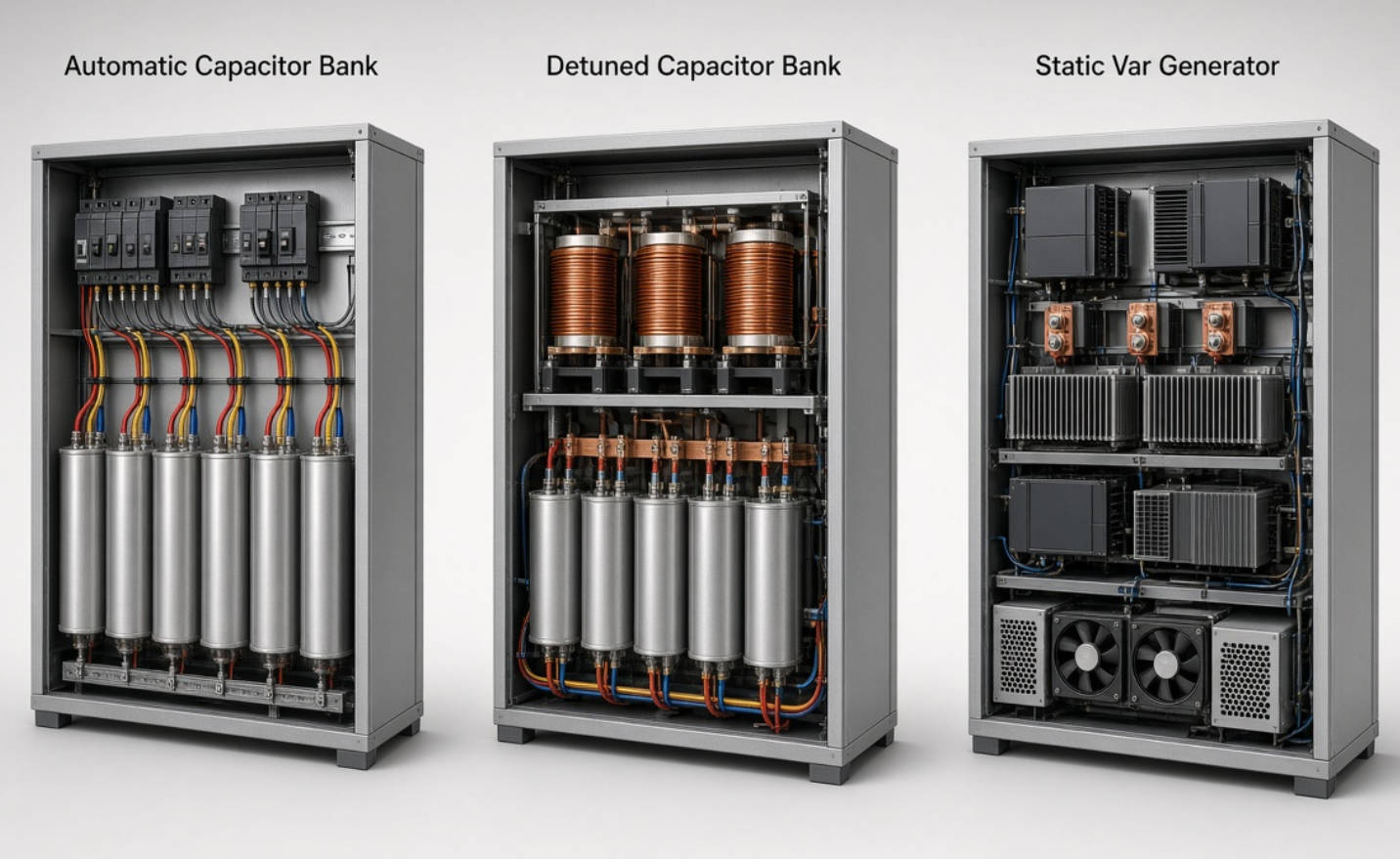
For low-voltage capacitor and reactor procurement, the RFQ should request evidence covering:
- Dielectric construction and applicable capacitor test standards.
- Capacitance tolerance, losses, and protection arrangements.
- Reactor conductor material, inductance tolerance, and temperature-rise limits.
- Insulation system and thermal protection.
- Busbar material, conductor sizing, and connection details.
- Enclosure construction, cooling, and environmental suitability.
Material substitution is a contractual risk worth controlling—not an allegation against the suppliers listed here. Require an approved bill of materials and written authorization before changing capacitor cells, reactors, switching devices, or protective components.
For copper-versus-aluminum alternatives, compare the complete thermal and electrical design rather than treating material name alone as proof of quality.
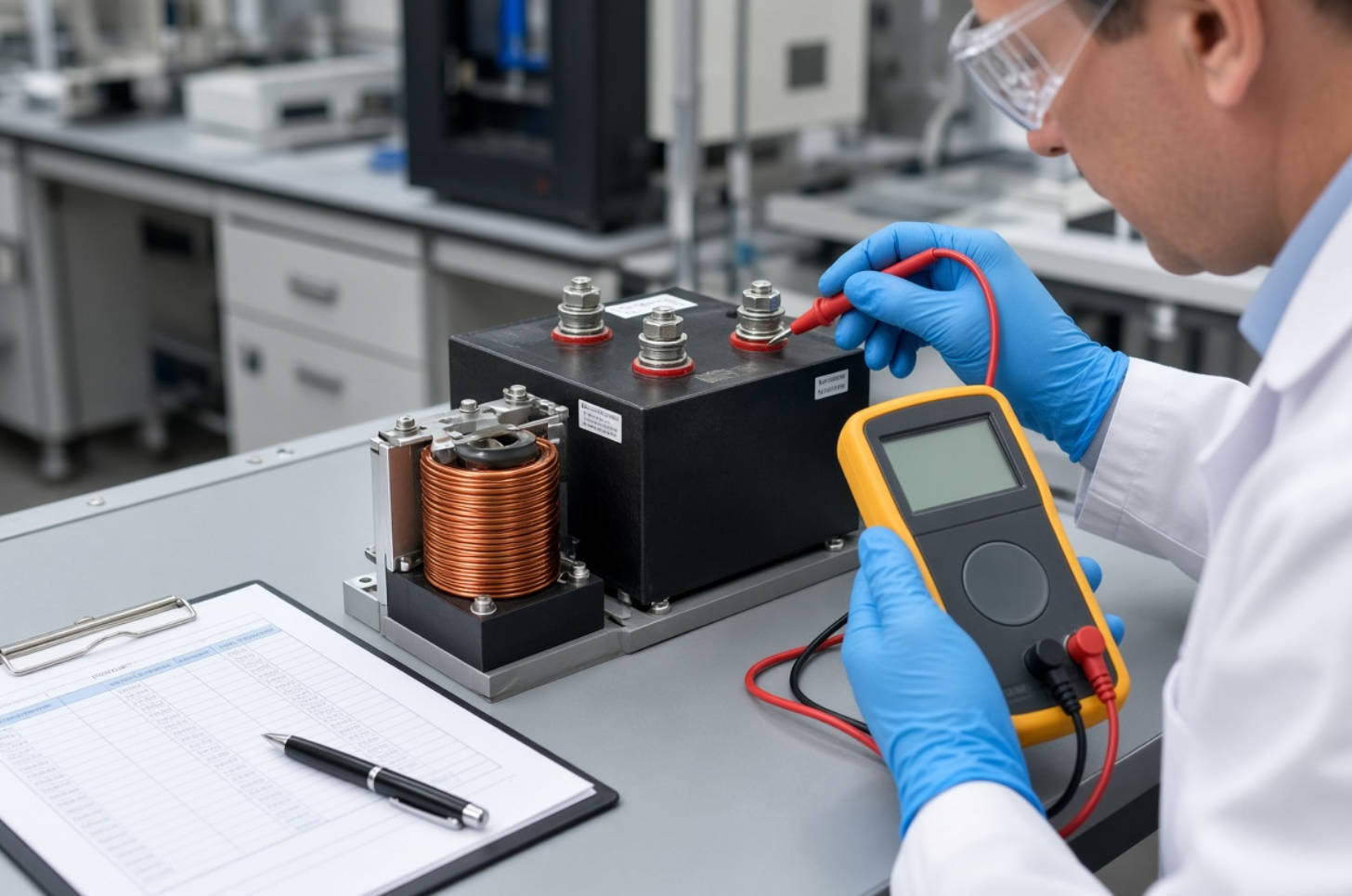
A management-system certificate does not prove that a particular capacitor bank is approved for installation.
Likewise, a certified capacitor component does not automatically establish certification of the finished automatic assembly. UL's published scope distinguishes general-use power factor correction units from automatic or circuit-monitoring systems that require additional evaluation.
CE documentation and RoHS declarations should be reviewed where relevant, but neither should be accepted as a substitute for the destination project's required North American evaluation.
For harmonics, IEEE 519 addresses system performance at the point of common coupling. It is not a generic factory certification attached to a capacitor bank.
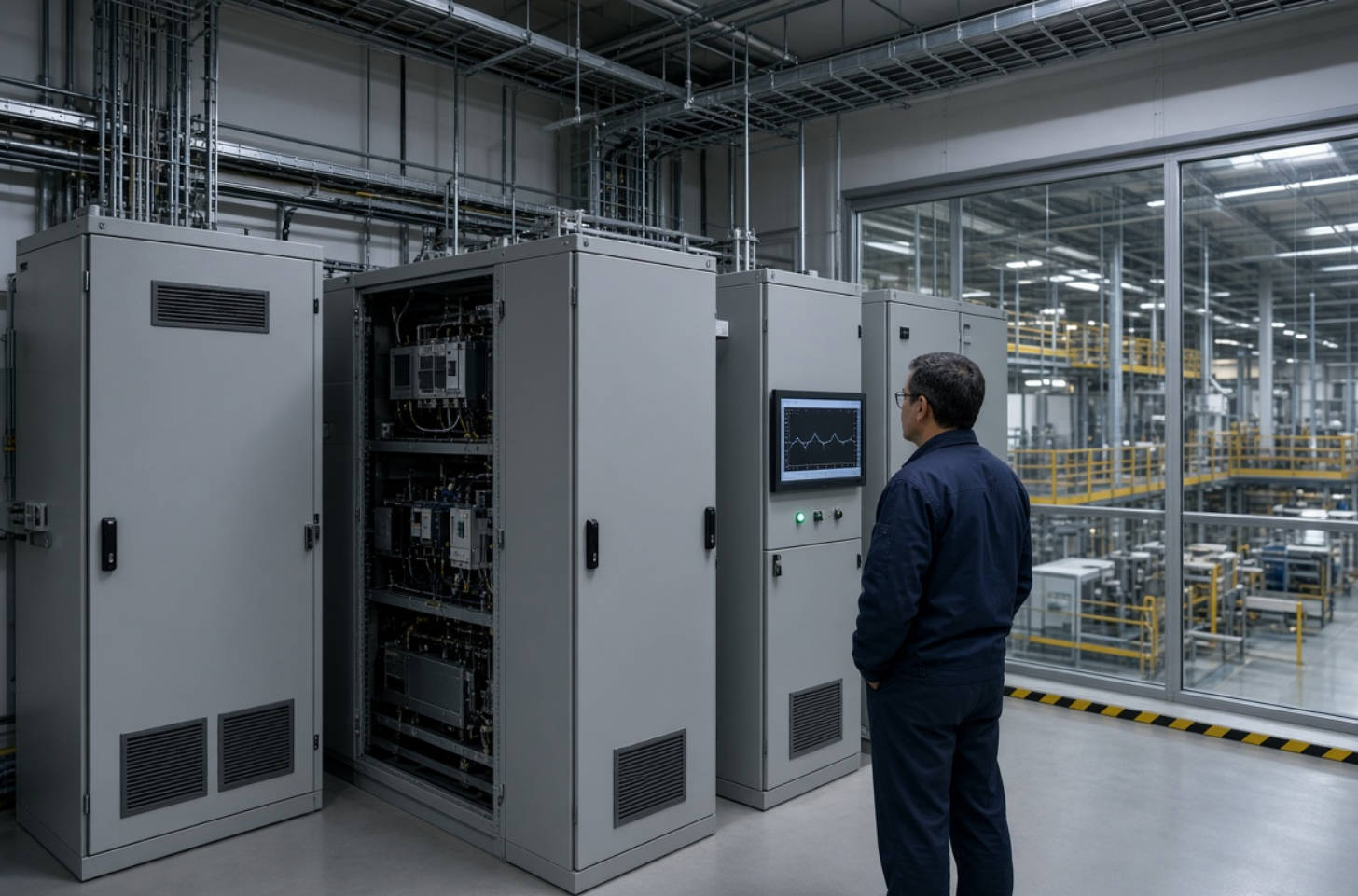
Provide the same information to every bidder:
- Nominal voltage and frequency.
- Single-line diagram.
- Transformer ratings and impedance.
- Available fault-current information.
- Measured demand and power factor.
- Harmonic measurements and major nonlinear loads.
- Utility tariff and required operating target.
- Ambient temperature, altitude, and enclosure location.
- Installation authority's certification requirements.
This prevents suppliers from quoting materially different solutions under the same "reactive power compensation" description.
Request a live walkthrough or independent audit covering incoming materials, assembly, testing, calibration, and finished-goods storage.
Ask which activities occur in-house. A supplier may manufacture reactors but buy capacitor cells, or assemble complete banks from externally sourced components. Neither model is automatically unsuitable; the issue is visibility and responsibility.
For repeat component purchases, approve a representative sample with a documented configuration.
For engineered assemblies, use an agreed factory acceptance test rather than relying on a small component sample. Depending on the equipment, the test plan should address wiring, control sequences, protection, communications, insulation testing, and agreed electrical measurements.
Record acceptance criteria before production begins.
Compare more than the purchase price:
- Freight and cargo insurance.
- Applicable duties and import requirements.
- Certification or field-evaluation costs.
- Installation and commissioning.
- Initial spare parts.
- Engineering changes.
- Warranty administration and replacement freight.
Define Incoterms, unloading responsibility, lifting provisions, packaging, moisture protection, and shipping documents in the purchase order.
Do not assume that buying from an American sales office establishes American manufacturing origin.
A particularly useful comparison check is whether every quotation expresses reactive output on the same voltage and frequency basis.
A capacitor's kvar output depends on operating voltage and frequency. Consequently, a capacitor cell's nameplate rating is not necessarily the compensation delivered at the customer's bus. Eaton's application guidance includes capacitor-rating and sizing relationships that make this distinction important.
The risk becomes greater when comparing different cell voltage ratings or reactor-equipped assemblies.
Require every bidder to provide:
1. Guaranteed net fundamental kvar delivered at the specified bus.
2. Operating voltage and frequency used in the calculation.
3. Capacitor-cell ratings and total installed capacitance.
4. Reactor characteristics, where applicable.
5. Expected operating current and component voltage.
6. Performance assumptions at minimum and maximum load.
This prevents an apparently lower price per nameplate kvar from disguising a smaller effective compensation package.
The shortlist serves different procurement needs.
DINGNUO offers a documented customization route for buyers evaluating an overseas manufacturing partner. Eaton provides broad PFC product coverage. NEPSI concentrates on engineered medium-voltage systems. TCI offers automatic compensation with a documented detuned-reactor design. Powerside connects monitoring, engineering, and customized correction equipment.
The appropriate partner is the one that can substantiate its proposed design, maintain repeat-order consistency, and accept clear responsibility for testing, delivery, and support.
For a DINGNUO quotation, submit your single-line diagram, voltage and frequency, load measurements, harmonic data, installation conditions, and required compliance documentation. Request a written technical proposal with net kvar output, customization scope, factory acceptance criteria, and itemized delivery milestones.
Search the legal company name or certificate number through IAF CertSearch and review the certificate's status, scope, covered sites, issuing certification body, and accreditation information. Do not rely solely on the expiry date printed on a PDF.
If the record is missing or inconsistent, contact the issuing certification body directly and obtain clarification before accepting the credential.
Do not assume so. Establish the evaluation and documentation required for the complete assembly with the project engineer and authority having jurisdiction before ordering.
UL's scope distinguishes capacitor components, general-use correction units, and automatic systems. A document covering one category should not be treated as blanket approval for another.
No. IEEE 519 concerns voltage and current distortion at the applicable point of common coupling, so compliance depends on the installation and operating conditions—not simply the product label.
Require a study or performance agreement defining the measurement point, network assumptions, operating scenarios, acceptance measurements, and responsibility if results are not achieved.
Require a common comparison basis: net compensation at the actual bus voltage and frequency.
Ask bidders to show cell ratings, capacitance, reactor data where relevant, and calculated operating output. Compare guaranteed delivered kvar and the complete protection and thermal design, not just the sum of capacitor nameplates.
Not without a project-specific analysis. Power factor correction can reduce reactive-power penalties, lower current-related distribution losses, and release electrical capacity, but financial results depend on the utility tariff and system conditions. Eaton's guide explicitly distinguishes billing changes from reductions in energy consumed.
Require separate estimates for tariff savings, loss reduction, and any avoided infrastructure expenditure. Reject proposals that treat an improvement in power factor as an equivalent percentage reduction in the facility's productive energy demand.
1. DINGNUO Electric. “About Us.” Company background, establishment year, product portfolio, customization capabilities, and reported credentials. [dingnuopower]
2. U.S. Energy Information Administration. “Annual Energy Outlook 2026.” U.S. electricity consumption trends and long-term demand projections. [eia]
3. Eaton. “Our Heritage.” Corporate history and founding information. [eaton]
4. Eaton. “Power Factor Correction Capacitors.” Overview of the company’s power factor correction product portfolio. [eaton]
5. Eaton. “Power Factor Correction: A Guide for the Plant Engineer.” Technical guidance on capacitor sizing, utility billing, harmonic considerations, and equipment selection. [eaton]
6. Eaton. “Unipump Power Factor Correction.” Product specifications and model-specific certification information. [eaton]
7. Northeast Power Systems. “Statement of Qualifications.” Company history, manufacturing specialization, and published certification scope. [nepsi]
8. Northeast Power Systems. “Power Systems Studies.” Engineering analysis for medium-voltage capacitor banks and harmonic filters. [nepsi]
9. TCI, an Allient Company. “About.” Company background and power-quality manufacturing capabilities. [transcoil]
10. TCI, an Allient Company. “PFG Capacitor Bank.” Automatic power factor correction and detuned-reactor product information. [transcoil]
11. Powerside. “About Powerside.” Company heritage, markets, and power-quality solutions. [powerside]
12. Powerside. “Powerside Expands Operations and Relocates Its Montreal Facility.” Manufacturing expansion and relocation announcement, 2026. [prweb]
13. UL Solutions. “Capacitor Products and Systems Certification Services.” Certification requirements for capacitor products and systems. [ul]
14. UL Standards & Engagement. “UL 810: Capacitors.” Standard scope covering capacitors and power factor correction units. [shopulstandards]
15. IEEE Standards Association. “IEEE 519-2022: IEEE Standard for Harmonic Control in Electric Power Systems.” System-level harmonic-control requirements and application at the point of common coupling. [standards.ieee]
16. IAF CertSearch. “Find and Verify Any Certificate in Seconds.” Verification of accredited management-system certificates by company name or certificate number. [iafcertsearch]


