
Views: 286 Author: Dingnuo Electric Publish Time: 2026-09-14 Origin: Site


Content Menu
● Top 10 Detuned Harmonic Filter Manufacturers
>> 1. DINGNUO ELECTRIC CO., Ltd.
>> 3. LASTONE
>> 4. Xi'an CoEpower Electric Co., Ltd.
>> 6. YIYEN Electric Technology Co., Ltd.
>> 7. Shenzhen Great Energy Technology Co., Ltd.
>> 8. Shanghai Huakun Electrical Company Ltd.
>> 10. Baoyu
● Detuned Harmonic Filter Technology: What Buyers Should Understand
>> 1. Quoting a Detuned Bank Without Harmonic Data
>> 2. Substituting Lower-Grade Capacitors
>> 3. Under-Sized or Saturating Reactors
>> 4. Ignoring Capacitor Voltage Derating
>> 5. Treating CE as a Universal Quality Certificate
>> 6. No Thermal Design Review
● The Less-Discussed Insider Tip
>> Validate the Technical Proposal
>> Order a Sample or Pilot Unit
>> Manage Logistics and Documentation
>> 1. How can I verify whether a supplier's ISO 9001 certificate has expired?
>> 2. Is a 7% detuned reactor suitable for every 400 V, 50 Hz capacitor bank?
>> 3. What documents should I request before buying a detuned harmonic filter?
>> 4. Should I choose a passive detuned filter, an active harmonic filter, or a hybrid system?
>> 5. How do I prevent suppliers from changing capacitor or reactor brands after sample approval?
China is a major sourcing base for detuned harmonic filters, detuned capacitor banks, filter reactors, power-factor-correction systems, and wider power-quality equipment. For procurement teams, however, the right supplier is not simply the one offering the lowest quotation: it is the one that can correctly assess harmonic conditions, select an appropriate detuning ratio, document component quality, and support stable delivery over the life of a project.
This guide is designed for industrial procurement managers, panel builders, EPC contractors, electrical distributors, and OEM brands seeking long-term Chinese partners for detuned harmonic filters, harmonic filter capacitor banks, detuned reactors, and reactive-power-compensation systems.
China's electrical-machinery manufacturing ecosystem remains highly export-oriented. In the first three quarters of 2025, China's mechanical and electrical exports reached RMB 12.07 trillion, accounting for 60.5% of total exports; the category grew 9.6% year on year. This gives international buyers access to extensive component supply chains, engineering capacity, and export experience—but it also makes supplier verification essential.
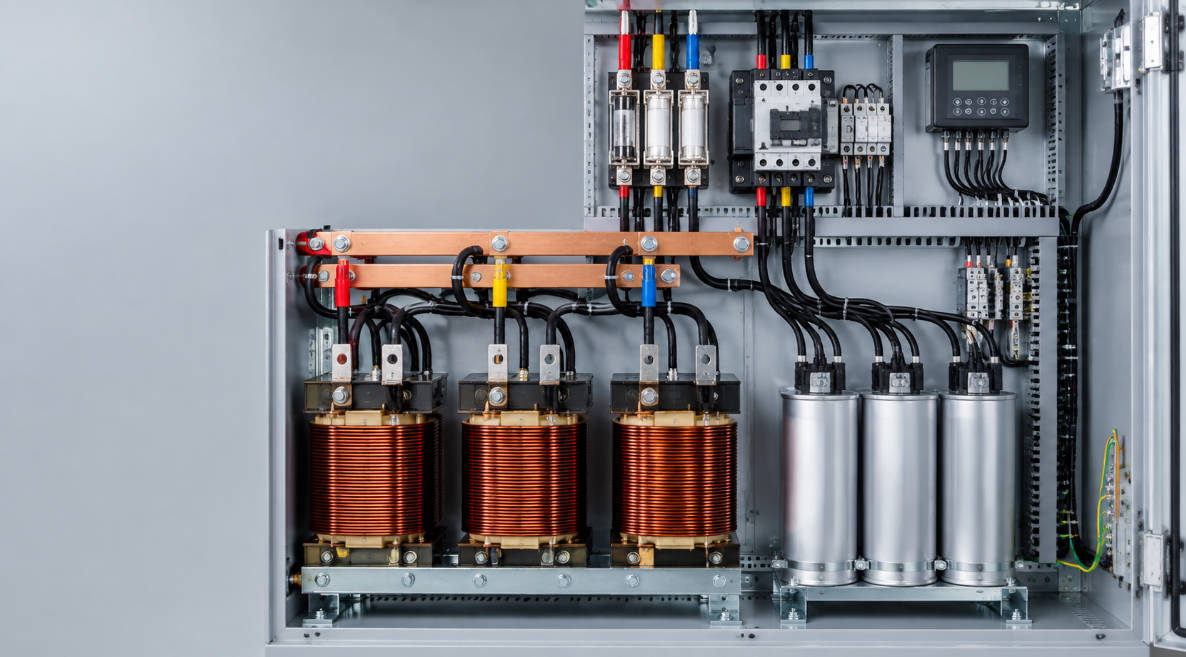
A detuned harmonic filter is not a generic cabinet. It is a coordinated system of capacitors, reactors, switching devices, protection devices, controllers, busbars, and enclosure engineering. A poorly designed system can amplify harmonics, overheat reactors, shorten capacitor life, or create resonance risks.
For this list, manufacturers were assessed using the following practical procurement criteria:
- Power-quality product scope: Ability to supply detuned capacitor banks, tuned reactors, harmonic filter cabinets, APF, SVG, or related compensation equipment.
- Engineering capability: Capacity to review voltage level, transformer rating, load profile, harmonic spectrum, target power factor, and detuning requirements before design.
- Manufacturing and QC controls: Traceability of capacitors, reactor winding materials, thermal protection, incoming inspection, routine testing, and final functional testing.
- Certification transparency: Ability to provide valid ISO documentation, CE-related technical files where applicable, RoHS declarations when required, and product test records.
- Customization depth: Availability of OEM/ODM services, private labeling, non-standard cabinet dimensions, protection ratings, component-brand options, and regional voltage/frequency adaptations.
- Export readiness: Familiarity with packing, documentation, Incoterms, shipment coordination, and technical communication in English.
- Long-term service: Willingness to provide single-line diagrams, wiring drawings, commissioning guidance, spare-part planning, and post-sales troubleshooting.
A credible supplier should be willing to discuss the actual harmonic environment—not merely quote a standard 7% reactor and capacitor bank without reviewing the site. IEC 61921 specifically notes that harmonics can reduce the life of PFC equipment and that suitable detuning reactors can mitigate damage; it also highlights saturation and overheating as concerns for iron-core reactors.
China's strength in this market comes from the concentration of low- and medium-voltage electrical-appliance production, capacitor and reactor component supply, metal enclosure fabrication, switchgear assembly, and export logistics.
Zhejiang remains particularly relevant for buyers of low-voltage electrical products. Leqing, Wenzhou, for example, is recognized as a manufacturing cluster for medium- and low-voltage electrical appliances. Ningbo, Wenzhou, Shanghai, Shenzhen, Xi'an, and nearby industrial regions provide access to electrical-component supply chains, engineering labor, panel-building capacity, and international shipping infrastructure.
That said, "Made in China" is not a quality specification by itself. The differences between suppliers often appear in:
- Capacitor dielectric and internal safety design.
- Reactor conductor material and insulation class.
- Actual inductance tolerance and detuning-frequency stability.
- Thermal margin at elevated ambient temperatures.
- Cabinet ventilation and derating design.
- Component traceability.
- Whether the supplier can provide harmonic-study-based selection rather than a one-size-fits-all quotation.
The following table is a procurement-oriented comparison. Capacity and MOQ vary by voltage, kvar rating, enclosure configuration, component brand, and project documentation requirements. Buyers should treat them as discussion starting points and request a written quotation with technical deviations clearly identified.
| Manufacturer | Location | Primary Focus | Typical Order Profile | MOQ Flexibility | Certifications / Compliance to Verify | OEM/ODM Suitability |
|---|---|---|---|---|---|---|
| DINGNUO ELECTRIC CO., Ltd. | Ningbo, Zhejiang | Detuned filter cabinets, capacitors, reactors, APF, SVG, customized power-quality systems | Small-to-mid-volume industrial and project orders | Generally flexible for customized projects | CE claims; request current ISO, CE technical file, RoHS declaration if needed | Strong for private-label, custom cabinet, drawing-to-production support |
| Hengyi Electrical Group | Zhejiang / Shanghai | Intelligent capacitors, anti-harmonic compensation, APF, SVG, controllers | Larger utility, commercial, panel-building, and distribution projects | Moderate | ISO certificates and product-specific test reports | Suitable for branded and project-based supply |
| LASTONE / Hengyi-related product lines | Zhejiang | Smart capacitor compensation, APF, SVG, filtering reactors | Standardized LV compensation and harmonic-control assemblies | Moderate | ISO and product conformity documents | Suitable for distributors and panel builders |
| Xi'an CoEpower Electric | Xi'an, Shaanxi | AHF, SVG, PFC, energy storage, voltage-sag correction | Power-quality and electronics-intensive projects | Moderate | ISO and electrical safety documentation | Suitable for OEM/ODM power-electronics programs |
| YT Electric | China | Active harmonic filters and power-quality solutions | Large harmonic-mitigation and industrial projects | Project dependent | Product test reports, factory system certifications | Better for advanced AHF-focused applications |
| YIYEN Electric Technology | Zhejiang | Harmonic filters, power-quality and energy products | Export-oriented electrical-system projects | Moderate | International-standard and market-entry documentation | Suitable for export distribution |
| Shenzhen Great Energy Technology | Shenzhen, Guangdong | Harmonic filters, voltage-dip compensation, SVG, power-quality products | OEM/ODM and higher-electronics-content projects | Moderate | ISO 9001 / ISO 14001 / ISO 45001 claims to verify | Strong potential for ODM integrations |
| Shanghai Huakun Electrical | Shanghai | APF, SVG, capacitors, harmonic filter reactors | Panel builders and custom electrical equipment | Moderate | ISO and component test reports | Appropriate for OEM/ODM cabinet sourcing |
| Sanhe Energy | China | Detuned filter capacitor banks and reactive-power systems | Conventional detuned capacitor-bank projects | Project dependent | Capacitor, reactor, and complete-bank test documentation | Suitable for standard and semi-custom applications |
| Baoyu | China | Harmonic filter capacitors and electrical power-quality components | Component sourcing and capacitor-bank assembly | Usually more component-oriented | Capacitor safety, performance, and material documentation | Suitable for assemblers and system integrators |
The table should be used as a shortlist, not as a substitute for engineering validation. Marketplace listings can indicate that a supplier offers a product category, but they do not prove a supplier's current factory capability, certification status, or ability to execute a particular project specification.
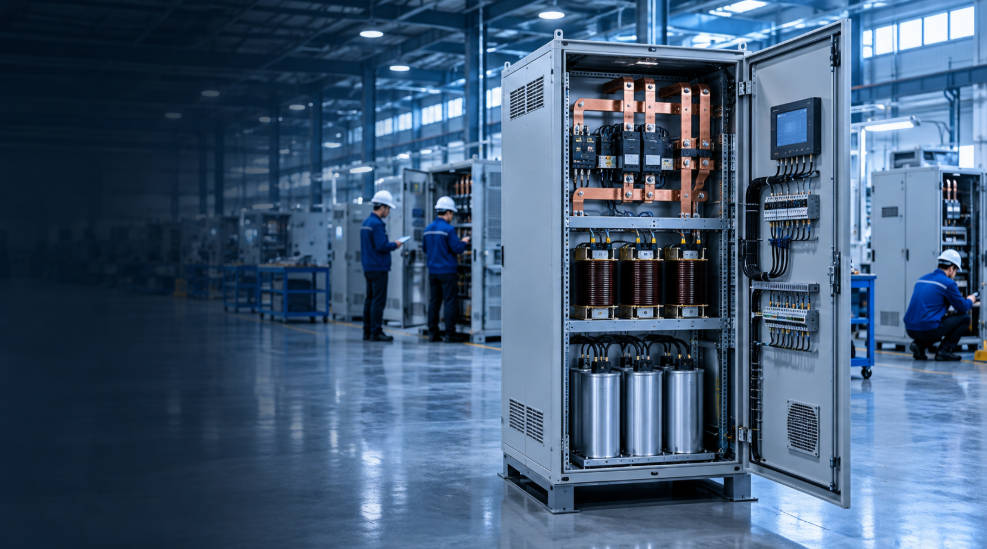
Location: Ningbo, Zhejiang, China
Established: 2008
Core products: Low- and high-voltage capacitors, low- and high-voltage reactors, detuned filter cabinets, harmonic filter cabinets, active power filters, SVG systems, intelligent controllers, multifunction meters, and customized electrical cabinets.
Best suited for: Buyers seeking flexible engineering support, responsive communication, tailored cabinet configurations, and OEM/ODM cooperation for industrial power-quality projects.
DINGNUO ELECTRIC CO., Ltd. is a practical option for small-to-medium industrial buyers, electrical contractors, panel builders, and overseas brands that need more than a catalog product. The company focuses on reactive-power compensation and harmonic-control equipment, offering integrated solutions that include capacitors, reactors, tuned filter cabinets, active power filters, and static var generators. Its product range is positioned around industrial and infrastructure power-quality applications.
A notable strength is its custom-production approach. DINGNUO states that it can provide non-standard electrical cabinet designs based on site conditions and equipment parameters, covering schematic development, component selection, complete assembly, and commissioning support. The company also offers customized nameplates, cabinet dimensions, internal layouts, and protection ratings—useful capabilities for OEM customers that need country-specific branding, panel-builder compatibility, or project-specific cabinet layouts.
For detuned harmonic filter sourcing, this is especially relevant because the reactor/capacitor combination should be selected according to the actual network. DINGNUO describes its low-voltage tuned filter cabinet as a series combination of capacitors and reactors, normally tuned below the lowest relevant harmonic—commonly below the fifth harmonic in a 50 Hz network—to reduce harmonic amplification while supplying reactive power at the fundamental frequency.
Why consider DINGNUO:
- Flexible non-standard cabinet design for industrial sites and OEM projects.
- Product portfolio covers passive detuned filters as well as APF and SVG alternatives.
- Suitable for customers that need a supplier able to communicate directly on electrical drawings, component choices, and commissioning considerations.
- Offers 24/7 remote technical support and states an on-site response target within 72 hours when remote troubleshooting is insufficient.
- Particularly relevant for projects in metallurgy, petrochemicals, automotive, paper, textiles, building materials, and municipal infrastructure, where nonlinear loads and reactive-power demand can coexist.
OEM/ODM scope to discuss:
- Customized cabinet dimensions and IP protection levels.
- Private-label nameplates and branding.
- 50 Hz or 60 Hz designs.
- Capacitor and switching-device brand options.
- Customized kvar step arrangements.
- Detuning ratio selection, such as 5.67%, 6%, 7%, or other project-specific values.
- RS485/Modbus metering and communication requirements.
- Export-ready packing, documentation, and spare-part kits.
Buyer note: Ask DINGNUO to provide a single-line diagram, capacitor-step schedule, reactor data sheet, thermal design assumptions, test report format, and a list of critical bought-in components before comparing its quotation with competitors.
Location: Zhejiang and Shanghai, China
Established: 1993
Core products: APF, SVG, smart power-factor-correction systems, intelligent anti-harmonic capacitor modules, low- and high-voltage capacitors, automatic reactive-power controllers, and related power-quality products.
Best suited for: Buyers requiring a mature supplier with broad product coverage and substantial capacitor-production capacity.
Hengyi Electrical Group is one of the more established names in China's power-quality and reactive-power-compensation market. The company reports that it was founded in 1993, operates production bases in Zhejiang and Shanghai, and has annual capacity in the millions of capacitor units. Its published product range includes active power filters, static var generators, intelligent capacitor-compensation equipment, anti-harmonic intelligent capacitor modules, capacitors, and automatic reactive-power compensation controllers.
For detuned harmonic filter projects, Hengyi is relevant where buyers need system-scale supply rather than only individual reactor or capacitor components. Its scale can be useful for distributors, industrial projects, and OEM panel builders that require continuity of supply.
Core strengths:
- Long operating history in the reactive-power and power-quality segment.
- Broad product coverage across conventional capacitor compensation and active harmonic mitigation.
- Zhejiang and Shanghai production footprint.
- Potential fit for industrial distribution systems, commercial facilities, public infrastructure, and panel-building applications.
OEM/ODM scope to confirm:
- Private-label production.
- Custom capacitor-bank wiring and enclosure layouts.
- Local-language controller interfaces.
- Customized component brands and circuit-breaker selections.
- Project-specific detuning ratios and harmonic-study support.
Location: Zhejiang, China
Core products: Active power filters, SVG, smart power capacitors, anti-harmonic intelligent capacitor-compensation systems, capacitors, controllers, and related power-quality equipment.
Best suited for: Buyers looking for standardized intelligent low-voltage compensation products and distribution-oriented power-quality systems.
LASTONE is associated with the broader Zhejiang power-quality manufacturing ecosystem and offers products including APF, SVG, intelligent capacitor-compensation systems, anti-harmonic compensation equipment, and automatic controllers. Its portfolio is relevant to buyers combining power-factor correction with harmonic management.
The company can be a useful shortlist candidate for conventional low-voltage compensation projects where the buyer requires intelligent switching, monitoring, and modularized anti-harmonic capacitor solutions.
Core strengths:
- Strong focus on intelligent compensation systems.
- Product range suitable for distribution cabinets and standardized LV projects.
- Capability across passive and active power-quality equipment categories.
OEM/ODM scope to confirm:
- Private branding for intelligent capacitor modules.
- Cabinet assembly for local electrical-panel standards.
- Customized communication protocols and controller parameters.
- Export-market documentation and third-party testing options.
Location: Xi'an, Shaanxi, China
Core products: Active harmonic filters, static var generators, power-factor-correction equipment, energy-storage systems, and voltage-sag-correction solutions.
Best suited for: Buyers with complex nonlinear loads requiring a comparison between passive detuned filters, active harmonic filters, SVG, or hybrid solutions.
CoEpower positions itself as a power-quality manufacturer with engineering experience in AHF, SVG, PFC, energy storage, and voltage-sag correction. The company states that its founding engineering group has nearly 20 years of experience in power-quality R&D and that it serves more than 10,000 clients globally through OEM and ODM supply.
Although active filters are not direct substitutes for detuned capacitor banks in every application, CoEpower is relevant for projects where harmonic levels vary significantly, multiple harmonic orders are present, or the site needs dynamic compensation. Procurement teams should compare a passive detuned solution and an active/hybrid alternative using actual harmonic measurements.
Core strengths:
- Engineering emphasis on AHF and SVG technologies.
- Suitable for variable-load factories, data-intensive buildings, UPS-heavy facilities, and sites with VFDs or rectifier loads.
- International OEM/ODM orientation.
OEM/ODM scope to confirm:
- Private-label AHF/SVG modules.
- Customized cabinet layout and rated current.
- Modbus, Ethernet, or BMS/SCADA integration.
- Hybrid design with passive detuned capacitor bank plus AHF.
Location: China
Core products: Active harmonic filters and advanced power-quality systems.
Best suited for: Large industrial projects where active harmonic mitigation, high-current capacity, or dynamic compensation is the main requirement.
YT Electric promotes active harmonic filter solutions and identifies itself as a subsidiary of CSG. Its public materials emphasize active harmonic filtering and power-quality technology.
For buyers evaluating detuned harmonic filters, YT Electric belongs on the comparison list when the project contains rapidly changing harmonic loads. A passive detuned filter helps prevent capacitor-bank resonance and can provide reactive power, but an AHF may be preferable when the harmonic spectrum changes frequently or when precise dynamic compensation is required.
Core strengths:
- Focus on active harmonic mitigation.
- Potential fit for VFD-heavy manufacturing, semiconductor-related loads, large UPS installations, charging infrastructure, and complex industrial systems.
- Useful benchmark supplier when deciding whether a passive, active, or hybrid filter strategy is appropriate.
OEM/ODM scope to confirm:
- Current rating and modular expansion.
- Harmonic-order compensation range.
- Response time and control topology.
- Site survey and pre-sale harmonic analysis.
- Export certification and field-service availability.
Location: Zhejiang, China
Core products: Harmonic filters and broader electrical power-management products.
Best suited for: Export-oriented buyers seeking a manufacturer with an international-facing power-quality product range.
YIYEN Electric Technology markets harmonic-filter products and states that its products are intended to meet international standards. This makes it a candidate for distributors and buyers who want to source power-quality equipment alongside broader energy-management or electrical-system products.
Core strengths:
- Zhejiang-based electrical manufacturing ecosystem.
- Harmonic-filter product offering.
- Potential fit for export-oriented product portfolios.
OEM/ODM scope to confirm:
- Detuned filter capacitor-bank availability.
- Component sourcing and approved-brand list.
- Factory certifications, CE file scope, and RoHS declarations.
- Customized mechanical design and documentation language.
Location: Shenzhen, Guangdong, China
Core products: Harmonic filters, voltage-dip compensators, SVG systems, and power-quality-improvement products.
Best suited for: Buyers seeking OEM/ODM collaboration on electronics-intensive harmonic and voltage-quality equipment.
Shenzhen Great Energy Technology is listed as a manufacturer of harmonic filters, voltage-dip compensation products, SVG systems, and broader power-quality equipment. Public sourcing information indicates ISO 9001, ISO 14001, and ISO 45001 claims, along with OEM/ODM availability; buyers should independently verify certificates directly with the issuing body before contracting.
Shenzhen's electronics and control-system supply chain can be advantageous for suppliers focused on digital monitoring, advanced control, communication modules, and power-electronics-based equipment.
Core strengths:
- Product categories extend beyond passive filters into voltage-quality and reactive-power technologies.
- OEM/ODM orientation.
- Potential fit for projects requiring smart controls, power-electronic modules, and custom interfaces.
OEM/ODM scope to confirm:
- Firmware or HMI branding.
- Communications integration.
- Export-market EMC and safety documentation.
- Long-term availability of IGBTs, controllers, and critical electronic components.
Location: Shanghai, China
Core products: Active harmonic filters, SVG, capacitors, harmonic filter reactors, and related electrical equipment.
Best suited for: Panel builders and project buyers that need component-to-cabinet sourcing flexibility.
Shanghai Huakun is listed as supplying active harmonic filters, static var generators, capacitors, and harmonic filter reactors, with OEM and ODM capability. This product combination makes it relevant for sourcing projects that require both passive components and active compensation technologies.
Core strengths:
- Coverage of reactors, capacitors, APF, and SVG.
- Potential suitability for custom panel and system-integration orders.
- Shanghai logistics and supply-chain access.
OEM/ODM scope to confirm:
- Reactor inductance and thermal-class documentation.
- Capacitor make and rated service conditions.
- Full cabinet assembly versus component-only supply.
- Final inspection, factory acceptance test, and shipment records.
Location: China
Core products: Detuned filter capacitor banks and related reactive-power-compensation systems.
Best suited for: Buyers sourcing conventional detuned capacitor banks for known, relatively stable harmonic conditions.
Sanhe Energy publicly offers detuned filter capacitor bank products. For factories with stable, measurable harmonic conditions and a clear reactive-power requirement, suppliers focused on standard detuned-bank configurations can be cost-effective.
A buyer should not assume, however, that a standard bank is automatically suitable. The system design must confirm transformer impedance, background voltage distortion, capacitor step ratings, detuning ratio, overload conditions, ambient temperature, and future VFD or rectifier expansion.
Core strengths:
- Specific market focus on detuned filter capacitor banks.
- Potential fit for conventional PFC plus resonance-avoidance projects.
- Suitable for buyers that already have a confirmed bill of materials and technical specification.
OEM/ODM scope to confirm:
- Capacitor-step layout.
- Reactor detuning ratio.
- Cabinet IP rating and cooling arrangement.
- Controller type and communications.
- Component-brand substitutions and approval procedure.
Location: China
Core products: Harmonic filter capacitors and related electrical components.
Best suited for: System integrators, panel builders, and buyers seeking component-level sourcing for custom harmonic-filter assembly.
Baoyu markets harmonic filter capacitors intended for power-quality applications. Component-focused suppliers can be useful when an overseas panel builder or EPC contractor wants to assemble filter banks locally, maintain control over the enclosure and switching section, or source replacement capacitors for installed systems.
Core strengths:
- Component-level focus.
- Potential fit for local assembly, maintenance stock, and retrofit projects.
- Useful as a secondary supplier for capacitor procurement.
OEM/ODM scope to confirm:
- Capacitor dielectric construction and self-healing performance.
- Rated voltage, kvar, inrush current, and overvoltage tolerance.
- Discharge resistor design.
- Batch traceability and date-code tracking.
- Compatibility with specific detuned reactors.
A detuned harmonic filter—often called a detuned capacitor bank or detuned PFC system—is normally used where a facility needs reactive-power compensation but has harmonic-producing loads such as:
- Variable-frequency drives.
- Rectifiers and DC drives.
- UPS systems.
- Welding equipment.
- Arc furnaces.
- Thyristor-controlled loads.
- Large LED drivers.
- Data-center power electronics.
- EV charging systems.
- Renewable-energy inverters.
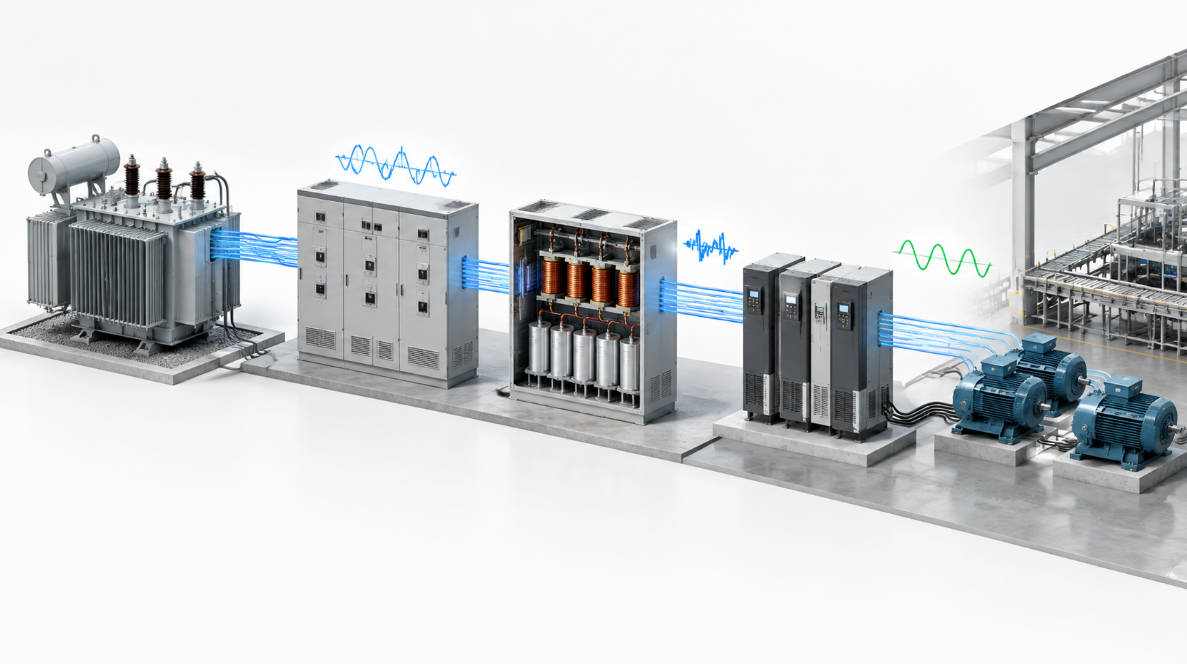
The most common configuration places a reactor in series with each capacitor step. The reactor and capacitor are selected so that the circuit's resonance frequency is below a problematic harmonic order. In a 50 Hz system, a detuned filter may be designed around 189 Hz, 210 Hz, or another calculated point, depending on the selected detuning factor and the system's harmonic environment.
For example, a 7% detuned reactor is commonly associated with a resonant frequency below the fifth harmonic in 50 Hz systems. But "7%" is not a universal answer. A buyer must consider the actual network, including existing harmonic orders, transformer impedance, capacitor step size, background distortion, and expected future load additions.
IEC 61921 covers low-voltage AC shunt capacitor banks used for power-factor correction and references IEC 60831 for self-healing shunt capacitors. It specifically cautions that connecting capacitor banks to systems containing harmonics can reduce equipment life and recommends suitable detuning reactors to mitigate the harmful effects.
Before issuing an RFQ, request or provide:
- System voltage and frequency: 400 V, 415 V, 440 V, 480 V, 525 V, 690 V, 50 Hz, or 60 Hz.
- Transformer rating and impedance.
- Existing power factor and target power factor.
- Monthly kWh and kvarh data, where available.
- Harmonic measurement report, including THDv and THDi.
- Dominant harmonic orders: fifth, seventh, eleventh, thirteenth, and others.
- Nonlinear-load profile and future expansion plan.
- Required capacitor-bank capacity in kvar.
- Number of switching steps and minimum controllable step size.
- Site ambient temperature, altitude, dust level, humidity, and required IP rating.
- Available installation space and cable-entry direction.
- Required communications protocol, such as Modbus RTU, Modbus TCP, or Ethernet.
- Applicable standards: IEC, UL, CE, RoHS, local utility requirements, or customer specifications.
Some suppliers quote a standard capacitor bank after receiving only the required kvar. This is risky. Reactive-power demand alone does not determine the correct detuning ratio, reactor rating, capacitor voltage rating, or thermal design.
How to avoid it: Provide a 7-day or longer power-quality measurement report if possible. If no report exists, request a supplier proposal that clearly states assumptions and identifies what must be confirmed during commissioning.
Capacitors can look identical externally while varying significantly in dielectric film quality, internal protection design, overvoltage capability, self-healing performance, and expected service life.
How to avoid it: Require the capacitor manufacturer, model number, rated voltage, rated kvar, tolerance, discharge method, certification documents, and batch traceability in the approved bill of materials.
A reactor that is poorly designed or incorrectly selected can saturate under high current, overheat, shift its inductance, and undermine the intended detuning frequency.
How to avoid it: Ask for reactor inductance tolerance, rated current, overload capacity, insulation class, temperature-rise data, core material details, conductor material, thermal-protection method, and test conditions.
In detuned systems, the capacitor can experience a higher voltage than the nominal line voltage because of the series reactor. Selecting a 440 V capacitor simply because the network is 400 V may be inadequate in some designs.
How to avoid it: Ask the supplier to calculate expected capacitor terminal voltage at fundamental frequency and under specified harmonic conditions. Require this calculation in the technical proposal.
CE marking is a conformity declaration for applicable EU requirements; it does not automatically verify long-term electrical reliability, harmonic-design accuracy, or factory-process quality.
How to avoid it: Request the Declaration of Conformity, applicable directives, test-report references, manufacturer information, and product model coverage. For important projects, verify the issuing laboratory and test-report validity directly.
A filter bank designed for a 25°C workshop may perform poorly in a 45°C electrical room with restricted ventilation. Heat is one of the most common hidden reasons for shortened capacitor and reactor life.
How to avoid it: Specify maximum ambient temperature, enclosure location, ventilation constraints, and permitted temperature rise. Require the supplier to identify any derating factor.
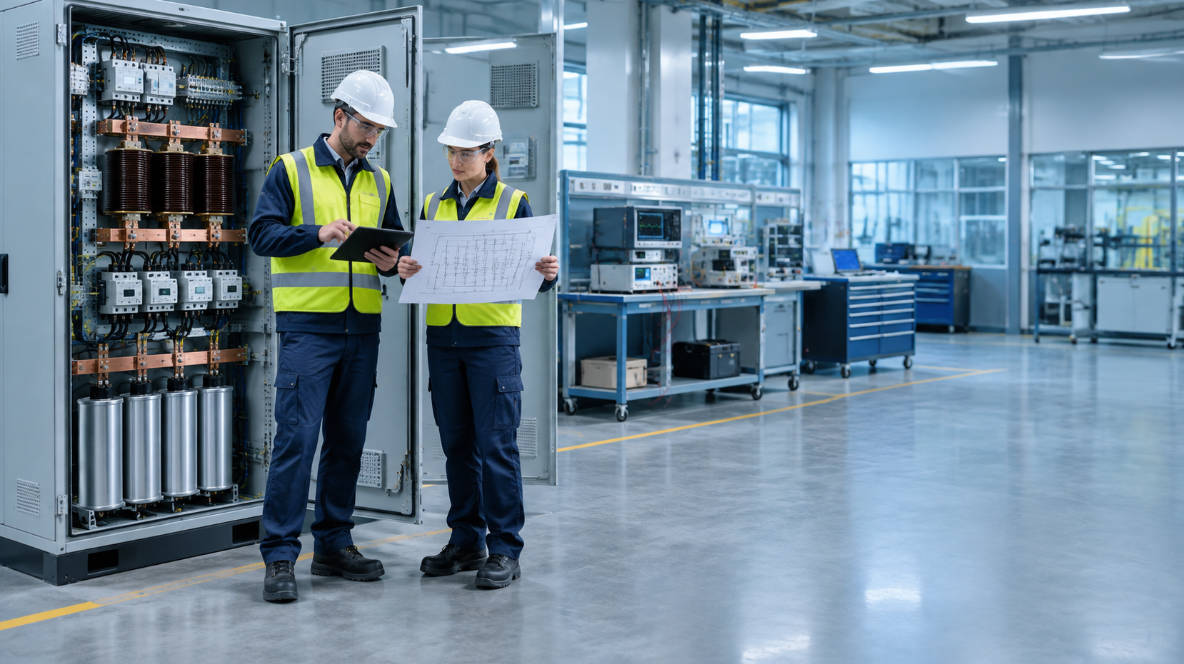
The most overlooked issue in detuned filter sourcing is often the mismatch between the factory's stated detuning ratio and the actual assembled resonant frequency.
A supplier may label a bank "7% detuned," but the real system frequency depends on capacitor tolerance, reactor inductance tolerance, temperature effects, core saturation behavior, and substituted components. If the capacitor and reactor are sourced from different batches or changed after sample approval, the actual resonant point can drift closer to a problematic harmonic order.
This is why professional buyers should request a step-level impedance or resonance verification as part of the factory acceptance process. At a minimum, request:
- Measured reactor inductance for each phase.
- Capacitor capacitance tolerance records.
- Calculated resonant frequency for each capacitor-reactor step.
- Reactor current and temperature-rise test data.
- Final bill of materials with approved component models.
- Confirmation that no critical component substitution occurred after drawing approval.
This check costs far less than replacing overheated reactors, failed capacitors, or damaged contactors after installation.
Before placing a production order, ask for:
- Business registration details and legal company name.
- Factory address and recent production-floor photos or a live video audit.
- ISO 9001 certificate with certificate number, scope, issuing body, issue date, and expiry date.
- CE Declaration of Conformity for the exact product model.
- Product test reports tied to the quoted configuration.
- Quality-control procedures for incoming materials, in-process assembly, and final testing.
- Photos or video of similar completed projects.
- Major customer references, where disclosure is permitted.
- Export packing examples and previous export documentation samples with sensitive data removed.
A serious supplier should be able to provide:
- Single-line diagram.
- General arrangement drawing.
- Bill of materials.
- Capacitor and reactor data sheets.
- Detuning ratio and resonant-frequency calculation.
- Kvar-step schedule.
- Controller model and switching logic.
- Enclosure IP rating and cooling design.
- Short-circuit withstand assumptions.
- Protection-device selection.
- Recommended commissioning procedure.
For a new supplier relationship, consider ordering a pilot unit or a representative capacitor-reactor step before committing to a larger project.
A practical sample process is:
1. Send the RFQ, load data, site voltage, frequency, and target compensation requirement.
2. Request the supplier's preliminary design and engineering assumptions.
3. Review the bill of materials and component brands.
4. Approve drawings and critical technical parameters in writing.
5. Request a pre-shipment inspection or remote factory acceptance test.
6. Approve packaging, labels, manuals, and spare parts.
7. Install the pilot unit with power-quality measurement before and after commissioning.
8. Confirm operational temperatures, power factor, THD trend, switching performance, and noise level.
9. Release the mass-production order only after pilot acceptance.
Detuned harmonic filter cabinets can be heavy, sensitive to moisture, and vulnerable to vibration during transport. Buyers should specify:
- ISPM 15-compliant wooden packing where required.
- Moisture barriers and desiccants for sea freight.
- Shock-resistant packing for control electronics and meters.
- Clear external labels with project number, cabinet number, voltage, and destination.
- Spare fuses, contactors, controller backup, and critical maintenance parts.
- Packing list linked to cabinet serial numbers.
- Correct HS classification confirmed with the importer or customs broker.
- Incoterms that clearly define freight, insurance, export clearance, and destination responsibilities.
China offers a broad supplier base for detuned harmonic filters, capacitor banks, detuned reactors, APF systems, SVG equipment, and complete power-quality solutions. The most suitable manufacturer depends on whether your priority is price, standardization, customization, active-filter technology, passive-filter engineering, export documentation, or long-term OEM support.
For buyers seeking a flexible China-based partner for custom detuned filter cabinets, reactive-power compensation systems, capacitor/reactor combinations, and private-label electrical assemblies, DINGNUO ELECTRIC CO., Ltd. is worth including in the initial RFQ process. Its product range, customized cabinet capabilities, and engineering-to-commissioning service model make it relevant for industrial buyers that need configuration flexibility rather than an off-the-shelf capacitor bank.
Before selecting any manufacturer, compare proposals based on the complete technical design—not only on kvar rating and unit price. Ask for harmonic assumptions, reactor and capacitor specifications, resonant-frequency calculations, verification documents, and final component traceability. That process will help protect project uptime, equipment life, and long-term maintenance cost.
CTA: Send your system voltage, transformer data, load profile, harmonic measurement report, target power factor, and required cabinet rating to begin a technical assessment for a detuned harmonic filter or customized power-quality solution.
Ask for the full certificate, not only a cropped image. Check the legal entity name, factory address, certificate scope, certificate number, issuing certification body, issue date, and expiry date. Then use the certification body's public database or contact the issuing body directly. Confirm that the certificate covers the manufacturing activity relevant to the product—not only trading, sales, or unrelated assembly activity.
No. A 7% detuning ratio is common, but it is not automatically suitable for every network. The correct design depends on transformer impedance, existing harmonic levels, dominant harmonic orders, capacitor size, short-circuit capacity, background voltage distortion, and future nonlinear-load growth. Require a written resonance-frequency calculation and design assumptions.
At minimum, request a single-line diagram, general arrangement drawing, bill of materials, capacitor and reactor data sheets, detuning calculation, test plan, warranty terms, packing specification, CE declaration where applicable, and quality-system certificates. For critical projects, request factory acceptance test records and a commissioning checklist.
Choose based on the load profile. A passive detuned capacitor bank is typically suitable where reactive-power demand is relatively stable and the objective is to avoid resonance while improving power factor. An active harmonic filter is often better for variable nonlinear loads, multiple harmonic orders, or rapidly changing conditions. A hybrid system can combine stable kvar support from passive equipment with dynamic harmonic mitigation from APF equipment.
Include approved manufacturers, model numbers, technical data sheets, and substitution rules in the purchase contract. State that any change to capacitors, reactors, switching devices, controllers, busbars, or protection devices requires written approval. Require serial-numbered final inspection records and a final bill of materials before shipment.
1. - National Bureau of Statistics of China, industrial production data and electrical-machinery growth statistics. [stats.gov]
2. - State Council Information Office of the People's Republic of China, 2025 mechanical and electrical export statistics. [english.scio.gov]
3. - IEC 61921: Low-voltage AC shunt capacitor banks for power factor correction; references IEC 60831 and discusses detuning reactors in harmonic environments. [cdn.standards.iteh]
4. - DINGNUO ELECTRIC CO., Ltd., product scope, customized cabinet capabilities, tuned-filter-cabinet design notes, and service information. [dingnuopower]
5. - Hengyi Electrical Group, company history, production bases, product range, and reported capacitor capacity. [lastone]
6. - China industrial cluster reference identifying Leqing, Wenzhou as a medium- and low-voltage electrical-appliance manufacturing cluster. [iberchina]


